
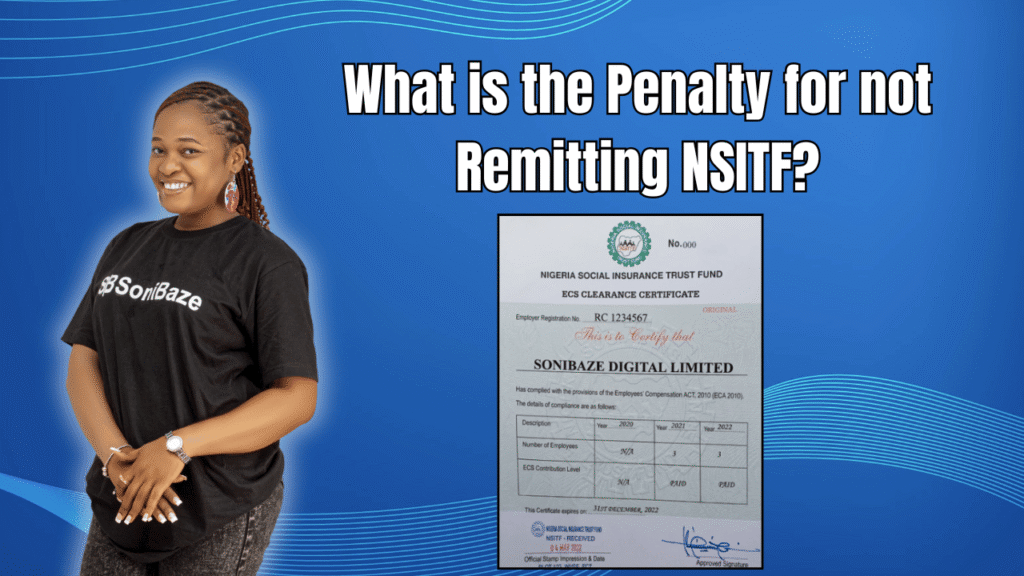
Most business owners in Nigeria know NSITF exists. Fewer know what happens when contributions are not remitted on time, or at all. The penalties are real, they compound, and in the worst cases, they include criminal liability. This article covers what the law says, how much it costs to default, and what the consequences look like beyond the monthly penalty figure.

Obtain Your NSITF Certificate
Let us help you obtain your Nigeria Social Insurance Trust Fund (NSITF) Compliance Certificate quickly and hassle-free. Our experts provide reliable support throughout the application process, ensuring your business meets all statutory compliance requirements.
What Is NSITF and Who Must Contribute?
NSITF stands for the Nigeria Social Insurance Trust Fund, established under the Employees’ Compensation Act (ECA) 2010. The fund exists to provide compensation to employees or their dependents in the event of workplace injuries, occupational diseases, mental stress arising from work, disability, or death during employment.
Every employer in Nigeria operating in the formal or informal sector is required to contribute to the fund. The only exemption is members of the Armed Forces. The contribution is 1% of the employer’s total monthly payroll, and it is paid entirely by the employer. It is not deducted from employees’ salaries.
The deadline for remitting contributions is the last working day of the current month, covering that month’s payroll. So January contributions are due by the last working day of January.
What Is the Penalty for Not Remitting NSITF?
The Employees’ Compensation Act is specific on this. Where an employer fails to remit the required contribution within the prescribed time, a penalty of 5% of the unpaid amount is added for each month or part of a month that passes after the due date. This amount is recoverable as a debt owed to the NSITF Board by the employer.
Some sources cite rates between 2% and 10% per month depending on interpretation or whether the employer is also unregistered, but the figure most consistently cited in the Act and by legal practitioners is 5% per month on the outstanding contribution.
The NSITF official website lists the late filing penalty as between 5% and 10% per month on unpaid or unremitted contributions.
| Default Scenario | Penalty |
|---|---|
| Late remittance of monthly contribution | 5% of unpaid amount per month (compounded) |
| Late filing penalty range per official NSITF schedule | 5% to 10% per month on outstanding amounts |
| Failure to register as an employer | Fine of not less than NGN 50,000 or imprisonment of not less than one year, or both |
| Unregistered employer facing a workplace accident | Loss of statutory ECS protection and exposure to unlimited common-law liability |

The Compounding Effect of Monthly Penalties
The 5% monthly penalty does not stop after one month. It continues to compound for every month or part of a month that the contribution remains unpaid. A business that misses three months of remittances and then gets flagged does not just owe the 5% on each missed month in isolation. The debt grows each month, and the longer it goes unaddressed, the larger the total liability becomes.
For a business with a monthly payroll of, say, ₦5,000,000, the NSITF contribution is ₦50,000 per month. Six months of non-remittance means ₦300,000 in unpaid contributions. With compounding penalties running at 5% per month over that same period, the total amount owed can grow significantly beyond the original contribution figure.
This is why NSITF compliance is not something to defer and catch up on later. The longer the gap, the more painful the settlement.
Criminal Liability for Failing to Register
Beyond the monthly financial penalties for late remittance, an employer who fails to register with NSITF at all commits a criminal offence under the Employees’ Compensation Act. The penalty for this is a fine of not less than NGN 50,000, or imprisonment of not less than one year, or both.
That is a separate consequence from the remittance penalty. An employer can face both if they have neither registered nor contributed.
The Biggest Risk: Unlimited Liability in Workplace Accidents
The financial penalties are manageable if caught early. The risk that most business owners do not consider is what happens when an unregistered or non-compliant employer faces a workplace accident.
The Employees’ Compensation Scheme exists precisely to cap and manage workplace injury costs through a pooled insurance mechanism. When an employee is injured or dies at work, a registered and compliant employer is covered by the ECS. Compensation claims go through the fund.
An employer who is not registered or has not been contributing loses that protection entirely. They face unlimited common-law liability for the employee’s injuries or death. There is no cap. Depending on the severity of the incident, the financial exposure from a single workplace accident can far exceed years of unpaid contributions and penalties combined.
Obtain Your NSITF Certificate
Let us help you obtain your Nigeria Social Insurance Trust Fund (NSITF) Compliance Certificate quickly and hassle-free. Our experts provide reliable support throughout the application process, ensuring your business meets all statutory compliance requirements.
What Counts as an Employer Under NSITF?
The Act applies broadly. It covers employers in the formal sector, informal sector, and even domestic employment in certain interpretations. The exemption applies only to the Armed Forces. Any business with at least one employee is expected to register and contribute.
The contribution is calculated based on total monthly emoluments, which includes salaries, wages, allowances, and other payroll-related payments made to employees in that month.
How to Regularise Outstanding NSITF Contributions
If a business has missed contributions, the recommended path is to approach NSITF proactively rather than wait to be flagged. Voluntary disclosure and settlement typically result in a more manageable outcome than enforcement action. The process involves registering (if not yet done), calculating arrears, and approaching NSITF with a payment schedule where the full amount cannot be settled at once.
NSITF can be contacted through:
| Contact Channel | Details |
|---|---|
| General enquiries email | info@nsitf.gov.ng |
| Corporate Affairs | corporateaffairs@nsitf.gov.ng |
| Corporate Affairs phone | 08113592555 |
| SERVICOM line | 08113592554 |
| Abuja headquarters | +234-9-2911810 or +234-9-2911811 |
NSITF Penalties Compared to Other Statutory Contributions
To give context, here is how NSITF’s penalty structure sits alongside other major statutory contributions in Nigeria.
| Statutory Obligation | Monthly Penalty for Default |
|---|---|
| NSITF (Employees’ Compensation Act) | 5% per month on unpaid contributions |
| Pension (PRA 2014) | Minimum 2% per month on unpaid amounts |
| ITF (Industrial Training Fund) | 5% per month on unpaid contributions |
| NHF (National Housing Fund) | Fixed fine of NGN 50,000 for late remittance |
| WHT (Withholding Tax) | 10% of tax not withheld or remitted |
NSITF sits in the middle of this range, but the compounding nature of the 5% monthly penalty means the actual cost of default grows faster than the headline figure suggests.
Frequently Asked Questions
Is the NSITF penalty calculated on the original unpaid amount or the growing balance?
The penalty is calculated on the unpaid contribution for each month or part of a month after the due date. Some sources describe this as compounding, meaning the penalty amount added in one month can itself attract additional penalties in subsequent months if still unpaid. The safest interpretation is to treat it as compounding and move to settle as quickly as possible.
Can NSITF penalties be waived?
There is no automatic waiver provision in the Act. However, engaging NSITF proactively and settling arrears in full has, in some cases, resulted in negotiated outcomes. This is not guaranteed, and there is no formal waiver programme in place.
Does NSITF apply to small businesses with very few employees?
Yes. Unlike ITF, which exempts companies with fewer than five employees and less than NGN 50 million turnover, NSITF has no small business exemption beyond the Armed Forces exclusion. A business with one employee is still expected to register and contribute.
What is the registration fee for NSITF?
The official registration and certification processing fee is approximately NGN 50,000. This is separate from the 1% monthly payroll contribution and is a one-time fee for initial registration and receipt of the compliance certificate.
How does NSITF non-compliance affect BPP registration?
An NSITF compliance certificate is one of the core documents required for BPP registration on the National Database of Federal Contractors, Consultants and Service Providers. A company that is not NSITF-compliant cannot complete BPP registration and therefore cannot bid for Federal Government contracts.
How often must NSITF contributions be remitted?
Contributions are monthly. Payment is due by the last working day of each month for that month’s payroll. There is no quarterly or annual option. Missing a single month starts the penalty clock.
Conclusion: The Cost of Ignoring NSITF Compounds Every Month
The 5% monthly penalty is not trivial, and it does not stop running until the debt is cleared. Beyond the financial cost, the exposure to unlimited liability in the event of a workplace accident is a risk that no business with employees should carry voluntarily.
Registration is straightforward, contribution is 1% of monthly payroll, and the protection it provides in the event of a workplace incident is the most practical reason to comply outside of avoiding penalties. For businesses with outstanding arrears, the right move is to engage NSITF directly and settle before enforcement action makes the conversation more difficult.
Obtain Your NSITF Certificate
Let us help you obtain your Nigeria Social Insurance Trust Fund (NSITF) Compliance Certificate quickly and hassle-free. Our experts provide reliable support throughout the application process, ensuring your business meets all statutory compliance requirements.