
A Tax Clearance Certificate does not last forever. Many business owners get one for a contract or a bank requirement, file it away, and then rediscover it months later when it has already expired. By then, they are applying again under time pressure and scrambling to fix whatever gap in their tax records caused the delay the first time around.
This article explains how TCC renewal works in Nigeria, what the process looks like for existing companies, and what commonly holds things up.
Obtain Your Tax Clearance Certificate (TCC)
Let us help you obtain your Tax Clearance Certificate (TCC) quickly and hassle-free. Our experts provide reliable support throughout the application process, ensuring your business meets all tax compliance requirements.
What Is a Tax Clearance Certificate?
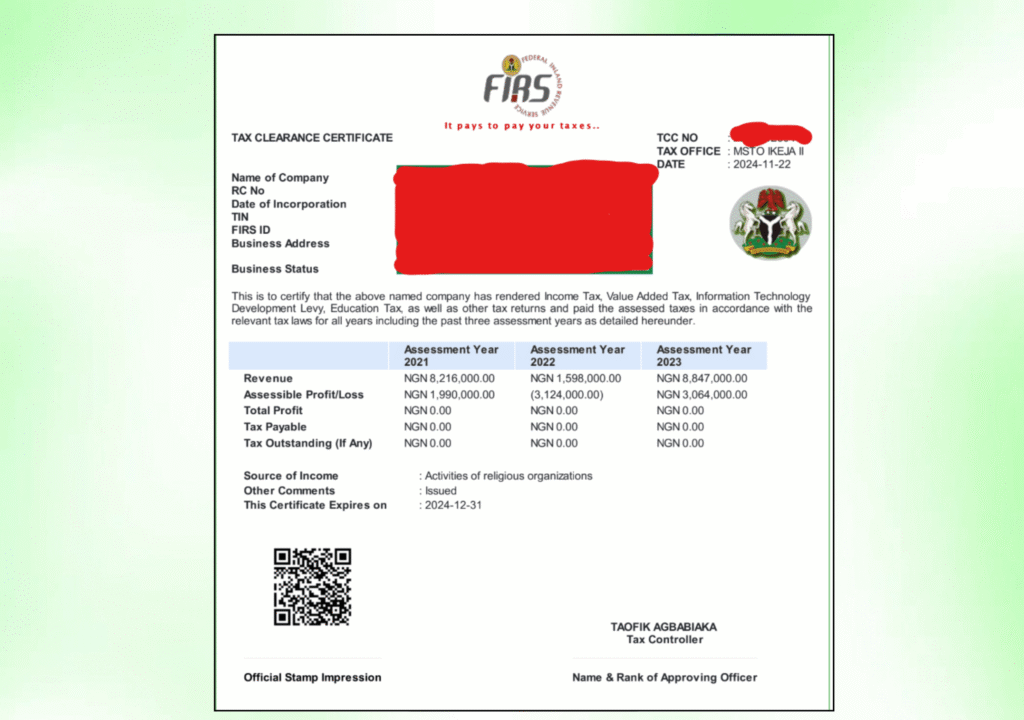
A Tax Clearance Certificate, commonly called a TCC, is an official document confirming that a taxpayer has paid all due taxes for the preceding three years. It is issued by the Federal Inland Revenue Service for companies and by the relevant State Internal Revenue Service for individuals.
The certificate covers federal taxes for corporate applicants. State taxes are handled separately by state IRS offices, and local government levies sit outside both. A company with a valid FIRS TCC is not automatically covered for state or local obligations, which matters when submitting compliance documents for procurement or licensing purposes.
Since the 2025 tax reforms took effect in January 2026, the process for existing companies has been significantly digitised. Companies with at least two years of filing history can now generate their TCC online in minutes through the Nigeria Revenue Service e-TCC portal at tcc.firs.gov.ng, provided their records are clean and up to date.
How Long Is a TCC Valid?
A Tax Clearance Certificate is valid until the 31st of December of the year it is issued, regardless of when during the year it was obtained. A TCC collected in March expires in December of that same year. One collected in October also expires in December of that year.
This means renewal is an annual exercise. The renewal window opens from January 1 of the following year. Companies that need a TCC for contracts, licensing, or banking throughout the year need to plan renewal early in the calendar year rather than waiting until a specific need arises.

Who Needs to Renew?
Any individual or company that has previously obtained a TCC and needs one for ongoing compliance purposes must renew annually. This includes companies bidding for government contracts, businesses renewing sector licences that require TCC evidence, individuals applying for expatriate permits or certain banking services, and organisations submitting compliance documents to regulatory bodies.
The renewal process differs slightly depending on whether the applicant is an existing company with filed tax history or a new company applying for the first time. This article focuses on renewal for existing companies, which is the more common scenario.
Prerequisites Before Renewal
The system checks compliance status automatically before issuing a certificate. If any of these conditions are not met, the renewal will not go through online and will require manual intervention at a tax office.
All tax returns for the preceding three years must have been filed. This covers Company Income Tax, Value Added Tax, Withholding Tax, and any other applicable returns. Missing even a nil return for one year is enough to block the online process.
All assessed taxes must have been paid. Outstanding liabilities, including penalties and interest, will prevent issuance until they are cleared.
If your company claims Withholding Tax credits, those credits must have been validated by the payer on the FIRS portal. Unvalidated WHT credit notes are one of the more common reasons TCC applications stall at the verification stage.
Your registered address on the CAC portal must match what is on your NRS profile. A mismatch between the two systems triggers a manual verification process that can significantly extend the timeline.
Your declared turnover must also be broadly consistent with the financial activity visible in your bank records. The Nigeria Revenue Service now receives data from the Nigeria Inter-Bank Settlement System. If your bank inflows significantly exceed your declared income, the system will flag your application for review.
Obtain Your Tax Clearance Certificate (TCC)
Let us help you obtain your Tax Clearance Certificate (TCC) quickly and hassle-free. Our experts provide reliable support throughout the application process, ensuring your business meets all tax compliance requirements.
How to Renew a TCC Online (Existing Companies)
Step 1: Log In to the e-TCC Portal
Go to tcc.firs.gov.ng and log in using your company’s Tax Identification Number and the password linked to your tax profile. If you do not yet have portal access, you will need to create an account tied to your Tax ID before proceeding.
Step 2: Confirm Your Tax Filing Status
Before generating a TCC, verify that all returns for the preceding three years are showing as filed on the portal. Check CIT, VAT, and WHT filing statuses. If any return is missing, file it before attempting to generate the certificate.
This step catches most problems before they become reasons for rejection. Resolving a missing return takes far less time than going back and forth after a failed application.
Step 3: Generate the TCC
Once the system confirms your compliance status is clean, click the option to generate your TCC. For companies that meet all requirements, the certificate is generated instantly and can be downloaded directly from the portal.
The downloaded document is the electronic TCC and is valid for verification purposes. Third parties can verify it online using the TCC number and taxpayer details on the same portal.
Step 4: Verify the Certificate
After downloading, run a quick verification using the certificate number to confirm that the document is showing as valid in the system. This is good practice before submitting the TCC anywhere, since a certificate that fails online verification will raise questions even if it looks legitimate on paper.
How to Renew a TCC Manually (Where Online Generation Is Not Available)
New companies, companies with unresolved tax issues, or applicants in states where the online system is not yet fully functional will need to apply manually at the relevant tax office.
The manual process involves completing the TCC application form, assembling supporting documents, submitting at the tax office, and waiting for assessment and issuance. For companies, supporting documents typically include audited financial statements for the relevant years, evidence of tax payments, previous TCC where available, and any other documents requested by the tax office.
Manual processing takes longer than the online route. Applicants should allow several weeks and follow up regularly rather than waiting for the office to initiate contact.
Common Reasons TCC Renewal Gets Delayed
Unfiled returns. A single missing return for any of the three preceding years will block online generation and complicate manual processing. File all outstanding returns, including nil returns for years with no taxable income, before applying.
Outstanding tax liabilities. Unpaid taxes, penalties, or interest from previous years need to be cleared first. The system will not issue a certificate while any liability remains outstanding.
Turnover inconsistency. Where the declared income in your tax filings differs significantly from the financial flows visible through banking data, the NRS will flag the application for manual review. This is a newer development tied to the 2025 tax reforms and catches businesses that have been under-reporting income.
Address mismatches. Your CAC registered address and your NRS profile address must match. If they differ because of a recent office move or a historical error, correct the discrepancy on one or both systems before applying.
Unvalidated WHT credits. Companies claiming Withholding Tax credits must have those credits validated by the paying party on the portal. Unvalidated credits cause the system to pause the application pending verification.
Renewal at a Glance
| Requirement | What to Check | Common Issue |
|---|---|---|
| Tax returns filed | CIT, VAT, WHT for preceding 3 years | Missing nil returns for low-income years |
| Tax liabilities cleared | All outstanding payments, penalties, interest | Partial payments leaving a balance |
| WHT credits validated | Payer must validate on NRS portal | Credits claimed but not yet validated |
| Address consistency | CAC address matches NRS profile | Old or incorrect address on one system |
| Turnover consistency | Declared income aligns with NIBSS data | Significant gap between reported and actual inflows |
Frequently Asked Questions
How often does a TCC need to be renewed in Nigeria?
Every year. The certificate expires on December 31 of the year it is issued regardless of when it was obtained, so renewal is an annual requirement for any company or individual that needs to maintain continuous TCC compliance.
Can I generate a TCC online if I have outstanding tax debt?
No. The e-TCC portal checks compliance status automatically. If any return is unfiled or any liability is unpaid, the system will not generate the certificate. The outstanding issue must be resolved first, after which you can return to the portal and generate the TCC.
How long does TCC renewal take through the manual process?
Manual processing timelines vary by tax office and by how complete your documentation is. Allow a minimum of two to four weeks for a straightforward manual application. Applications with outstanding issues or incomplete documentation can take considerably longer.
Is the electronic TCC as valid as a physical one?
Yes. The electronic TCC generated through the NRS portal at tcc.firs.gov.ng is the official document. It can be verified online by third parties using the certificate number. There is no separate physical version that carries more legal weight.
Do I need a separate TCC for state taxes?
Yes. The FIRS TCC covers federal taxes only. If a contracting party or regulatory body requires evidence of state tax compliance, a separate certificate from the relevant State Internal Revenue Service is needed. Multi-state businesses may need certificates from more than one state.
What happens if my company does not renew its TCC?
There is no direct penalty specifically for failing to renew a TCC. The practical consequences are significant, though. Without a valid TCC, you cannot bid for government contracts, renew certain licences, access some banking services, or meet compliance requirements for procurement. In some cases, failing to renew also surfaces underlying tax obligations that attract their own statutory penalties once reviewed.
Conclusion: Renew Early, File Everything First
The biggest mistake companies make with TCC renewal is starting too late and discovering a gap in their filing history after a deadline is already pressing. The online portal is fast when everything is clean. The manual route is slower. Both routes hit the same wall when tax records have gaps.
The practical approach is to audit your filing status at the start of each year, clear any outstanding returns or liabilities, and generate the certificate before any specific need arises. A TCC sitting ready in your compliance folder is far less stressful than one you are racing to get the week before a submission deadline.
Obtain Your Tax Clearance Certificate (TCC)
Let us help you obtain your Tax Clearance Certificate (TCC) quickly and hassle-free. Our experts provide reliable support throughout the application process, ensuring your business meets all tax compliance requirements.