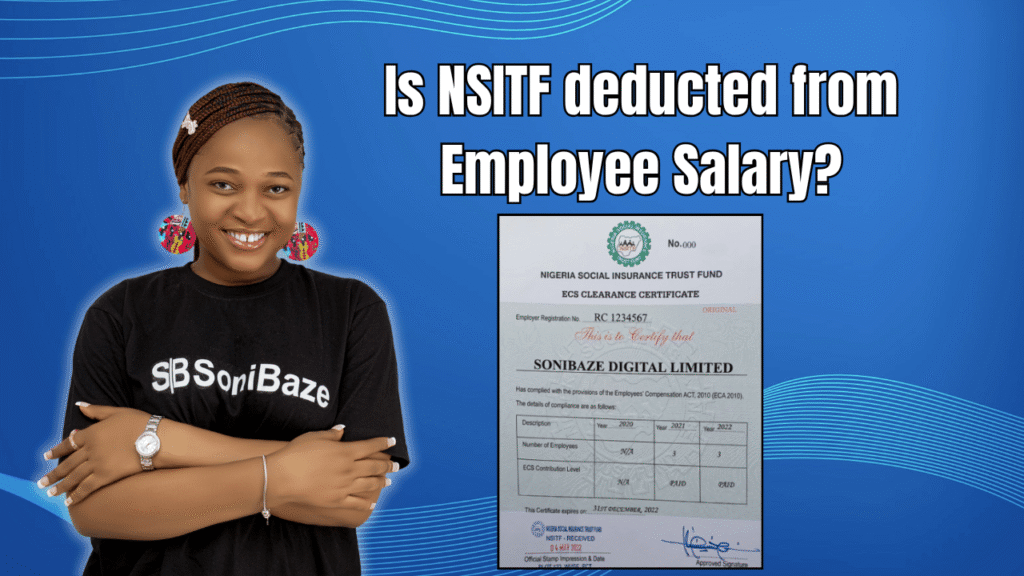
A common question from Nigerian employees who have seen NSITF mentioned on their payslip or in job offer documents is whether it comes out of their own salary. The short answer is no. But the full picture is worth understanding, especially for business owners and HR teams managing payroll compliance.
This article explains exactly what NSITF is, what percentage applies, who pays it, and how it fits into the broader picture of statutory deductions in Nigeria.

Obtain Your NSITF Certificate
Let us help you obtain your Nigeria Social Insurance Trust Fund (NSITF) Compliance Certificate quickly and hassle-free. Our experts provide reliable support throughout the application process, ensuring your business meets all statutory compliance requirements.
What Is NSITF?
NSITF stands for the Nigeria Social Insurance Trust Fund. It is a federal scheme that provides compensation to workers or their dependants in the event of work-related injuries, disabilities, or death. The fund is administered by the NSITF Board and applies across the public and private sectors in Nigeria, with the exception of members of the Armed Forces.
The legal basis for the current scheme is the Employees’ Compensation Act 2010, which replaced the earlier Workmen’s Compensation Act and expanded the scope of who is covered and what benefits apply.
What Percentage of Salary Is NSITF?
The NSITF contribution rate is 1% of an employer’s total monthly payroll. This is an employer-only contribution. It is not deducted from an employee’s salary.
To be precise: the 1% is calculated on the total monthly payroll, not on any individual employee’s salary in isolation. If a company’s total monthly payroll across all staff amounts to ₦5,000,000, the NSITF contribution due is ₦50,000, and the company pays that from its own funds before the 16th day of the following month.
Employees do not see this deduction on their payslips because it is not taken from their pay. It is entirely a cost borne by the employer.

Is NSITF Deducted From Employee Salary?
No. This is one of the most misunderstood aspects of NSITF. The contribution is a statutory obligation placed on employers, not employees. The fund exists to protect workers, but the funding mechanism does not reduce the worker’s take-home pay.
Some payslips or HR systems label it under compliance deductions, which causes confusion. But even where it appears on a payroll report, it represents a cost to the employer, not a reduction to the employee’s net salary.
What Payroll Components Does the 1% Apply To?
The 1% is calculated on the employee’s remuneration as defined under the Employees’ Compensation Act. This includes basic salary, housing allowance, and transport allowance. It excludes pension contributions, bonuses, overtime payments, and one-off payments such as 13th-month income.
| Included in NSITF Calculation | Excluded From NSITF Calculation |
|---|---|
| Basic salary | Pension contributions |
| Housing allowance | Bonuses |
| Transport allowance | Overtime payments |
| Regular monthly allowances | 13th-month income |
| Other regular remuneration | One-off or irregular payments |
After the first two years of the Act’s commencement, the NSITF Board is empowered to review and adjust contribution rates based on a risk assessment of workers’ exposure in different industries. This means the 1% flat rate could change over time depending on sector-specific risk classifications, though it remains the current applicable rate.
Obtain Your NSITF Certificate
Let us help you obtain your Nigeria Social Insurance Trust Fund (NSITF) Compliance Certificate quickly and hassle-free. Our experts provide reliable support throughout the application process, ensuring your business meets all statutory compliance requirements.
When Must NSITF Be Remitted?
Employers must remit their NSITF contribution before the 16th day of the month following salary payment. Missing this deadline attracts a penalty of 10% of the unremitted amount. Repeated non-compliance can escalate to more serious regulatory consequences, including issues during BPP registration or renewal, since NSITF certification is one of the required compliance documents for government contract eligibility.
How NSITF Compares to Other Statutory Contributions
It helps to see NSITF alongside the other major payroll obligations in Nigeria, since they are often confused with each other.
| Contribution | Rate | Who Pays | Deducted From Employee Salary? |
|---|---|---|---|
| NSITF | 1% of monthly payroll | Employer only | No |
| Pension (employee) | 8% of monthly emolument | Employee | Yes |
| Pension (employer) | 10% of monthly emolument | Employer | No |
| PAYE tax | Progressive (7% to 24%) | Employee | Yes |
| NHF | 2.5% of basic salary | Employee | Yes |
| NHIS (employee) | 5% of basic salary | Employee | Yes |
| NHIS (employer) | 10% of basic salary | Employer | No |
| ITF | 1% of annual payroll | Employer | No |
From this table, it is clear that NSITF sits in the same category as ITF and the employer portion of pension and NHIS. These are all employer costs, not deductions from what employees take home.
What Employees Actually Have Deducted From Their Salary
Since NSITF is not one of them, here is a summary of what actually reduces an employee’s net pay in Nigeria.
| Deduction | Rate | Applies To |
|---|---|---|
| PAYE tax | 7% to 24% progressive | Taxable income above ₦800,000 annually |
| Pension contribution | 8% of monthly emolument | All employees of companies with 3 or more staff |
| NHF | 2.5% of basic salary | Employees in the formal sector |
| NHIS | 5% of basic salary | Companies with 10 or more employees |
These four are the deductions that directly affect an employee’s monthly take-home. NSITF is not among them.
Who Is Exempt From NSITF?
Members of the Armed Forces of the Federal Republic of Nigeria are exempt from the NSITF scheme. All other employers and employees in both the public and private sectors fall under its scope.
There is no employee count threshold for NSITF the way there is for ITF or pension. Every employer with staff on payroll is expected to register and contribute.
Frequently Asked Questions
Does NSITF apply to very small businesses with just one or two employees?
Yes. Unlike ITF, which has a minimum threshold of five employees or ₦50 million annual turnover, NSITF applies to all employers. A business with a single employee on payroll is still required to register with NSITF and remit the 1% monthly contribution.
Can an employer deduct the 1% NSITF contribution from employee salaries to recover the cost?
No. The contribution is a statutory employer obligation. Deducting it from employee salaries would be contrary to the Employees’ Compensation Act and could expose the employer to legal risk. The cost must be absorbed by the business.
What benefit does an employee actually get from NSITF?
Employees covered by NSITF are entitled to compensation if they suffer a work-related injury, occupational disease, or disability. In the event of a worker’s death arising from a work-related incident, the worker’s dependants are entitled to benefits from the fund. The scheme replaces what was previously handled under the Workmen’s Compensation Act, but with broader coverage.
Is NSITF the same as NSITF certificate for BPP registration?
They are related but different things. The NSITF certificate is a compliance document issued to employers who are registered with NSITF and up to date with their contributions. This certificate is one of the required documents for BPP registration. So while NSITF is the scheme itself, the certificate is the proof of compliance that government procurement processes require.
What happens if an employer fails to register with NSITF?
Failure to register and contribute attracts a penalty of 10% of the unremitted amount for each month of default. Beyond financial penalties, the absence of an NSITF compliance certificate creates problems when tendering for government contracts, opening corporate bank accounts in some cases, and meeting other regulatory requirements.
Is NSITF contribution tax-deductible for the employer?
NSITF contributions made by an employer are generally treated as a business expense and may be deducted when calculating the company’s taxable income. Businesses should confirm the specific treatment with a qualified tax practitioner, as application can vary depending on the company’s tax position and the relevant provisions under the Finance Act.
Conclusion: NSITF Is an Employer Cost, Not an Employee Deduction
The 1% NSITF contribution comes entirely from the employer‘s payroll budget. Employees do not lose anything from their monthly pay as a result of NSITF. What employees should be aware of is that the scheme exists to protect them, and a company that is registered and contributing is one that has met a basic standard of workforce protection.
For business owners and HR teams, the key points are straightforward: register with NSITF, calculate 1% of your total monthly payroll excluding pension, bonuses, and overtime, and remit before the 16th of the following month. Missing that deadline costs an extra 10% on top of what was due.
Obtain Your NSITF Certificate
Let us help you obtain your Nigeria Social Insurance Trust Fund (NSITF) Compliance Certificate quickly and hassle-free. Our experts provide reliable support throughout the application process, ensuring your business meets all statutory compliance requirements.