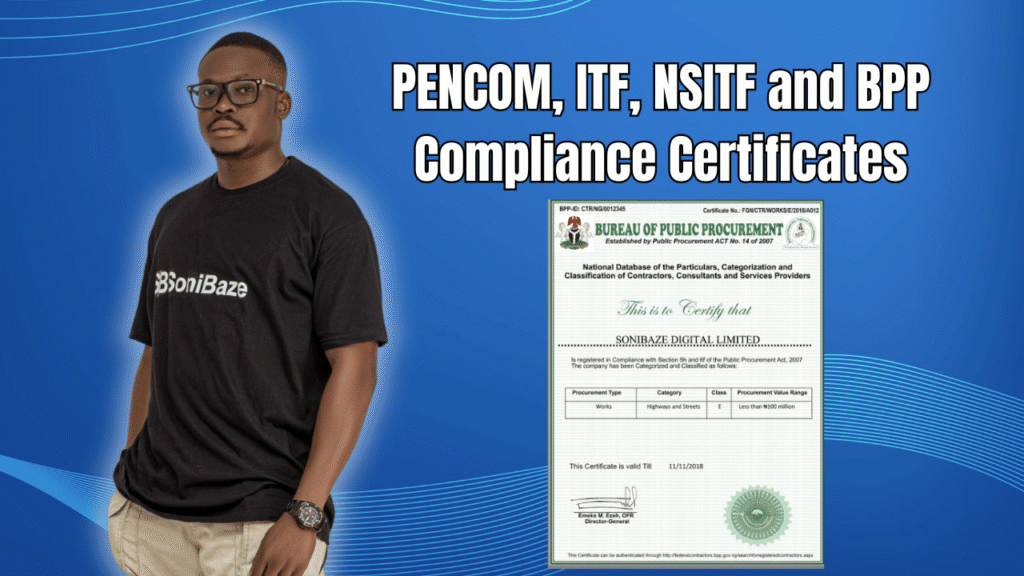
If you have ever prepared a bid for a Nigerian government contract, you already know the feeling. The tender document arrives, and before you even get to the technical or financial requirements, there is a compliance checklist. PENCOM, ITF, NSITF, BPP. Four certificates. Four separate agencies. Four different processes.
Each one exists for a specific reason, and each one has its own requirements, timelines, and renewal cycles. This article breaks down all four in one place so you know exactly what each certificate involves, what you need to obtain it, and why it matters.

Obtain Your BPP Certificate
Let us help you obtain your Bureau of Public Procurement (BPP) Registration Certificate quickly and hassle-free. Our experts provide reliable support throughout the registration process, ensuring your business is ready to participate in public procurement opportunities.
Why These Four Certificates Matter
The Public Procurement Act 2007 established the framework that governs how Nigerian businesses access federal government contracts. Under this framework, contractors, consultants, and service providers are expected to demonstrate that they are compliant with core regulatory obligations before they can bid.
PENCOM, ITF, and NSITF certificates confirm that your company is meeting its obligations to employees, covering pension contributions, industrial training levies, and workplace injury compensation respectively. The BPP certificate confirms that your company is registered on the National Database of Federal Contractors, Consultants and Service Providers, making you a recognised vendor for government procurement purposes.
All four certificates are valid until the 31st of December of the year they are issued. This means every company that depends on government contracts must renew all four annually.
PENCOM Compliance Certificate
What It Is
The PENCOM Compliance Certificate is issued by the National Pension Commission and serves as proof that your company has complied with the Pension Reform Act 2014. It confirms that your employees are registered under the Contributory Pension Scheme and that pension contributions have been remitted correctly.
Without a valid PENCOM certificate, a bid for a government contract can be disqualified at the preliminary stage before any technical evaluation begins.

Who Needs It
Any company with three or more employees is required to participate in the Contributory Pension Scheme. Companies with 15 or more staff are expected to be fully registered and compliant as a baseline requirement.
Key Requirements
Before applying, your company must have an employer code from PENCOM. Every employee must have a Retirement Savings Account with a Pension Fund Administrator of their choice. Pension contributions must have been remitted consistently and documented.
The documents required for the application include a Certificate of Incorporation, a current CAC Status Report, a FIRS Tax Identification Number printout, a letter requesting an employer code if one does not yet exist, a staff list with RSA PINs and PFA details for each employee, remittance evidence covering the applicable period, and a current group life insurance policy covering at least three times each employee’s annual total emoluments.
Contribution Rates
The minimum contribution rate under the Contributory Pension Scheme is 10% of an employee’s monthly emolument from the employer, and a minimum of 8% from the employee. Both figures are calculated on basic salary, housing allowance, and transport allowance combined.
Validity and Renewal
The certificate expires on the 31st of December each year. Companies must reapply annually. The application is submitted through PENCOM’s online portal, and processing typically takes two to three weeks when documentation is complete and consistent.
ITF Compliance Certificate
What It Is
The ITF Compliance Certificate is issued by the Industrial Training Fund. The ITF was established to promote and encourage the acquisition of skills in industry and commerce in Nigeria, and companies above a certain size are required to contribute financially to this mandate.
The certificate confirms that your company has paid its annual training levy and is therefore compliant with the ITF Act.
Who Needs It
Companies with five or more employees and an annual turnover of N50 million or more are required to register with the ITF and pay the annual training contribution. However, for government contract purposes, most companies include the ITF certificate as part of their compliance package regardless of size, since procurement officers often require it.
Contribution Rate
Companies are required to contribute 1% of their total annual payroll to the ITF. This figure is calculated on the total salary bill for all staff, not just those above a certain grade or role.
Key Requirements and Process
The employer downloads and completes ITF Form 7A, which is the Employer Registration and Payment of Training Contribution Form. This form is submitted to the nearest ITF area office along with a copy of the Certificate of Incorporation issued by the CAC, a certified true copy of the company’s audited accounts, a copy of the company’s tax clearance certificate, and evidence of payment of the training levy.
Once these are submitted and verified, the ITF issues the compliance certificate confirming the company’s levy is up to date.
Validity and Renewal
Like the PENCOM certificate, the ITF Compliance Certificate expires on the 31st of December each year and must be renewed annually.

Obtain Your NSITF Certificate
Let us help you obtain your Nigeria Social Insurance Trust Fund (NSITF) Compliance Certificate quickly and hassle-free. Our experts provide reliable support throughout the application process, ensuring your business meets all statutory compliance requirements.
NSITF Compliance Certificate
What It Is
The Nigerian Social Insurance Trust Fund manages the Employee Compensation Scheme, a social insurance programme that provides compensation to employees who suffer work-related injuries, diseases, or disabilities. The NSITF Compliance Certificate confirms that your company has registered under this scheme and is remitting contributions.
The scheme covers all employees in both public and private sector organisations in Nigeria. The practical consequence is that nearly every registered company with staff falls under its scope.
Who Needs It
All employers with at least one employee are technically within the scope of the Employee Compensation Scheme. For government contract purposes, the NSITF certificate is a standard requirement alongside PENCOM and ITF.
Contribution Rate
The NSITF contribution is 1% of five staff members’ total monthly salary, multiplied by the number of months applicable to the applying company. In practice, the assessment is calculated based on your payroll records for the period under review.
Key Requirements and Process
To apply, the company sends a request letter on its official letterhead to the NSITF office. This letter is accompanied by a copy of the Certificate of Incorporation issued by the CAC, a completed ECS RE 01 Registration Form, a completed payroll form ECS RE 03, the ten-digit registration number issued to the employer upon registration with the Fund, and a copy of the NSITF payment receipt showing evidence of remittance through Remita.
The employer must be registered with NSITF before applying for the compliance certificate. Companies applying for the first time need to complete the registration step before they can obtain a certificate.
Validity and Renewal
The NSITF Compliance Certificate is also valid until the 31st of December each year and requires annual renewal.
BPP Registration Certificate
What It Is
The Bureau of Public Procurement maintains the National Database of Federal Contractors, Consultants and Service Providers. The BPP registration certificate is proof that your company is listed on this database and is therefore eligible to bid for federal government contracts.
Unlike the other three certificates, BPP registration is not about employee welfare contributions. It is about vendor eligibility. Without being on the BPP database, a company simply does not exist in the procurement system, regardless of how strong its PENCOM, ITF, and NSITF compliance records are.
Who Needs It
Any company, consultant, or service provider intending to supply goods, deliver works, or provide services to a federal government ministry, department, or agency must be registered on the BPP National Database. Only limited liability companies registered with the CAC are eligible. Sole proprietorships and business names cannot register directly.
Key Requirements
The BPP registration requires a Certificate of Incorporation, a current CAC Status Report, a FIRS Tax Identification Number and tax clearance certificate covering the last three years, company address and contact information, a list of key personnel with their qualifications, financial capacity documentation such as audited accounts or bank statements, NSITF and ITF compliance certificates, PENCOM remittance evidence, and details of your business category and sector.
Cost and Process
BPP registration is free. The application is completed through the official portal at federalcontractors.bpp.gov.ng. Since March 2025, BPP has operated as a fully paperless system, and all applications and correspondence go through the digital portal.
After account creation, the company completes its profile and uploads supporting documents. BPP then verifies the submitted information against CAC and FIRS records before issuing the certificate.
Validity and Renewal
BPP registration has an expiration period and must be renewed periodically. Companies relying on the certificate for ongoing contracts should track their renewal date and start the process early enough to avoid a lapse.
Side by Side Comparison
| Certificate | Issuing Body | Who Needs It | Key Contribution or Fee | Validity |
|---|---|---|---|---|
| PENCOM | National Pension Commission | Companies with 3 or more employees | 10% employer, 8% employee of monthly emoluments | 31 December annually |
| ITF | Industrial Training Fund | Companies with 5 or more staff and N50m+ turnover | 1% of total annual payroll | 31 December annually |
| NSITF | Nigerian Social Insurance Trust Fund | All employers with at least one employee | 1% of five staff monthly salary per applicable period | 31 December annually |
| BPP | Bureau of Public Procurement | All companies bidding for federal government contracts | Free registration | Periodic, must be renewed |
Documents You Need Across All Four
Several documents appear in the requirements for more than one of these certificates. Gathering them once and keeping them current saves significant time when applying for all four at the same time.
A Certificate of Incorporation is required by all four. A current CAC Status Report is needed for PENCOM and BPP. A FIRS Tax Identification Number is required by PENCOM, ITF, and BPP. A tax clearance certificate is needed for ITF and BPP. Audited accounts appear in ITF and BPP requirements. PENCOM remittance evidence is required by BPP as part of its document checklist.
The practical recommendation is to start the process with PENCOM and NSITF, since these require the most lead time to set up if your company has not been remitting contributions consistently. ITF and BPP are typically faster once the core company documents are in order.
Frequently Asked Questions
Can I apply for all four certificates at the same time?
Yes, and many companies do. Since several of the required documents overlap, particularly the Certificate of Incorporation, TIN, and tax clearance certificate, it makes sense to gather everything together and run the four applications concurrently rather than sequentially.
What happens if one certificate expires while the others are still valid?
An expired certificate on any one of the four is enough to disqualify a bid. Procurement officers check all four as part of their preliminary evaluation. One expired certificate has the same effect as having none at all for the purposes of that specific tender.
How far in advance should I start the renewal process?
Starting at least four to six weeks before your contracts’ deadlines gives you a reasonable buffer. PENCOM typically takes two to three weeks when documents are clean. ITF and NSITF can be faster, but delays due to remittance discrepancies or queue times at area offices can add time. BPP verification timelines vary depending on how quickly queries are resolved.
Are these certificates required for state government contracts as well as federal?
BPP registration specifically covers federal government procurement. State governments sometimes have their own procurement databases and requirements. However, PENCOM, ITF, and NSITF compliance is a federal statutory obligation regardless of whether you are bidding for state or federal contracts, and most state procurement processes also ask for them.
What if my company has never remitted contributions before?
Outstanding remittances for PENCOM, NSITF, and ITF need to be settled before a compliance certificate can be issued. The amount owed depends on how long the company has been operating and the number of employees on payroll during that period. Companies in this situation typically need more time to prepare for the application than those with a clean remittance history.
Conclusion: Treat Compliance as an Ongoing Commitment
The four certificates covered here, PENCOM, ITF, NSITF, and BPP, are not a one-time requirement. They all expire. They all need annual renewal. And a lapse in any one of them at the wrong moment can cost your company a contract opportunity that was otherwise within reach.
The businesses that navigate government contracting most effectively in Nigeria are the ones that treat compliance as a permanent operational function rather than something to sort out when a tender lands in their inbox. Keep your records current, track your renewal dates, and make sure your remittances are consistent year round.

Obtain Your ITF Certificate
Let us help you obtain your Industrial Training Fund (ITF) Compliance Certificate quickly and hassle-free. Our experts provide reliable support throughout the application process, ensuring your business meets all statutory compliance requirements.