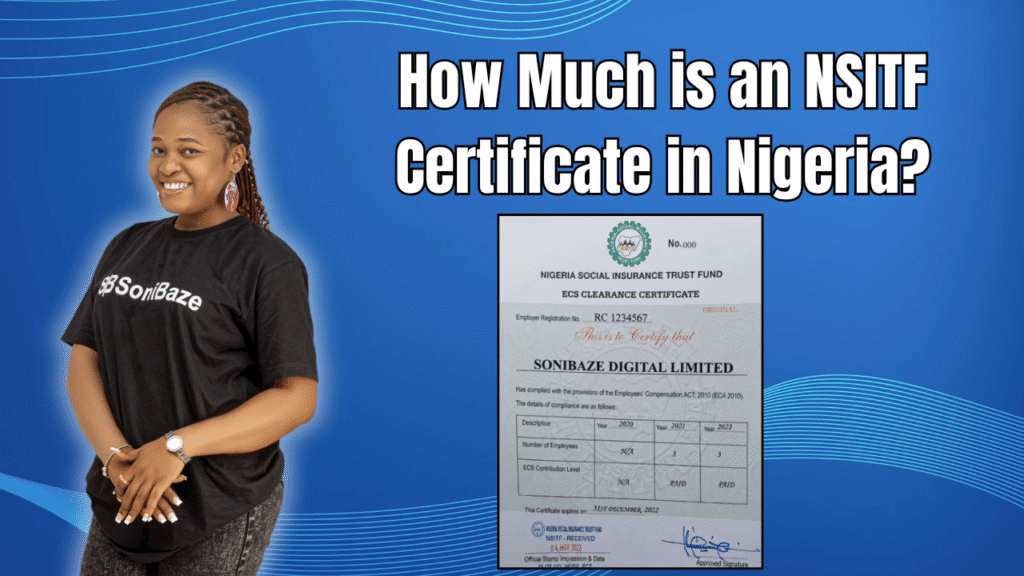
Every employer bidding for a federal government contract in Nigeria will hit the same wall at some point: the procurement checklist asks for an NSITF Compliance Certificate, and many businesses are caught without one. The bigger problem is that most business owners are not sure what it costs, what triggers the cost, or why the amount differs from one company to the next.
This article breaks down exactly what you pay to get an NSITF certificate in Nigeria, why the figure is not the same for every business, and what to expect going through the process.
Obtain Your NSITF Certificate
Let us help you obtain your Nigeria Social Insurance Trust Fund (NSITF) Compliance Certificate quickly and hassle-free. Our experts provide reliable support throughout the application process, ensuring your business meets all statutory compliance requirements.
What Is NSITF?
NSITF stands for the Nigeria Social Insurance Trust Fund, a federal government agency under the Federal Ministry of Labour and Employment. It was established in 1993 by Decree No. 73 and administers the Employees’ Compensation Scheme under the Employees’ Compensation Act 2010.
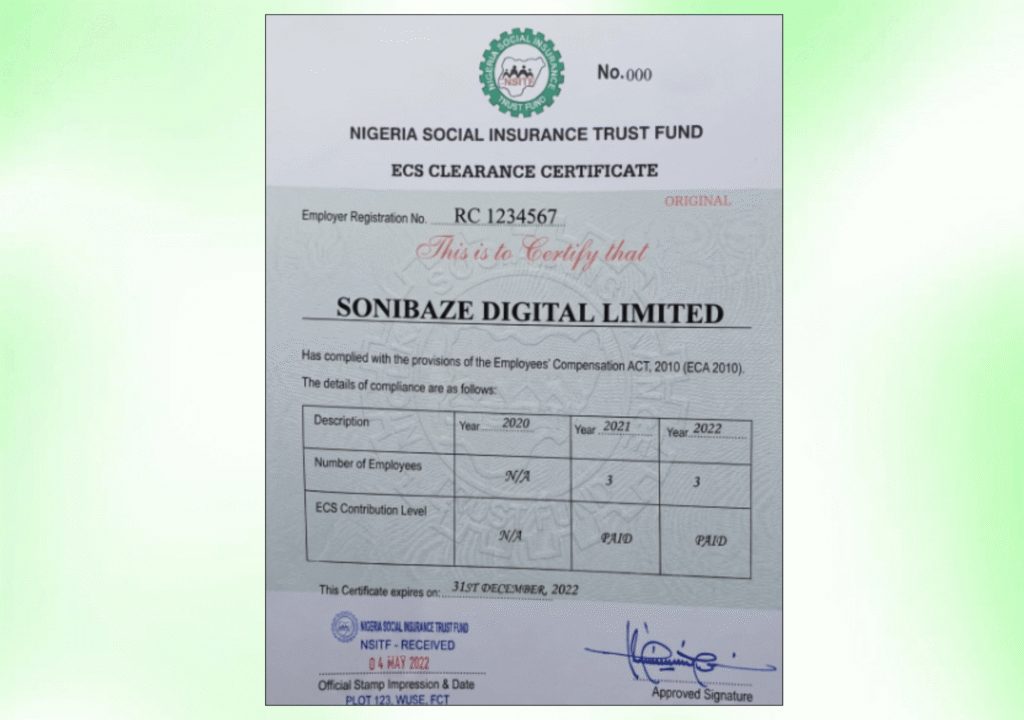
In plain terms, NSITF exists to compensate employees who suffer work-related injuries, diseases, disability, or death. The employer funds this by contributing to the scheme monthly. The NSITF Compliance Certificate is proof that a company is registered and up to date with its contributions.
Every employer operating in Nigeria with five or more employees is required to register. Without the certificate, government contracts are off the table.
How Much Does an NSITF Certificate Cost?
There is no single flat fee for an NSITF certificate. The cost has two components: a fixed registration fee and a variable contribution amount calculated based on your payroll.
| Cost Component | Amount |
|---|---|
| Registration / Certification Fee | Approximately ₦50,000 (official NSITF figure) |
| Monthly Employer Contribution | 1% of total gross monthly payroll |
| Late Payment Penalty | 5% of unpaid amount per month |
| Consultant / Agent Fee (optional) | Varies typically ₦30,000 to ₦150,000+ depending on provider |

The Registration Fee
NSITF charges approximately ₦50,000 for initial registration and certification processing. This is paid via the Remita platform after NSITF has assessed your business.
Some older sources cite ₦20,000 as the registration fee. This figure has been in circulation for years, and the current official position puts it closer to ₦50,000. If you are registering now, budget for the higher figure and confirm the exact amount with your nearest NSITF office or the online portal before payment.
The Monthly Contribution
The contribution is not a fixed fee, it is calculated from your payroll. The NSITF Employees’ Compensation Scheme contribution is 1% of total gross monthly payroll, payable by the employer alone. No deduction is made from employee salaries, and remittance is due on the last working day of each month.
So what does this mean in practice? A company with ten employees earning an average of ₦150,000 gross monthly has a total payroll of ₦1,500,000. The monthly NSITF contribution for that business is ₦15,000. A larger company with 50 employees on an average gross salary of ₦300,000 has a total payroll of ₦15,000,000 and owes ₦150,000 per month.
The contribution is assessed based on the number of employees, their salaries, and, for older companies, any years during which contributions were not made.
What “Total Gross Payroll” Includes
The contribution base is broader than pension calculations. For NSITF, the total of everything paid to employees in cash during the period is included — not just basic salary. This means housing allowances, transport allowances, and other regular cash payments are part of the base. Pension contributions, bonuses, overtime, and one-off payments are excluded.
Cost Summary by Company Size
| Company Size | Average Monthly Salary | Total Monthly Payroll | Monthly NSITF Contribution |
|---|---|---|---|
| 5 employees | ₦100,000 | ₦500,000 | ₦5,000 |
| 10 employees | ₦150,000 | ₦1,500,000 | ₦15,000 |
| 25 employees | ₦200,000 | ₦5,000,000 | ₦50,000 |
| 50 employees | ₦300,000 | ₦15,000,000 | ₦150,000 |
| 100 employees | ₦400,000 | ₦40,000,000 | ₦400,000 |
These are illustrative figures. Your actual contribution depends on your real payroll data, not averages.
What Happens if You Have Not Been Contributing?
For businesses that have been operating without NSITF registration, the assessment at registration will cover all unpaid contributions going back to when the company was incorporated, not just the current period. This is what catches many older businesses off guard.
Any contribution not paid on time attracts a penalty of 5% of the unpaid amount for each month or part of a month after the due date. Unpaid contributions and interest are recoverable as a debt owed to NSITF.
A company that has been operating for five years without contributing will be assessed for five years of back contributions at 1% of payroll, plus penalties. This can result in a significant sum before the certificate is even issued. The earlier a business registers, the lower this exposure.
What the Certificate Costs You in Practice
For a newly registered business with a clean slate:
Total initial cost = Registration fee (~₦50,000) + First month contribution (1% of monthly payroll)
For a business that has been operating without registration:
Total initial cost = Registration fee + All back contributions (1% per month × number of months unpaid) + Penalties (5% per month on each unpaid amount)
This is why compliance consultants often tell clients to register as early as possible. The longer you wait, the more expensive the entry point becomes.
Obtain Your NSITF Certificate
Let us help you obtain your Nigeria Social Insurance Trust Fund (NSITF) Compliance Certificate quickly and hassle-free. Our experts provide reliable support throughout the application process, ensuring your business meets all statutory compliance requirements.
Who Pays and Who Is Exempt?
All employers with five or more employees in the private sector registered under CAMA are required to register and contribute. Persons exempted include employees in the public service of the Federation, a State, or local government who are entitled to pension on substantially similar terms; persons with diplomatic or equivalent status; non-Nigerian citizens employed for less than six years who already contribute to a social security scheme in another country; and ministers of religion engaged in propagating their faith.
How to Pay
Payments are made via the Remita platform after an assessment of staff remuneration by NSITF. To obtain the compliance certificate, an employer submits an official request letter along with the Certificate of Incorporation, completed ECS forms (ECS RE01 and ECS RE03), and evidence of payment.
The certificate itself is issued within approximately five working days once all requirements are submitted and payment is verified.
Should You Use a Consultant?
NSITF registration can be handled directly. The process involves visiting the nearest NSITF office, obtaining the ECS RE01 form, completing the employer schedule of payment, making the assessed payment via Remita, and submitting documentation for the certificate.
Where consultants add value is in calculating back contributions accurately, ensuring documents are complete before submission, and avoiding the back-and-forth that delays certificate issuance. If you are a larger company with a complex payroll history or years of unregistered operations, professional assistance is worth considering. If you are a newly incorporated business with a straightforward payroll, direct registration is manageable.
Frequently Asked Questions
Is NSITF registration free?
No. Unlike SCUML, NSITF registration has an associated registration fee of approximately ₦50,000, plus the monthly employer contribution of 1% of gross payroll. The contribution is an ongoing statutory obligation, not a one-time payment.
Does the NSITF certificate expire?
Yes. The compliance certificate covers a specific period and must be renewed annually. The certificate is typically valid for one year from the date of issue. Businesses bidding on government contracts need to ensure their certificate is current, not a document from two years ago.
Can I get the NSITF certificate online?
Registration is initiated online through the NSITF portal, but some steps, particularly the physical assessment and document submission, may require visiting an NSITF office depending on the size and history of your business. The compliance certificate, once approved, is available for download from the portal.
What documents do I need for NSITF registration?
The core documents are the Certificate of Incorporation (CAC), MEMART or status report, Tax Identification Number, particulars of all employees including their names and salary details, and evidence of payment via Remita. Businesses with professional licensing requirements may also need copies of relevant operational licences.
What is the NSITF certificate used for?
The certificate is a mandatory requirement for government contract procurement across federal ministries, departments, and agencies. It also serves as proof of employee welfare compliance for corporate clients and increasingly for private-sector vendor qualification processes.
Can a sole proprietor or small business name register for NSITF?
Yes. Sole proprietors and business names with five or more employees fall under the NSITF requirement. The registration process for business names follows the same path, using the business name CAC registration and status report rather than a certificate of incorporation.
Conclusion: The Actual Cost Depends on Your Payroll History
There is no single price for an NSITF certificate in Nigeria because the biggest variable is your payroll. The registration fee sits around ₦50,000. After that, your monthly contribution is 1% of gross payroll, and if your business has been operating without contributions for any period, that back contribution is assessed and added at registration.
The businesses that end up paying the most are not the ones with the largest payrolls. They are the ones that delayed registration and accumulated years of unpaid contributions plus penalties. Getting registered early is the cheapest version of this compliance.
Obtain Your NSITF Certificate
Let us help you obtain your Nigeria Social Insurance Trust Fund (NSITF) Compliance Certificate quickly and hassle-free. Our experts provide reliable support throughout the application process, ensuring your business meets all statutory compliance requirements.