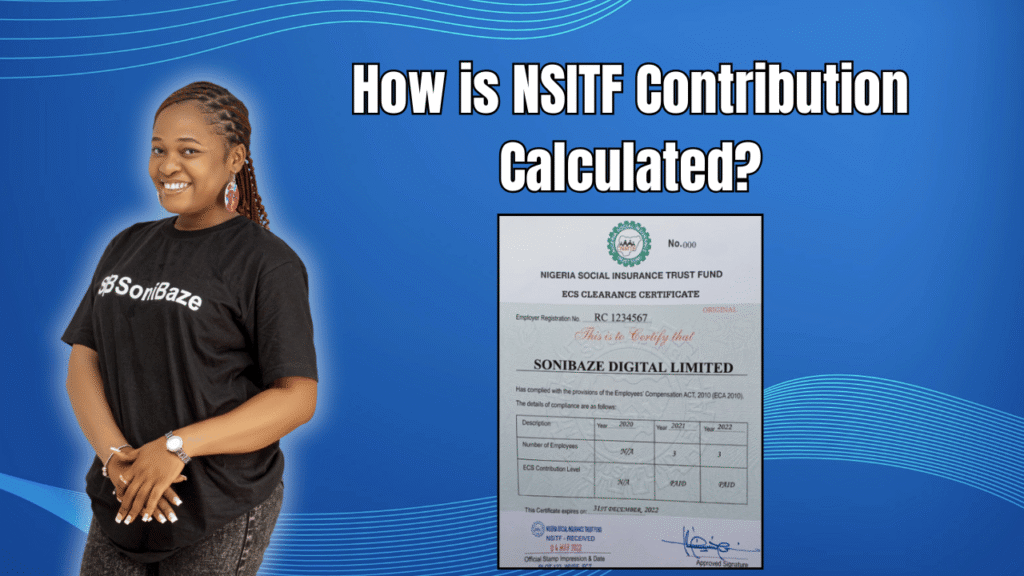
Many Nigerian employers pay their NSITF contributions without fully understanding how the figure is arrived at. They see a number on the remittance schedule, approve it, and move on. That works fine until an audit raises a query or a compliance certificate application reveals that the amounts paid do not match what NSITF expects.
This article explains how the NSITF contribution is calculated, what counts as payroll for the purpose of this contribution, who pays it, and what happens if you get it wrong.

Obtain Your NSITF Certificate
Let us help you obtain your Nigeria Social Insurance Trust Fund (NSITF) Compliance Certificate quickly and hassle-free. Our experts provide reliable support throughout the application process, ensuring your business meets all statutory compliance requirements.
What Is NSITF and Why Does the Contribution Exist?
The Nigeria Social Insurance Trust Fund manages the Employees’ Compensation Scheme, established under the Employees’ Compensation Act of 2010. The scheme exists to compensate employees or their dependants in the event of work-related death, injury, disability, or disease.
The contribution is funded entirely by employers. It is a social responsibility charge, not a shared deduction between employer and employee. Employees do not contribute to this fund, and it is actually an offence under the Act for an employer to deduct NSITF contributions from an employee’s salary.
The Contribution Rate: 1% of Monthly Payroll
The calculation is straightforward. Employers contribute 1% of their total monthly payroll to the NSITF. This is the current rate, applicable to all employers in both the public and private sectors.
The law provides that this 1% rate applies during the initial period after the Act’s commencement. After that, NSITF is empowered to conduct a risk assessment and classify employers by industry sector and workplace risk level. In theory, some industries could eventually pay more than 1% depending on their risk classification. In practice, the 1% rate has remained the standard for most employers.

What “Payroll” Means for NSITF Calculation Purposes
This is where many employers make errors. Not everything that goes into an employee’s pay packet counts as payroll for NSITF purposes.
Payroll for NSITF means the total remuneration paid to employees as defined under the Employees’ Compensation Act. It covers basic salary, housing allowances, transport allowances, and other regular emoluments that form part of monthly take-home pay.
The following are specifically excluded from the payroll figure used for NSITF calculation:
Pension contributions deducted from salary are excluded. Bonuses are excluded. Overtime payments are excluded. One-off payments such as 13th-month income are excluded.
This means if an employer’s total payroll for a month is N5,000,000 but N300,000 of that is made up of bonuses and overtime, the NSITF contribution is calculated on N4,700,000, not the full N5,000,000.
A Practical Calculation Example
Here is how it works with real numbers.
| Payroll Component | Amount |
|---|---|
| Total gross salaries for the month | N4,200,000 |
| Bonuses paid this month | N400,000 |
| Overtime payments | N150,000 |
| Pension contributions | N210,000 |
| Qualifying payroll for NSITF | N3,440,000 |
| NSITF contribution at 1% | N34,400 |
The employer pays N34,400 to NSITF for that month, not 1% of the N4,200,000 gross figure.
Getting this distinction right matters. Employers who calculate on the full gross payroll including bonuses and overtime overpay slightly. Employers who miss it entirely and calculate on a reduced figure without proper justification can face queries during an audit.
Obtain Your NSITF Certificate
Let us help you obtain your Nigeria Social Insurance Trust Fund (NSITF) Compliance Certificate quickly and hassle-free. Our experts provide reliable support throughout the application process, ensuring your business meets all statutory compliance requirements.
Who Bears the Cost?
The employer bears the full NSITF contribution. No portion of it comes from employees.
This is different from pension contributions, where both employer and employee each contribute a share. With NSITF, the 1% is entirely the employer’s cost, sitting on top of payroll rather than within it.
When Must Contributions Be Remitted?
Payment must be made before the 16th day of the month following the month in which salaries were paid. So if salaries for April are paid in April, the NSITF contribution for April must reach NSITF before the 16th of May.
This deadline applies consistently, regardless of company size or sector.
Penalties for Late or Missing Contributions
The penalties are significant enough to matter.
The standard penalty for late or unremitted contributions is 10% of the amount due per period of default. NSITF’s own published service fees note a late filing penalty ranging from 5% to 10% per month on unpaid or unremitted contributions.
Beyond the financial penalty, non-compliance affects your ability to obtain or renew a NSITF Compliance Certificate. Since this certificate is required for BPP registration, government contract bids, and other regulatory filings, employers who fall behind on contributions end up blocked from procurement opportunities while they sort out the arrears.
What the 1% Covers
The contribution funds compensation benefits paid out under the Employees’ Compensation Scheme. These include periodic cash compensation for permanent or temporary disability, refund of medical expenses for work-related injuries, counselling and rehabilitation services, and prosthetic support for permanently disabled employees.
It is a no-fault scheme. This means a qualifying employee does not need to prove employer negligence to receive compensation. The injury or illness simply needs to have arisen out of, or in the course of, employment.
Who Is Covered and Who Is Exempt?
The scheme covers all employees in both the public and private sectors. It extends to casual workers and outsourced employees as well. Self-employed persons are also covered under the Act.
The only category explicitly exempt is members of the Armed Forces of the Federal Republic of Nigeria.
NSITF Contribution Quick Reference
| Item | Detail |
|---|---|
| Contribution rate | 1% of qualifying monthly payroll |
| Who pays | Employer only, no employee deduction |
| What is included in payroll | Regular monthly emoluments, basic salary, standard allowances |
| What is excluded from payroll | Pension contributions, bonuses, overtime, 13th-month payments |
| Payment deadline | Before the 16th of the following month |
| Penalty for late payment | 10% of unremitted amount |
| Who is covered | All employers and employees, public and private sector |
| Who is exempt | Members of the Armed Forces |
Frequently Asked Questions
Can an employer deduct NSITF contributions from employee salaries?
No. The Employees’ Compensation Act explicitly prohibits this. NSITF contributions are the employer’s statutory obligation. Deducting any portion from an employee’s emoluments for the purpose of contributing to the fund is an offence under the Act.
Does the 1% apply to every single employee on the payroll?
Yes. The 1% is calculated on the total qualifying payroll figure, which covers all employees on the payroll for that month, not just full-time or senior staff. Casual and outsourced employees are included.
What happens if my company’s risk level changes after a NSITF audit?
Once NSITF conducts a risk assessment and classifies your company’s industry or workplace, a different contribution rate may be applied going forward depending on the level of occupational risk in your sector. Companies in higher-risk industries such as construction, manufacturing, or oil and gas may eventually pay a rate higher than 1%.
Is NSITF contribution tax-deductible for the employer?
No. The employer’s contribution under the Employees’ Compensation Act does not qualify as a tax-deductible expense. There is no provision in the Act that grants this treatment.
How does the NSITF compliance certificate connect to contributions?
The compliance certificate confirms that an employer has been registering with NSITF and remitting contributions correctly. NSITF typically processes compliance certificates within five working days once all required documentation is submitted and verified. Arrears in contribution or gaps in remittance records will delay or block certificate issuance.
If an employer overpays NSITF contributions, can they claim a refund?
The ITF has a 50% refund provision for training expenditure. NSITF does not operate the same way. There is no standard refund provision for overpaid NSITF contributions in the Act. If you believe an overpayment has occurred, the appropriate step is to contact NSITF directly rather than adjusting future contributions without their approval.
Conclusion: Simple Rate, Important Details
The NSITF contribution rate itself is easy enough: 1% of qualifying monthly payroll, paid by the employer before the 16th of the following month. What trips up most employers is the definition of qualifying payroll. Pension contributions, bonuses, overtime, and one-off payments are out. Everything else that forms regular monthly remuneration is in.
Getting the base figure right protects the employer from either overpaying or facing audit queries for underpayment. Both outcomes are avoidable with a properly structured payroll process.
Obtain Your NSITF Certificate
Let us help you obtain your Nigeria Social Insurance Trust Fund (NSITF) Compliance Certificate quickly and hassle-free. Our experts provide reliable support throughout the application process, ensuring your business meets all statutory compliance requirements.