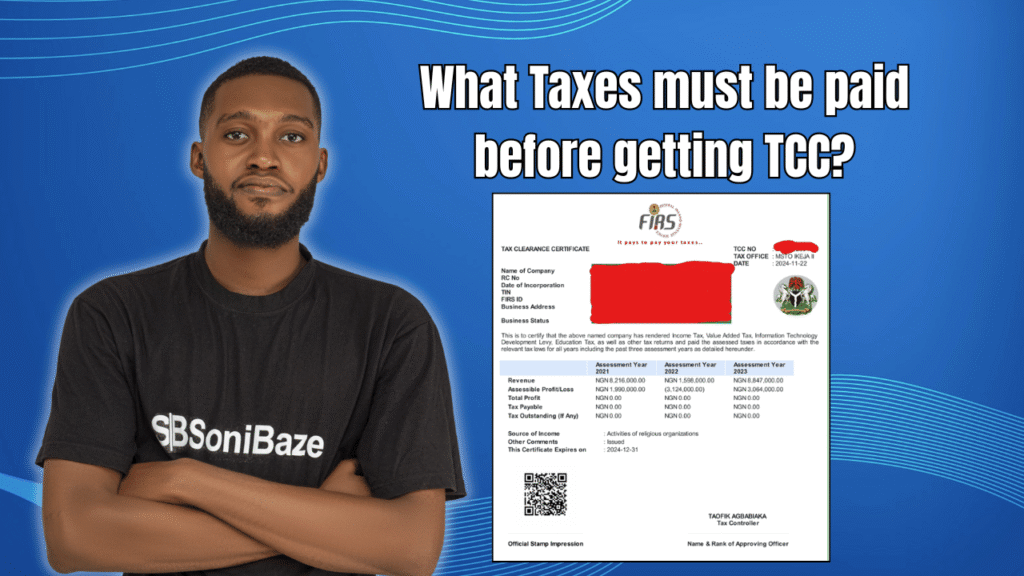
The Tax Clearance Certificate is one of those documents that businesses in Nigeria discover they urgently need at exactly the wrong moment, usually when a contract tender is due or a bank is asking for it before processing a loan. Then comes the next question: what taxes do I actually need to have paid before I can get one?
The answer depends on who is applying, whether the TCC is being sought from FIRS or a State Internal Revenue Service, and how many years of returns are in order. This article breaks it all down.
Obtain Your Tax Clearance Certificate (TCC)
Let us help you obtain your Tax Clearance Certificate (TCC) quickly and hassle-free. Our experts provide reliable support throughout the application process, ensuring your business meets all tax compliance requirements.
What Is a TCC and Who Issues It?
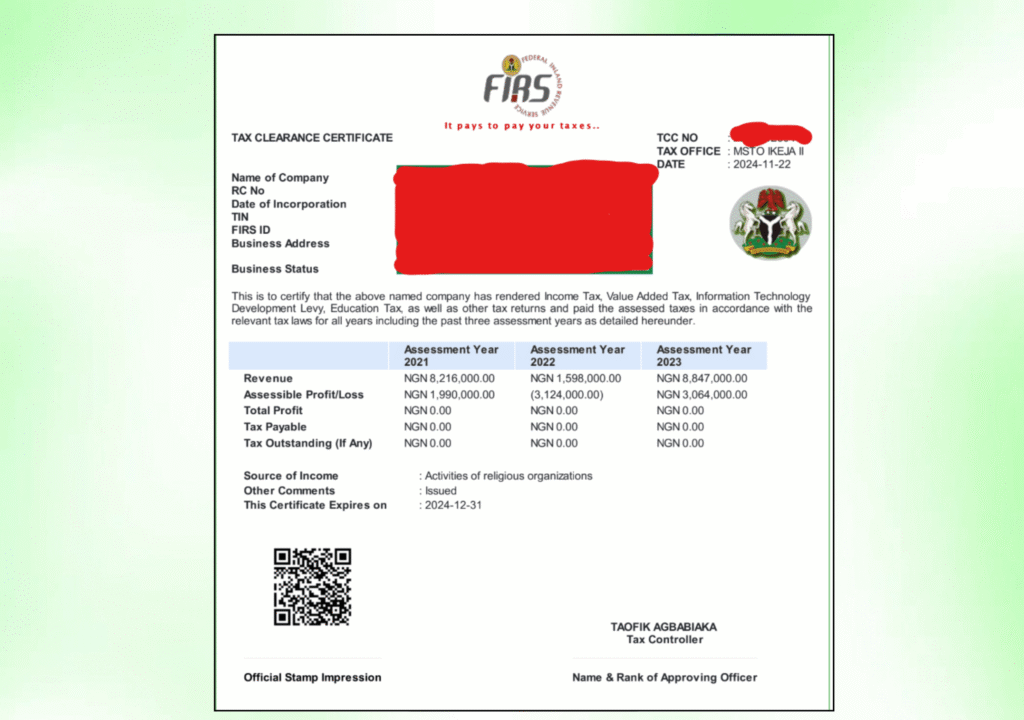
A Tax Clearance Certificate is an official document that confirms a taxpayer has paid all taxes due for a specified period, typically the three years immediately preceding the year of application. It does not mean the person or company has no tax obligations going forward. It confirms that all outstanding liabilities up to that point have been settled.
Two types of authorities issue TCC in Nigeria.
| Issuing Authority | Who It Covers | Taxes Covered |
|---|---|---|
| Federal Inland Revenue Service (FIRS) | Companies registered under CAMA, NGOs, and entities under federal tax jurisdiction | Company Income Tax (CIT), Value Added Tax (VAT), Withholding Tax (WHT), Tertiary Education Tax (TET) |
| State Internal Revenue Service (SIRS) | Individuals, sole proprietors, self-employed persons, and employees under PAYE | Personal Income Tax (PIT), Pay As You Earn (PAYE) |
A company TCC from FIRS does not cover state taxes. A personal TCC from a state IRS does not cover federal corporate taxes. For business owners who are also directors, some tax authorities now require proof of a personal TCC before issuing a corporate TCC for the company.
Taxes That Must Be Paid Before Getting a FIRS TCC (Companies)
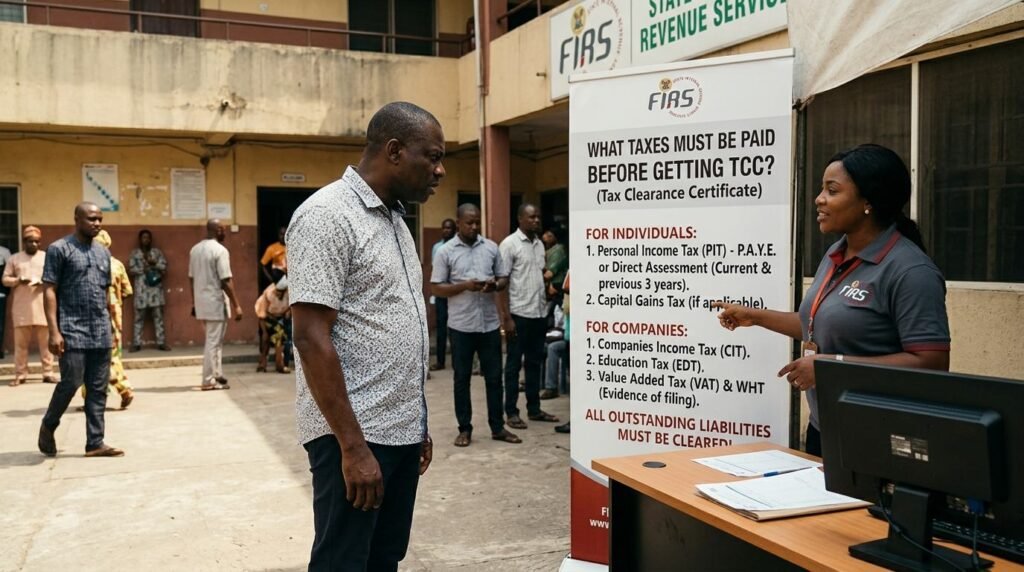
For a company to obtain a TCC from FIRS, all outstanding liabilities under FIRS jurisdiction must be fully settled. These are the taxes involved.
Company Income Tax (CIT)
Company Income Tax is the tax on a company’s profits. All companies carrying on trade or business in Nigeria are required to file CIT returns within six months of the end of their financial year. The current rates are 30% for companies with turnover above N100 million, 20% for medium companies with turnover between N25 million and N100 million, and 0% for small companies with turnover below N25 million.
Even if a company qualifies for the 0% rate, returns must still be filed. The FIRS system checks whether returns have been filed for the three preceding years. If any year of CIT is missing on the portal, the TCC application cannot proceed.
Value Added Tax (VAT)
VAT is charged at 7.5% on goods and services. Companies are required to file VAT returns monthly, on or before the 21st day of the month following the transaction, whether or not any VAT was collected during that period. A nil return must be filed for months with no VAT activity. Missing months of VAT returns are among the most common reasons companies cannot generate a TCC on the FIRS portal. The system scans every month of the three preceding years, and a single missing monthly filing can lock the application.
Withholding Tax (WHT)
Withholding Tax is deducted at source on specific transactions such as dividends, rent, contract payments, interest, and professional fees. The standard rate is 10%, with some categories charged at lower rates. WHT deducted from payments to third parties must be remitted to FIRS within 21 days of the month in which the deduction was made. Any unremitted WHT, along with associated penalties and interest, must be cleared before a TCC can be issued.
Tertiary Education Tax (TET)
Tertiary Education Tax is charged at 3% of a company’s assessable profit and is filed alongside the CIT return. It is often overlooked by smaller businesses because it sits inside the CIT filing process rather than having its own separate return. Outstanding TET liabilities block TCC issuance the same way CIT arrears do.
Taxes That Must Be Paid Before Getting a State TCC (Individuals and Sole Proprietors)
Individuals, employees, and sole proprietors apply to the relevant State Internal Revenue Service rather than FIRS. The taxes that must be settled are different.
Personal Income Tax (PIT)
Personal Income Tax applies to income earned by individuals in Nigeria, including business income, rental income, investment income, and other sources. Sole proprietors and self-employed individuals must file PIT returns and pay the tax due for the three preceding years before a TCC can be issued.
Pay As You Earn (PAYE)
For employees, income tax is deducted from monthly salary by the employer and remitted to the state IRS. If an individual applies for a personal TCC and their employer has not been remitting PAYE correctly, this can create a liability gap that blocks the certificate. The state IRS issues the TCC for the employee, but it reflects the PAYE compliance of the employer on their behalf. Business owners who also have employment income must ensure PAYE compliance is in order alongside their personal returns.
Obtain Your Tax Clearance Certificate (TCC)
Let us help you obtain your Tax Clearance Certificate (TCC) quickly and hassle-free. Our experts provide reliable support throughout the application process, ensuring your business meets all tax compliance requirements.
Tax Obligations at a Glance
| Tax Type | Who It Applies To | Rate | Filing Frequency | Issuing Authority |
|---|---|---|---|---|
| Company Income Tax (CIT) | Companies | 0%, 20%, or 30% depending on turnover | Annual (within 6 months of financial year end) | FIRS |
| Value Added Tax (VAT) | Companies and registered VAT persons | 7.5% | Monthly (by 21st of following month) | FIRS |
| Withholding Tax (WHT) | Companies making qualifying payments | 10% (standard) | Monthly (within 21 days of deduction) | FIRS |
| Tertiary Education Tax (TET) | Companies | 3% of assessable profit | Annual (filed with CIT return) | FIRS |
| Personal Income Tax (PIT) | Individuals, sole proprietors | Progressive rates | Annual | State IRS |
| Pay As You Earn (PAYE) | Employers on behalf of employees | Progressive rates | Monthly | State IRS |
What Counts as “Outstanding” Tax
FIRS does not only check whether taxes have been paid. It checks whether returns have been filed and whether all associated penalties and interest on late payments have been settled. A company can have paid its CIT but still have outstanding penalties from a late filing. Those penalties must be cleared before the TCC can be generated.
The FIRS portal scans the three years immediately before the application year. For a TCC applied for in 2026, the system checks 2023, 2024, and 2025. Every month of VAT, every annual CIT filing, every WHT remittance for that period must be accounted for. A single gap, whether a missing nil return or an unpaid penalty, can hold the application.
Common Reasons TCC Applications Get Stuck
| Reason | What It Means |
|---|---|
| Missing monthly VAT returns | Even nil returns must be filed; gaps block the portal |
| Unfiled CIT returns | Annual filing required even for zero-profit or small companies |
| Unpaid penalties and interest | Tax paid but late, with outstanding surcharges not cleared |
| TIN not linked to NIN or RC number | FIRS now requires TIN to be linked to the relevant identity number |
| WHT not remitted | Withholding tax deducted from third-party payments but not paid to FIRS |
| Directors’ personal TCC not in order | Some processes now require directors to have a personal TCC before corporate TCC is issued |
How Long Is a TCC Valid?
A TCC is valid for one year from the date of issue. It covers a specific three-year period of prior compliance but expires after twelve months regardless. Businesses that regularly need a valid TCC, particularly those bidding on government contracts throughout the year, need to renew annually. The safest approach is to apply at the start of each calendar year after all prior-year returns are filed and all liabilities are settled.
Frequently Asked Questions
Can a company get a TCC if it made no profit?
Yes. A company that made no profit or operated at a loss during the assessment period can still obtain a TCC, provided that all returns have been filed for those years, including nil returns where applicable, and any minimum tax obligations have been addressed. Filing returns is mandatory regardless of whether tax is due.
Does paying taxes guarantee a TCC will be issued?
Not automatically. Paying taxes is necessary but not sufficient. All returns must also have been filed on time. If a company paid its CIT but never filed the return, the system will not recognise the payment as a valid filing. Both the return and the payment must be on record with FIRS.
What is the difference between a company TCC and an individual TCC?
A company TCC covers the corporate taxes under FIRS jurisdiction: CIT, VAT, WHT, and TET. An individual TCC covers personal income tax and PAYE under the relevant State IRS. Directors of companies may be required to have both, as some processes now verify that personal tax obligations are also in order before releasing a corporate TCC.
How long does it take to get a TCC from FIRS?
For existing companies that are fully compliant, FIRS introduced a process allowing TCC to be generated within minutes through the e-TCC portal. If there are outstanding liabilities or missing returns, the application cannot proceed until those issues are resolved. Once everything is in order, the electronic certificate is sent to the company’s registered email address. For new companies or those with outstanding issues, the process can take two to four weeks depending on how quickly the liabilities are cleared.
What happens if a TCC is requested but there are outstanding taxes?
The TCC application will not go through. FIRS will indicate what is outstanding: missing returns, unpaid tax, or unsettled penalties. The applicant must resolve each item before resubmitting. This is why many businesses engage a tax consultant to audit their compliance position before applying, rather than discovering gaps at the point of application.
Do sole proprietors apply to FIRS or the state IRS?
Sole proprietors apply to the State Internal Revenue Service in the state where they are based, not FIRS. The taxes covered are Personal Income Tax and any applicable PAYE if they have employees. FIRS handles companies and corporate entities registered under CAMA.
Conclusion: Compliance Comes Before the Certificate
A TCC is not a document you apply for and then figure out the taxes later. It is the end result of a multi-year compliance trail. Every return filed on time, every tax paid before the deadline, and every penalty settled adds up to a position where the certificate can be issued quickly and without friction.
For companies, that means staying current on CIT, VAT, WHT, and TET every month and every year. For individuals and sole proprietors, it means keeping PIT and PAYE returns up to date with the relevant State IRS. The businesses that never struggle with TCC are not doing anything complicated. They are just filing and paying on schedule, year after year.
Obtain Your Tax Clearance Certificate (TCC)
Let us help you obtain your Tax Clearance Certificate (TCC) quickly and hassle-free. Our experts provide reliable support throughout the application process, ensuring your business meets all tax compliance requirements.