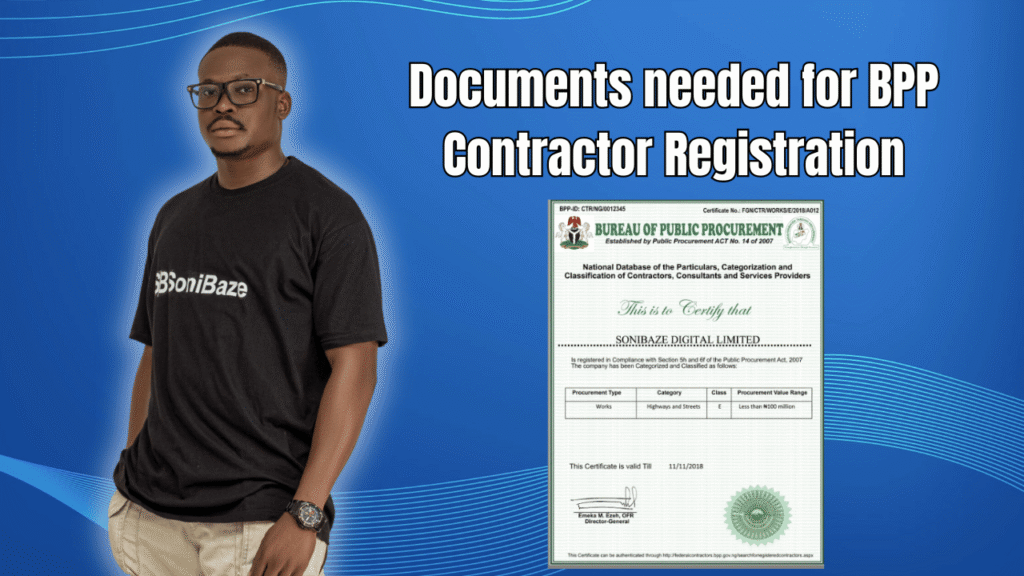
Getting onto the BPP National Database is one of the first things a Nigerian business needs to do before it can participate in Federal Government procurement. Most companies know this. Where the process stalls is the document stage. Either something is missing, a document does not match the company details on CAC, or a compliance certificate has expired and needs to be renewed before anything else can move.
This article lists every document required for BPP contractor registration, explains what each one is, and flags the common issues that cause delays.
Obtain Your BPP Certificate
Let us help you obtain your Bureau of Public Procurement (BPP) Registration Certificate quickly and hassle-free. Our experts provide reliable support throughout the registration process, ensuring your business is ready to participate in public procurement opportunities.
What Is BPP Contractor Registration?
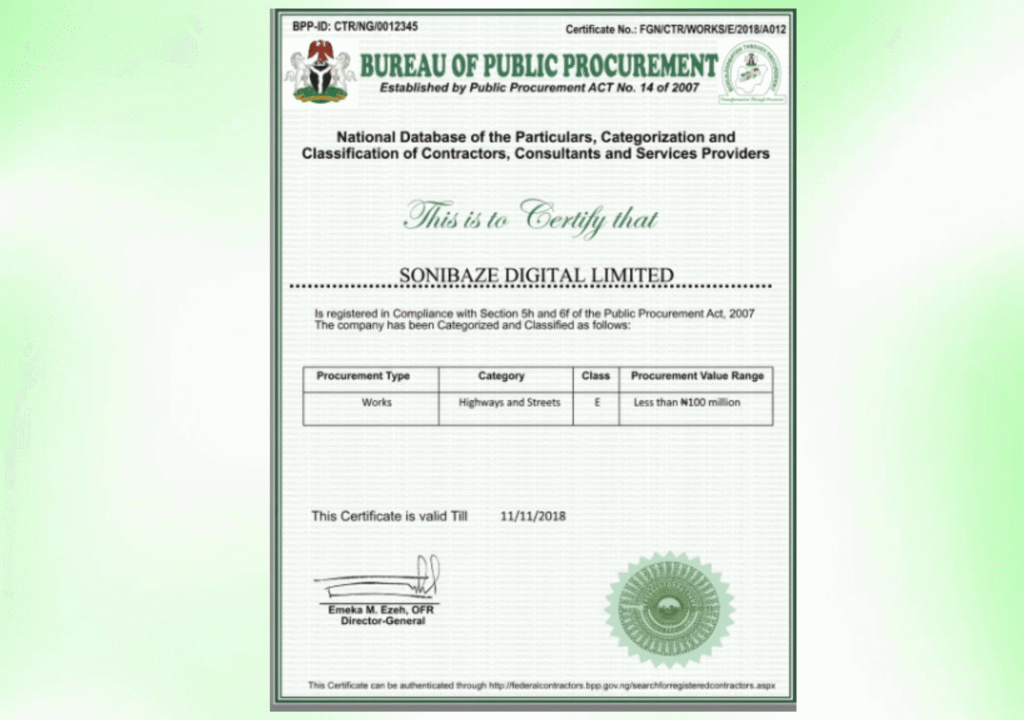
The Bureau of Public Procurement maintains a National Database of Federal Contractors, Consultants and Service Providers, accessible at federalcontractors.bpp.gov.ng. Any company that wants to bid for Federal Government contracts must be registered on this database. The document issued upon successful registration is the Interim Registration Report, commonly referred to as the BPP certificate or IRR. Without it, a company cannot be considered for federal procurement regardless of how qualified it is.
Registration is free for Nigerian-registered companies. It is done entirely online and requires no physical visit to any BPP office.
Documents Required for BPP Contractor Registration
1. CAC Certificate of Incorporation
Every company must provide its Certificate of Incorporation issued by the Corporate Affairs Commission. For businesses registered as business names rather than limited liability companies, the Certificate of Registration serves the same purpose.
The company name on this certificate must match exactly with every other document submitted. Even minor differences, such as “Limited” versus “Ltd” or an abbreviation in one document that appears in full in another, can trigger a query from the system.

2. Tax Identification Number (TIN)
The TIN is required at the very start of the registration process. It is issued by the Federal Inland Revenue Service and links the company’s tax records to its BPP application. This number must be active and correctly entered during online submission.
3. Tax Clearance Certificate (TCC)
The Tax Clearance Certificate from FIRS confirms that the company has met its tax obligations for the preceding three years. It must be current and valid at the time of registration. An expired TCC means the company must return to FIRS, renew it, and only then proceed with BPP registration.
This is one of the most common bottlenecks. Many companies discover their TCC lapsed months earlier and have to spend additional weeks getting it renewed before the BPP process can even begin.
4. NSITF Compliance Certificate
The Nigeria Social Insurance Trust Fund Compliance Certificate confirms that the employer has registered with NSITF and is remitting the required 1% of total monthly payroll to the employees compensation scheme. This applies to every employer with at least one employee on payroll. There is no minimum employee threshold for NSITF, unlike ITF.
5. ITF Training Compliance Certificate
The Industrial Training Fund Training Compliance Certificate confirms that the company has paid its annual training contribution levy of 1% of total annual payroll to the ITF.
Companies with fewer than five employees or with an annual turnover below N50 million are exempt from ITF. If your company falls below both thresholds, you do not need this certificate to complete BPP registration. If you are above either threshold, it is mandatory.
6. PENCOM Clearance Certificate
The National Pension Commission clearance certificate, often called the PENCOM e-PCC, confirms that the company is registered with a licensed Pension Fund Administrator and is remitting pension contributions on behalf of its employees. The minimum contribution is 18% of monthly emoluments, split as 10% from the employer and 8% from the employee.
Companies with fewer than three employees are exempt from the pension contribution requirement and do not need this certificate. Some sources quote the threshold as fifteen employees based on older BPP guidance, but the Pension Reform Act sets the threshold at three employees. Confirm the current requirement directly with PENCOM before assuming an exemption applies.
Obtain Your BPP Certificate
Let us help you obtain your Bureau of Public Procurement (BPP) Registration Certificate quickly and hassle-free. Our experts provide reliable support throughout the registration process, ensuring your business is ready to participate in public procurement opportunities.
Summary of Required Documents
| Document | Issuing Body | Exemption |
|---|---|---|
| CAC Certificate of Incorporation | Corporate Affairs Commission | None. Business name certificate applies for sole proprietors |
| Tax Identification Number (TIN) | Federal Inland Revenue Service (FIRS) | None |
| Tax Clearance Certificate (TCC) | Federal Inland Revenue Service (FIRS) | None |
| NSITF Compliance Certificate | Nigeria Social Insurance Trust Fund | None. Applies to all employers with at least 1 employee |
| ITF Training Compliance Certificate | Industrial Training Fund | Exempt if fewer than 5 employees or below N50m annual turnover |
| PENCOM Clearance Certificate | National Pension Commission | Exempt if fewer than 3 employees |
Additional Company Information Required on the Portal
Beyond uploading documents, the BPP registration portal collects detailed information about the company. This is not document submission. It is data the portal asks you to fill in during the registration process, and every section must be completed before the application can be submitted.
| Information Section | What Is Collected |
|---|---|
| Company details | Name, address, registration number, year of incorporation, contact person |
| Email address | A working email address where the temporary contractor ID and password will be sent |
| Board of directors | Names, roles, and details of all current directors |
| Parent company | If the company is a subsidiary of another entity |
| Business category | Whether the company is a contractor, supplier, consultant, or service provider |
| Professional association | Relevant professional body the company is affiliated with |
| Manufacturer representation | Whether the company distributes or represents products made by another manufacturer |
| Financial capacity | Details of audited accounts and financial standing |
| Key personnel | Names, qualifications, and work experience of principal staff |
| Completed jobs | All contracts executed and fully delivered in the last five years, including private sector jobs |
| Equipment | Relevant plant and equipment details for construction and technical categories |
Completed jobs is the section that catches many applicants off guard. You are expected to list verifiable previous work, with enough detail for the information to be confirmed. Private sector projects count, so this section is not limited to companies that have already done government work.
Documents That May Be Requested During or After Review
While the items above cover the standard registration, some procurement processes and post-registration verification steps may also ask for supporting evidence. These are not always required for the initial BPP registration itself but come up frequently during tender submissions.
| Additional Document | When It Is Usually Required |
|---|---|
| Audited financial statements | Required for larger categories and some contract values |
| Company profile | Requested at tender stage by individual MDAs |
| Evidence of similar contracts | Verifiable references from previous jobs |
| Group life insurance policy | Required by some procuring entities for staff coverage confirmation |
| Bank account details | Collected during registration for payment verification |
Common Reasons BPP Applications Get Delayed
Document issues are behind most delays in BPP registration. These are the ones that come up most often.
The name on the CAC certificate does not exactly match the name used on other compliance documents. This triggers a mismatch query. The fix requires going back to either CAC or the other issuing body to correct the discrepancy before resubmitting.
The Tax Clearance Certificate is expired. TCC must cover the three years preceding the application year and must be valid at the time of submission. Companies that have not been filing returns consistently may face additional delays at FIRS before a fresh TCC can be issued.
The PENCOM or NSITF certificate was renewed for the wrong year. All compliance certificates should be current for the year in which the BPP registration or renewal is being done.
Documents are uploaded in formats the portal does not accept or at file sizes above the platform limit. Clear scans in PDF or JPEG format within the specified file size limits are the safest option.
Frequently Asked Questions
Is BPP registration free?
Yes. Registration on the BPP National Database is free for Nigerian-registered companies. No payment should be made to any person or body for the certificate itself. Consultants who assist with the process charge professional fees for their service, not for the certificate.
How long does registration take once documents are complete?
BPP registration takes an average of five working days once a complete and accurate application has been submitted. Applications with document errors or mismatched company details take longer due to the query and correction cycle.
Can a new company with no contracts register?
Yes. There is no requirement to have executed government contracts before registering. The database accepts private sector job history in the completed jobs section. A new company with no prior work history at all should still proceed with registration and can indicate the section is not applicable.
Does BPP registration need to be renewed?
Yes. Registered companies must update their information annually from the start of each new year, submitting updated data on company performance from the preceding year. Dormant accounts may be flagged and can affect eligibility for procurement processes.
What is the difference between BPP registration and pre-qualification?
BPP registration places the company on the national database as an eligible vendor across all Federal Government procurement. Pre-qualification is a separate exercise done by a specific procuring Ministry, Department or Agency for a particular contract. They serve different purposes and one does not replace the other.
What happens after the application is approved?
Once approved, the company receives a BPP Contractor Identification Number and is classified by business category and tier. The Interim Registration Report becomes available for download from the portal and can be presented as the BPP certificate in tender submissions.
Conclusion: Prepare Your Documents Before You Open the Portal
The BPP registration portal is straightforward once you are in front of it. What determines how fast you get through it is whether your compliance documents are current, your company details are consistent across all of them, and your key personnel and job history information is organised before you start.
The preparation sequence that works: CAC documents first, then TIN and Tax Clearance Certificate from FIRS, then NSITF compliance, then PENCOM if applicable, then ITF if your company meets the threshold. With all of these in hand, the actual registration process moves quickly and the Interim Registration Report is available within a few working days.
Obtain Your BPP Certificate
Let us help you obtain your Bureau of Public Procurement (BPP) Registration Certificate quickly and hassle-free. Our experts provide reliable support throughout the registration process, ensuring your business is ready to participate in public procurement opportunities.