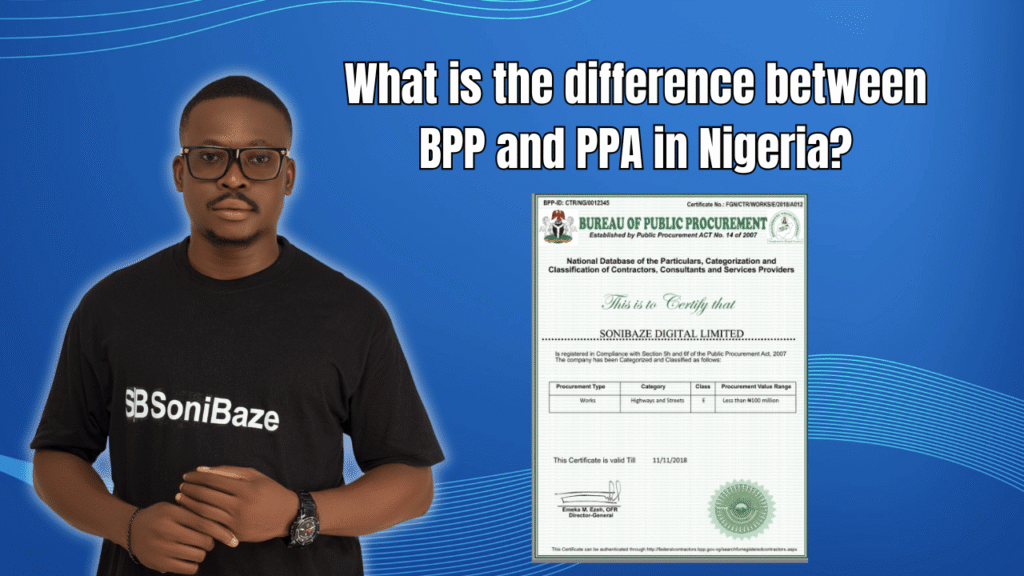
If you have spent any time dealing with Federal Government contracts in Nigeria, you have seen both abbreviations. BPP and PPA show up constantly in procurement documents, tender requirements, and compliance checklists. Many people use them interchangeably. They should not, because they are not the same thing.
One is a law. The other is the agency created by that law. Understanding the difference matters practically for any business navigating Federal procurement.
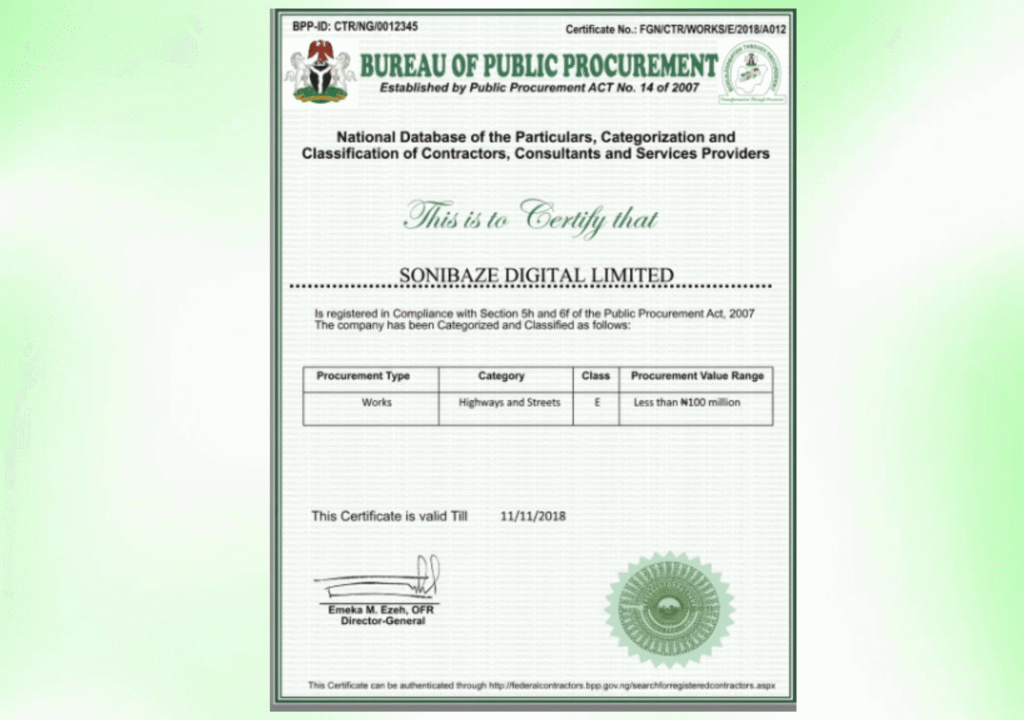
Obtain Your BPP Certificate
Let us help you obtain your Bureau of Public Procurement (BPP) Registration Certificate quickly and hassle-free. Our experts provide reliable support throughout the registration process, ensuring your business is ready to participate in public procurement opportunities.
The Short Answer
PPA stands for the Public Procurement Act 2007. It is legislation, a piece of law passed by the National Assembly.
BPP stands for the Bureau of Public Procurement. It is a government agency, the regulatory body created and empowered by that same law.
The relationship is straightforward: the PPA is the legal framework, and the BPP is the institution set up to implement and enforce it.
What Is the PPA?
The Public Procurement Act 2007 is the primary federal legislation governing how the Nigerian government buys goods, works, and services. Before the PPA was enacted, public procurement in Nigeria had no unified legal framework. Different ministries, departments, and agencies operated under inconsistent rules, creating conditions for inefficiency, abuse, and outright corruption.
The PPA was designed to change that. It introduced a single, standardised legal framework for all federal procurement, built around five core principles: transparency, competition, efficiency, accountability, and value for money.
The Act applies to all procurements of goods, works, and services by the Federal Government and all ministries, departments, and agencies that derive at least 35% of their funds from the Federation’s share of the Consolidated Revenue Fund.
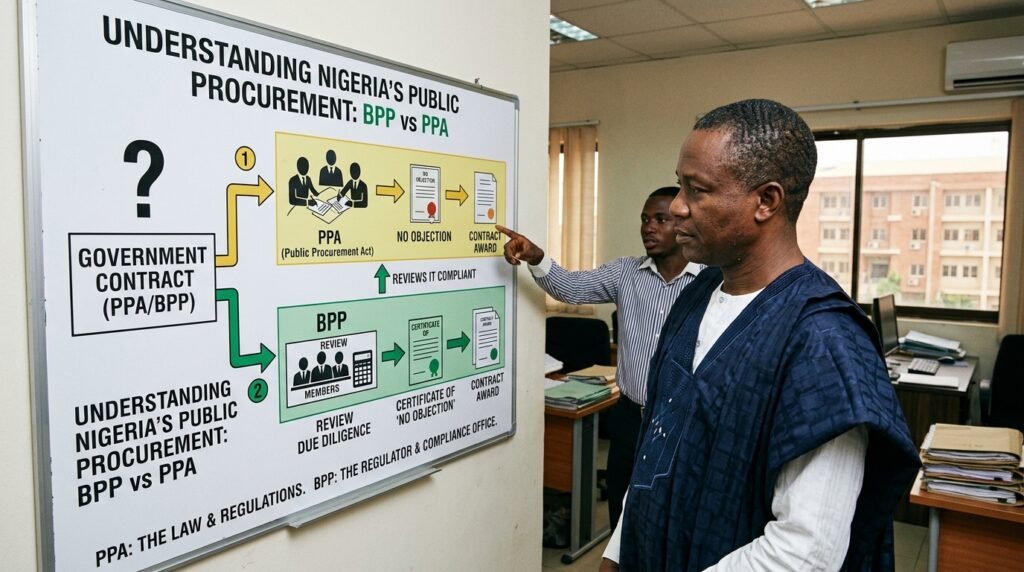
Key things the PPA established include:
- The National Council on Public Procurement as the policy oversight body
- The Bureau of Public Procurement as the day-to-day regulatory and enforcement agency
- Open competitive bidding as the default and preferred procurement method
- Mandatory advertisement of tenders above specified thresholds in national newspapers and the BPP procurement journal
- The Certificate of No Objection requirement, which blocks contract payments unless BPP certifies that proper procurement procedures were followed
- Sanctions for violations, including debarment from future procurement
The PPA does not change by the year. It is a statute. Amendments require an Act of the National Assembly, which is a lengthy process.
What Is the BPP?
The Bureau of Public Procurement is the regulatory authority created under Section 3 of the PPA 2007. Where the PPA is the rulebook, the BPP is the referee. It is the institution that reads, interprets, and enforces what the PPA says on a day-to-day basis.
The BPP is responsible for monitoring and overseeing public procurement across all Federal ministries, departments, and agencies. Its headquarters sits at the BPP office in the Central Business District, Abuja.
The BPP’s functions include setting standards for procurement practice, developing the legal and professional framework, and harmonising existing government procurement policies. It also manages the National Database of Federal Contractors, Consultants and Service Providers, which is the database businesses must register on to participate in Federal procurement. This database sits at federalcontractors.bpp.gov.ng and is what generates the Interim Registration Report, commonly called the BPP certificate.
The BPP also issues Certificates of No Objection for contracts above specified thresholds. Without this certificate, a Ministry or Agency cannot legally make payment on a contract, no matter how legitimate the work.
Beyond enforcement, the BPP identifies cases of corruption in the procurement process and reports them to anti-corruption agencies including the EFCC.
Obtain Your BPP Certificate
Let us help you obtain your Bureau of Public Procurement (BPP) Registration Certificate quickly and hassle-free. Our experts provide reliable support throughout the registration process, ensuring your business is ready to participate in public procurement opportunities.
BPP vs PPA at a Glance
| Feature | PPA | BPP |
|---|---|---|
| Full name | Public Procurement Act 2007 | Bureau of Public Procurement |
| What it is | Federal legislation | Federal regulatory agency |
| Created by | National Assembly | Established by the PPA under Section 3 |
| Purpose | Sets the legal framework for Federal procurement | Implements and enforces that framework |
| Who makes it | National Assembly | Its governing board and Director-General |
| How it changes | Requires an Act of Parliament | Operates within the mandate the PPA gives it |
| Scope | All Federal procurement funded by consolidated revenue | All Federal MDAs and contractors dealing with them |
| Key output | The law itself, including all procurement rules and thresholds | Certificates, the contractor database, procurement oversight |
| Anti-corruption role | Provides the legal basis for sanctions | Reports cases to the EFCC and other enforcement agencies |
How the Two Work Together
The PPA creates the rules. The BPP enforces them. Neither works without the other.
The PPA defines, for example, that open competitive bidding is the standard procurement method, that contracts above certain thresholds must be advertised in national newspapers, and that sanctions can be applied to contractors who breach the Act. But the PPA cannot enforce itself. The BPP is the institution that monitors compliance, reviews procurement processes, issues or withholds clearances, and flags violations.
When a procurement goes wrong, which happens, it is the BPP that investigates and acts, but the PPA that provides the legal authority to do so.
The National Council on Public Procurement
The PPA also created a third element that often gets overlooked: the National Council on Public Procurement. This is the policy body that sits above the BPP. Where the BPP is the operational regulator, the NCPP is the policy oversight layer, responsible for approving procurement policy and setting direction. The BPP implements what the NCPP directs, within the framework the PPA provides.
Most businesses dealing with government contracts never interact with the NCPP directly. The BPP is where the practical work happens.
Procurement Methods Under the PPA
One of the most important things the PPA defines is how procurement must be conducted. The Act specifies four permitted methods:
| Method | When It Applies |
|---|---|
| Open competitive bidding | The default method for all standard procurement |
| Restricted tendering | Limited to pre-qualified suppliers, for specific circumstances |
| Two-stage tendering | For complex procurements where full specifications cannot be set upfront |
| Direct procurement or single sourcing | Permitted only in exceptional circumstances |
The BPP oversees compliance with these methods. An MDA that tries to use direct procurement where open bidding is required would need BPP approval, and the BPP has the authority to withhold its Certificate of No Objection if it determines the method was inappropriate.
What Has Changed Recently
In 2025, President Tinubu approved a comprehensive review of public procurement thresholds following recommendations from the BPP. The revised thresholds were designed to reflect current economic realities, particularly the effects of inflation and naira depreciation on contract values. The adjustment was aimed at reducing bureaucratic bottlenecks that had been slowing contract awards and budget execution across Federal MDAs.
This is a good example of how the system works in practice. The PPA sets the framework and empowers the BPP to recommend threshold changes. The BPP identifies the problem and proposes a solution. The Federal Executive Council or the President approves. The BPP then implements the revised thresholds operationally.
Frequently Asked Questions
Do businesses register with the PPA or the BPP?
Businesses register with the BPP, specifically on the National Database of Federal Contractors, Consultants and Service Providers. The PPA is legislation and has no registration portal. The database, the Interim Registration Report, and all procurement-related administrative processes sit with the BPP.
Can a contract be awarded without BPP involvement?
For contracts below certain thresholds, procurement entities can proceed without BPP’s Certificate of No Objection. For contracts above the relevant thresholds, BPP clearance is mandatory before payment can be made. The exact thresholds have been revised in 2025 to reflect current economic conditions.
Does the PPA apply to state governments?
The PPA 2007 applies to Federal Government procurement. Each state government has its own procurement law, some of which are modelled on the PPA. The BPP has no jurisdiction over state-level procurement, though several states have established their own equivalent agencies.
What is the Certificate of No Objection and who issues it?
The Certificate of No Objection is issued by the BPP. It confirms that a proposed procurement followed the correct procedures under the PPA. Without it, an MDA cannot legally authorise payment on a contract above the applicable threshold. It is a core control mechanism that exists to prevent contracts from being awarded outside due process.
Is the PPA the only law governing procurement in Nigeria?
The PPA 2007 is the primary federal procurement legislation, but it is not the only relevant law. The Infrastructure Concession Regulatory Commission Act governs public-private partnerships. Sector-specific agencies like NNPC operate under their own mandates. The PPA’s procurement rules apply specifically to goods, works, and services procured through standard Federal MDA channels.
Where can I find the full text of the PPA?
The Public Procurement Act 2007 is publicly available through the National Assembly website and through the BPP’s own portal at bpp.gov.ng. The BPP also publishes guidelines and standard bidding documents that help contractors and MDAs interpret and apply the Act’s requirements.
Conclusion: One Is the Law, the Other Enforces It
The confusion between BPP and PPA comes from the fact that both names appear in the same context, often in the same sentence. But they are distinct. The PPA is the statute that defines how Federal procurement must work in Nigeria. The BPP is the agency empowered by that statute to make sure it actually does.
For any business seeking to participate in Federal Government procurement, understanding this distinction matters. Compliance with the PPA is not optional. The BPP is the body that decides whether you have met that standard.
Obtain Your BPP Certificate
Let us help you obtain your Bureau of Public Procurement (BPP) Registration Certificate quickly and hassle-free. Our experts provide reliable support throughout the registration process, ensuring your business is ready to participate in public procurement opportunities.