
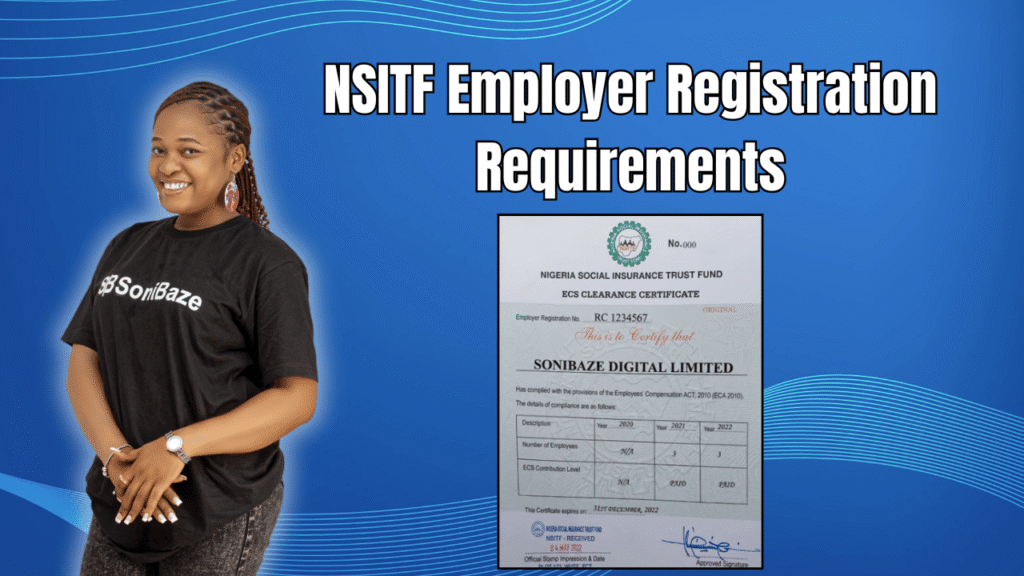
A lot of Nigerian businesses only start thinking about NSITF registration when a tender document asks for the compliance certificate. By then, the clock is already ticking. Registration takes time, payment assessments require physical visits, and missing the deadline can cost a contract.
This article covers what NSITF registration requires, the documents you need, the forms involved, how payment works, and how to get the compliance certificate once registration is done.

Obtain Your NSITF Certificate
Let us help you obtain your Nigeria Social Insurance Trust Fund (NSITF) Compliance Certificate quickly and hassle-free. Our experts provide reliable support throughout the application process, ensuring your business meets all statutory compliance requirements.
What Is NSITF?
NSITF stands for the Nigeria Social Insurance Trust Fund, a Federal Government statutory body established to provide social insurance benefits to employees across Nigeria. It administers the Employees Compensation Scheme under the Employees Compensation Act 2010, which provides compensation to employees who suffer work-related injuries, diseases, disability, or death.
The scheme covers both public and private sector workers. The key distinction from older arrangements is that compensation is funded entirely by employers, not employees. Workers receive protection without any deduction from their salaries.
Is NSITF Registration Mandatory?
Yes, and there are no meaningful exceptions for size or sector. Every employer in Nigeria with at least one employee is required to register with NSITF under the Employees Compensation Act 2010. This includes private companies, NGOs, educational institutions, religious organisations, and government bodies operating as employers.
The NSITF compliance certificate is also one of the documents required by any contractor or supplier doing business with the Federal Government. Without it, participation in Federal procurement processes is blocked at the compliance stage.

NSITF Employer Registration Requirements
Registration happens through the NSITF online portal at nsitf.gov.ng. Before you begin, gather the following:
Documents Required for Registration
| Document | Details |
|---|---|
| Certificate of Incorporation (CAC) | Issued by the Corporate Affairs Commission. Business names submit their Certificate of Registration |
| CAC Status Report or MEMART | Supporting company documents from the Corporate Affairs Commission |
| Company letterhead | Used for the official request letter required at the certification stage |
| Valid means of identification | For the employer or company directors, such as National ID, international passport, or driver’s licence |
| Employee records in CSV format | Full list of all employees typed in Microsoft Excel and saved as CSV (Comma Delimited) for Windows or Windows CSV for Mac users |
Company Information Required During Online Registration
| Information | Details |
|---|---|
| Business name and incorporation number | Must match CAC records |
| Company address | Physical business address |
| Phone number and email address | Active contact details for the company |
| Full names and positions of owners or directors | Mode of identification for each |
| Details of the contact person | The designated point of contact for NSITF correspondence |
| Number of employees and their categories | Used to calculate the contribution assessment |
The Two Key Registration Forms
NSITF uses two specific forms during the registration and payment process.
| Form | Purpose |
|---|---|
| Form ECS RE01 (Registration of Employer) | The primary employer registration form, filled at the point of registration |
| Form ECS RE03 (Employer Schedule of Payment) | Issued after registration for completion of payment scheduling |
Both forms are obtained from NSITF directly, either at a branch office or through the online portal.
Obtain Your NSITF Certificate
Let us help you obtain your Nigeria Social Insurance Trust Fund (NSITF) Compliance Certificate quickly and hassle-free. Our experts provide reliable support throughout the application process, ensuring your business meets all statutory compliance requirements.
How the Registration Process Works
Step 1: Online Registration Go to nsitf.gov.ng and click on employer registration. Fill in all required business particulars, director details, and contact person information.
Step 2: Upload Employee Records On the employee registration page, select the prepared CSV file containing your employee records and upload it. Fill in all required employee details, leaving the NSITF Employee Number column blank. The system generates this automatically.
Step 3: Receive Invoice After uploading employee records, NSITF sends an email from donotreply@nsitf.gov.ng. This email contains the invoice number and the calculated 1% contribution figure based on your total staff emolument for the year. The amount depends on your payroll figures and the year of your company registration.
Step 4: Make Payment Payments are made through the Remita platform. NSITF carries out a physical assessment of employee wages before finalising the payment amount. This assessment confirms the contribution figure based on the actual number of staff and their remuneration.
Step 5: Visit an NSITF Branch Office After payment, proceed to the nearest NSITF branch office with duplicate copies of your payment receipt and other supporting documents. The physical visit is required to complete the process and receive your registration letter.
Step 6: Receive Registration Letter Upon successful registration, NSITF issues a Letter of Notification with a 10-digit registration number. This confirms the company is registered on the Employees Compensation Scheme.
How NSITF Contributions Are Calculated
The contribution rate is 1% of total gross monthly payroll. This is paid entirely by the employer. Nothing is deducted from employees.
| Payroll Variable | Contribution |
|---|---|
| Contribution rate | 1% of total gross monthly earnings |
| Who pays | Employer only |
| Employee deduction | None |
| Payment platform | Remita |
| Payment frequency | Monthly |
For a company with a monthly payroll of N2,000,000, the monthly NSITF contribution would be N20,000. The annual figure forms the basis of the invoice generated during registration.
Getting the NSITF Compliance Certificate
Registration and certification are two separate stages. Registration places the company on the NSITF scheme. The compliance certificate, issued annually, confirms that the employer has met its contribution obligations for the year.
To obtain the ECS Compliance Certificate, the following are required:
| Requirement | Details |
|---|---|
| Official request letter | Written on company letterhead and signed by an authorised person |
| Copy of Certificate of Incorporation | From CAC |
| Completed ECS forms | Form ECS RE01 and ECS RE03 |
| Evidence of payment | Proof of contribution payments made for the relevant period |
Once these are submitted, NSITF processes the certificate request and issues the yearly ECS Compliance Certificate. This is the document that most tender processes and Federal Government procurement requirements are asking for.
What Happens After Registration
Once registered, employers have ongoing obligations. Workplace accidents or injuries must be reported to NSITF within 7 days of occurrence. Formal claims must be filed within 21 days of the incident or diagnosis. Monthly contribution payments must be maintained to remain in good standing for annual certificate renewal.
Frequently Asked Questions
Does NSITF registration cost anything?
The registration itself does not carry a fixed fee. The cost to the employer is the 1% monthly contribution calculated on total gross payroll, which is assessed by NSITF based on employee numbers and salary information provided during registration.
How long does NSITF registration take?
Registration with NSITF takes an average of 5 working days when all documents are complete and the physical assessment is carried out without delays. The compliance certificate comes separately after contributions are confirmed.
Can a company register with NSITF online without visiting a branch?
The initial registration is done online through the NSITF portal. However, after payment, a physical visit to the nearest branch office is required to complete the process and receive the registration letter. The full process is not end-to-end digital.
What if a company fails to register with NSITF?
Failure to register exposes an employer to sanctions under the Employees Compensation Act 2010. Beyond the legal risk, unregistered companies cannot obtain the NSITF compliance certificate, which blocks participation in Federal Government procurement.
Does the NSITF compliance certificate expire?
Yes. The ECS Compliance Certificate is issued yearly. Employers must maintain monthly contribution payments and renew the certificate annually to remain compliant. A lapsed certificate affects eligibility for government contracts.
What employee information is needed for the CSV upload?
The file should contain all employee names, roles or categories, and salary details. The format must be CSV (Comma Delimited) for Windows systems or Windows CSV for Mac users. NSITF uses this file to verify headcount and calculate the contribution assessment.
Conclusion: Registration Is the Starting Point, Not the Finish Line
NSITF registration is mandatory for every employer in Nigeria and required for any business seeking Federal Government contracts. The process involves online registration, a physical wage assessment, payment through Remita, and a branch office visit before the 10-digit registration number is issued.
The compliance certificate that most people actually need comes after registration and requires annual renewal backed by consistent monthly contributions. Getting registered early and maintaining contributions month to month means the certificate is always available when a tender or contract requires it.
Obtain Your NSITF Certificate
Let us help you obtain your Nigeria Social Insurance Trust Fund (NSITF) Compliance Certificate quickly and hassle-free. Our experts provide reliable support throughout the application process, ensuring your business meets all statutory compliance requirements.