One of the most common compliance mix-ups Nigerian businesses run into is treating the Tax Clearance Certificate as a single document. It is not. There are two types, issued by two different authorities, covering two different sets of taxes. Getting one does not mean you have the other, and submitting the wrong one for a particular requirement can delay a contract, a bank application, or a regulatory process.
This article breaks down what each type of TCC covers, who issues it, who needs it, and when you actually need both.
Obtain Your Tax Clearance Certificate (TCC)
Let us help you obtain your Tax Clearance Certificate (TCC) quickly and hassle-free. Our experts provide reliable support throughout the application process, ensuring your business meets all tax compliance requirements.
What Is a Tax Clearance Certificate?
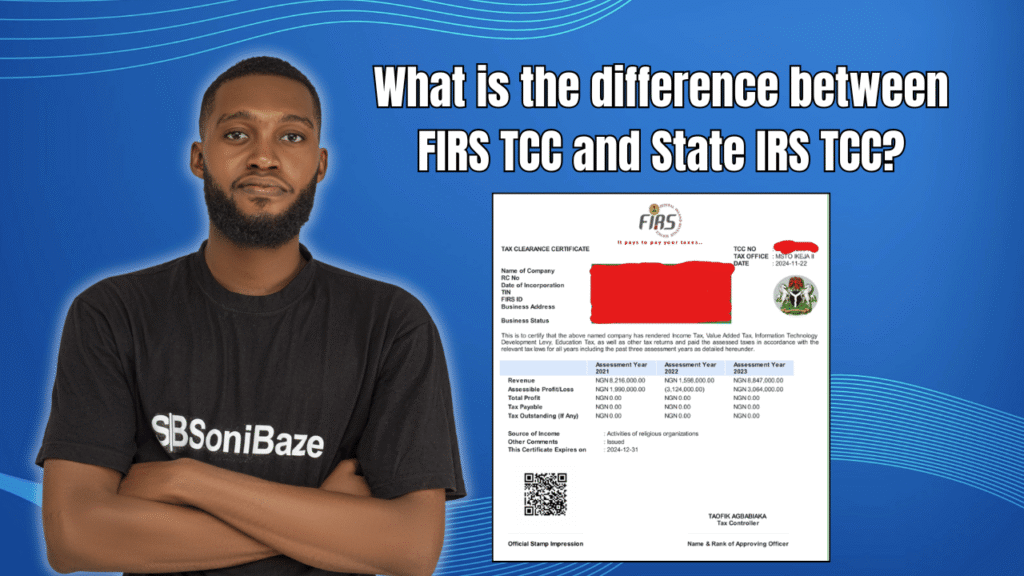
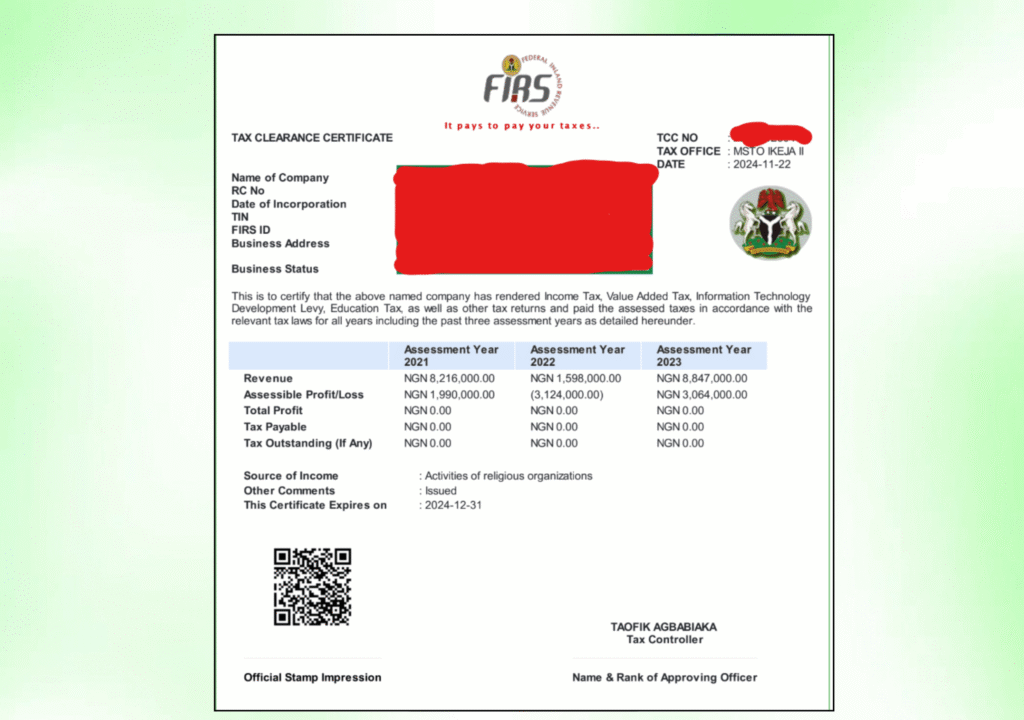
A Tax Clearance Certificate, commonly called a TCC, is an official document confirming that a taxpayer has no outstanding tax liabilities for the three years preceding the date of issue. It is not a permanent document. It reflects your compliance status at the time of issuance and must be renewed regularly.
In Nigeria, TCCs are issued by two separate authorities depending on the type of tax involved. The Federal Inland Revenue Service issues TCCs for federal taxes. State Internal Revenue Services issue TCCs for state-level taxes. These are separate documents from separate authorities and must be obtained independently.
FIRS TCC vs State IRS TCC: The Core Difference
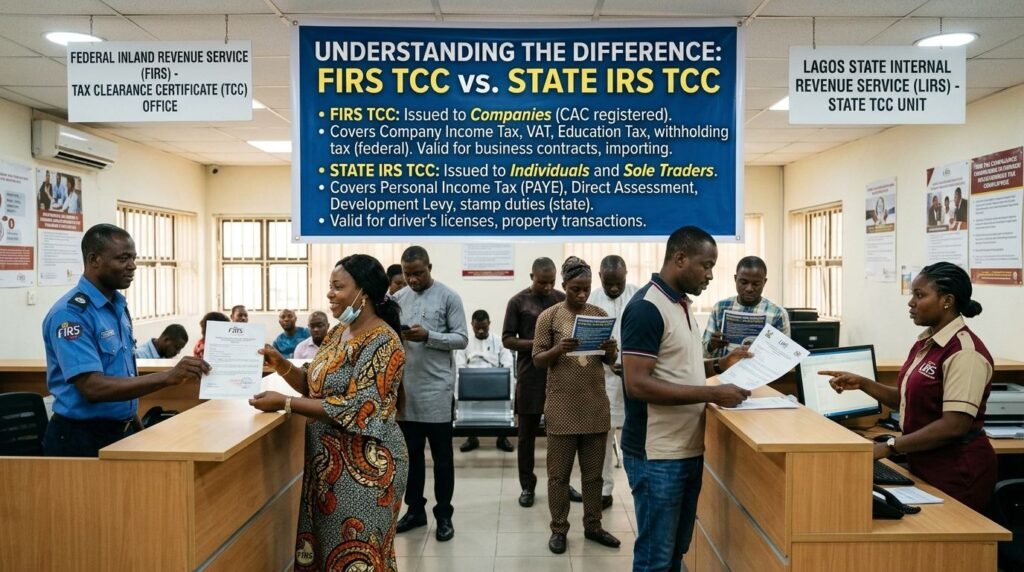
The fundamental difference between the two certificates comes down to jurisdiction. Each authority can only certify compliance for the taxes it administers. Neither can speak to the obligations of the other.
| Feature | FIRS TCC | State IRS TCC |
|---|---|---|
| Issuing authority | Federal Inland Revenue Service (FIRS) | State Internal Revenue Service (e.g. FCT-IRS, Lagos IRS, Rivers IRS) |
| Taxes covered | Company Income Tax, VAT, Withholding Tax, Education Tax, Petroleum Profits Tax | Personal Income Tax (PAYE and self-assessment) |
| Who it applies to | Companies and corporate entities | Individual taxpayers and sole proprietors |
| Applicable law | Companies Income Tax Act (CITA), FIRS Establishment Act | Personal Income Tax Act (PITA) |
| Geographic scope | Valid nationwide for federal tax compliance | Valid only for state-level taxes within the issuing state |
| Portal | Taxpromax (taxpromax.firs.gov.ng) | Varies by state (e.g. eTax portal for FCT-IRS) |
| Verification | tcc.firs.gov.ng | Through the relevant state IRS |
What the FIRS TCC Covers
The FIRS TCC certifies compliance with taxes collected at the federal level. These include Company Income Tax, which is the tax on the profits of incorporated companies; Value Added Tax on goods and services supplied; Withholding Tax deducted on qualifying payments; Education Tax levied on assessable profits of companies; and Petroleum Profits Tax for companies in the upstream oil and gas sector.
Companies and corporate entities are the primary holders of FIRS TCCs. If your business is a limited liability company registered with the CAC, your primary TCC obligation is with FIRS. For federal government contracts, procurement processes, and regulatory applications that require evidence of federal tax compliance, the FIRS TCC is the document requested.
The FIRS TCC is valid nationwide. A company registered in Lagos but bidding for a contract in Abuja does not need to obtain a separate TCC from a different FIRS office for that purpose.
What the State IRS TCC Covers
The State IRS TCC certifies compliance with Personal Income Tax, which is the tax on income earned by individuals. This is administered by whichever state the individual’s employer is registered in, not where the employee lives.
Employees pay Personal Income Tax through the Pay As You Earn system, and their employer remits those deductions to the relevant State IRS on their behalf. A self-employed individual files personal income tax directly with their State IRS. The State IRS then issues a TCC confirming that all due taxes under its jurisdiction have been settled for the preceding three years.
For businesses in Abuja, the relevant state authority is the FCT Internal Revenue Service. Lagos-based businesses deal with the Lagos State Internal Revenue Service. Each state maintains its own portal and processes, though the underlying framework follows the Personal Income Tax Act.
A state TCC is not valid across borders. A TCC issued by the FCT-IRS does not cover Personal Income Tax obligations in another state if the taxpayer also has income or employees there.
Obtain Your Tax Clearance Certificate (TCC)
Let us help you obtain your Tax Clearance Certificate (TCC) quickly and hassle-free. Our experts provide reliable support throughout the application process, ensuring your business meets all tax compliance requirements.
Who Needs Which TCC
| Taxpayer Type | Which TCC Is Needed |
|---|---|
| Registered company (Ltd) | FIRS TCC |
| Sole proprietor or business name | State IRS TCC (based on where the business operates) |
| Employed individual | State IRS TCC from employer’s state |
| Self-employed individual | State IRS TCC from state of residence or business |
| Company bidding for federal government contracts | FIRS TCC (some tenders request both) |
| Individual applying for a visa, loan, or land transaction | State IRS TCC, sometimes also FIRS TCC |
| Expatriate with Nigerian employment income | State IRS TCC through employer |
When You Need Both
Some processes require both certificates. Banks handling corporate accounts or loan applications sometimes ask for both FIRS and state TCC to confirm comprehensive tax compliance. Larger federal procurement processes may specify both as part of the tender documentation. Land transactions and certain regulatory filings can also require the combination.
The fact that you hold one does not imply the other. An FIRS TCC does not stop the state IRS from pursuing outstanding Personal Income Tax. A state TCC does not satisfy a procurement officer asking for evidence of corporate tax compliance with FIRS. They are independently issued and independently verified.
What Neither TCC Covers
Both the FIRS TCC and the State IRS TCC are silent on local government levies. Tenement rates, business premises fees, and other charges administered at the local government level fall outside both certificates entirely. A business showing both TCCs can still face demands from local government for unpaid levies, and those officials would be correct to raise them.
If your business operates in multiple states, the situation becomes more complex. You may have PAYE obligations in every state where you have a registered office, and a TCC from one state IRS does not cover the others.
Verifying a TCC
The FIRS TCC can be verified online at tcc.firs.gov.ng using the certificate number and taxpayer details. Banks, procurement officers, and regulatory agencies use this portal to confirm authenticity. State IRS TCCs are verified through the relevant state authority, and processes vary by state.
Frequently Asked Questions
Can a company use a State IRS TCC for federal government contracts?
No. Federal procurement processes require the FIRS TCC as evidence of corporate tax compliance at the federal level. A state TCC covers Personal Income Tax and would not satisfy a federal procurement requirement asking for evidence that Company Income Tax and other federal obligations have been settled.
Does a new company need a TCC if it has not yet made any profit?
Yes. A new company is still required to obtain a TCC. If there are no tax liabilities for the preceding three years, the certificate will state NIL for those periods. This NIL TCC still needs to be applied for and obtained, as procurement and regulatory processes typically require a valid TCC regardless of liability status.
What taxes does the FIRS TCC not cover?
The FIRS TCC does not cover Personal Income Tax for individual employees, local government levies, tenement rates, or state-level taxes. It covers only the federal taxes administered by FIRS.
How long does it take to get a FIRS TCC?
Processing times vary. If there are no outstanding liabilities and all returns are up to date on Taxpromax, a TCC can be issued within two weeks. Delays typically occur when tax returns have not been filed, assessments are outstanding, or there are discrepancies in the taxpayer’s records.
Is a state TCC from one state valid in another state?
No. A state TCC issued by the FCT-IRS, for example, applies only to Personal Income Tax obligations within the FCT. If a company has employees based in another state or a registered office in another state, separate compliance and a separate TCC from that state’s IRS may be required.
What is the difference between a TCC and a TIN?
A Tax Identification Number is a unique identifier assigned to a taxpayer for tracking purposes. A TCC is a certificate confirming that taxes due under the issuing authority’s jurisdiction have been paid for the preceding three years. You need a TIN to apply for a TCC, but holding a TIN alone does not constitute tax compliance.
Conclusion: Two Certificates, Two Authorities, Two Different Jobs
The FIRS TCC and the State IRS TCC answer two separate questions. The FIRS TCC confirms that a company has settled its federal tax obligations, particularly Company Income Tax, VAT, and Withholding Tax. The State IRS TCC confirms that Personal Income Tax obligations within a particular state have been met.
For most Nigerian companies, both will be required at some point. Federal government contracts, certain banking processes, and some regulatory filings ask for both. The safest approach is to maintain compliance with both authorities consistently rather than scrambling to obtain a certificate when a specific requirement demands it.
Obtain Your Tax Clearance Certificate (TCC)
Let us help you obtain your Tax Clearance Certificate (TCC) quickly and hassle-free. Our experts provide reliable support throughout the application process, ensuring your business meets all tax compliance requirements.