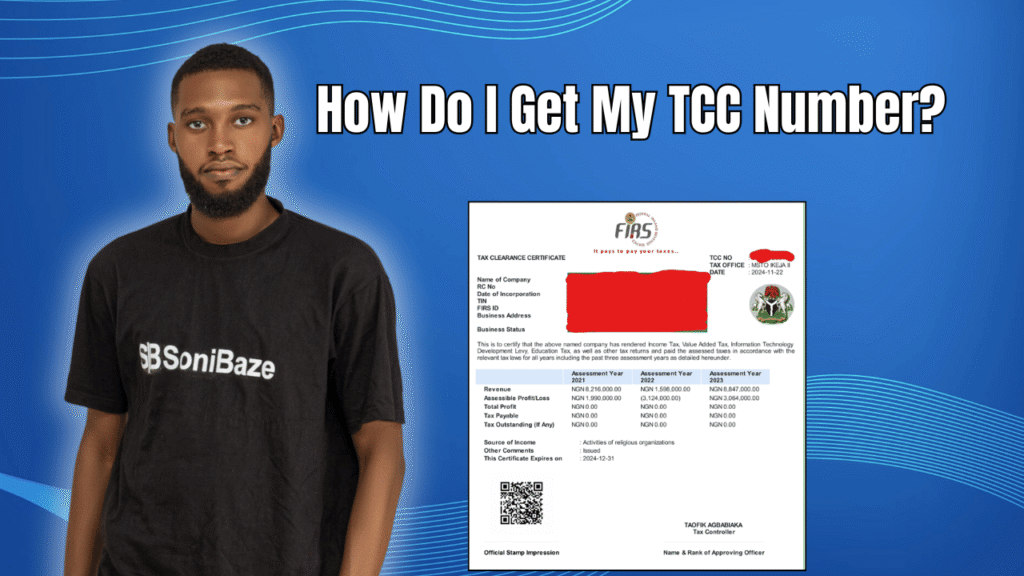
The question comes up constantly. A government tender closes in three days. A bank loan is waiting for one more document. A business licence is due for renewal. And somewhere in the requirements list sits the Tax Clearance Certificate.
Most business owners in Nigeria know they need one. Fewer know exactly how to get the TCC number, what it covers, or why it sometimes fails to generate even when they believe they are fully compliant.
This article answers all of that.
Obtain Your Tax Clearance Certificate (TCC)
Let us help you obtain your Tax Clearance Certificate (TCC) quickly and hassle-free. Our experts provide reliable support throughout the application process, ensuring your business meets all tax compliance requirements.
What Is a TCC Number?
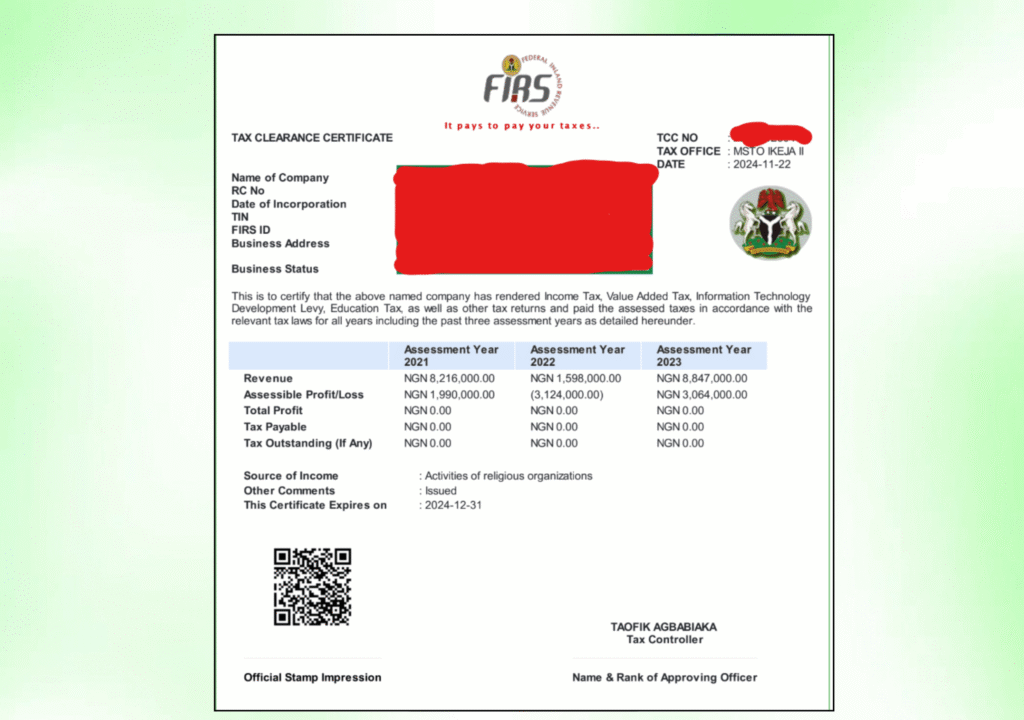
A Tax Clearance Certificate is an official document issued by the Federal Inland Revenue Service or the relevant State Internal Revenue Service. It confirms that a taxpayer, whether an individual or a company, has no outstanding tax liabilities for the three years immediately preceding the date of issuance.
The TCC number is the unique identifier printed on that certificate. It is the number procurement officers, banks, and government agencies use to verify authenticity through the FIRS online verification portal.
The certificate is not a blanket confirmation of all-round tax compliance. An FIRS TCC covers federal taxes only. A state IRS TCC covers state taxes. Neither covers local government levies. This distinction matters in practice, especially when a procurement process asks for both federal and state tax compliance documents.
Who Issues the TCC?
There are two issuing authorities in Nigeria.
FIRS handles federal taxes, including Company Income Tax, Value Added Tax, Withholding Tax, and Education Tax. If your company operates at the federal level or bids for federal contracts, your TCC must come from FIRS.
State Internal Revenue Services handle Personal Income Tax at the state level. Abuja-based businesses and residents deal with the FCT Internal Revenue Service. Lagos businesses deal with the Lagos Internal Revenue Service. The issuing authority depends on where your business or personal income is domiciled for tax purposes.
What the TCC Is Used For
A valid TCC is required for a wide range of transactions in Nigeria. The most common ones are bidding for government contracts and tenders, renewing business licences and permits, applying for loans from commercial banks, obtaining import and export licences, applying for work or residency permits for expatriates, processing real estate title documents such as a Certificate of Occupancy, and demonstrating tax compliance to regulatory authorities.
The Nigerian government mandates all MDAs and commercial banks to request a valid TCC from individuals and businesses before processing applications for licences, permits, and government contracts.
Two Categories of Applicants: Existing vs New Companies
The TCC process in Nigeria is not identical for everyone. FIRS draws a clear line between existing companies and new companies, and the steps differ between them.
An existing company is one that has registered for taxes with FIRS and has filed corporate tax returns for two or more years. For this category, the TCC process is fully automated and can be completed online in under a minute.
A new company is a taxpayer that has not yet filed returns with FIRS, is filing for the first time, or has been registered with FIRS for less than two full years of assessment. This category follows a different route.
How to Get Your TCC Number: Existing Companies
Step 1: Ensure Your Tax Obligations Are Current
Before touching the portal, confirm that all tax returns are filed and all outstanding payments are settled. This includes Company Income Tax, PAYE for employees, VAT, and Withholding Tax where applicable. FIRS verifies compliance before issuing a certificate, and any outstanding assessment or pending reconciliation will block generation.
Step 2: Log In to the FIRS TCC Portal
Visit tcc.firs.gov.ng. This is the official FIRS e-Services portal for TCC applications and downloads. Log in using your registered credentials.
Step 3: Click “Generate TCC”
Once logged in, click the Generate TCC button. For existing companies with a clean compliance record, the system processes the request automatically and sends a copy of the certificate to your registered email address.
That is the complete process for an existing company in good standing. What used to take two weeks now takes under a minute when all obligations are met.
Step 4: Verify Your TCC Number
Once received, your TCC number can be verified by third parties through the same portal at tcc.firs.gov.ng. Banks, procurement officers, and partner organisations use this portal to confirm that the certificate presented is genuine.
How to Get Your TCC Number: New Companies
New companies follow a similar starting point but cannot complete the process entirely online.
Log in to the FIRS TCC portal at tcc.firs.gov.ng and click Generate TCC. For new taxpayers, the system will not automatically send the certificate to your email. Instead, the taxpayer or an authorised representative must visit the designated FIRS tax office to complete the application manually.
At the office, you may be required to provide additional information to support your application. Once the application is reviewed and approved, the electronic TCC can be downloaded from the portal.
Obtain Your Tax Clearance Certificate (TCC)
Let us help you obtain your Tax Clearance Certificate (TCC) quickly and hassle-free. Our experts provide reliable support throughout the application process, ensuring your business meets all tax compliance requirements.
How to Apply at an FIRS Office (Manual Process)
For taxpayers who prefer to apply in person, or who are required to do so as new companies, the manual process involves the following steps.
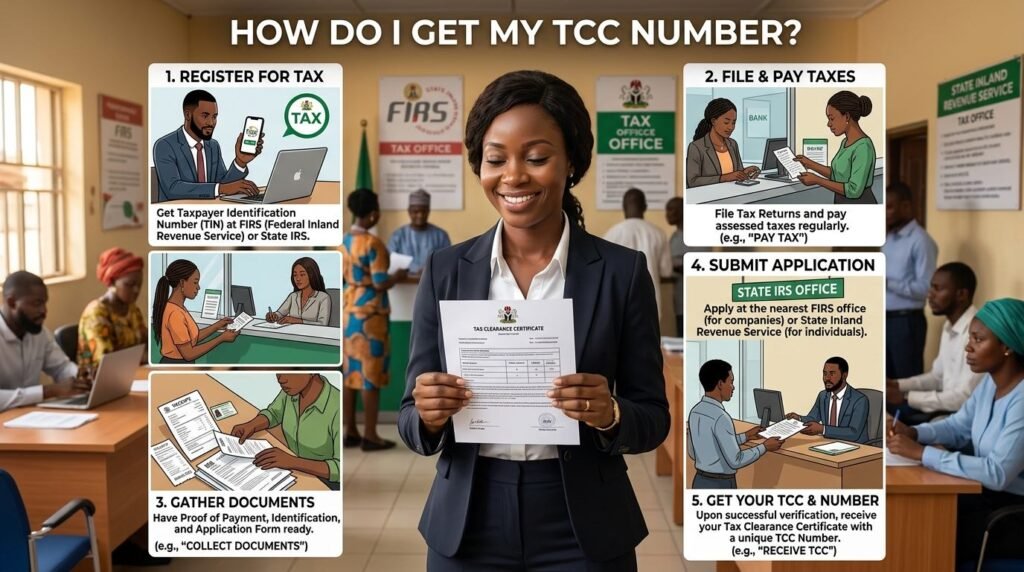
Visit your nearest FIRS office. Request the TCC application form. Complete the form accurately with your company’s details. Submit the form together with your required documents, which include your TIN certificate, copies of filed tax returns for the relevant years, proof of tax payments, and any other supporting documents specified by FIRS. FIRS will review the application and verify your compliance status. If approved, the certificate is issued.
Before the FIRS introduced the automated e-TCC system, the statutory processing time was two weeks. The automated system now processes eligible applications in under a minute. Manual applications at the office can still take up to two weeks where additional review or reconciliation is required.
Documents Required for TCC Application
The exact list varies depending on whether you are a company or an individual and whether you are on the PAYE scheme or self-employed. Below is the standard set.
For companies: Tax Identification Number, evidence of tax registration, filed tax returns for the past three years, proof of tax payments, and audited financial statements where applicable.
For individuals on PAYE: TIN, completed TCC application form (Form 802 for FCT-IRS applicants), payslips for the previous three years (January, April, September, and December), a valid means of identification, and a photocopy of the previous TCC where this is a renewal.
For self-employed individuals: TIN, completed application form, Annual Income Tax returns, proof of tax payments, bank statements where no payslips exist, and a valid means of identification.
Common Reasons TCC Generation Fails
Outstanding tax liabilities. The most common reason. Any unpaid tax, penalty, or interest on account will prevent generation. Confirm with your FIRS office if you are unsure whether your account is fully cleared.
Unfiled returns. Even if no tax was due in a particular year, returns must still be filed. A missing annual return for any of the three preceding years will block the certificate.
Pending tax reconciliation. If there is an open query or audit on your account, the system will not generate a certificate until the matter is resolved.
Wrong TIN or mismatched details. Using a TIN not properly linked to your FIRS records, or submitting details that do not match your registered profile, leads to processing delays or outright rejection.
Name or company data mismatch. Differences between your CAC documents and your FIRS registration, such as a different company name, address, or director information, can trigger compliance flags that hold up the application.
TCC Application at a Glance
| Applicant Type | Process | Timeline |
|---|---|---|
| Existing company (2 or more years of filed returns) | Online via tcc.firs.gov.ng | Under 1 minute when fully compliant |
| New company (less than 2 years of filing history) | Portal initiation, then manual completion at FIRS office | Up to 2 weeks |
| Individual on PAYE | Manual application at State IRS or FIRS office | Up to 2 weeks |
| Self-employed individual | Manual application at relevant tax office | Up to 2 weeks |
Frequently Asked Questions
Is the TCC the same as a TIN?
No. A TIN (Tax Identification Number) is the unique number assigned to you when you register with FIRS. It identifies your account in the system. A TCC is a certificate issued annually that confirms you have paid your taxes. You need a TIN before you can apply for a TCC.
How long is a TCC valid?
A TCC is valid for one year from the date of issuance. It covers the three years preceding the current year of assessment. For ongoing contract or licence requirements, it needs to be renewed annually.
Can I get a TCC if my company is new and has not paid any tax yet?
If your company is genuinely new and has not yet had taxable income, you may be issued a TCC that confirms no tax liability exists for the period. However, you still need to have registered with FIRS, obtained a TIN, and filed the relevant returns to make the application. The TCC documents your compliance status, even where that status is zero liability.
What is the difference between an FIRS TCC and a state IRS TCC?
An FIRS TCC covers federal taxes such as Company Income Tax, VAT, and Withholding Tax. A state IRS TCC covers Personal Income Tax administered at the state level. For federal government contracts, the FIRS TCC is typically what is required. Some procurement processes and banks may ask for both. They are separate documents from separate authorities and must be obtained independently.
Can I verify someone else’s TCC number?
Yes. The FIRS TCC verification portal at tcc.firs.gov.ng allows third parties to verify any TCC using the certificate number and other taxpayer details. This is the channel used by banks, procurement officers, and regulatory agencies to confirm authenticity.
What should I do if my TCC fails to generate online even though I believe I am compliant?
Visit your designated FIRS tax office rather than retrying the portal repeatedly. The officer can check your account for specific flags such as pending reconciliation, unfiled returns, or a technical mismatch. Most blocks on TCC generation have a clear reason that is visible on the FIRS side, even when the portal gives no useful error message.
Conclusion: Start with Your Compliance Record, Not the Portal
The TCC portal is fast. For a company with clean records, the certificate generates in under a minute. The difficulty is never the portal itself. It is the compliance record that sits behind it.
Businesses that file their returns consistently each year, settle outstanding taxes before the renewal window, and keep their FIRS registration details current will find TCC generation almost effortless. Those who wait until a contract deadline forces the issue often discover a compliance gap that takes weeks to resolve.
The TCC number you need is already available through the FIRS system. What it requires is a clean account to attach itself to.
Obtain Your Tax Clearance Certificate (TCC)
Let us help you obtain your Tax Clearance Certificate (TCC) quickly and hassle-free. Our experts provide reliable support throughout the application process, ensuring your business meets all tax compliance requirements.