
Bidding for a government contract in Nigeria without a valid PENCOM Compliance Certificate is a non-starter. Procurement officers check for it early, and a missing or expired certificate can knock a company out of a bidding process before the technical evaluation even begins.
This guide walks through what the PENCOM Compliance Certificate actually is, who needs it, and the exact steps to get one through PenCom’s online application portal.
Obtain Your PENCOM certificate
Let us help you obtain your PENCOM Compliance Certificate quickly and hassle-free. Our experts provide reliable support throughout the application process, ensuring you meet all requirements and remain compliant.
What Is a PENCOM Compliance Certificate?
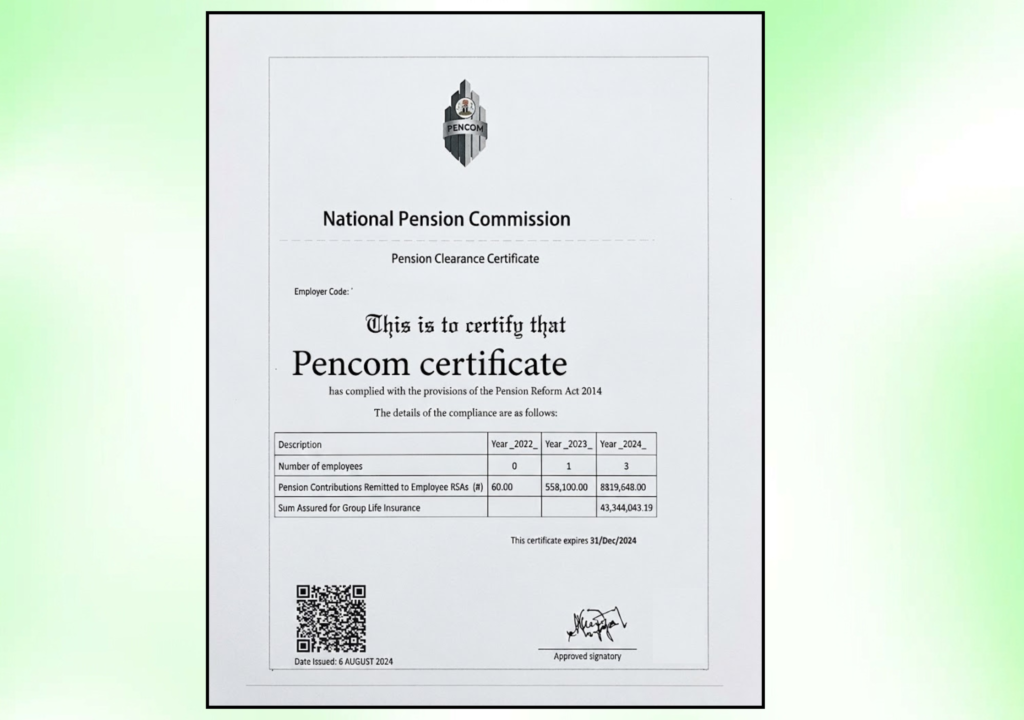
A PENCOM Compliance Certificate, often shortened to PCC, is issued by Nigeria’s National Pension Commission. It confirms that an employer has registered its employees under the Contributory Pension Scheme and has been remitting pension contributions consistently.
Any company with three or more employees is required to register with PenCom and make monthly pension remittances on their behalf. The PCC is the document that proves this has been done correctly. It is valid until December 31 of the year it was issued, so companies typically renew it annually.
For most businesses, the certificate only becomes urgent when they want to bid for a federal or state government contract. Without it, the bid is incomplete regardless of how strong the technical proposal is.
Who Needs This Certificate?
| Business Situation | Do You Need a PCC? |
|---|---|
| Bidding for a federal government contract or tender | Yes, mandatory |
| Renewing a business license that requires regulatory compliance proof | Often required |
| Entering a public-private partnership | Yes |
| Company has fewer than 3 employees | Not eligible to apply |
| Private sector contracts with no government involvement | Not usually required, but good practice |

Prerequisites Before You Apply
PenCom will not process an application unless certain documents and records are already in place. Getting these sorted before you start the online application saves weeks of back and forth.
| Requirement | What It Confirms |
|---|---|
| Certificate of Incorporation (CAC) | Your business is legally registered in Nigeria |
| FIRS Tax Identification Number (TIN) | Your business has a valid tax record |
| PenCom Employer Code | Unique identifier assigned to your company by PenCom |
| Registration of employees with a PFA | Employees have active Retirement Savings Accounts |
| Evidence of monthly pension remittances | Contributions have actually been paid, not just registered |
| Group Life Insurance (GLI) policy | Coverage of at least three times an employee’s annual emoluments |
| Minimum of 3 employees | PenCom only issues certificates to employers meeting this threshold |
If any of these are missing, especially the GLI policy or remittance history, sort them out first. Applying without them guarantees a rejection.
How to Get a PENCOM Compliance Certificate: Step by Step
Step 1: Register Your Company With PenCom and Get an Employer Code
Every company needs an Employer Code before it can do anything else with PenCom. This is a unique identifier tied to your business, used to track your pension contributions over time.
If your company has never registered with PenCom, this is your starting point. You can register through PenCom’s office or, increasingly, through the online portal where new employer registrations are also processed.
Step 2: Register All Employees With a Pension Fund Administrator
Each employee needs an active Retirement Savings Account with a licensed Pension Fund Administrator, commonly called a PFA. If your staff are not yet registered with PFAs, this has to happen before any contributions can be remitted on their behalf.
Make sure the employee names, dates of birth, and other personal details on file with the PFA match exactly what is on your company’s payroll records. Mismatches here are one of the most common reasons applications get rejected.
Step 3: Remit Monthly Pension Contributions Consistently
PenCom checks remittance history as part of the compliance review. You need to show consistent monthly contributions, not a single lump payment made right before applying.
If your company has gaps in its remittance history, those gaps need to be addressed first, sometimes with backdated payments and supporting evidence, before PenCom will consider the application complete.
Step 4: Secure a Group Life Insurance Policy
The Pension Reform Act requires employers to maintain a Group Life Insurance policy covering each employee for at least three times their annual total emoluments. This is separate from pension contributions but is checked as part of the PCC application.
If your company does not already have this in place, you will need to get a policy from a licensed insurance provider before moving forward. PenCom will ask for evidence of this policy during the application.
Step 5: Gather Your Supporting Documents
With the groundwork done, pull together the documents PenCom will ask for. At minimum, this includes your CAC Certificate of Incorporation, your FIRS Tax Identification Number, your PenCom Employer Code, your employee schedule with PFA details, evidence of remittances, and your Group Life Insurance policy document.
Having these as clean, properly named digital files (PDFs work best) before you start the online application makes the upload process much faster.
Step 6: Apply Through PenCom’s e-PCC Portal
As of April 2026, all PCC applications must go through PenCom’s online application portal. Create an account if you do not already have one, then start a new compliance certificate application under your registered Employer Code.
The portal will ask you to upload your company profile, your employee schedule, evidence of pension remittances, and your Group Life Insurance details. Each section needs to be completed fully before you can move to the next. The system flags incomplete or inconsistent entries with an error prompt, so fix those before proceeding.
Step 7: Make Payment Through an Approved PSSP
PenCom only accepts payments through its approved Payment Solution Service Providers, referred to as PSSPs. Attempting to pay through any other channel will not be accepted as part of the application.
Once payment is confirmed on the portal, your application moves into the review queue.
Step 8: Submit and Wait for Review
Once submitted, the application cannot be edited. PenCom’s review process typically takes between two and three weeks if everything submitted is accurate and complete. Some sources cite up to fifteen working days for straightforward applications.
If there is a mismatch between what you submitted and what PenCom has on record for your employees or remittances, the application can be automatically rejected, and you will need to start the process again.
Step 9: Download Your Certificate
Once approved, the PCC becomes available on the portal for download. It is valid until December 31 of the issuing year, regardless of when in the year it was issued. Mark your calendar for renewal well before that date if your company regularly bids for government contracts, since the certificate needs to be current at the time of submission, not just at the start of the bidding process.
Obtain Your PENCOM certificate
Let us help you obtain your PENCOM Compliance Certificate quickly and hassle-free. Our experts provide reliable support throughout the application process, ensuring you meet all requirements and remain compliant.
PCC Application at a Glance
| Stage | What Happens | Typical Timeframe |
|---|---|---|
| Pre-application setup | Employer Code, PFA registration, GLI policy, remittance history | Varies, can take months if starting from scratch |
| Document gathering | CAC, TIN, employee schedule, remittance evidence | 1 to 2 days if records are organised |
| Portal application | Upload documents, complete profile, pay via PSSP | Under 1 hour if documents are ready |
| PenCom review | Verification against PFA and remittance records | 2 to 3 weeks |
| Certificate issuance | Download from portal | Immediate once approved |
Common Mistakes That Lead to Rejection
The most frequent reason applications get rejected is a mismatch between employee details on the company’s records and what the PFA has on file. A misspelled name, wrong date of birth, or different employee count between the two systems is enough to trigger an automatic rejection.
Another common issue is applying with an incomplete remittance history. Some companies make a single payment shortly before applying, hoping it will be enough. PenCom checks for consistency over time, not a one-off payment.
Companies also frequently overlook the Group Life Insurance requirement entirely, assuming pension contributions alone are sufficient. The GLI policy is a separate, mandatory requirement, and its absence will stall an otherwise complete application.
Finally, since the portal does not allow edits after submission, rushing through the upload stage without double-checking every field against source documents often results in a rejection that could have been avoided with a five-minute review.
Frequently Asked Questions
How long does it take to get a PENCOM Compliance Certificate?
If all documents are accurate and the company has a clean remittance history, the review typically takes two to three weeks after submission. Companies starting from scratch, meaning they have not yet registered employees with PFAs or secured a Group Life Insurance policy, should expect the full process to take significantly longer, since those steps need to be completed before the application itself can even be submitted.
Can a company with fewer than three employees get a PCC?
No. PenCom only issues compliance certificates to employers with at least three active employees registered under the Contributory Pension Scheme. Companies below this threshold are not eligible to apply.
Is the PENCOM Compliance Certificate the same as PENCOM registration?
No. PENCOM registration is the process of getting an Employer Code and registering your company with the commission. The Compliance Certificate is a separate document confirming that your company has met its ongoing pension obligations, including remittances and Group Life Insurance, and is issued after registration is already in place.
What happens if my PCC expires while a bid is still ongoing?
The certificate is valid until December 31 of the year it was issued. If a bidding process extends past that date, you will likely need a renewed certificate to remain compliant for that submission. Renewing ahead of major bidding seasons avoids this problem entirely.
Can I apply for a PCC without using a consultant?
Yes. The application is designed to be completed directly through PenCom’s online portal by the employer. That said, companies that are missing prerequisites such as PFA registration, Group Life Insurance, or a clean remittance history sometimes engage a consultant to help put those pieces in place before applying, since gaps in any of these areas are the most common cause of delay.
Why was my PCC application rejected?
The most common reasons are mismatched employee details between company records and PFA records, incomplete remittance history, a missing or insufficient Group Life Insurance policy, and submission errors that cannot be corrected after the fact since the portal locks the application once submitted. Reviewing every uploaded document against your source records before submitting significantly reduces the chance of rejection.
Conclusion: Start With the Groundwork, Not the Portal
The PenCom portal itself is the easy part. Most delays and rejections happen because the groundwork, PFA registration, consistent remittances, and Group Life Insurance, was not properly in place before the application started.
If your company already has these basics sorted, the certificate application can realistically be completed in under an hour, with the certificate itself arriving two to three weeks later. If you are starting from zero, treat the prerequisite steps as the real project, and the portal application as the final formality once everything else checks out.
Obtain Your PENCOM certificate
Let us help you obtain your PENCOM Compliance Certificate quickly and hassle-free. Our experts provide reliable support throughout the application process, ensuring you meet all requirements and remain compliant.