
If you have ever applied for an IT-related government tender in Nigeria and seen “CPN registration” on the requirements list, you have probably wondered whether this applies to you. It is one of those regulatory bodies that many people in tech have heard of but few fully understand, until a contract or job application makes it unavoidable.
This article explains what the CPN certificate is, who is legally expected to hold one, and how the requirements differ between individuals and registered businesses.
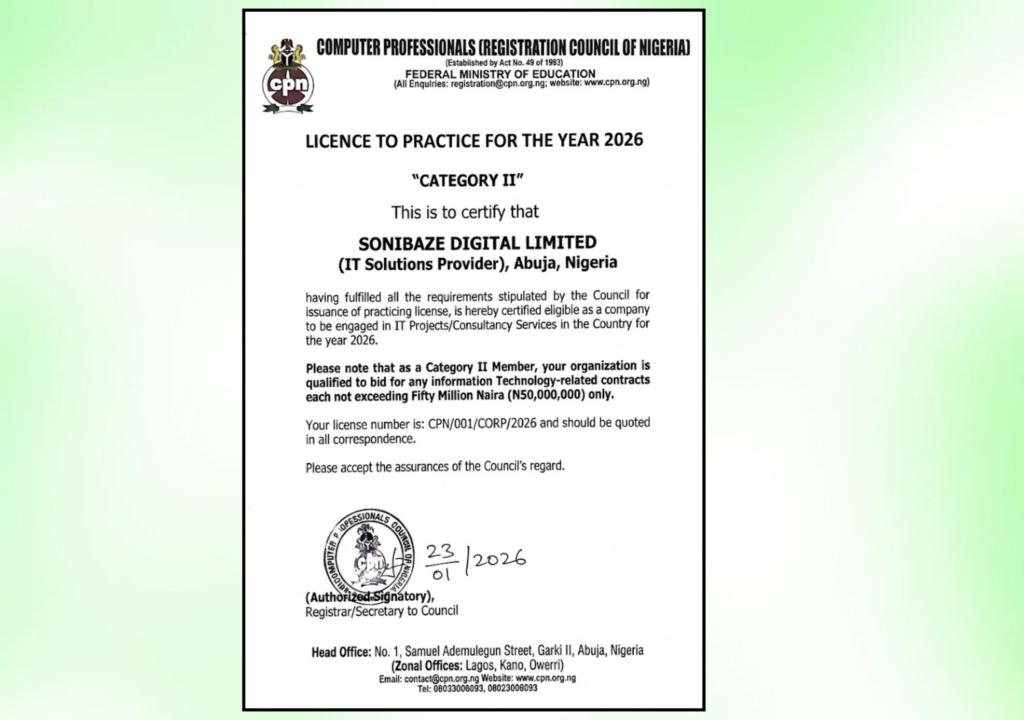
Obtain Your CPN certificate
Let us help you obtain your Computer Professionals Registration Council of Nigeria (CPN) Certification with ease. Our experts provide guidance throughout the application process, helping you achieve professional recognition and compliance.
What Is the CPN Certificate?
CPN stands for the Computer Professionals Registration Council of Nigeria. It was established by Decree No. 49 of 1993, later codified as the CPN Act, and is the body responsible for regulating and supervising the practice of computing and information technology in Nigeria.
In simple terms, CPN is to IT professionals what COREN is to engineers and what ICAN is to accountants. It sets standards for who can practice computing professionally in the country, and the certificate it issues is proof that an individual or organisation has met those standards.
CPN operates as an educational institution domiciled under the Federal Ministry of Education, and it remains the only body in Nigeria authorised to license and issue the Chartered Information Technology Practitioner designation to IT professionals.
Who Needs CPN Registration?
Individuals Practicing in Computing or IT Roles
If you work professionally in computing, software development, systems administration, networking, or any related IT discipline in Nigeria, CPN registration applies to you. The Council’s mandate covers anyone “involving in sale or use of computing services,” which is a fairly wide net.
In practice, this matters most for IT professionals who want their qualifications formally recognised, who are applying for senior roles where chartered status is a requirement, or who plan to bid for government IT contracts as individual consultants.
Corporate Organisations With Computing Departments
Businesses that operate computing departments or units, or that provide IT-related products and services, fall under CPN’s corporate membership category. This includes software companies, IT consultancies, systems integrators, and businesses where technology delivery is a core part of what they sell.
For corporate registration, the requirement is that at least two members of the organisation must themselves be registered with CPN. The corporate certificate sits on top of, not instead of, individual registration for relevant staff.

IT Consultants and Freelancers Bidding for Government Contracts
This is where CPN registration becomes most visible in practice. Government tenders and expressions of interest for IT-related projects frequently list CPN registration as a prerequisite, the same way PENCOM and ITF certificates appear on broader procurement checklists.
If you are an independent IT consultant or a small IT firm planning to work with government ministries, departments, or agencies, CPN registration is one of the boxes that needs to be checked before your bid will even be considered.
Graduates and NYSC Members Entering the IT Profession
CPN registration is not only for established professionals. The Council has a structured pathway for people entering the profession, including graduates and those completing the National Youth Service Corps.
A member who has completed NYSC typically joins the Council’s Executive Registration Programme, which leads toward associate or full membership depending on further requirements such as the CPE 3 examination. For people early in their IT careers, registering with CPN now builds toward the chartered status that more senior roles and contracts will eventually expect.
Individual vs Corporate Registration: What’s Different
The CPN registration process splits clearly into two tracks, and the requirements are not identical.
For individuals, the application fee is twenty thousand naira. Applicants need to provide a supporter who can validate their recent professional experience, typically an employer, colleague, or client, and that supporter’s agreement should be obtained before their contact details are submitted as part of the application.
For corporate registration, the application fee is thirty thousand naira. The corporate application also requires a supporter to validate recent experience, but the underlying requirement is that the organisation has at least two CPN-registered individual members already on its staff.
Both individual and corporate members are required to pay an annual licence fee afterward to renew their practitioner’s licence and remain eligible to practice.
Who Needs What: Quick Reference
| Category | Registration Type | Key Requirement |
|---|---|---|
| IT professional working in Nigeria | Individual | Application fee of ₦20,000, plus a supporter to validate experience |
| Software company or IT consultancy | Corporate | Application fee of ₦30,000, plus at least two CPN-registered staff |
| Freelance IT consultant bidding for government contracts | Individual | CPN certificate often required on tender checklists |
| Graduate or NYSC member entering IT | Individual, via ERP pathway | Completion of relevant CPE stages toward full membership |
| Company with an internal IT/computing department | Corporate | Registration of the department or unit under corporate membership |
Obtain Your CPN certificate
Let us help you obtain your Computer Professionals Registration Council of Nigeria (CPN) Certification with ease. Our experts provide guidance throughout the application process, helping you achieve professional recognition and compliance.
How the Registration Process Works
Both individual and corporate applications are submitted through CPN’s online registration portal. The process involves completing the application form, uploading supporting documents such as academic credentials and a CV, providing supporter details for experience validation, and paying the relevant application fee.
After the Council reviews the submission, successful applicants are issued a registration number along with a certificate of registration. From there, ongoing membership depends on annual licence fee payments to keep the practitioner’s licence active.
For individuals on the examination pathway toward chartered status, there are additional stages, including the Computer Professional Examination at various levels, each carrying its own fee. These exams build toward designations that correspond to academic qualification levels, from the CPN Foundation Certificate through to the CPE III Certificate for those with a master’s degree.
Frequently Asked Questions
Is CPN registration legally compulsory for everyone working in IT in Nigeria?
The CPN Act frames registration as an obligation for individuals and organisations involved in the sale or use of computing services in Nigeria. In practice, enforcement is most visible around government contracts and formal procurement, where CPN registration appears as a stated requirement rather than something optional.
How much does CPN registration cost for an individual?
The individual application fee is ₦20,000. Beyond the application itself, individuals progressing through the examination pathway toward chartered status will encounter additional fees for each Computer Professional Examination stage, which vary depending on the level.
Can a small IT business register with CPN if it doesn’t have two registered staff yet?
The corporate registration requirement specifies that at least two members of the organisation must be registered with CPN individually. A small business in this position would typically need to have its key technical staff complete individual registration first, before the organisation applies for corporate membership.
Does CPN registration expire?
Yes, in the sense that registered members, both individual and corporate, are required to pay an annual licence fee to renew their practitioner’s licence. Without this renewal, a member’s ability to practice under CPN’s framework lapses even though the original registration record remains.
Is CPN the same as the Nigeria Computer Society (NCS)?
No. CPN is the statutory regulatory body for computing practice in Nigeria, while NCS is a professional society. They are related, registration with CPN for at least five years is one pathway toward certain NCS membership categories, but they serve different functions and require separate applications.
Do freelancers need CPN registration if they only work with private clients?
If a freelancer’s work is entirely with private sector clients and never touches government procurement, the practical pressure to register is lower. However, since CPN’s mandate covers anyone selling or using computing services in Nigeria, freelancers who anticipate moving into larger contracts, including government work, are better positioned by registering before that need becomes urgent.
Conclusion: Registration Matters Most When Contracts Are on the Line
For many IT professionals and businesses in Nigeria, CPN registration sits quietly in the background until a specific opportunity, usually a government contract or a senior role, requires it. At that point, the registration and examination pathway can take longer than the opportunity’s timeline allows.
If your work touches government IT projects, or if you run a business with a computing department that might eventually bid for such work, registering ahead of time removes one more item from the list of things that can hold up a bid.
Obtain Your CPN certificate
Let us help you obtain your Computer Professionals Registration Council of Nigeria (CPN) Certification with ease. Our experts provide guidance throughout the application process, helping you achieve professional recognition and compliance.