Billboard advertising in Nigeria is a multi-billion naira industry. Every major road in Lagos, Abuja, Port Harcourt, and Kano is lined with outdoor structures carrying brand messages. Someone owns those structures. Someone is collecting the rent.
Starting a billboard business means becoming that person. You acquire or lease land, erect structures, and rent the advertising space to brands. Done right, it is one of the most durable asset-based businesses in Nigeria. A single well-placed structure can generate income for years with minimal ongoing effort.
This article walks through every step required to start a billboard business in Nigeria, from researching locations to getting your first client signed.
Let’s get your brand on billboards around Abuja and seen by the right audience.
How the Billboard Business Model Works
The business is simple at its core. You identify a high-traffic location, secure rights to place a structure there, build the billboard, and then rent the advertising face to clients on a monthly or annual basis.
Your revenue comes from those rental fees. Billboard rent in Nigeria ranges from ₦200,000 to over ₦5,000,000 per month depending on location, size, and format. Premium unipoles on major corridors in Abuja, Lagos, or Port Harcourt sit at the top of that range. Smaller static boards in secondary locations sit at the lower end.
The business scales by adding more structures over time. One board pays back the investment. Ten boards become a meaningful business. The challenge is capital at the start and regulatory approval throughout.
What You Need Before You Start
This is not a business you start without preparation. These are the foundations that need to be in place before spending money on anything else.
| Prerequisite | What It Means |
|---|---|
| Market research on locations | Know which corridors in your target city have high traffic and available land |
| Understanding of local regulations | Each state and the FCT has its own outdoor advertising regulations and approval bodies |
| Starting capital | Minimum ₦3,000,000 to ₦10,000,000 for a first structure depending on size and location |
| A registered business | CAC registration is required before obtaining regulatory approval |
| Basic knowledge of ad sales | You will need to pitch brands directly or partner with agencies to fill the space |
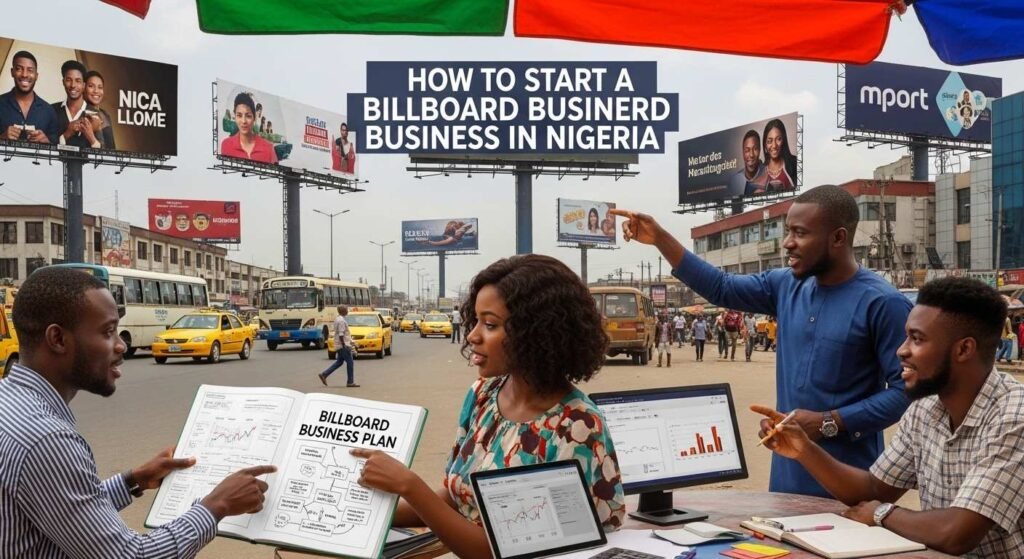
Steps to Start a Billboard Business in Nigeria
Step 1: Choose Your Target City and Key Corridors
Every billboard business decision starts with location. A board in the right spot will never struggle for clients. One in a poor location will stay empty no matter how good your sales pitch is.
Study traffic patterns in your city. Count the volume of vehicles passing specific junctions during morning and evening rush hours. Areas with heavy commuter traffic, near commercial districts, or along major entry and exit roads are the most valuable. In Abuja, the Airport Road corridor, Kubwa Expressway, Wuse II, Maitama, and Garki consistently attract premium advertising budgets. In Lagos, routes like the Third Mainland Bridge approach, Lekki-Epe Expressway, and Lagos-Ibadan Expressway carry enormous daily traffic volumes.
Choose two or three priority corridors to focus on first. Trying to cover too many locations at once dilutes your focus and stretches your capital before you have proven the business.
Step 2: Research Land Availability and Secure Access Rights
Once you have identified target corridors, the next job is finding specific plots where a structure can be erected. You need either a lease agreement with the landowner or permission from whoever controls the right-of-way.
In Nigeria, roadside land falls into different categories. Some is privately owned. Some is government land managed by state ministries or the FCT Administration. Some falls under FERMA (Federal Roads Maintenance Agency) jurisdiction on federal roads. Knowing who controls a particular strip of land determines who you need to negotiate with.
Approach landowners directly for private land and negotiate a lease. Typical lease terms in Nigeria run from one to three years with renewal options. Get everything in writing and have it reviewed by a lawyer. A verbal agreement protects no one.
For government land and right-of-way, you will need formal approval from the relevant outdoor advertising regulatory body before any structure can go up.
Step 3: Register Your Business and Obtain Regulatory Approvals
Operating a billboard business without regulatory approval in Nigeria is a significant risk. State governments and the FCT Administration periodically conduct billboard clearance exercises, removing unapproved structures without compensation. This happens in Lagos, Abuja, and other cities with some regularity.
Register your business with the Corporate Affairs Commission first. This gives you a legal entity to operate under and is required for most regulatory applications.
After registration, apply to the relevant outdoor advertising regulatory body for your state. In Lagos, this is LASAA (Lagos State Signage and Advertisement Agency). In Abuja and the FCT, approvals are handled through the FCT Administration’s relevant department. Other states have their own equivalents. The application will typically require your business registration documents, the proposed location, structural engineering drawings, and payment of application fees.
Processing time varies. Budget four to twelve weeks for approvals in most Nigerian states, and factor the approval cost into your startup budget from the beginning.
Step 4: Get a Structural Design and Engage a Fabricator
A billboard structure needs to be safe. In Nigeria, structures that are poorly constructed collapse, particularly during heavy rains and strong winds. A collapsed billboard is a liability. It can injure people and result in legal action.
Engage a structural engineer to design the foundation and frame for your billboard. The design needs to account for the size of the structure, soil conditions at the location, and wind load. Most outdoor advertising regulatory bodies require a structural engineering certificate as part of the approval process.
Once the design is ready, source a qualified fabricator. Billboard fabricators in Nigeria can produce a standard static unipole structure in three to six weeks depending on size and complexity. Get at least three quotes before committing. Pricing for fabrication and installation of a medium-sized static board typically starts from around ₦2,500,000 and rises depending on height, face size, and finish quality.
Step 5: Build and Commission the Structure
Construction should only begin once you have your regulatory approval and a signed land agreement in hand. Starting before either of these is in place is a common mistake that leads to costly disputes or forced demolition.
Supervise construction closely. Confirm that the foundation depth matches the engineer’s specification. Check that the steel used meets the structural design. Inspect the final installation before signing off. A structural defect discovered after the board is erected is far more expensive to fix than one caught during construction.
Once the board is up, take professional photographs of it from multiple angles. These photographs will be part of every client proposal you send going forward.
Step 6: Price Your Advertising Space
Pricing a billboard is not guesswork. It is based on traffic volume, location quality, board size, and what comparable boards in the area are charging.
Research what similar boards in your corridor are renting for. You can do this by calling other outdoor advertising companies directly or speaking to media buyers at advertising agencies who regularly buy outdoor space. Media buyers know the market rates better than almost anyone.
For a new board in a good Abuja location, monthly rates between ₦300,000 and ₦800,000 are realistic depending on size and exact positioning. Premium digital boards or large-format unipoles on major corridors command significantly more. Start slightly below the market rate to attract your first clients, then raise rates as the board develops a track record.
| Board Type and Location | Estimated Monthly Rate |
|---|---|
| Small static board, secondary Abuja road | ₦200,000 – ₦350,000 |
| Medium static board, major Abuja corridor | ₦350,000 – ₦700,000 |
| Large unipole, premium Abuja location | ₦700,000 – ₦2,000,000 |
| Digital board, high-traffic Abuja site | ₦1,500,000 – ₦5,000,000+ |
| Medium static board, Lagos Island | ₦500,000 – ₦1,500,000 |
| Large unipole, Lagos Expressway | ₦1,500,000 – ₦5,000,000+ |
Step 7: Find Your First Clients
A new billboard with no rental history needs to be sold actively. Waiting for clients to find you will result in months of empty space and zero revenue.
Your first targets are local businesses in the area where your board is located. A bank, a real estate company, a supermarket, a hospital, or a church near your billboard all have reason to advertise on it. Walk in, ask for the marketing manager, and present your rate card with the board photographs.
Your second channel is advertising agencies and media buyers. Agencies in Nigeria regularly purchase outdoor space on behalf of their clients. Getting your board into the inventory of two or three agencies can keep it occupied year-round. Contact agencies directly, introduce your inventory, and ask to be added to their supplier list.
SoniBaze Digital works with outdoor advertising clients in Abuja and can point businesses toward available billboard inventory and advertising solutions across the FCT.
Step 8: Manage the Business and Scale
Once the first board is generating income, the operating work shifts to client management, renewals, and maintenance. Send monthly or quarterly invoices. Follow up on late payments early. Keep the board structure in good condition, as a dilapidated board reflects poorly on your rates and your clients.
Track occupancy rates closely. If a board sits empty for more than three months, review your pricing and expand your outreach. A board occupied eleven out of twelve months at a lower rate generates more revenue than one priced optimally but occupied only seven months.
Scale by adding a second location once the first is profitable and you have the capital to invest. Each additional board increases revenue with relatively little increase in overhead, which is what makes the billboard business attractive as a long-term investment.
Startup Cost Estimate
These figures are approximate and will vary based on city, board size, and supplier pricing.
| Cost Item | Estimated Range |
|---|---|
| CAC business registration | ₦30,000 – ₦80,000 |
| Regulatory approval fees | ₦100,000 – ₦500,000 |
| Land lease (first year) | ₦200,000 – ₦1,000,000 |
| Structural engineering design | ₦100,000 – ₦300,000 |
| Fabrication and installation | ₦2,500,000 – ₦8,000,000 |
| Printing of first client artwork | ₦50,000 – ₦200,000 |
| Marketing and business development | ₦50,000 – ₦200,000 |
| Total estimated startup cost | ₦3,000,000 – ₦10,000,000+ |
Let’s get your brand on billboards around Abuja and seen by the right audience.
Common Mistakes to Avoid
Many first-time billboard operators underestimate the cost of regulatory approval. The application fees, structural certificates, and agency levies add up faster than expected. Budget for all of them upfront rather than discovering costs as you go.
Another frequent mistake is building before approvals are secured. The cost of a forced demolition, both financial and reputational, far exceeds the cost of waiting. Patience at the approval stage protects everything that comes after.
New operators also often price too high from the start. An empty board earns nothing. A board at ₦350,000 per month with consistent occupancy will outperform a board priced at ₦600,000 that sits empty for half the year.
Finally, do not neglect maintenance. A board with torn printing, faded vinyl, or a leaning structure will not attract premium clients. Schedule a visual inspection every three months and address issues quickly.
Frequently Asked Questions
How much capital do I need to start a billboard business in Nigeria?
A realistic minimum for a single static billboard in a good Nigerian city location is between ₦3,000,000 and ₦10,000,000. This covers land lease, regulatory approvals, structural engineering, fabrication, and installation. Costs vary significantly by city and board size. Abuja and Lagos tend to cost more for land and approvals than secondary cities.
Do I need approval from the government to erect a billboard in Nigeria?
Yes. Every state in Nigeria and the FCT requires approval from the relevant outdoor advertising regulatory body before any billboard structure can be erected. Operating without approval puts you at risk of forced removal and loss of your entire investment. In Lagos, approvals go through LASAA. In Abuja, through the FCT Administration. Budget both time and money for this process before starting construction.
How long does it take to recoup the investment in a billboard business?
At a monthly rental rate of ₦500,000 and high occupancy, a billboard with a total investment of ₦6,000,000 would break even in about twelve months. The payback period varies based on your location quality, rental rates, and how quickly you fill the space. Most well-located boards in Nigerian cities recover their investment within one to two years of consistent occupancy.
Can I start a billboard business with one board?
Yes, and most operators start with one. The key is choosing the right location for that first board, since your entire business depends on its performance at the start. One profitable board gives you the cash flow to fund a second, and the business grows from there without needing external financing at every stage.
Do I need an advertising agency background to sell billboard space?
No. Most of your early clients will be local businesses that you approach directly, not sophisticated media buyers. Basic sales skills, a professional rate card, good photographs of your board location, and traffic data for the corridor are enough to close your first rentals. As the business grows, building relationships with advertising agencies and media buyers will expand your client base significantly.
What is the difference between a static billboard and a digital billboard?
A static billboard displays one fixed printed advertisement at a time. A digital billboard uses LED screens to rotate between multiple advertisers, sometimes displaying several different ads per hour. Digital boards cost significantly more to build and maintain but can generate higher revenue because multiple clients share the same structure simultaneously. Static boards are the more practical starting point for most first-time operators in Nigeria given the lower capital requirement and simpler operation.
Conclusion: A Business That Pays While You Sleep
Billboard advertising is one of the few businesses in Nigeria where the asset works continuously without requiring your daily involvement. Once a board is erected, approved, and occupied, it generates income around the clock.
The barriers are real. Capital requirements are significant. Regulatory processes take time. Selling the space requires persistence, particularly in the early months. But the operators who get through those early challenges own physical infrastructure that keeps paying them back year after year.
Starting with the right location, securing proper approvals, and actively selling the space from day one are the three decisions that separate successful billboard operators from those who built something that never reached its potential.
SoniBaze Digital helps brands advertise on billboards across the FCT and supports outdoor advertising clients in Abuja with placement, design, and campaign strategy.
Let’s get your brand on billboards around Abuja and seen by the right audience.