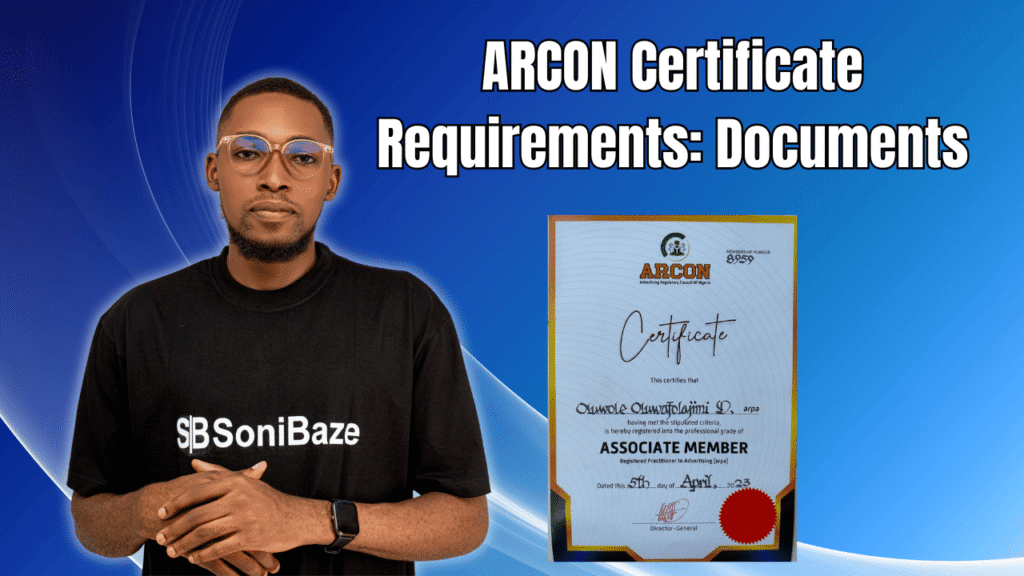
Every advertisement that goes public in Nigeria, whether on TV, radio, a billboard, or a sponsored Instagram post, is supposed to pass through ARCON first. A Federal High Court ruling in April 2025 confirmed this applies to everyone, not just registered advertising agencies. That means understanding ARCON’s documentation requirements is no longer optional for businesses that advertise.
This article breaks down what ARCON is, the documents needed to register as a practitioner, and the documents required to get an advertisement approved for public exposure.
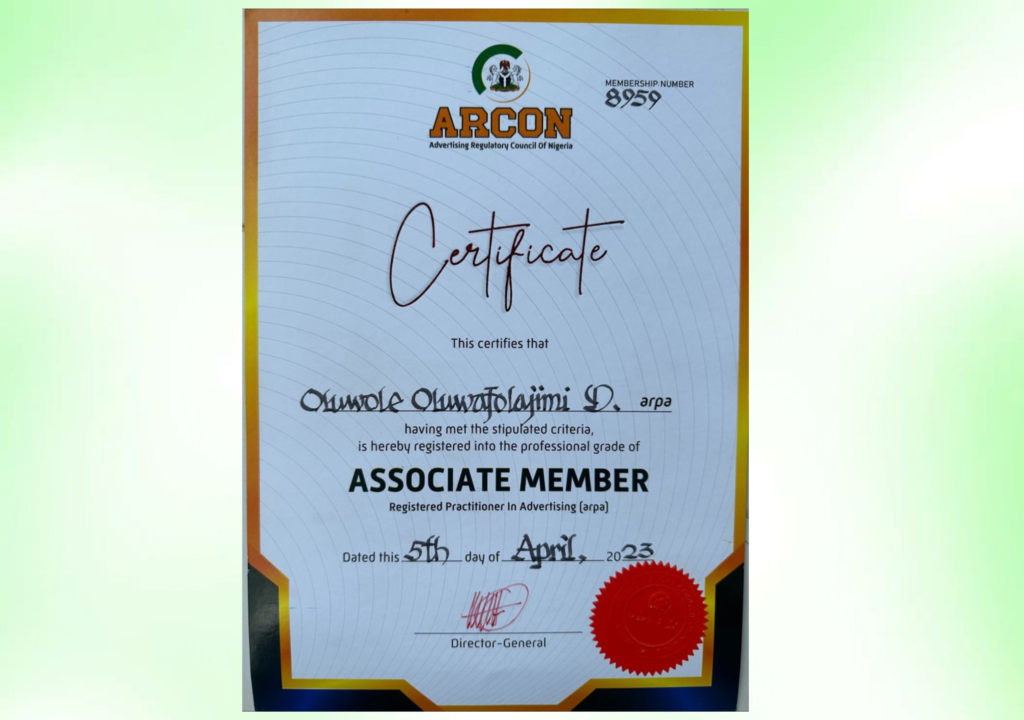
Obtain Your ARCON certificate
Let us help you obtain your Advertising Regulatory Council of Nigeria (ARCON) Certificate quickly and hassle-free. Our experts provide professional guidance throughout the registration and certification process, ensuring compliance with industry regulations.
What Is ARCON?
ARCON stands for the Advertising Regulatory Council of Nigeria, established by the Advertising Regulatory Council of Nigeria Act, 2022. It replaced the older Advertising Practitioners Council of Nigeria (APCON), expanding regulatory powers to cover digital and social media advertising alongside traditional formats.
The council is headquartered at ARCON House, National Theatre Annexe, Iganmu, Lagos, and is led by a Director-General appointed by the Federal Government. Its core job is regulating advertising content, protecting consumers from misleading claims, and maintaining a register of who is authorised to practise advertising in Nigeria.
Why ARCON Registration and Approval Matter
Two separate processes fall under ARCON’s documentation requirements, and businesses often confuse them.
The first is practitioner registration, which applies to individuals who want to be formally recognised as advertising professionals. The second is the Certificate of Approval to Advertise, which applies to the actual advertisement content before it can be published or aired.
A business can work with a registered practitioner and still need a Certificate of Approval for each campaign. The two processes serve different purposes, and both involve specific document requirements.

Documents for Individual Practitioner Registration
To register as an advertising practitioner with ARCON, an individual generally needs to provide documentation proving their educational background, professional standing, and identity. Based on the registration framework, the following are typically required.
| Document | Purpose |
|---|---|
| Completed application form | Formal request for registration, submitted to the Director General |
| Passport photograph | Identity verification |
| O’Level certificate (WAEC, NECO, or equivalent) | Proof of secondary education |
| Degree certificate (B.Sc., HND, or equivalent) | Proof of relevant tertiary qualification |
| NYSC discharge certificate or exemption letter | Proof of completed national service or exemption |
| Referee forms from registered practitioners | Endorsement from existing members in good standing |
Applications are submitted through the prescribed format specified under the ARCON Act, addressed to the Director General. Once submitted, applications go through a review process before registration is confirmed.
Documents for the Certificate of Approval to Advertise
This is the document most businesses actually need before running a campaign. No advertisement, with limited exceptions, should be exposed to the public without this certificate, and it must be attached to all media orders for the campaign.
The Advertising Standards Panel (ASP) reviews these applications monthly. The required documents are as follows.
| Document | Purpose |
|---|---|
| Formal application letter | Addressed to the Director General, requesting vetting of the advertisement |
| Standards Panel Form 001 | Must be completed and signed by a registered practitioner not below Associate Member (ARPA), including their registration number |
| Advertiser’s authorisation letter | Confirms the agency or organisation is authorised to apply for vetting on the advertiser’s behalf |
| Copy of the advertisement material | The exact concept or version intended for publication, in physical or digital format. Links alone are not accepted |
| Regulatory approvals where applicable | For food, beverages, drugs, or similar regulated products, evidence of approval from bodies like NAFDAC must be attached |
For commercials involving motion pictures, ARCON may also request a printed, coloured commercial script or storyboard before approving the production.
What ARCON Checks During Vetting
Once the documents are submitted, the Advertising Standards Panel evaluates the advertisement against several criteria before issuing approval.
The panel checks that claims made in the advertisement are truthful and not misleading, and that the content does not include spurious testimonials. It also checks for offensive, indecent, or exploitative material, and confirms compliance with sector-specific regulations where relevant, such as advertising for health products or financial services.
If everything checks out, ARCON issues a Certificate of Approval to Advertise, signed and stamped by the Director General. If the application is denied, the applicant can appeal to the ARCON Governing Council through the Director General, stating the grounds for the appeal.
Obtain Your ARCON certificate
Let us help you obtain your Advertising Regulatory Council of Nigeria (ARCON) Certificate quickly and hassle-free. Our experts provide professional guidance throughout the registration and certification process, ensuring compliance with industry regulations.
Required Documents at a Glance
| Process | Key Documents | Submitted To |
|---|---|---|
| Practitioner registration | Application form, certificates, NYSC documents, referee forms | Director General, ARCON |
| Certificate of Approval to Advertise | Application letter, Form 001, authorisation letter, ad material, regulatory approvals | Advertising Standards Panel |
Common Mistakes to Avoid
A common mistake is submitting a link to the advertisement instead of the actual material. ARCON requires the physical or digital file itself, not a URL, regardless of whether the ad is for TV, radio, print, or digital platforms.
Another mistake is assuming social media advertising falls outside ARCON’s scope. Following the April 2025 Federal High Court ruling, this is no longer the case. Sponsored posts, influencer content, and organic marketing posts promoting a product or service can all fall under ARCON’s vetting requirements, even for amounts as small as ₦5,000.
Businesses also sometimes submit Form 001 signed by someone below the Associate Member (ARPA) rank. ARCON specifies a minimum rank for the signatory, and applications signed by unqualified individuals are likely to face delays or rejection.
Frequently Asked Questions
Do small businesses need ARCON approval for social media ads?
Based on the 2023 Vetting Guidelines and the 2025 court ruling, yes. The guidelines apply to advertising of all sizes, including small sponsored posts on social platforms. This has created a practical burden for small businesses and individual entrepreneurs, since vetting fees and processes were originally designed with larger campaigns in mind.
How long does ARCON take to approve an advertisement?
The Advertising Standards Panel reviews applications on a monthly basis. Businesses planning a campaign should factor this review cycle into their timeline and submit materials well ahead of the planned launch date rather than waiting until the last minute.
What happens if an ad runs without ARCON approval?
Advertisements are not supposed to be exposed to the public until the Certificate of Approval is received. Running an ad without this certificate exposes the business to regulatory action from ARCON, since the council has confirmed authority to regulate advertising regardless of the advertiser’s registration status.
Can a foreign company register as an advertising practitioner with ARCON?
ARCON examines the extent of foreign participation in agencies incorporated in Nigeria to determine the appropriate business structure. Foreign and national agencies can apply for licences to operate, provided they meet the requirements set out in the Nigerian Code of Advertising and other applicable guidelines.
What is the difference between ARCON and APCON?
APCON, the Advertising Practitioners Council of Nigeria, was the predecessor body. The ARCON Act 2022 repealed the older Advertising Practitioners Act and replaced APCON with ARCON, expanding the scope of regulation to cover digital and social media advertising in addition to traditional formats.
Where can application forms be submitted?
Applications for both practitioner registration and the Certificate of Approval to Advertise are addressed to the Director General of ARCON. The council’s headquarters is ARCON House, National Theatre Annexe, Iganmu, Lagos.
Conclusion: Get Your Documentation Right Before You Launch
ARCON’s documentation requirements cover two distinct but related processes: registering as a practitioner, and getting individual advertisements approved before they go public. Missing or incorrect documents at either stage can delay a campaign or, worse, expose a business to penalties for advertising without approval.
For businesses running campaigns across radio, TV, print, or digital platforms, building ARCON’s vetting timeline into the campaign schedule from the start avoids last-minute scrambling. Working with a practitioner who already understands the documentation requirements also reduces the chance of an application bouncing back over a missing signature or an unaccepted file format.
Obtain Your ARCON certificate
Let us help you obtain your Advertising Regulatory Council of Nigeria (ARCON) Certificate quickly and hassle-free. Our experts provide professional guidance throughout the registration and certification process, ensuring compliance with industry regulations.