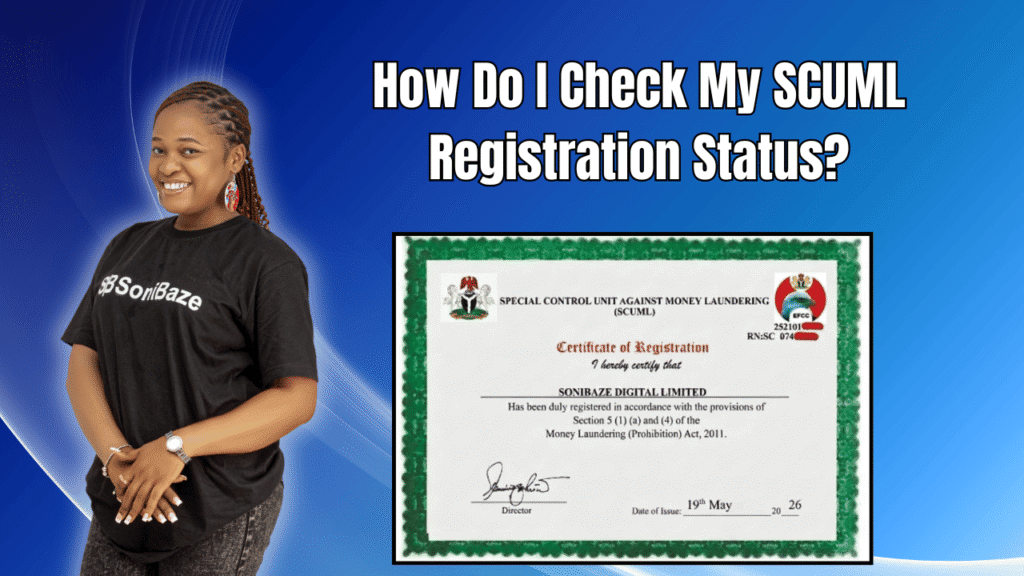
Banks in Nigeria will ask for a SCUML certificate before opening a corporate account for businesses in certain sectors. If you do not have one ready, the account opening stalls. If you never get one, your existing account can be frozen. That is not a hypothetical. It happens regularly to business owners who assumed CAC registration alone was enough.
This article covers the specific documents SCUML requires, how they differ between limited liability companies and business names, and what sector-specific additions can catch applicants off guard.
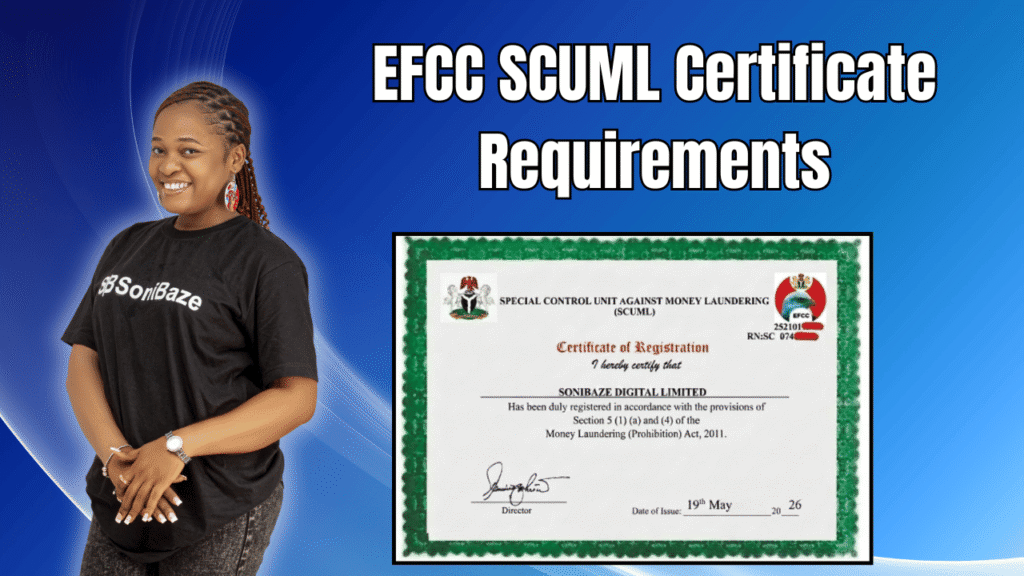
Obtain Your EFCC SCUML Certificate
Let us help you get your EFCC SCUML Certificate quickly and hassle-free. Our team provides fast, reliable support to ensure your SCUML registration is completed accurately and in compliance with regulatory requirements.
What SCUML Is Checking For
SCUML stands for the Special Control Unit Against Money Laundering. It operates under the Economic and Financial Crimes Commission and was set up to monitor businesses classified as Designated Non-Financial Businesses and Professions under Nigeria’s Money Laundering (Prevention and Prohibition) Act, 2022.
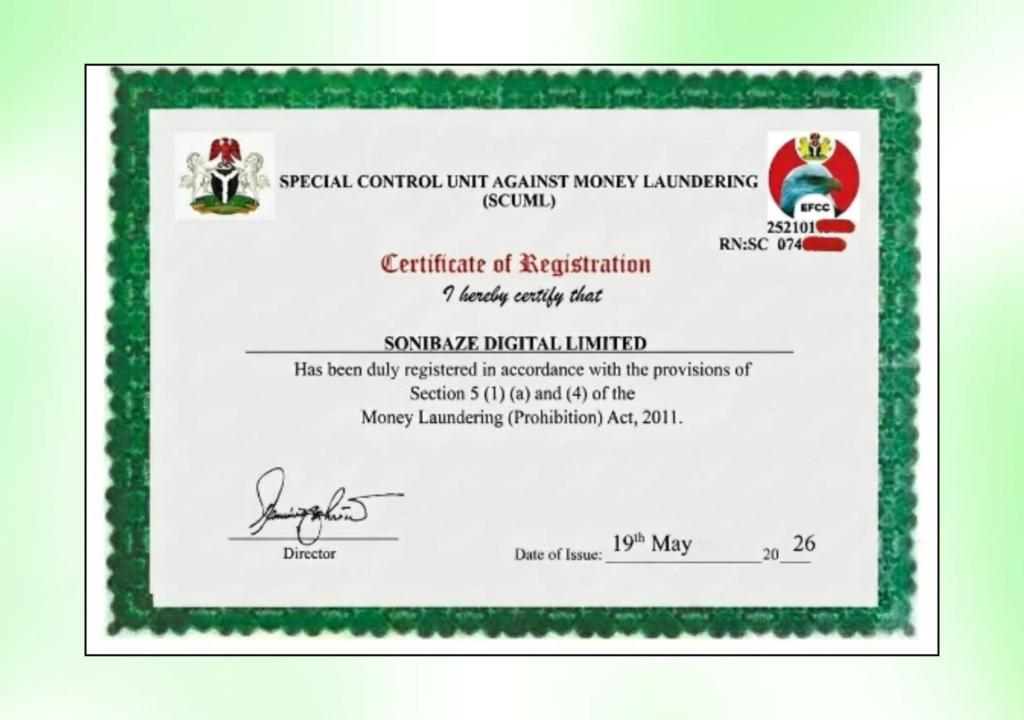
The certificate it issues is proof that your business has registered, provided full ownership and identity information, and committed to ongoing anti-money laundering compliance. When a bank asks for a SCUML certificate, what it is really doing is confirming that EFCC has already vetted your business. That is why banks treat the absence of this document as a hard stop rather than a technicality.
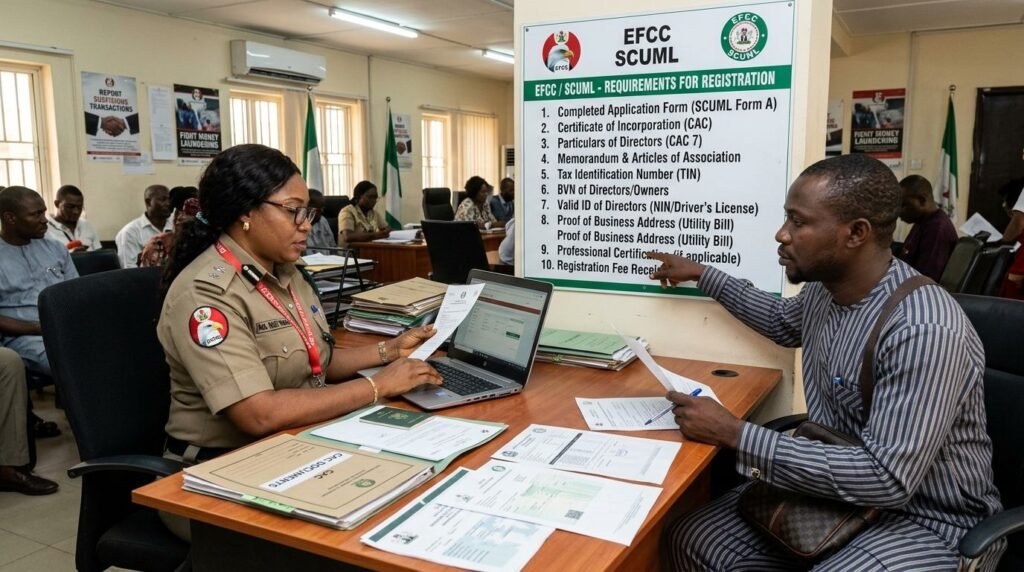
Core Documents Required for All Business Types
Whether you are registering a limited liability company, a business name, or an incorporated trustee organisation, the following documents form the base of every SCUML application.
CAC Certificate of Registration
This is your proof of legal existence, whether a Certificate of Incorporation for a limited company or a Certificate of Registration for a business name. The details on this document must match exactly what you enter on the SCUML registration form.
CAC Status Report
A current status report from the Corporate Affairs Commission is required alongside the registration certificate. This document shows your current directors, shareholders or proprietors, registered address, and share capital. SCUML uses it to verify the ownership structure of your business.
Pull a fresh status report close to your application date. An outdated one that no longer reflects your current directors or address will create mismatches that slow the process down.
Evidence of Tax Identification Number (TIN)
A TIN printout from the Federal Inland Revenue Service is a standard requirement across most Nigerian regulatory compliance processes, and SCUML is no exception. This links your business to its tax registration record.
BVN of All Proprietors, Directors, or Trustees
Every owner listed on your CAC documents needs to provide their Bank Verification Number. For business names, this means all proprietors. For limited companies, this means directors. For incorporated trustees, this means the trustees named on the registration.
Some applications ask for the BVN of at least one director rather than all of them, but the safest approach is to have the BVN available for every listed owner before submitting.
Valid ID of Proprietors, Directors, or Trustees
Alongside the BVN, each listed owner needs to provide a valid government-issued ID. Acceptable forms include a National Identification Number card, an international passport, a permanent voter’s card, or a driver’s licence. The ID must be current and match the name on the CAC records.
Personal Bank Account Details
At least one proprietor or director must provide their personal bank account details. This is part of SCUML’s beneficial ownership verification, confirming that a real, identifiable individual stands behind the business.
Registered Business Address and Sector Information
The SCUML registration form asks for your registered office address, the sector your business operates in, and your main business objectives. These details should match your CAC documents. SCUML uses the sector information to determine whether any additional professional certificates are required.
Additional Documents for Limited Liability Companies
Limited companies are required to submit their Memorandum and Articles of Association alongside the standard documents listed above. This sets out the company’s constitutional framework and stated objects.
Companies with directors who are themselves corporate entities rather than individuals may need to provide additional documentation establishing the identity of the ultimate beneficial owners behind those corporate directors.
Obtain Your EFCC SCUML Certificate
Let us help you get your EFCC SCUML Certificate quickly and hassle-free. Our team provides fast, reliable support to ensure your SCUML registration is completed accurately and in compliance with regulatory requirements.
Sector-Specific Requirements
This is where many applicants run into unexpected delays. SCUML treats different categories of Designated Non-Financial Businesses differently, and some sectors have additional professional certification requirements on top of the standard document set.
| Business Sector | Additional Requirement |
|---|---|
| Law firms | Call to Bar certificate and Legal Practising Certificate |
| Accounting and audit firms | ICAN or ANAN professional certificate |
| Dealers in precious stones and metals | Ministry of Solid Minerals permit, geologist’s certificate, NEPC or NIPC registration |
| Car dealerships | Evidence of registration with the Association of Motor Dealers of Nigeria |
| Hotels and hospitality | Hotel registration documentation |
| NGOs and non-profit organisations | Evidence of registration with the relevant regulatory body |
| Fintech companies | CBN licence or approval letter |
| Construction companies | Evidence of registration with relevant professional body |
If your business falls into one of these categories and you submit only the standard document set, SCUML will come back asking for the additional professional evidence. That adds days or weeks to the process depending on how quickly you can track down those documents.
Complete Document Checklist at a Glance
| Document | Applies To |
|---|---|
| CAC Certificate of Incorporation or Registration | All business types |
| CAC Status Report (current) | All business types |
| Memorandum and Articles of Association | Limited liability companies only |
| FIRS TIN printout | All business types |
| BVN of all proprietors, directors, or trustees | All business types |
| Valid government-issued ID of each owner | All business types |
| Personal bank account details (at least one owner) | All business types |
| Registered address and sector information | All business types |
| Professional certifications | Sector-dependent |
How the Registration Process Works
SCUML registration is free. The application is submitted through SCUML’s online portal, not in person. You complete the registration form, upload your documents, and submit for review.
Recent innovations in technology have made it possible to have your SCUML certificate delivered via email and WhatsApp, with the certificate now digitalised to reduce the stress of physical document handling. The whole process typically takes between three and five working days when all documents are complete and accurately submitted.
Upon completion, a registration number is attached to your certificate, which can be used to verify your registration online.
One thing worth knowing before you submit: SCUML may request clarification or additional documents after review. This is common when sector-specific requirements were missed in the initial submission or when details on uploaded documents do not match the registration form. Responding to these queries promptly keeps the timeline close to the standard three-to-five-day window. Delays in responding extend it significantly.
What Happens If Your Documents Have Mismatches
The most common reason SCUML queries an application is a mismatch between documents. A director’s name spelled differently on their ID versus their CAC record, an address on the status report that differs from the address on the registration form, or a TIN that does not correspond to the business name on the certificate — any of these will trigger a query.
Before uploading anything, cross-check the names, addresses, and registration numbers across every document in your package. A few minutes of checking at this stage can save several days of back-and-forth after submission.
Frequently Asked Questions
Is SCUML registration free?
Yes. There is no official government fee to register with SCUML and obtain the certificate. Some businesses choose to pay a compliance consultant or agent to handle the document preparation and submission on their behalf, but the certificate itself does not carry a registration fee.
How long does SCUML registration take?
When documents are complete and accurate, registration typically takes three to five working days. Applications that trigger queries due to missing sector-specific documents or name mismatches take longer, sometimes several weeks if the underlying issue requires obtaining a new document rather than just correcting an entry.
Can a business name register with SCUML or is it only for limited companies?
Both business names and limited liability companies can register with SCUML. The document requirements are slightly different, with business names submitting a status report rather than a memorandum and articles of association, but the process and timeline are the same.
Does every director need to provide a BVN?
The safest approach is to gather BVN details for every listed director or proprietor before submitting, since SCUML’s requirements specify beneficial ownership details for all owners. Some applications ask for at least one director’s BVN, but having all of them ready avoids a query that delays the process.
What happens if my business operates without a SCUML certificate?
Banks will reject opening a corporate account, and even if an account was previously opened, it could be frozen at any time. Beyond banking, operating as a DNFI without SCUML registration is a regulatory violation under the Money Laundering (Prevention and Prohibition) Act, 2022, and carries the risk of fines and penalties.
Can I check if my SCUML certificate is genuine?
Yes. SCUML certificates carry a registration number that can be verified through SCUML’s official online portal. This verification option is useful for banks and partners checking the authenticity of a certificate presented to them.
Conclusion: Documents First, Portal Second
The SCUML portal is not complicated to use. The challenge is almost never the submission itself. It is showing up to the portal with a complete, consistent, sector-appropriate document package that matches across every field.
Companies that take the time to reconcile their CAC documents, verify their TIN, collect BVN and ID details for all owners, and identify any sector-specific certifications needed before logging into the portal are the ones that get through in three to five days. Everyone else ends up in a query cycle that stretches the process considerably longer.
Obtain Your EFCC SCUML Certificate
Let us help you get your EFCC SCUML Certificate quickly and hassle-free. Our team provides fast, reliable support to ensure your SCUML registration is completed accurately and in compliance with regulatory requirements.