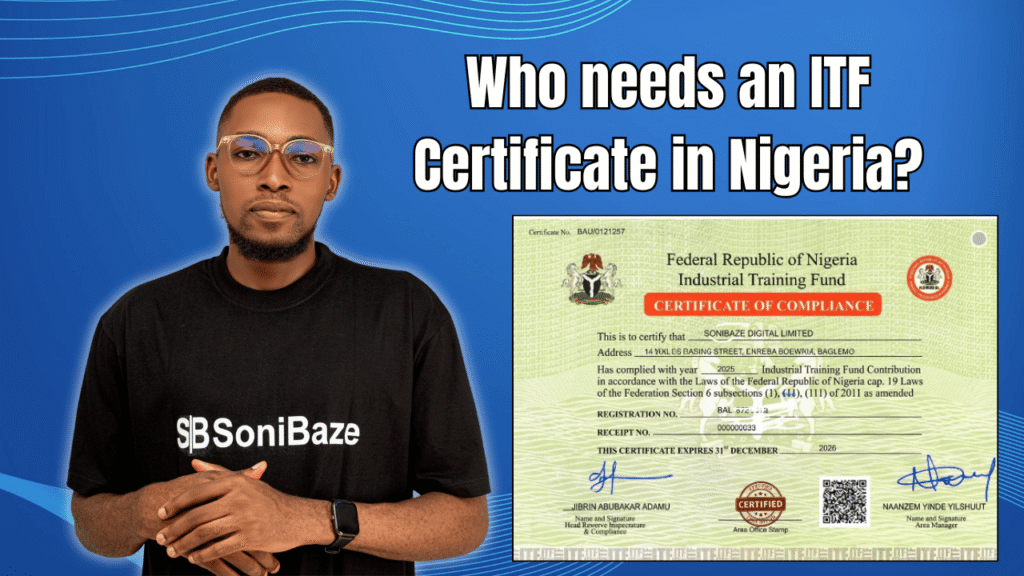
If your business has ever bid for a government contract in Nigeria, you have seen the ITF Compliance Certificate on the requirements list. Most business owners assume it only applies to manufacturing companies or large corporations. That assumption has cost many companies bids they were otherwise qualified to win.
This article explains what the ITF certificate is, exactly which businesses are legally required to have one, and why the threshold matters more than most people realise.
Obtain Your ITF Certificate
Let us help you obtain your Industrial Training Fund (ITF) Compliance Certificate quickly and hassle-free. Our experts provide reliable support throughout the application process, ensuring your business meets all statutory compliance requirements.
What Is the ITF Certificate?
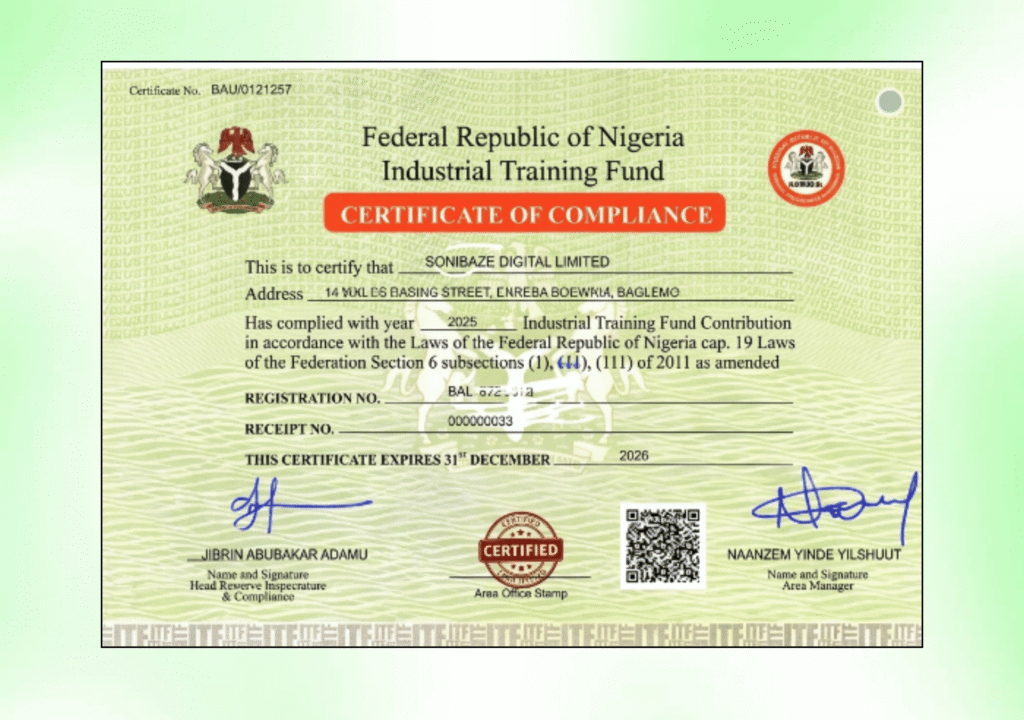
The ITF Compliance Certificate is an official document issued by the Industrial Training Fund, a federal government agency established on 8 October 1971 under Decree No. 47 of 1971. The Fund operates under the Federal Ministry of Industry, Trade and Investment and was created to promote the acquisition of skills in industry and commerce across Nigeria.
The certificate itself confirms two things: that your organisation has registered with the Industrial Training Fund, and that you have paid the mandatory annual training contribution based on your total payroll. It is proof of compliance with the ITF Act Cap I9 LFN 2004 and is one of the standard documents checked during procurement evaluations.
Registration and compliance are separate steps. Registration puts your company on the ITF database. The Compliance Certificate is issued annually to companies that have actually paid their contributions. Having one does not mean you have the other automatically.
Who Is Legally Required to Have an ITF Certificate?
The ITF Act sets out two clear triggers for mandatory compliance. Your business falls within scope if either of the following is true.
Businesses With Five or More Employees
Any employer with five or more employees on its payroll is required to register with the Industrial Training Fund and make annual contributions. This applies to both public and private sector companies operating in Nigeria. The headcount threshold is five, not fifty or five hundred. A small engineering firm with six staff, a logistics company with eight drivers, and a hospitality business with ten front desk and kitchen staff all fall within this requirement.

Businesses With Annual Turnover of N50 Million and Above
Even if your company has fewer than five employees, you are still caught by the ITF requirement if your annual turnover reaches N50 million or more. This provision was designed to capture businesses that are commercially significant but operationally lean, such as consulting firms, trading companies, or tech businesses that generate strong revenue without large headcounts.
Both thresholds operate independently. Meeting either one is enough to make ITF registration and contribution compulsory.
Who Must Have It for Government Contracts
Beyond the general statutory obligation, the ITF Compliance Certificate is specifically mandatory for any supplier, contractor, or consultant bidding for contracts and business from any federal government ministry, department, or agency. It is also required when dealing with commercial, industrial, and private companies that have adopted procurement standards similar to those of the federal government.
In practice, this means the certificate shows up as a required document in virtually every serious government tender in Nigeria, whether the contract is for construction, IT services, consulting, supplies, or facility management. Missing it means automatic disqualification, regardless of how strong the rest of the bid is.
What the Contribution Actually Involves
The financial obligation that triggers the certificate is a contribution of one percent of the company’s total annual payroll, paid to the Fund each year. Employers are expected to make this payment within the first quarter of each calendar year, covering the previous year’s payroll.
The contribution is calculated on total payroll, which includes all salaries, wages, allowances, and benefits paid to employees during the year. ITF Revenue, Inspectorate and Compliance Officers assess each company’s liability based on audited accounts submitted during the registration or renewal process.
Late payment can attract penalties and interest charges, so companies that miss the first-quarter window are not simply deferred, they are already accumulating additional liability.
Obtain Your ITF Certificate
Let us help you obtain your Industrial Training Fund (ITF) Compliance Certificate quickly and hassle-free. Our experts provide reliable support throughout the application process, ensuring your business meets all statutory compliance requirements.
Quick Reference: Does Your Business Need an ITF Certificate?
| Business Type | Needs ITF Certificate? | Reason |
|---|---|---|
| Company with 5 or more employees | Yes | Mandatory under the ITF Act |
| Company with fewer than 5 employees but N50m+ annual turnover | Yes | Turnover threshold triggers the obligation |
| Supplier bidding for government contracts | Yes | Standard procurement requirement for MDAs |
| Contractor working with federal MDAs | Yes | Mandatory compliance document for all federal tenders |
| Consultant bidding for public sector work | Yes | Required regardless of sector |
| Sole proprietorship below both thresholds | Generally not required | Falls outside the mandatory scope of the ITF Act |
The Difference Between Registration and the Compliance Certificate
A point that trips up many first-time applicants is the distinction between ITF registration and the ITF Compliance Certificate itself.
Registration is the one-time process of enrolling your company with the ITF and obtaining an ITF National Number. The Compliance Certificate is issued annually, after your company has paid its training contribution for that year. It is the certificate, not the registration acknowledgement, that procurement officers and contracting agencies ask to see.
Companies that registered years ago but have not paid their contributions consistently may find that their registration is on file but their certificate has long since expired. Getting current means paying outstanding contributions and applying for the current year’s certificate, not simply pointing to an old registration record.
Why the Certificate Matters Beyond Government Contracts
The ITF Compliance Certificate also forms part of the broader compliance package required for BPP registration. Companies seeking to join the Bureau of Public Procurement’s National Database of Federal Contractors, Consultants and Service Providers are expected to submit it alongside PENCOM and NSITF compliance certificates as part of the documentation review.
Beyond procurement, having the certificate signals to larger private sector clients and international partners that your company meets Nigerian regulatory standards. As private sector organisations strengthen their vendor onboarding processes, compliance documents that were once checked only for government bids are increasingly appearing on private sector supplier questionnaires as well.
Frequently Asked Questions
What happens if a company operates without an ITF certificate in Nigeria?
Companies that fall within the mandatory scope of the ITF Act and fail to register or pay contributions are in breach of the law. Beyond losing eligibility for government contracts, they risk penalties and interest charges on unpaid contributions. Since the certificate is checked during BPP registration and many procurement processes, non-compliance creates a compounding problem across multiple business development activities.
Does the ITF certificate expire?
Yes. The Compliance Certificate is issued for each calendar year based on that year’s contribution payment. It needs to be renewed annually. Companies that pay their contributions consistently receive a new certificate each year. Those that miss a year’s payment will have a gap in their compliance record, which can surface during procurement document reviews.
How is the 1% ITF contribution calculated?
The contribution is one percent of the company’s total annual payroll, covering all salaries, wages, allowances, and benefits paid to employees during the year. ITF officers assess the liability based on the company’s audited accounts. Companies with higher payrolls pay more, and those that have understated their payroll figures during assessment risk additional charges if discrepancies are found later.
Can a company with only three employees need an ITF certificate?
Yes, if that company’s annual turnover reaches N50 million or above. The headcount and turnover thresholds are independent of each other. A small consulting firm with three highly paid partners and strong revenue can be within mandatory scope even though it is well below the five-employee headcount threshold.
Is the ITF certificate the same as SIWES?
No. SIWES is the Student Industrial Work Experience Scheme, which ITF administers for students in tertiary institutions undergoing practical industrial training as part of their academic programmes. The ITF Compliance Certificate is a separate document issued to registered employers as evidence of their annual contribution to the Fund. They are connected by the same agency but serve entirely different purposes.
Where can I find the nearest ITF area office?
ITF has area offices across Nigeria in all geopolitical zones. Abuja, Lagos, Port Harcourt, Kano, Enugu, and Ibadan all have ITF area offices, among many others. For new registrations, Form 7A is submitted to the nearest area office. For renewals, registered employers use Form 5A, which is available online through the ITF portal.
Conclusion: Know Your Threshold Before a Bid Forces the Issue
The ITF certificate catches businesses off guard because the thresholds are lower than most people assume. Five employees is not a large workforce. N50 million in annual turnover is not an exceptional number for a business that has been operating for a few years. Many companies that consider themselves too small to worry about this requirement are already within scope.
The time to find out is not when a contract deadline is two weeks away. If your business has crossed either threshold, getting registered and contributions up to date is a straightforward process. The certificate follows once the contribution is paid.
Obtain Your ITF Certificate
Let us help you obtain your Industrial Training Fund (ITF) Compliance Certificate quickly and hassle-free. Our experts provide reliable support throughout the application process, ensuring your business meets all statutory compliance requirements.