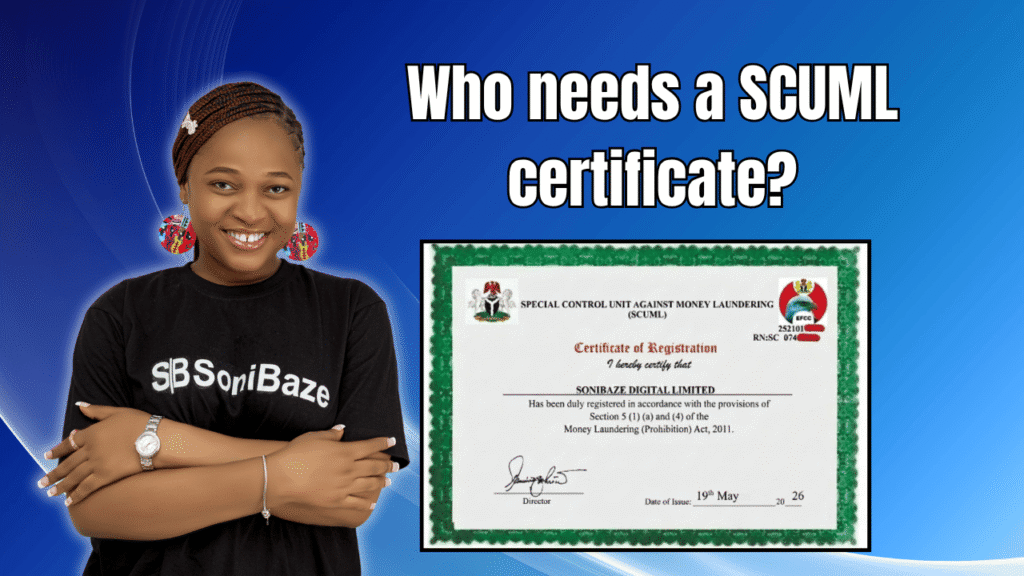
A registered business in Nigeria can do everything right, file taxes, pay staff, sign clients, and still have its bank account frozen overnight. The reason is often the same: no SCUML certificate. Many business owners only hear the term when their bank places a Post No Debit restriction on their account.
This article explains what SCUML is, which businesses are legally required to register, and what happens if a qualifying business operates without one.
Obtain Your EFCC SCUML Certificate
Let us help you get your EFCC SCUML Certificate quickly and hassle-free. Our team provides fast, reliable support to ensure your SCUML registration is completed accurately and in compliance with regulatory requirements.
What SCUML Is and Why It Exists
SCUML stands for Special Control Unit Against Money Laundering. It is a unit under the Economic and Financial Crimes Commission, established under Section 17(1) of the Money Laundering (Prevention and Prohibition) Act, 2022.
Its job is to monitor and regulate a category of businesses known as Designated Non-Financial Businesses and Professions, or DNFBPs. These are businesses that are not banks but still handle large cash flows, manage client assets, or deal in high-value goods, making them attractive channels for laundering money if left unregulated.
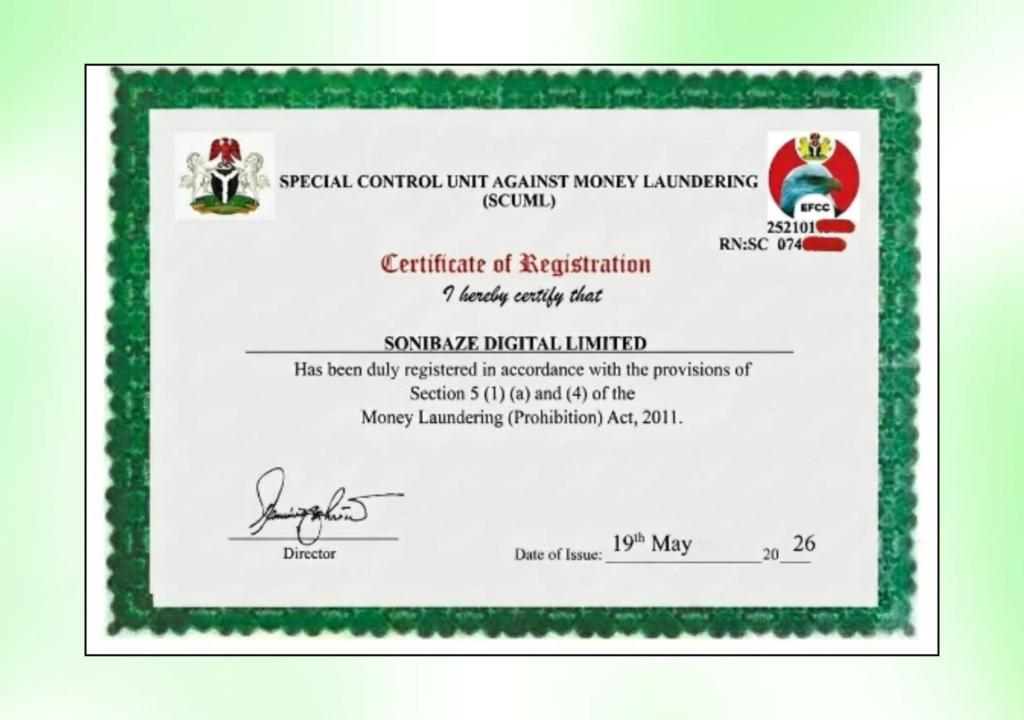
A SCUML certificate is the document that proves a business has registered with this unit and passed its compliance checks. Registration is free. The Federal Government has repeatedly stated that no individual or office should charge for the certificate itself, though businesses sometimes pay consultants for help preparing documentation.
Which Businesses Need a SCUML Certificate
The EFCC maintains a defined list of DNFBP categories. If your business falls into one of these, registration is not optional. It is a legal obligation under the Money Laundering Act, and most businesses are expected to register within three months of starting operations.
| Category | Examples |
|---|---|
| Legal and professional services | Law firms, accounting and audit firms, tax consultants |
| Property and construction | Real estate companies and agents, estate surveyors and valuers, mortgage brokers, construction companies |
| High-value goods dealers | Jewelers and dealers in precious stones and metals, dealers in luxury goods, car dealers |
| Trade and logistics | Clearing and forwarding companies, supermarkets and merchants handling large cash transactions |
| Hospitality and leisure | Hotels, casinos, pool betting and lottery businesses |
| Agriculture | Mechanized farming operations |
| Non-profits | Charities, NGOs, and other non-profit organisations |
| Consulting | General consulting companies |
This list is not exhaustive in practice. Banks and regulators sometimes require SCUML compliance from businesses outside these categories if they are perceived to handle large cash volumes, deal in high-value items, or act as intermediaries managing client funds. One notable exception is software and technology startups, which are generally not monitored by SCUML and do not need a certificate.

What Happens If a Required Business Does Not Register
The most immediate consequence falls on banking. The Central Bank of Nigeria directs banks to monitor DNFBP customers for SCUML compliance. If a business in a designated category cannot produce a valid certificate, the bank can place a Post No Debit order on its account.
A PND restriction means the account is effectively frozen for outgoing transactions. Withdrawals, transfers, and direct debits all stop working. Suppliers go unpaid. Salaries are delayed. Clients lose confidence. For a business running on tight cash flow, even a few days under PND can cause serious damage.
Beyond banking, operating without required SCUML registration is a breach of the Money Laundering Act itself. This can lead to fines, compliance audits, and in serious cases, investigation for money laundering offences, regardless of whether the business was actually involved in any wrongdoing.
How SCUML Registration Affects Business Operations
Banking Relationships
A SCUML certificate is often the deciding factor in whether a DNFBP can open or maintain a corporate bank account. Banks treat it as a standard compliance document, similar to a CAC certificate or Tax Identification Number. Without it, account opening for qualifying businesses can be refused outright.
Government and Corporate Contracts
Government agencies and large corporations increasingly require proof of AML compliance before awarding contracts, particularly for real estate, construction, and consulting engagements. A business that cannot show a SCUML certificate may be disqualified from bidding regardless of how strong its proposal is.
Reputation With Clients and Partners
A registered business signals that it operates within Nigeria’s legal compliance framework. For sectors like real estate and high-value retail, where large cash transactions are common, this matters to clients who want assurance they are dealing with a legitimate operation.
International Transactions
Businesses seeking foreign investment, cross-border partnerships, or international banking relationships face additional scrutiny. International partners increasingly check whether a Nigerian counterpart complies with Financial Action Task Force recommendations, which SCUML registration directly supports.
Obtain Your EFCC SCUML Certificate
Let us help you get your EFCC SCUML Certificate quickly and hassle-free. Our team provides fast, reliable support to ensure your SCUML registration is completed accurately and in compliance with regulatory requirements.
What Information Is Needed to Register
The registration process is entirely online through SCUML’s official portal. Before starting, businesses should have the following ready.
For the organisation: incorporation name and registration number, incorporation date, Tax Identification Number, sector and main business objective, full physical address, incorporation documents, and bank account details.
For each director or trustee: full name, physical address, phone number, email, date of birth, a valid means of identification, preferably NIN, and Bank Verification Number.
For each shareholder or partner: the same personal details as directors, plus their ownership stake in the business.
Some categories require additional documents. Professional firms such as law and accounting practices need certificates of proficiency for each director or partner. Churches need a letter of consent from the General Overseer. Trust-based NGOs need particulars of settlors, trust deed agreements, and tax exemption documents where applicable.
SCUML Registration at a Glance
| Question | Answer |
|---|---|
| Who must register | DNFBPs as defined by the EFCC, including real estate, legal, accounting, hospitality, NGOs, and high-value goods dealers |
| Cost | Free on the official SCUML portal |
| Timeframe to register | Within three months of commencing operations |
| Where to apply | scuml.efcc.gov.ng |
| Main consequence of non-compliance | Post No Debit restriction on bank accounts |
| Validity | Certificate may require periodic renewal |
| Prerequisite | Must already be registered with CAC |
Frequently Asked Questions
Is SCUML registration mandatory or optional?
For businesses falling under the DNFBP categories defined by the EFCC, SCUML registration is mandatory under the Money Laundering (Prevention and Prohibition) Act, 2022. It is not a voluntary compliance step. Businesses outside these categories are generally not required to register, though banks may occasionally request it depending on transaction patterns.
How much does it cost to get a SCUML certificate?
SCUML registration is completely free through the official portal. The Federal Government has explicitly discouraged any commercialisation of the certificate. Some businesses choose to pay consultants or accountants for help preparing and submitting documentation correctly, but this fee covers professional service, not the certificate itself.
How long does it take to get a SCUML certificate?
Processing time depends on document accuracy and the regulatory workload at the time of application. On average, it can take anywhere from a few days to several weeks. Applications with complete and correctly formatted documents tend to move faster, while incomplete submissions cause delays through rejection and resubmission.
Can a business operate without a SCUML certificate while waiting for approval?
A business can technically continue operating during the application process, but banks may still place restrictions if the SCUML requirement applies to that business category and no certificate has been issued. It is advisable to begin the registration process as early as possible, ideally as part of post-incorporation compliance steps alongside CAC and tax registration.
Do small businesses and sole proprietors need SCUML registration?
Size alone does not exempt a business from SCUML requirements. What matters is the business category and activity. A small real estate agency, a one-person accounting practice, or a small jewelry shop can all fall under DNFBP categories regardless of revenue. The determining factor is the nature of the business, not its scale.
What is the difference between CAC registration and SCUML registration?
CAC registration is the process of incorporating a business as a legal entity in Nigeria. SCUML registration is a separate, additional compliance step required for businesses in specific high-risk categories. CAC registration is a prerequisite for SCUML, meaning a business must already be incorporated before it can apply for a SCUML certificate.
Conclusion: Treat SCUML as Part of Your Compliance Foundation
For businesses in real estate, legal services, accounting, hospitality, high-value retail, and similar sectors, SCUML registration is not paperwork to deal with later. It directly affects whether a bank account stays operational, whether contracts can be won, and whether a business is seen as legitimate by partners and regulators.
The registration itself is free and the document requirements are clear once gathered. Businesses that fall under a DNFBP category should treat SCUML registration as part of their initial compliance setup, alongside CAC incorporation and tax registration, rather than something to address after a problem arises.
Obtain Your EFCC SCUML Certificate
Let us help you get your EFCC SCUML Certificate quickly and hassle-free. Our team provides fast, reliable support to ensure your SCUML registration is completed accurately and in compliance with regulatory requirements.