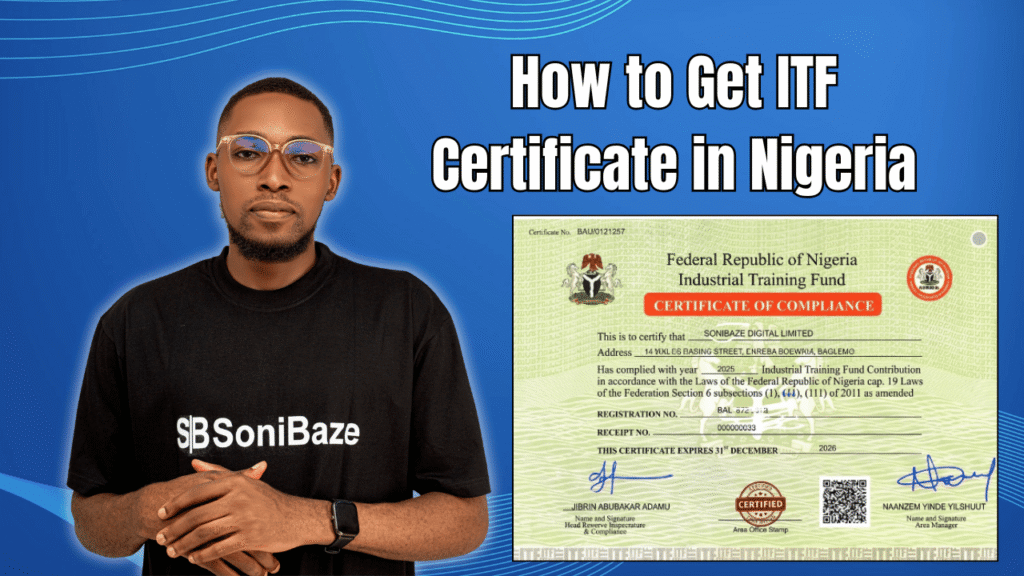
Most businesses in Nigeria only start thinking about the ITF certificate when a government contract bid requires it. By that point, there is usually a deadline involved and no room to figure things out slowly. This guide walks through the full 2026 application process so you know exactly what to prepare, where to go, and what to expect.
Obtain Your ITF Certificate
Let us help you obtain your Industrial Training Fund (ITF) Compliance Certificate quickly and hassle-free. Our experts provide reliable support throughout the application process, ensuring your business meets all statutory compliance requirements.
What Is the ITF Certificate?
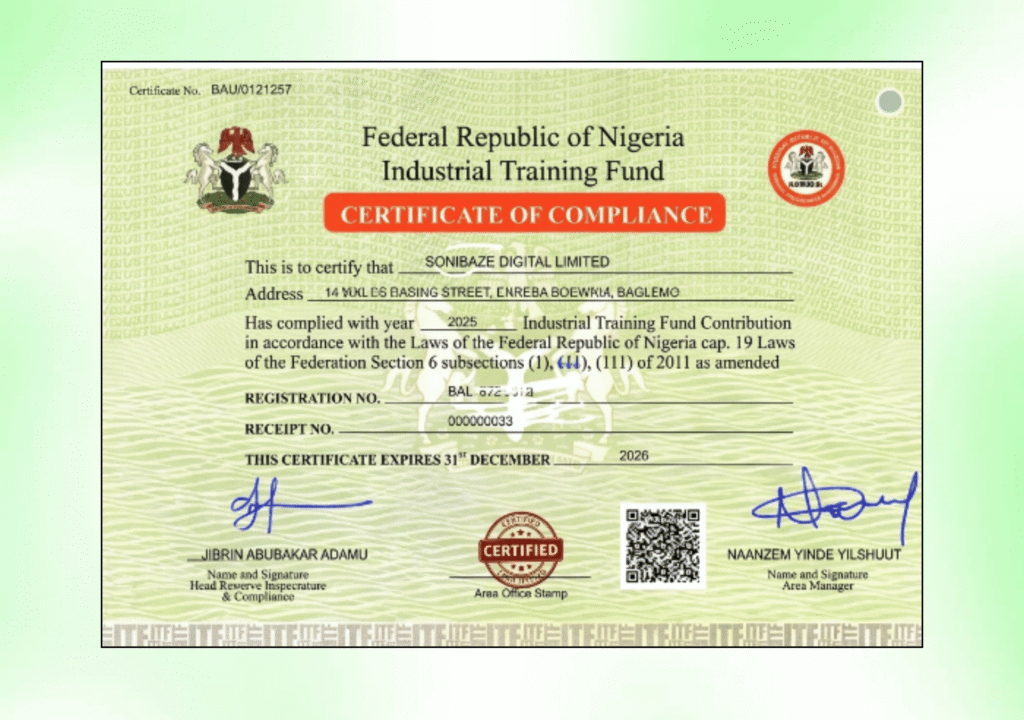
The ITF Certificate, formally called the ITF Training Compliance Certificate, is issued by the Industrial Training Fund to employers who have paid their annual training contribution levy and filed the required returns. It is issued as proof of compliance with the Industrial Training Fund Act (Cap I8, Laws of the Federation of Nigeria 2004).
Any supplier, contractor, or consultant bidding for contracts from Federal Government Ministries, Departments, and Agencies must hold a valid ITF Compliance Certificate. Banks and large private-sector clients are also increasingly requesting it as part of vendor qualification.
The certificate is typically valid for one year from the date of issue.
Who Is Required to Get the ITF Certificate?
The ITF Act obligates every employer having either five or more employees in its establishment, or having less than five employees but with a turnover of ₦50 million and above per annum, to contribute one percent of its total annual payroll to the ITF.
This applies to both public and private sector companies. Companies with less than five personnel, or less than fifty million naira annual turnover, are not required to pay ITF Fund contributions and do not require an ITF Compliance Certificate.
If you are unsure whether your business crosses either threshold, check your current staff headcount and most recent annual turnover before starting the application.

What the ITF Certificate Costs in 2026
Employers are required to remit one percent of the total annual payroll of their employees to ITF. The actual figure depends on your payroll size and will be assessed by ITF officers at your area office.
| Cost Type | Amount |
|---|---|
| Annual training contribution (qualifying employers) | 1% of total annual payroll |
| New startups with fewer than 5 employees | Fixed fee of ₦110,000 |
| Penalty for late filing | 5% of unpaid amount per month of default |
| Professional consultant fees (optional) | ₦50,000 to ₦150,000 |
The certificate itself is free. You pay the levy, not the certificate. If anyone asks for a separate payment specifically for the certificate, that is not a legitimate charge.
Documents Required
Two processes exist depending on whether your company is registering for the first time or renewing an existing registration.
New Employers — First-Time Registration
| Document | Notes |
|---|---|
| Completed ITF Form 7A | Employer Registration and Training Contribution Form |
| CAC Certificate of Incorporation | Copy accepted |
| Certified true copies of Audited Accounts | Used to assess your payroll liability |
| Tax Clearance Certificate | Current year |
| Company Profile | Including nature of business and key personnel |
Already Registered Employers — Annual Renewal
| Document | Notes |
|---|---|
| Completed ITF Form 5A | Annual return form for registered employers |
| 10-digit ITF Registration Number | Issued at initial registration |
| Completed Payroll Form RE 03 | Details employee numbers and payroll |
| Proof of previous compliance certificate | Where applicable |
Step-by-Step Application Process for New Employers
Step 1: Download and Complete ITF Form 7A
A prospective employer is expected to complete ITF Form 7A. This form captures your business details, employee count, payroll figures, and beneficial owner information. Download it from the ITF website at itf.gov.ng or collect a copy from the nearest ITF area office.
Fill it accurately. Errors in payroll figures or company details are the most common cause of delays at the assessment stage.
Step 2: Submit to the Nearest ITF Area Office
The completed Form 7A is to be submitted to the nearest ITF Area Office along with a copy of the company’s Certificate of Incorporation, certified true copies of the company’s Audited Account, and a copy of the company’s Tax Clearance.
ITF has area offices across Nigeria’s geopolitical zones. Submit in person, as assessment requires a face-to-face review of your documents by ITF compliance officers.
Step 3: Liability Assessment by ITF Officers
At the ITF area office, Revenue Inspectorate and Compliance Officers will evaluate and assess the liability of the company based on the total annual payroll contained in the Company’s Audited Account.
This assessment determines the exact levy your company owes. It is not a flat rate — it is calculated against your actual payroll.
Step 4: Generate RRR and Make Payment
The client will then generate an RRR through the ITF Pay-portal or Remita platform. After generating the RRR, the client will take same to the Bank for payment of Training Contribution.
You can also pay directly via the Remita platform at remita.net if you prefer not to go to a physical bank. Keep the payment receipt and bank teller. You will need both.
Step 5: Return Payment Evidence to ITF Office
After payment, the client will bring the printout of payment and duplicate teller from the Bank to the ITF Office. Hard copy of receipt and acknowledgement letter will be issued to the client.
Do not lose this acknowledgement letter. It is your confirmation that payment has been received and will be needed to track the certificate issuance.
Step 6: ITF Headquarters Issues the National Number
The ITF Area Office will then forward the employer’s details as contained in the ITF Form 7A to Headquarters’ Revenue, Inspectorate and Compliance Department for issuance of an ITF National Number.
This is your unique identifier in the ITF system. New employers only receive this once.
Step 7: Certificate Issuance
The ITF National Number will then be sent to the Area Office for scripting and issuance of a Certificate of Compliance which serves as evidence of compliance with the ITF Act.
Collect the certificate from the area office where you submitted your documents.
Obtain Your ITF Certificate
Let us help you obtain your Industrial Training Fund (ITF) Compliance Certificate quickly and hassle-free. Our experts provide reliable support throughout the application process, ensuring your business meets all statutory compliance requirements.
Step-by-Step for Already Registered Employers (Annual Renewal)
Renewal is simpler since your ITF National Number already exists in the system.
| Step | Action |
|---|---|
| 1 | Complete ITF Form 5A |
| 2 | Submit Form 5A and Payroll Form RE 03 to your registered ITF Area Office |
| 3 | Officers assess your current year liability |
| 4 | Generate RRR via ITF Pay-Portal or Remita and make payment |
| 5 | Return payment receipt and bank teller to the ITF office |
| 6 | Collect updated compliance certificate |
After your levy payment is confirmed in the portal, navigate to the compliance certificate application section. Some area offices now allow renewal steps to begin online before the physical visit for document submission.
How Long Does It Take?
Registration with ITF takes an average of 10 working days. Some sources put this between 5 and 15 working days depending on how busy the area office is and how quickly your documents pass the review stage.
| Scenario | Estimated Timeline |
|---|---|
| All documents correct, low office volume | 5 to 7 working days |
| Standard processing | 10 working days |
| Document queries or corrections needed | 15 to 20 working days |
| High office volume period | Up to 4 weeks |
Build your timeline around the 10-working-day estimate and submit well ahead of any contract bid deadline.
What Happens If You Do Not Comply?
Failure to comply with filing deadlines incurs penalties of 5% of the unpaid amount for each month of default. Beyond financial penalties, operating without the certificate locks you out of any government contract bid. Employers who fail to comply with the ITF’s regulations on contributions may face legal actions, including fines or imprisonment.
ITF Certificate and Government Procurement
For federal government procurement bids, you will typically need to present all of the following simultaneously: FIRS Tax Clearance Certificate, PENCOM e-PCC, NSITF Compliance Certificate and the ITF Training Compliance Certificate.
Missing any one of these disqualifies the entire bid. If you are building toward government contracts in 2026, treat all four as a package and renew them on the same schedule.
Frequently Asked Questions
Where can I find the nearest ITF area office?
ITF has area offices across Nigeria’s six geopolitical zones and in most state capitals. The full list of area offices is published on the ITF website at itf.gov.ng. For businesses in Abuja, the FCT Area Office handles all FCT-based employer registrations.
Can I apply for the ITF certificate online?
The ITF now has an e-certificate portal at ecert.itf.gov.ng for digital certificate verification and some online services. However, the initial registration and physical document submission for new employers still requires a visit to an ITF area office. Renewal processes have more online options available.
What is the difference between ITF Form 7A and Form 5A?
Form 7A is for new employers registering with ITF for the first time. Form 5A is for employers who are already registered and filing their annual returns to renew their compliance certificate. If your business already has an ITF National Number, you use Form 5A.
Does the ITF certificate expire?
Yes. The ITF Training Compliance Certificate is valid for one year. It must be renewed annually by filing updated payroll returns and paying the current year’s levy. Letting the certificate lapse creates compliance gaps that affect your ability to bid for contracts.
Can a company with fewer than five employees get the certificate voluntarily?
Yes. While companies below the five-employee or ₦50 million turnover threshold are not legally required to register, they can do so voluntarily. This can be useful for businesses that anticipate growth or that have clients who request the certificate as part of vendor qualification.
What if my company’s audited accounts are not up to date?
ITF officers use audited accounts to assess your payroll liability. If your accounts are not current, this will delay or block the assessment stage. Sort out your annual audit before beginning the ITF application if there is a gap in your financial records.
Conclusion: Start the Process Early
The ITF certificate process in Nigeria is not particularly complicated once you understand the steps. The two biggest failure points are incomplete documents at submission and leaving it too late before a contract deadline. Both are avoidable.
For businesses that intend to bid for federal government contracts in 2026, the ITF certificate needs to be on your compliance calendar alongside your tax clearance, PENCOM, and NSITF certificates. Treating them separately and renewing them at different times creates gaps. Renew all four together, and you stay contract-ready throughout the year.
Obtain Your ITF Certificate
Let us help you obtain your Industrial Training Fund (ITF) Compliance Certificate quickly and hassle-free. Our experts provide reliable support throughout the application process, ensuring your business meets all statutory compliance requirements.