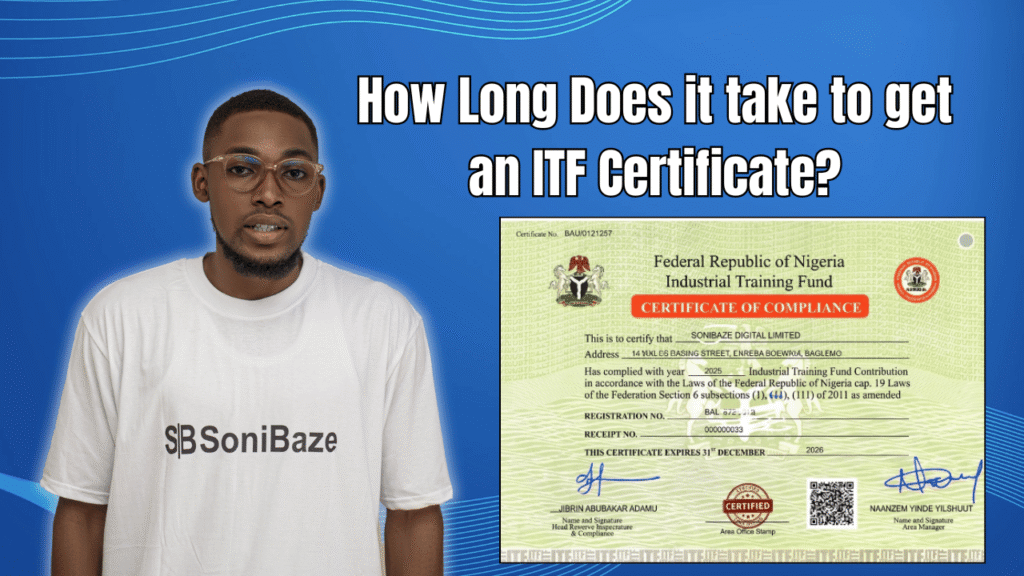
The ITF compliance certificate comes up on almost every government tender checklist in Nigeria. Companies that have never processed one before often underestimate how long the whole thing takes, not because the process itself is particularly difficult, but because it involves multiple steps across different offices before the certificate is finally issued.
This article gives you a realistic timeline, explains what causes delays, and walks through each stage so you know exactly where you are in the process at any point.
Obtain Your ITF Certificate
Let us help you obtain your Industrial Training Fund (ITF) Compliance Certificate quickly and hassle-free. Our experts provide reliable support throughout the application process, ensuring your business meets all statutory compliance requirements.
What Is the ITF Compliance Certificate?
The Industrial Training Fund was established in 1971 under the Industrial Training Fund Act. It operates as a federal parastatal under the Ministry of Industry, Trade and Investment, and its primary role is to promote skills acquisition and industrial training across Nigeria.
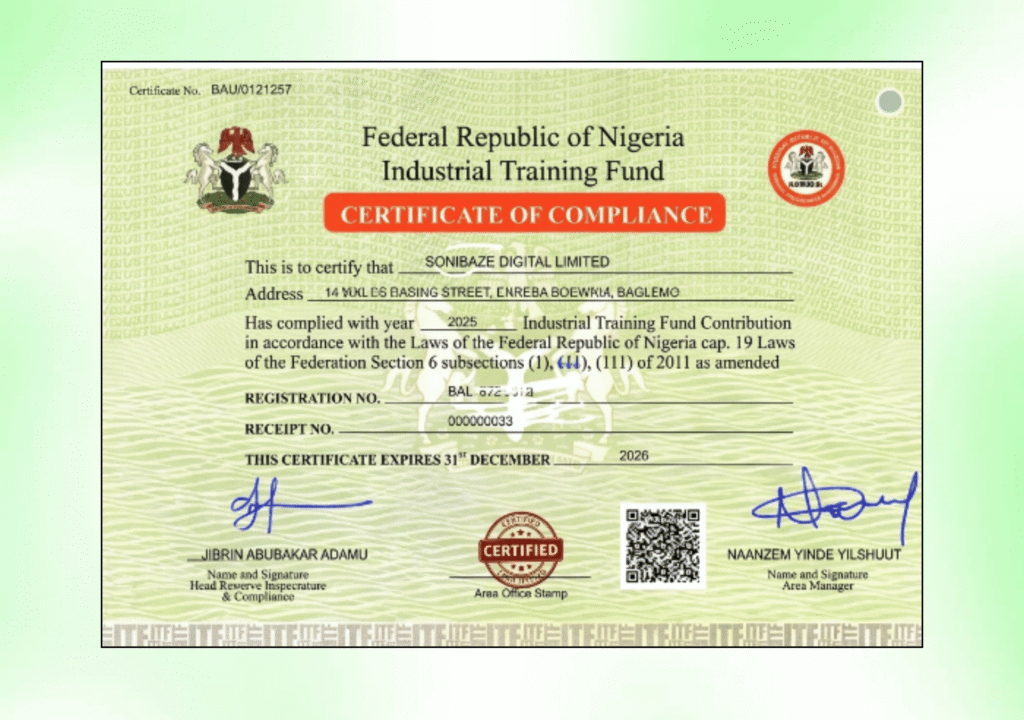
The ITF Compliance Certificate is the document that proves a company has fulfilled its financial obligation to the Fund. It is one of the mandatory compliance documents required by federal government ministries, departments, and agencies before awarding contracts. Without it, a bid can be disqualified at the point of document review, before your technical or financial proposal is ever evaluated.
Who Is Required to Get One?
Not every business in Nigeria is required to contribute to the ITF, and by extension, not every business needs the certificate.
The obligation applies to every employer with five or more employees, and also to employers with fewer than five employees but with an annual turnover of N50 million or above. If your company falls into either of these categories, contributing 1% of your total annual payroll to the ITF is a legal requirement, and the compliance certificate is evidence that you have done so.
Companies with fewer than five employees and a turnover below N50 million are not required to pay ITF contributions and do not need the certificate. However, if your company plans to bid for government contracts and is close to either threshold, it is worth checking your current staff numbers and financials before assuming you are exempt.

How Long Does It Actually Take?
The straightforward answer is around 10 working days for a new employer registration, assuming all documents are in order and the process moves without hold-ups.
That figure comes from the standard processing timeline cited by legal and compliance practitioners familiar with the ITF system. In practice, companies with incomplete documents, liability assessment queries, or payment discrepancies can take considerably longer, sometimes four to six weeks.
The 10-day figure assumes the following: you have submitted a correctly completed Form 7A with all required documents, your liability assessment goes through without queries, payment is made promptly, and your area office forwards your details to ITF headquarters without delays.
Each of those stages is an opportunity for the timeline to stretch.
The ITF Certificate Process, Stage by Stage
Stage 1: Download and Complete ITF Form 7A
Form 7A is the Employer Registration and Payment of Training Contribution form. It is available on the ITF website and must be completed with accurate details about your company, including your staff numbers and payroll figures.
Getting this form right from the start matters. Errors or missing information on the form lead to rejection at the area office, which pushes the entire process back to square one.
Stage 2: Submit Documents to Your Nearest ITF Area Office
The completed Form 7A is submitted in person to the nearest ITF area office, along with three documents: a copy of your CAC Certificate of Incorporation, certified true copies of your company’s audited accounts, and your tax clearance certificate or TIN slip if a tax clearance is not yet available.
The area office receives your submission and flags it for assessment.
Stage 3: Liability Assessment by ITF Officers
ITF Revenue, Inspectorate, and Compliance Officers assess your company’s liability based on the total annual payroll figures in your audited accounts. This assessment determines exactly how much your company owes to the Fund for the year.
If your audited accounts are not current, or if the figures provided are inconsistent with other information on file, the assessment can be delayed while clarifications are sought. This is one of the more common reasons the process takes longer than expected.
Obtain Your ITF Certificate
Let us help you obtain your Industrial Training Fund (ITF) Compliance Certificate quickly and hassle-free. Our experts provide reliable support throughout the application process, ensuring your business meets all statutory compliance requirements.
Stage 4: Generate RRR and Make Payment
Once your liability is assessed, a Remita Retrieval Reference number is generated through the ITF Pay-portal or the Remita platform. You take this RRR to any bank and make the training contribution payment.
After payment, you return to the ITF area office with a printout of the Remita payment and a duplicate teller from the bank. The office issues you a hard copy receipt and an acknowledgement letter at this point.
Stage 5: Forwarding to ITF Headquarters
The area office forwards your details to the Revenue, Inspectorate and Compliance Department at ITF headquarters in Jos for the issuance of your ITF National Number.
This is the stage most applicants cannot see from their end, and it is also where the process can slow down without any visible indication. The turnaround from area office submission to headquarters processing is not published as a guaranteed service level. In practice, it varies depending on the volume of applications being processed at any given time.
Stage 6: Issuance of Certificate
Once ITF headquarters has issued your National Number, it is sent back to the area office for scripting and issuance of your Certificate of Compliance. The certificate is then handed to you or your representative at the area office.
Timeline Summary
| Stage | Activity | Estimated Time |
|---|---|---|
| 1 | Complete and submit Form 7A with documents | Same day |
| 2 | Liability assessment by ITF officers | 1 to 3 working days |
| 3 | RRR generation and payment | 1 working day |
| 4 | Receipt and acknowledgement from area office | Same day as payment submission |
| 5 | Area office forwards details to headquarters | 1 to 3 working days |
| 6 | Headquarters issues National Number and certificate | 3 to 5 working days |
| Total | Full process from submission to certificate | Average of 10 working days |
What Causes Delays?
Outdated or Uncertified Audited Accounts
ITF requires certified true copies of your audited accounts, not photocopies and not unsigned drafts. Companies that submit accounts that are not current or not properly certified by an auditor trigger a review process that can add days or weeks.
Mismatch Between Submitted Documents and ITF Records
If your company has registered with ITF previously and your current submission contains different information, officers will need to reconcile the discrepancy before proceeding. This is common for companies that have changed directors, addresses, or company names without updating their ITF records.
Delays at the Area Office to Headquarters Stage
The step that businesses have the least visibility over is the forwarding of details from the area office to ITF headquarters. This stage has no fixed published timeline, and during periods of high application volume or administrative backlogs, it can stretch beyond the standard 10-day estimate.
Following up directly with the area office at the halfway point of your expected processing window is a practical way to check whether your file has been forwarded.
Penalties for Late Annual Contributions
If your company is not a new registrant but is renewing its certificate after a gap or late payment, there may be a penalty attached. The ITF Act specifies a 5% monthly penalty on any unpaid contribution from the first of April in each calendar year. Resolving outstanding penalties adds to the overall processing time before a fresh certificate can be issued.
Cost of the ITF Compliance Certificate
Two costs are involved in obtaining the certificate.
The first is a one-time payment of N100,000 for the Compliance Certificate itself. The second is the annual training contribution of 1% of your total annual payroll, calculated based on your audited accounts.
Both must be paid before the certificate is issued. Consultant or professional fees are separate and depend on whether you engage an agent to handle the process on your behalf.
Frequently Asked Questions
Can I get the ITF certificate faster than 10 working days?
The 10-day average is the standard timeline when everything goes smoothly. There is no expedited processing option that businesses can pay for to speed up the headquarters stage. Starting the process well before a contract deadline is the most reliable way to avoid running short on time.
Is the ITF certificate issued once or renewed annually?
The contribution to the ITF is an annual obligation, due by the 1st of April each year. The compliance certificate is issued upon payment for the relevant year and needs to be renewed each year. Companies that do not pay annually will not receive a fresh certificate and cannot show compliance to procurement officers.
What happens if my company misses the April 1st payment deadline?
A 5% monthly penalty applies to any unpaid contribution from the 1st of April of the relevant year. This means that by the time a company processes the certificate later in the year, it will owe the contribution amount plus accumulated penalties, which must all be settled before the certificate is issued.
Does a company with a branch in multiple states need to register at each area office?
Your company registers at the ITF area office that covers your primary place of business. For companies with multiple locations, the registration is typically centralised under the head office location rather than registered separately at each branch.
Can a consultant handle the entire ITF process on my company’s behalf?
Yes. Many companies use consultants or compliance agents to manage ITF registration, particularly when staff payroll figures need to be calculated carefully or when there are previous records that need updating. The certificate is still issued in your company’s name regardless of who manages the application.
Is the ITF compliance certificate the same as the NSITF compliance certificate?
No. These are two separate certificates from two separate agencies. The ITF certificate relates to the Industrial Training Fund contribution, which is calculated at 1% of annual payroll. The NSITF certificate relates to the Nigeria Social Insurance Trust Fund, which covers employee compensation insurance. Both are required for government contracts, but they are processed independently.
Conclusion: Ten Working Days Is the Target, Not the Guarantee
Ten working days is a realistic target for ITF certificate processing when documents are complete, accounts are current, and the area office to headquarters pipeline is moving without backlogs. Companies that go into the process with missing documents or unresolved liability issues should plan for at least three to four weeks.
For businesses that rely on compliance certificates for government contract bids, the safest approach is to treat ITF renewal as a recurring administrative task with a fixed annual deadline, rather than something to initiate when a tender deadline appears.
Obtain Your ITF Certificate
Let us help you obtain your Industrial Training Fund (ITF) Compliance Certificate quickly and hassle-free. Our experts provide reliable support throughout the application process, ensuring your business meets all statutory compliance requirements.