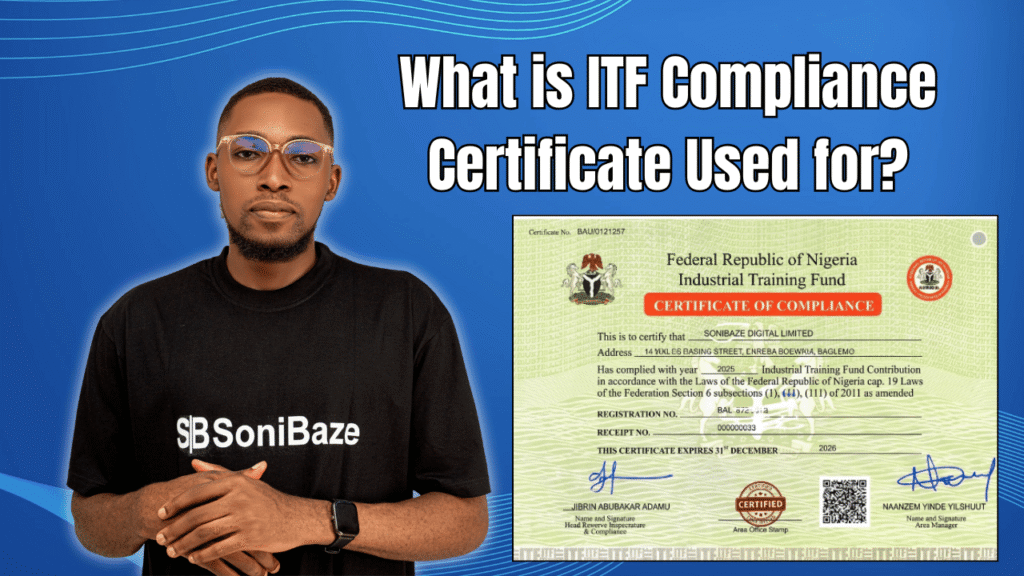
Many Nigerian business owners hear about the ITF compliance certificate for the first time when they try to bid for a government contract and discover it is missing from their documents. Some assume it is just a formality. It is not. Without it, the bid goes nowhere.
This article explains what the ITF compliance certificate is, what it is used for, who needs it, and what happens if a company ignores the obligation.
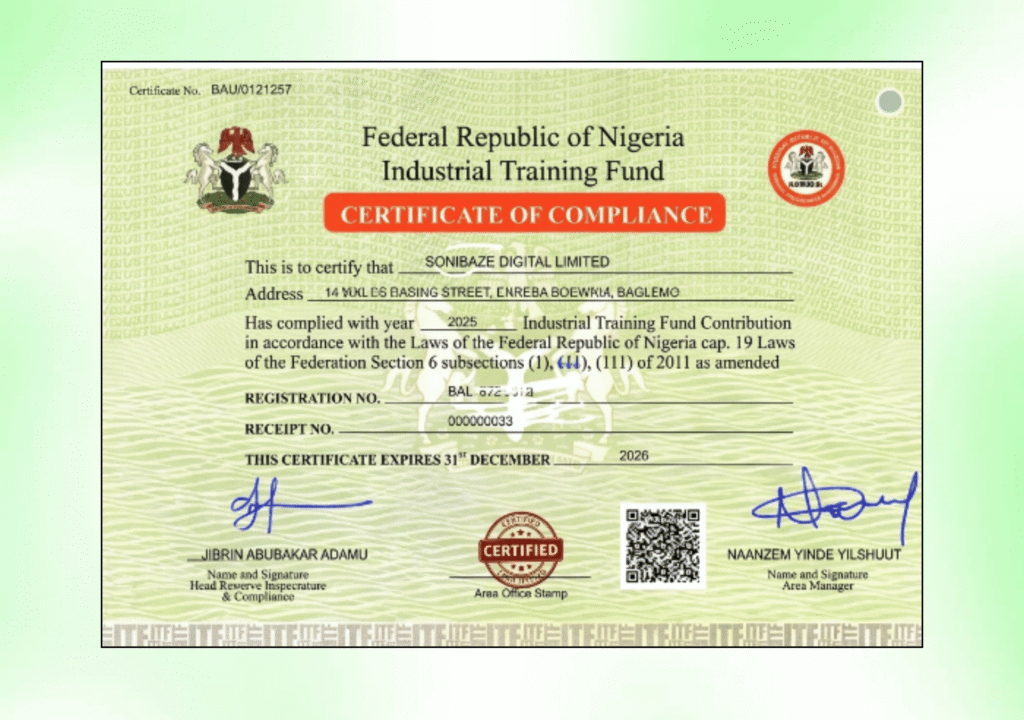
Obtain Your ITF Certificate
Let us help you obtain your Industrial Training Fund (ITF) Compliance Certificate quickly and hassle-free. Our experts provide reliable support throughout the application process, ensuring your business meets all statutory compliance requirements.
What Is ITF?
ITF stands for the Industrial Training Fund, a Federal Government parastatal established in 1971 under the Industrial Training Fund Act (Cap I8, Laws of the Federation of Nigeria 2004, as amended by the ITF Amendment Act 2011). It operates under the Federal Ministry of Industry, Trade and Investment.
The fund was created to promote and encourage the acquisition of skills in industry and commerce across Nigeria. Its mandate is to generate a pool of trained manpower sufficient to meet the needs of both the public and private sectors of the economy. ITF organises training programmes, vocational courses, industrial attachment placements, and skills development initiatives including the Students Industrial Work Experience Scheme, better known as SIWES.
Every qualifying employer contributes 1% of their total annual payroll to the fund. The ITF compliance certificate is what a company receives to confirm it has met that obligation.
What Is the ITF Compliance Certificate Used for?
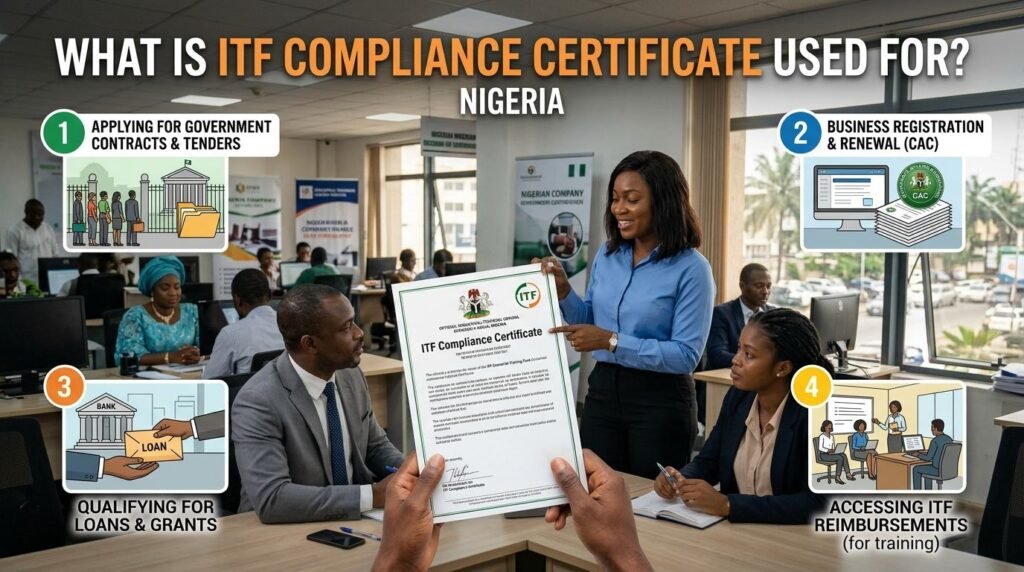
The certificate serves several important purposes, and the list has grown as government agencies and private sector organisations increasingly treat it as a standard vendor requirement.
Mandatory for Federal Government Contracts and Tenders
This is the primary use. Any supplier, contractor, or consultant bidding for contracts, businesses, goods, or services from any Federal Government Ministry, Department, or Agency is required to hold a valid ITF compliance certificate. This requirement flows directly from the ITF Act and is enforced by procuring entities across the country.
A tender submitted without a valid ITF certificate for the bidding year is considered incomplete. It does not matter how strong the rest of the bid is. The certificate must be current and valid through 31 December of the year in which the bid is submitted.
Required for BPP Registration
The Bureau of Public Procurement’s National Database of Federal Contractors, Consultants and Service Providers requires the ITF compliance certificate as one of the documents submitted during company registration. Without it, eligible companies cannot complete their BPP registration and therefore cannot access Federal procurement opportunities.
Required for Export and Import Customs Clearance
Companies utilising customs services for export and import activities must show proof of compliance with the ITF Act in respect of payment of training contributions for their employees. This means businesses involved in international trade need the certificate not just for government tenders but for customs processes as well.
Increasingly Required by Private Sector Clients
What started as a government procurement requirement has gradually extended into the private sector. Large private companies, multinationals, and commercial entities now request the ITF compliance certificate as part of their vendor prequalification processes. It signals that a company is a legitimate, compliant employer rather than one cutting corners on statutory obligations.
Required for Expatriate Quota Approval
Any organisation, public or private, including companies in the Free Trade Zones, requiring approval for an expatriate quota must show proof of compliance with the ITF Act. This covers the payment of training contributions for their employees.
Summary of Uses
| Use Case | Who Requires It |
|---|---|
| Federal Government tenders and contracts | All Federal MDAs |
| BPP National Database registration | Bureau of Public Procurement |
| Customs services for export and import | Nigeria Customs Service |
| Expatriate quota applications | Federal Ministry of Interior |
| Private sector vendor prequalification | Large corporates and multinationals |
| State government procurement | Select state MDAs |
Obtain Your ITF Certificate
Let us help you obtain your Industrial Training Fund (ITF) Compliance Certificate quickly and hassle-free. Our experts provide reliable support throughout the application process, ensuring your business meets all statutory compliance requirements.
Who Is Obligated to Contribute to ITF?
Not every business is required to contribute. The obligation applies to:
| Employer Category | Obligation |
|---|---|
| Companies with 5 or more employees | Must contribute 1% of total annual payroll |
| Companies with fewer than 5 employees but with annual turnover of N50 million or above | Must contribute 1% of total annual payroll |
| Companies registered in Free Trade Zones | Exempt from ITF contributions |
| Companies with fewer than 5 employees and turnover below N50 million | Generally exempt, but may still obtain a certificate through concession for business purposes |
The contribution rate is 1% of the total annual payroll, which the ITF Act defines as the sum total of all basic pay, allowances, and other entitlements payable within and outside Nigeria to any employee in the establishment.
The payment deadline is 1 April of each year, covering contributions for the preceding calendar year.
What Happens if a Company Does Not Comply?
The penalties are real and escalate with continued non-compliance.
If a contribution is not paid before 1 April in the relevant year, the company owes the outstanding contribution plus a 5% penalty for each month or part of a month that the payment remains unpaid after the due date.
Beyond late payment penalties, companies that fail to provide adequate training for their indigenous staff or refuse to accept students for industrial attachment face fines of N500,000 for a first breach and N1,000,000 for each subsequent breach. For principal officers of such companies, the penalty includes a fine of N50,000 or two years imprisonment for a first breach, and imprisonment without the option of a fine for subsequent breaches.
Providing false information in ITF returns is a separate offence carrying a fine of N500,000 for a first offence and N1,000,000 for subsequent offences.
How to Obtain the ITF Compliance Certificate
The process differs slightly depending on whether the company is registering for the first time or renewing an existing registration.
For new employers with five or more employees, the process starts by downloading and completing ITF Form 7A from the ITF website or area office. This form is submitted to the nearest ITF Area Office along with a copy of the CAC Certificate of Incorporation, certified true copies of the company’s audited accounts, and a copy of the Tax Clearance Certificate.
At the area office, ITF Revenue, Inspectorate, and Compliance Officers assess the company’s liability based on the total annual payroll contained in the audited accounts. Once the assessment is done, the company generates a Remita Retrieval Reference number through the ITF Pay-Portal or the Remita platform and makes payment at any bank. The payment receipt is then submitted to the area office, and the compliance certificate is issued.
For already-registered employers renewing annually, the process uses ITF Form 5A instead of Form 7A, submitted to the same area office where the company is registered.
Registration with ITF takes an average of 10 working days from submission of a complete application.
How Long Is the Certificate Valid?
The ITF compliance certificate is valid for one year from the date of issue and covers through 31 December of the year it is obtained. Companies must renew annually to remain compliant. For government tenders, the certificate must be current in the year the bid is submitted, so a certificate issued in the previous year does not satisfy the requirement.
Frequently Asked Questions
Is the ITF certificate free to obtain?
The registration itself does not carry an administrative fee, but the company must pay its assessed training contribution to receive the certificate. The contribution is 1% of total annual payroll. Some consultants charge professional fees for assisting with the registration and payment process, but these are separate from the statutory contribution.
Can a small business with fewer than five employees get an ITF certificate?
Yes, through concession. While companies below the threshold are not technically obligated to contribute, ITF grants concessions to small companies that need the certificate for business purposes such as tendering. The requirements for these companies differ from those of obligated employers, and the nearest ITF Area Office should be consulted for the specific process.
What is the difference between ITF registration and ITF compliance?
ITF registration is the initial process of enrolling the company with the fund and receiving an ITF National Number. ITF compliance is the ongoing annual obligation to pay training contributions and file returns, which results in the issuance of the compliance certificate. A company can be registered without being compliant if it has not paid its contributions for the current year.
Can a company with unpaid arrears still get a certificate?
Not until the arrears are cleared. A company with outstanding contributions from previous years must regularise by contacting their ITF Area Office, requesting a formal arrears assessment, and paying all outstanding amounts along with any applicable penalties before the current year’s certificate can be issued.
Does the ITF certificate apply to NGOs?
NGOs and non-profits that employ five or more staff are generally subject to the same ITF obligations as private companies. The fund’s mandate covers all employers in industry and commerce, and the ITF Act does not provide a blanket exemption for non-profit organisations.
Where are ITF Area Offices located?
ITF has area offices across Nigeria in major cities including Abuja, Lagos, Kano, Port Harcourt, Enugu, Ibadan, and others. Companies are expected to deal with the area office in the jurisdiction where they are registered with the CAC.
Conclusion: More Than a Procurement Checkbox
The ITF compliance certificate started as a requirement for government contracts. It has since extended into customs clearance, expatriate quota applications, and private sector vendor qualification. For any company that does business with the Federal Government or plans to, it is not optional.
The certificate is renewable annually, the contribution rate is fixed at 1% of payroll, and the penalties for ignoring the obligation compound quickly. Getting compliant early, before a tender deadline forces the issue, avoids the scramble that causes most businesses to miss bids they were otherwise qualified to win.
Obtain Your ITF Certificate
Let us help you obtain your Industrial Training Fund (ITF) Compliance Certificate quickly and hassle-free. Our experts provide reliable support throughout the application process, ensuring your business meets all statutory compliance requirements.