
Many businesses find out about the PENCOM Compliance Certificate at the worst possible moment: halfway through assembling a bid package for a government contract. By then, applying for the certificate, waiting for processing, and correcting any errors can easily push past a submission deadline.
The direct answer to the question is no. You cannot bid for federal government contracts in Nigeria without a valid PENCOM Compliance Certificate. This is not a soft recommendation from procurement officers. It is a requirement embedded in Nigerian federal procurement law.
This article explains exactly where that requirement comes from, what it means in practice, and what happens to businesses that try to work around it.
Obtain Your PENCOM certificate
Let us help you obtain your PENCOM Compliance Certificate quickly and hassle-free. Our experts provide reliable support throughout the application process, ensuring you meet all requirements and remain compliant.
Where the Requirement Comes From
The Pension Reform Act 2014 is the legal foundation. It requires all employers with three or more employees to register under the Contributory Pension Scheme and remit monthly pension contributions on behalf of their staff.
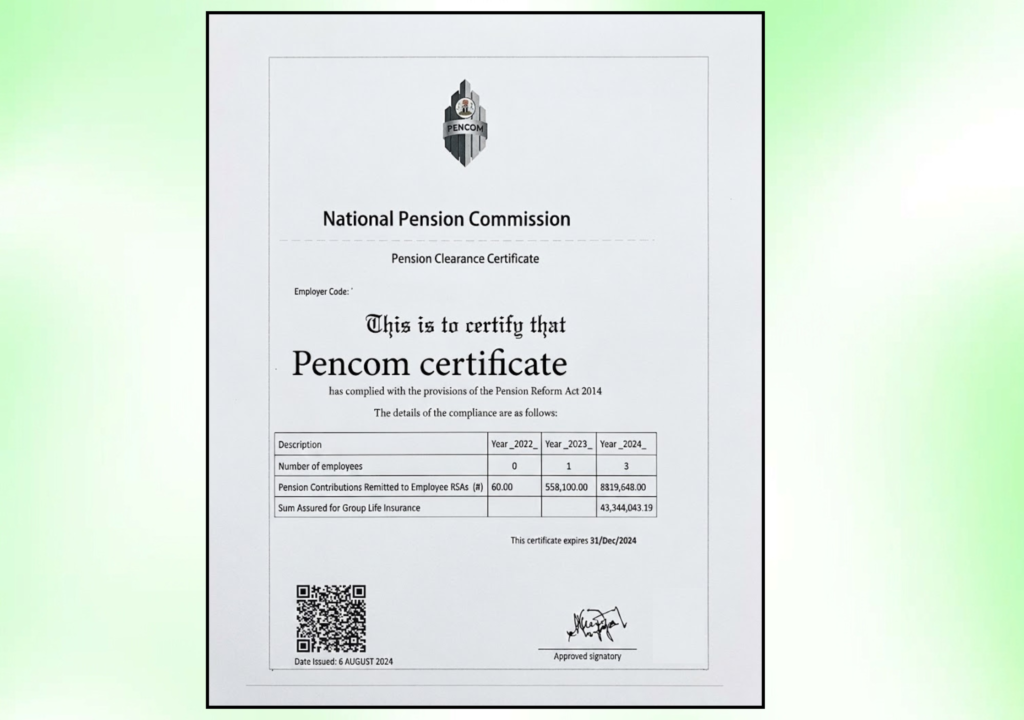
The PENCOM Compliance Certificate, often called the PCC, is proof that a company has met those obligations. It is not just an internal record-keeping document. It is a prerequisite for all suppliers, contractors, or consultants soliciting any contract or business from the federal government.
No federal procurement process or public bid can proceed without a valid PCC from the applicant company. That language comes directly from how PENCOM frames the certificate’s purpose. It is not a compliance bonus. It is a gate.
What Happens If You Bid Without One
Your bid is disqualified. Not penalised. Not queried for clarification. Disqualified.
Procurement officers at federal ministries, departments, and agencies check compliance certificates early in the evaluation process, often at the administrative compliance stage before technical evaluation even begins. A missing PCC means your bid file fails that initial check and does not advance further, regardless of how strong your technical proposal or pricing is.
The same applies at state government level in many cases. While the legal mandate is most clearly enforced at the federal level, many state governments and large public institutions have adopted the same procurement checklist, requiring PCC alongside other compliance certificates before entertaining a bid.

The PENCOM Certificate Is One of Several Procurement Certificates
This is worth understanding clearly. The PENCOM Compliance Certificate does not stand alone on a government contract checklist. It sits alongside several other mandatory compliance documents that federal procurement requires.
A company bidding for federal government contracts in Nigeria is typically expected to present all of the following:
| Certificate | Issuing Body | What It Confirms |
|---|---|---|
| PENCOM Compliance Certificate | National Pension Commission | Pension contributions for staff are remitted |
| ITF Compliance Certificate | Industrial Training Fund | Annual 1% payroll contribution to ITF is paid |
| NSITF Compliance Certificate | Nigeria Social Insurance Trust Fund | Monthly 1% emoluments contribution is paid |
| BPP Registration | Bureau of Public Procurement | Company is listed on the National Database of Contractors |
| CAC Certificate | Corporate Affairs Commission | Company is legally registered |
| FIRS Tax Clearance Certificate | Federal Inland Revenue Service | Tax obligations are current |
Missing any one of these is enough to disqualify a bid. PENCOM is not uniquely strict on this. It is simply one component of a compliance stack that federal procurement has built around contractor eligibility.
The Certificate Expires Every December
This is the detail that catches the most established businesses off guard.
The PCC is valid only until the 31st of December of the year it is issued. It does not carry forward. A company that obtained its certificate in January and then wins a contract in November cannot assume that certificate will still be valid by the time the contract execution phase begins if a new year starts during that window.
For businesses that depend on government contracts as a significant revenue source, renewing the certificate before December 31 every year is a non-negotiable operational task. Letting it lapse, even by a few days, creates a gap that can block contract renewals, variations, or new awards.
What the Certificate Actually Requires of Your Business
You cannot get the certificate without first doing the underlying work. PENCOM will not issue a PCC unless six conditions are all satisfied at the same time.
Monthly pension contributions must be fully current with no arrears. The Group Life Insurance policy covering staff must be active. The company’s tax clearance must be up to date. RSA PINs on the employee list must match what the Pension Fund Administrator holds. Contribution schedules processed through Remita PCRS must reconcile with actual bank payments. And the application must include all required supporting documents.
Falling out of step on any one of these delays the certificate, which then delays the procurement opportunity. The practical implication is that pension compliance should be treated as a continuous monthly process, not something addressed only when a tender deadline is approaching.
Obtain Your PENCOM certificate
Let us help you obtain your PENCOM Compliance Certificate quickly and hassle-free. Our experts provide reliable support throughout the application process, ensuring you meet all requirements and remain compliant.
How Long the Application Takes
PENCOM’s service standard is five working days from a complete application. When all documents are accurate and consistent, many applicants receive their certificate within two to three weeks in practice.
That timeline assumes everything is in order from the start. If there are discrepancies between the employee list and PFA records, if remittance schedules have gaps, or if the Group Life Insurance policy has lapsed, PENCOM will flag these issues. Resolving them and resubmitting adds significant time.
As of April 1, 2026, all PCC applications must go through PENCOM’s online portal. Walk-in and manual applications are no longer accepted. The portal does not allow edits after submission, so any error or mismatch discovered after clicking submit results in automatic rejection and a fresh application.
Private Sector Contracts and the PCC
Government contracts are where the PCC requirement is most firmly enforced, but the certificate has been spreading into private sector procurement as well.
Many large private-sector organisations, NGOs, and multinational companies now require a PENCOM Compliance Certificate from vendors and service providers before executing contracts or releasing payment. Some include it in their standard vendor onboarding checklist. Others request it only above a certain contract value.
This trend means the certificate is increasingly relevant even for companies that do not actively target government work. If you supply to a major Nigerian company, a bank, or an international NGO, you may encounter a PCC request as part of their supplier verification process.
Frequently Asked Questions
Is the PENCOM certificate required for state government contracts, not just federal?
The legal mandate under the Pension Reform Act 2014 is a federal law, and its strongest enforcement is at the federal level. However, many state governments and state-owned enterprises have adopted the same compliance checklist, particularly in states with active procurement reform. Whether a specific state requires the PCC depends on its procurement regulations. For federal contracts, the requirement is unambiguous.
Can a small company with three employees qualify for a government contract?
Yes. The certificate is available to any company with at least three employees who are registered under the Contributory Pension Scheme and whose contributions are current. Company size does not determine eligibility for the certificate. What matters is whether the pension obligations for your staff are met, not how many staff you have.
What happens if my PCC expires mid-contract?
The PCC covers compliance at the time of bidding. Once a contract is awarded and execution begins, the immediate risk of a lapsed certificate is around renewals, contract variations, or new awards from the same or other agencies. Some procurement frameworks include periodic compliance checks during contract execution, meaning a lapsed PCC can trigger issues even after award. Renewing annually before December 31 is the safest approach.
How do I know if a company’s PCC is genuine?
PENCOM publishes a list of organisations that have been issued compliance certificates on its official website. Procurement officers and private sector organisations can cross-check a submitted certificate against this public list to verify its authenticity.
Can I apply for the PCC myself or do I need a consultant?
The application goes through PENCOM’s online portal and can be completed without a consultant if your documents are well organised and your remittance records are clean. Many companies engage a consultant when their records have gaps, when ownership structures complicate the beneficial ownership submissions, or when a previous application was rejected and they want to identify the problem before resubmitting.
Does the PCC cover all employees, including contract staff?
The certificate covers employees on the company’s payroll who are registered under the Contributory Pension Scheme. Whether contract or casual staff need to be included depends on the nature of their engagement and whether they are classified as employees under Nigerian labour law. This is a detail worth clarifying with a compliance consultant if your workforce includes a mix of staff categories.
Conclusion: Treat Compliance as a Business Development Activity
Companies that win government contracts consistently do not scramble for compliance certificates when a tender opportunity appears. They maintain the certificates year-round because they have internalised that compliance is not a procurement formality. It is a commercial prerequisite.
The PENCOM certificate, alongside the ITF, NSITF, and BPP registrations, forms the minimum compliance stack for federal procurement eligibility. Keeping all of them current and valid through consistent monthly pension remittance is simpler than rebuilding the entire compliance picture in the weeks before a bid deadline.
Obtain Your PENCOM certificate
Let us help you obtain your PENCOM Compliance Certificate quickly and hassle-free. Our experts provide reliable support throughout the application process, ensuring you meet all requirements and remain compliant.