
If you run a registered business in Nigeria with employees, you have probably come across the term PENCOM Certificate at some point, usually when bidding for a government contract or renewing a business licence. For many business owners, it shows up as a confusing requirement on a checklist with little explanation of what it actually is.
This article explains what the PENCOM Certificate means, why it exists, who needs it, and what it is used for in practical terms.
Obtain Your PENCOM certificate
Let us help you obtain your PENCOM Compliance Certificate quickly and hassle-free. Our experts provide reliable support throughout the application process, ensuring you meet all requirements and remain compliant.
What Does PENCOM Stand For?
PENCOM is the National Pension Commission, the federal agency responsible for regulating and supervising pension schemes in Nigeria. PENCOM was established under the Pension Reform Act 2004 to regulate, supervise, and ensure the effective administration of pension matters in Nigeria.
The agency oversees the Contributory Pension Scheme, which requires employers and employees to contribute a percentage of salary into a Retirement Savings Account managed by a licensed Pension Fund Administrator. PENCOM’s job is to make sure employers actually do this.
What is the PENCOM Certificate?
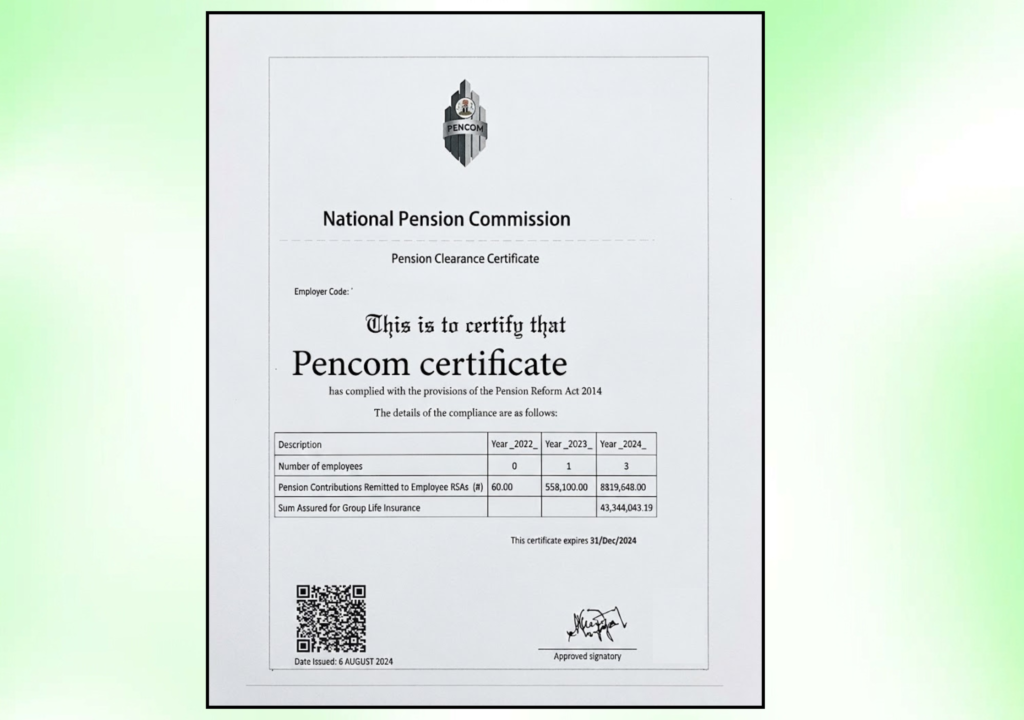
The PENCOM Certificate, more formally called the PENCOM Compliance Certificate or Pension Clearance Certificate, is an official document issued by the National Pension Commission. It confirms that a company is compliant with the Pension Reform Act, 2014.
In simpler terms, it is proof. It serves as official confirmation that an employer has been remitting pension contributions for its employees as required by law. Without this proof, a company has no formal way of demonstrating that it takes its pension obligations seriously.
The certificate is not permanent. It is valid until the 31st of December each year, which means companies need to renew it annually to remain compliant.

Who Needs a PENCOM Certificate?
The requirement applies broadly, but the threshold for mandatory registration is based on staff numbers. PENCOM registration is one of the key compliance requirements for companies engaging in business in Nigeria with a minimum of 15 employees, although other sources indicate the certificate itself is issued to employers with at least 3 active employees for registration purposes.
In practice, two groups of businesses care about this certificate the most. The first is any company that wants to bid for federal or state government contracts. The second is companies that deal with regulators, sectoral licensing bodies, or international government agencies where compliance documentation is part of the vetting process.
Even businesses below the mandatory threshold sometimes choose to register voluntarily. Doing so strengthens their compliance profile, which matters when applying for loans, tenders, or partnerships where due diligence is involved.
What is the Purpose of the PENCOM Certificate?
The purpose of the certificate goes back to the core function of the Pension Reform Act, which restructured Nigeria’s pension system to give workers in both the public and private sectors a more secure path to retirement. PENCOM was created to administer this system, and the compliance certificate is its primary enforcement tool.
Without a requirement that companies prove compliance before accessing major business opportunities, there would be little incentive for employers to remit pension contributions consistently. The certificate ties pension compliance directly to commercial opportunity. If a company wants to grow through government work, it has to first demonstrate it is treating its employees’ retirement savings correctly.
Benefits of Having a PENCOM Certificate
Access to Government Contracts and Tenders
This is the most immediate practical benefit. No federal procurement process or public bid can proceed without a valid PCC from the applicant company. If your business has any ambition to work with federal ministries, departments, or agencies, this certificate is non-negotiable.
Credibility With Regulators and Partners
A valid PENCOM Certificate signals that your company runs proper HR and payroll processes. This matters when banks assess your business for loans, when international partners conduct due diligence, or when you are applying for other regulatory licences that ask for evidence of statutory compliance.
Avoiding Penalties for Non-Compliance
Companies that fail to remit pension contributions accumulate liabilities and penalties over time. The process of obtaining a PENCOM Certificate often surfaces these gaps early, giving a business the chance to correct its pension records before the issue becomes a larger financial or legal problem.
Employee Retention and Trust
Although this benefit is less direct, it matters. Employees increasingly check whether their employer is remitting pension contributions correctly, particularly as awareness of Retirement Savings Accounts grows. A company that maintains proper PENCOM compliance is one that can confidently tell staff their retirement contributions are being handled correctly.
What is the PENCOM Certificate Used For?
The table below summarises the main practical uses of the certificate.
| Use Case | What It Means |
|---|---|
| Federal and state government contract bidding | Mandatory document for any tender submission |
| Regulatory licence applications and renewals | Required by various sectoral regulators as proof of compliance |
| International agency dealings | Used as part of due diligence for partnerships with foreign government bodies |
| Bank and financial due diligence | Demonstrates good standing for loan applications and credit assessments |
| Internal HR and audit records | Confirms pension obligations have been met for the reporting year |
Obtain Your PENCOM certificate
Let us help you obtain your PENCOM Compliance Certificate quickly and hassle-free. Our experts provide reliable support throughout the application process, ensuring you meet all requirements and remain compliant.
Requirements to Obtain a PENCOM Certificate
Before applying, a company needs to have certain things in place. A photocopy of the Certificate of Incorporation is required as the foundational document affirming the legal establishment of the organisation. A valid FIRS Tax Identification Number (TIN) is also required.
Companies must first complete the registration process with PENCOM. After registration, PENCOM issues an Employer Identification Code, which is used for pension reporting and compliance monitoring going forward. All eligible employees must also have Retirement Savings Accounts opened with PENCOM-licensed Pension Fund Administrators of their choice.
Beyond basic registration, companies must show evidence of remittance. This includes evidence of remittance of all outstanding pension contributions and penalties for organisations whose contributions have been reviewed by PenCom, where applicable. Companies must also provide evidence of a valid Group Life Insurance Policy for employees, including the certificate of group life, the policy document, and proof of payment.
How Long Does the Process Take?
Processing time depends heavily on how complete and accurate the submitted documents are. It typically takes two to three weeks if all documents are accurate and complete. One detail that catches many applicants off guard: after submission, no edits can be made until PENCOM reviews the file, and the portal does not allow corrections after submission. Any mismatch between employee details and the records held by Pension Fund Administrators can lead to automatic rejection.
This makes preparation the most important part of the process. Cross-checking employee data against PFA records before submitting saves weeks of delay.
Frequently Asked Questions
Is the PENCOM Certificate the same as the Pension Clearance Certificate?
Yes. The PENCOM Certificate, the PENCOM Compliance Certificate, and the Pension Clearance Certificate all refer to the same document. The names are used interchangeably across government communication, professional services firms, and business directories, but they all describe the certificate issued by the National Pension Commission confirming an employer’s compliance with the Pension Reform Act 2014.
How often does a company need to renew its PENCOM Certificate?
The certificate is valid until the 31st of December of the year it is issued, which means companies need to renew it annually. Businesses that regularly bid for government contracts should plan their renewal early in the year to avoid gaps that could disqualify them from time-sensitive tenders.
What happens if a company does not have a PENCOM Certificate?
A company without a valid certificate cannot participate in federal or state government procurement processes. Beyond government work, the absence of the certificate can also raise concerns during bank due diligence, partnership negotiations, and certain regulatory licence applications, since it signals a possible gap in statutory compliance.
Does a small business with few employees need to register with PENCOM?
The mandatory threshold is generally tied to staff numbers, with figures cited around three to fifteen employees depending on the source and type of registration involved. Many small businesses below these thresholds still choose to register voluntarily because it strengthens their compliance profile for future growth, particularly if government contracts or formal partnerships are part of their plans.
Can a company apply for the PENCOM Certificate online?
Yes. PENCOM has moved much of its registration and certificate application process online. Employers submit company documents, employee data, and evidence of pension remittance through the portal. Because the system does not allow edits after submission, businesses are advised to verify every document and employee record carefully before clicking submit.
What documents are commonly required for the application?
The core documents include the Certificate of Incorporation, the company’s FIRS Tax Identification Number, evidence of an Employer Identification Code from PENCOM, proof of employee Retirement Savings Account registrations with licensed Pension Fund Administrators, evidence of pension contribution remittances, and a valid Group Life Insurance Policy for employees.
Conclusion: A Compliance Document That Opens Doors
The PENCOM Certificate is often treated as just another box to tick on a tender checklist, but it represents something more substantial. It confirms that a company is meeting its legal obligations to its own employees, and that compliance becomes the key that unlocks access to some of the largest commercial opportunities in Nigeria, particularly government contracts.
For businesses planning to grow through public sector work or formal partnerships, getting pension compliance right early avoids a scramble later when a tender deadline is approaching and the documentation isn’t ready. Treating it as part of standard business operations, rather than a once-a-year scramble, is the difference between being ready for an opportunity and missing it.
Obtain Your PENCOM certificate
Let us help you obtain your PENCOM Compliance Certificate quickly and hassle-free. Our experts provide reliable support throughout the application process, ensuring you meet all requirements and remain compliant.