
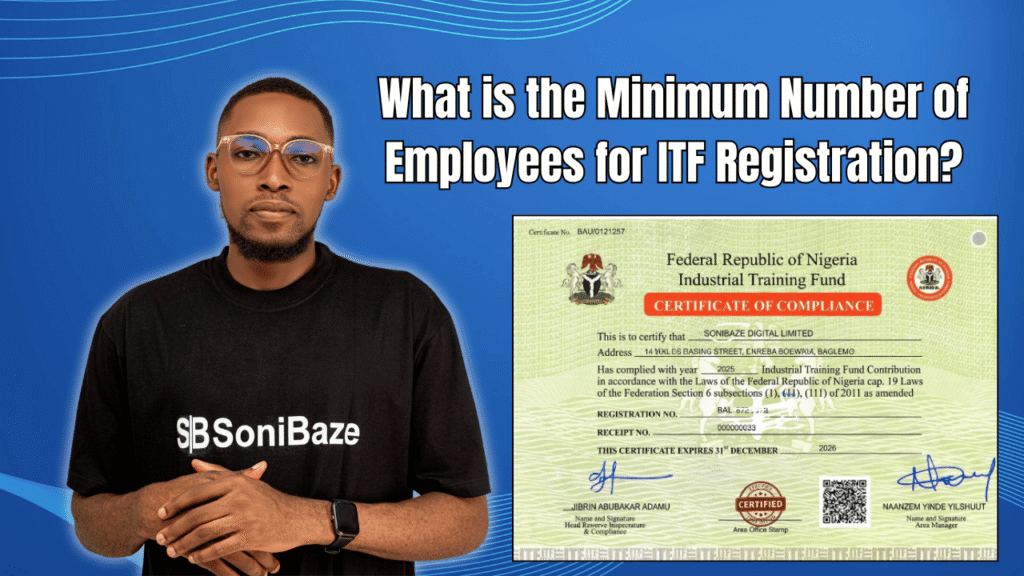
One of the most common questions Nigerian business owners ask when they first encounter the Industrial Training Fund is whether their company is even required to register. The answer depends on two things: your staff headcount and your annual turnover. Get either one of them wrong and you could either be paying contributions you are not obligated to pay, or accumulating penalties you did not know were coming.
This article explains the minimum threshold for ITF registration, what it means for different types of businesses, and what happens when a company falls on either side of that line.

Obtain Your ITF Certificate
Let us help you obtain your Industrial Training Fund (ITF) Compliance Certificate quickly and hassle-free. Our experts provide reliable support throughout the application process, ensuring your business meets all statutory compliance requirements.
What Is ITF?
The Industrial Training Fund is a Federal Government agency established on 8 October 1971 under the Industrial Training Fund Act. Its mandate is to promote and encourage skill acquisition in industry and commerce in Nigeria, with the goal of producing enough trained manpower to meet the needs of the economy.
ITF is headquartered in Jos, Plateau State, and operates area offices across all states of Nigeria. It is supervised by the Federal Ministry of Industry, Trade and Investment.
Every employer that meets the registration threshold is required to contribute 1% of its total annual payroll to the fund. In return, compliant companies receive an ITF Compliance Certificate, which is required for government contract bids, expatriate quota applications, and customs clearance for import and export operations.
The Minimum Employee Threshold for ITF Registration
The current minimum threshold, as set by the Industrial Training Fund (Amendment) Act 2011, is five employees.
Any employer with five or more employees in its establishment is required to register with ITF and contribute 1% of its annual payroll to the fund. This was a significant reduction from the previous threshold of 25 employees, which applied before the 2011 amendment. The change brought far more Nigerian businesses into the compliance net.
| Threshold | Requirement |
|---|---|
| 5 or more employees | Must register with ITF and contribute 1% of annual payroll |
| Fewer than 5 employees but annual turnover of ₦50 million or above | Must register and contribute regardless of headcount |
| Fewer than 5 employees AND turnover below ₦50 million | Exempt from ITF registration and contribution |
So the employee count alone does not tell the full story. A company with just two staff members but annual turnover of ₦60 million is still required to register and contribute. Both conditions, headcount and turnover, need to be checked.

Who Counts as an Employee Under the ITF Act?
The ITF Act defines an employee as any Nigerian or non-Nigerian who works for more than 30 days in a single calendar year in an establishment, on either a full-time or part-time basis, in exchange for a salary, wages, or other consideration.
This means contract staff and part-time workers count toward your headcount if they work more than 30 days in the year. Businesses that rely heavily on short-term or contract workers should not assume those workers are excluded from the count. If they work more than a month in the calendar year, they are employees for ITF purposes.
What Does “Annual Payroll” Mean for ITF Contribution Purposes?
The 1% contribution is calculated on the total payroll, not just basic salary. The Act defines payroll as the total of all basic pay, allowances, and other entitlements payable within and outside Nigeria to any employee in the establishment.
This covers housing allowances, transport allowances, and other regular entitlements. It does not just mean the figure on the payslip under “basic salary.” Businesses that have a large gap between basic salary and total remuneration should calculate their ITF contribution against the full remuneration figure, not just the basic component.
Obtain Your ITF Certificate
Let us help you obtain your Industrial Training Fund (ITF) Compliance Certificate quickly and hassle-free. Our experts provide reliable support throughout the application process, ensuring your business meets all statutory compliance requirements.
When Is the ITF Contribution Due?
ITF contributions for a given year are due by 1 April of the following year. A company calculating its 2025 payroll contribution must pay it no later than 1 April 2026. Missing this deadline exposes the business to penalties under the ITF Act.
| Period | Payment Deadline |
|---|---|
| Annual training contribution | Not later than 1 April of the following year |
| Compliance certificate fee (one-time) | Paid at point of registration |
| Annual training contribution rate | 1% of total annual payroll |
What Happens If a Company Does Not Register?
Companies that are required to register but do not face penalties under the Act. These include fines for the company as a body corporate and personal liability for the chief executive, secretary, or other principal officers. For companies involved in import and export or applying for expatriate quotas, an ITF compliance certificate is a compulsory document that cannot be substituted with anything else.
Continued non-compliance means the penalties accumulate year on year, making voluntary late registration far cheaper than waiting to be caught during a contract bid or customs process.
What If My Company Grows Past the Threshold Mid-Year?
If your company starts the year with three employees and hires a fourth and fifth before the year ends, you cross the threshold during that calendar year. The practical approach is to register as soon as you meet or expect to meet the threshold, rather than waiting until the contribution deadline to sort it out.
The same applies to turnover. If your projected revenue for the year will cross ₦50 million, begin the registration process early rather than scrambling at year end.
ITF Registration at a Glance
| Item | Detail |
|---|---|
| Governing law | Industrial Training Fund Act, amended 2011 |
| Minimum employee threshold | 5 employees |
| Alternative threshold | Annual turnover of ₦50 million or above |
| Contribution rate | 1% of total annual payroll |
| Payment deadline | 1 April of the following year |
| One-time compliance certificate fee | ₦100,000 |
| Who is exempt | Companies with fewer than 5 employees AND turnover below ₦50 million |
| ITF headquarters | Miango Road, Jos, Plateau State |
Frequently Asked Questions
Does the 5-employee rule apply to both public and private companies?
Yes. The ITF Act applies to both public and private sector employers. Government parastatals, private limited companies, and any other form of employer meeting the threshold are covered.
Are interns and NYSC corps members counted as employees?
NYSC corps members serving in a company are generally not counted as regular employees for ITF purposes since they are not directly on the company’s payroll. Interns who receive stipends and work more than 30 days in the year may be counted depending on the arrangement. When in doubt, seek clarification from the nearest ITF area office.
What is the penalty for late payment of ITF contributions?
The Act prescribes fines for non-compliant companies. For a body corporate, a first offence carries a fine of ₦500,000, with ₦1,000,000 for each subsequent breach. Principal officers of the company face personal fines of ₦50,000 or two years imprisonment for a first offence, and three years imprisonment without the option of a fine for subsequent offences.
Can a company register with ITF even if it has fewer than 5 employees?
There is no prohibition on voluntary registration for smaller companies, but the legal obligation only kicks in at five employees or ₦50 million annual turnover. Smaller companies sometimes register voluntarily to access ITF training programmes and industrial attachment placements.
Is the ITF compliance certificate the same as the ITF certificate of registration?
They are related but separate documents. The certificate of registration confirms that the employer has been added to the ITF register. The compliance certificate confirms that the employer has paid the required annual contributions for the current or most recent year. Most government procurement processes require the compliance certificate specifically, not just the registration certificate.
Where can a company register with ITF?
Registration is processed through the ITF area office closest to the company’s registered address or principal place of business. ITF has area offices in all states and the FCT. The ITF website is www.itf.gov.ng and the process involves completing Form 7A and submitting supporting documents to the relevant area office.
Conclusion: Know Your Threshold Before You Assume You Are Exempt
The 5-employee minimum is the figure most business owners encounter first, and for many small businesses, it is the only number that matters. But the ₦50 million annual turnover threshold catches companies that would otherwise assume their small headcount keeps them out of scope.
Check both numbers. If your business meets either one, ITF registration is not optional. The compliance certificate it produces is required for too many critical business processes, including government contracts, customs clearance, and expatriate quota applications, to treat as something you will sort out later.
Obtain Your ITF Certificate
Let us help you obtain your Industrial Training Fund (ITF) Compliance Certificate quickly and hassle-free. Our experts provide reliable support throughout the application process, ensuring your business meets all statutory compliance requirements.