Most Nigerian business owners trying to bid for a government contract run into both of these at the same time. The ITF certificate. The NSITF certificate. Two different acronyms, both mandatory, both sitting on the same tender checklist. And because they look similar on paper, a lot of people assume they are the same thing or that one covers the other.
They do not. They are entirely separate obligations, issued by different government agencies, serving different purposes, and calculated differently. This article breaks down exactly what each one is and where they differ.

Obtain Your NSITF Certificate
Let us help you obtain your Nigeria Social Insurance Trust Fund (NSITF) Compliance Certificate quickly and hassle-free. Our experts provide reliable support throughout the application process, ensuring your business meets all statutory compliance requirements.
What Is the ITF Certificate?
ITF stands for the Industrial Training Fund. The fund was established under the Industrial Training Fund Act, later amended in 2011, with a specific purpose: to develop and improve the quality of industrial and commercial skills in Nigeria by building a pool of trained indigenous manpower for both the public and private sectors.
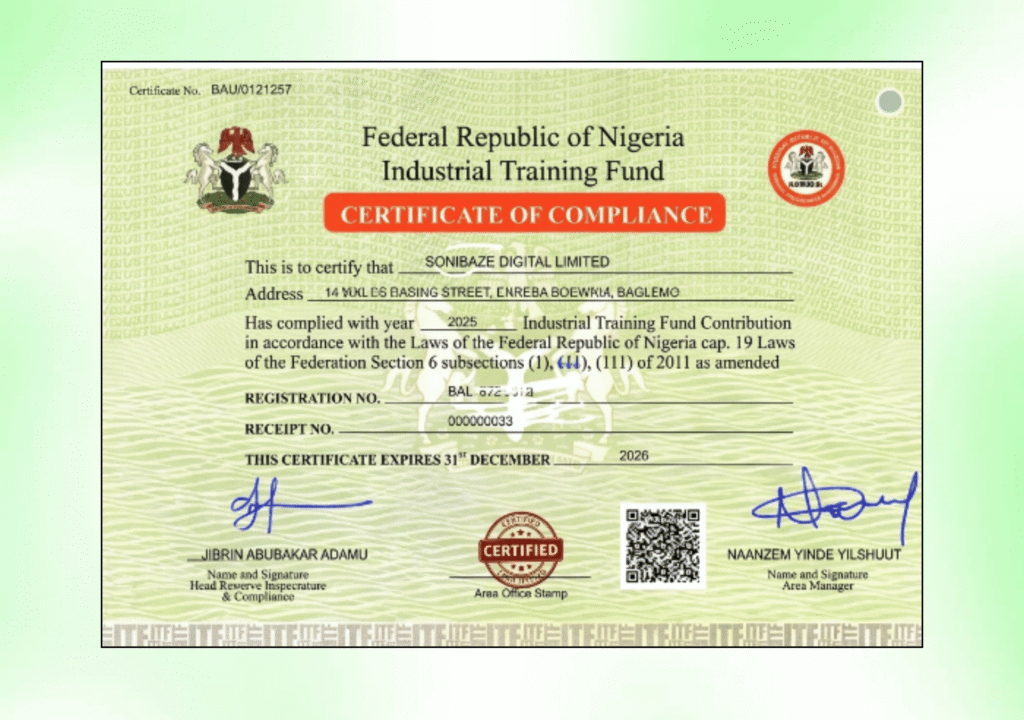
The ITF certificate, formally called the ITF Training Compliance Certificate, is issued to employers who have registered with the fund, paid their annual training contribution levy, and filed the required returns. It is an annual certificate that must be renewed each year to remain valid for procurement purposes.
The contribution rate is 1% of the company’s total annual payroll. This is paid by the employer, not deducted from employee salaries. Employers with fewer than five employees, or with an annual turnover below N50 million, are exempt from this obligation.
What Is the NSITF Certificate?
NSITF stands for the Nigeria Social Insurance Trust Fund. It operates under the Employees Compensation Act 2010, which replaced the older Workmen’s Compensation Act. The fund exists for an entirely different reason: to compensate employees who suffer workplace injuries, occupational diseases, disability, or death during the course of their employment.
Think of NSITF as mandatory workplace insurance. When an employee is injured at work or contracts an occupational illness, the NSITF fund covers their medical treatment, rehabilitation, and compensation. The employer pays into the fund so that this coverage exists for every staff member on their payroll.
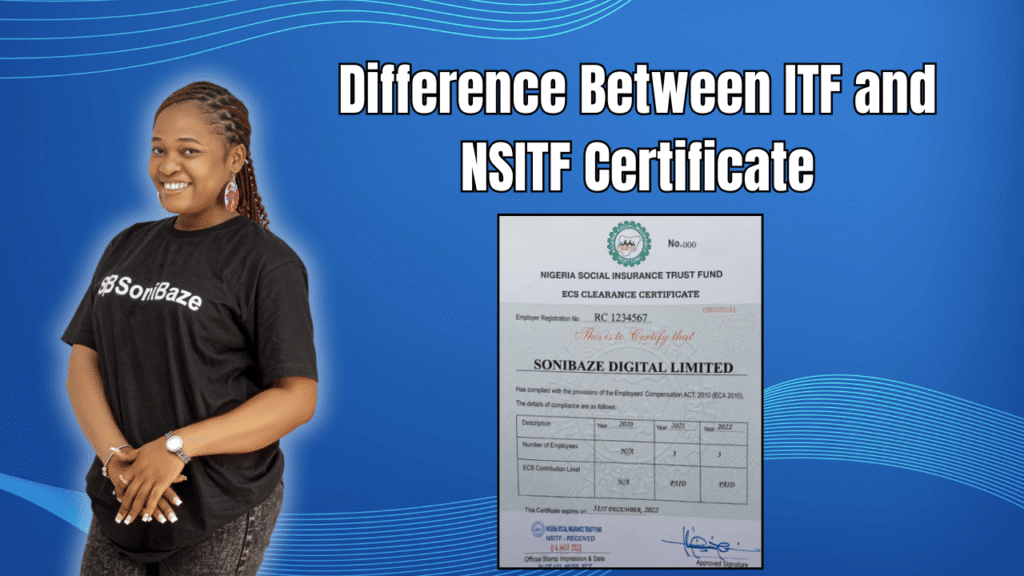
The NSITF compliance certificate confirms that an employer has registered and is making the required monthly contributions. The contribution rate is 1% of total monthly payroll, paid entirely by the employer. It is illegal for an employer to deduct this amount from an employee’s salary. Employers are required to remit before the 16th day of the month following salary payment. Late remittance attracts a 10% penalty on the unremitted amount.
Unlike ITF, NSITF applies to every employer in Nigeria with at least one employee on payroll. There is no size or turnover exemption.

Key Differences at a Glance
| Feature | ITF Certificate | NSITF Certificate |
|---|---|---|
| Full name | Industrial Training Fund Training Compliance Certificate | Nigeria Social Insurance Trust Fund Compliance Certificate |
| Governing law | Industrial Training Fund Act (amended 2011) | Employees Compensation Act 2010 |
| Issuing agency | Industrial Training Fund | Nigeria Social Insurance Trust Fund |
| Purpose | Funds skills development and industrial training in Nigeria | Compensates employees for workplace injuries, illness, disability, or death |
| Contribution rate | 1% of total annual payroll | 1% of total monthly payroll |
| Who pays | Employer only | Employer only |
| Minimum threshold | 5 or more employees, or N50 million annual turnover | Any employer with at least 1 employee |
| Frequency | Annual contribution and certificate renewal | Monthly contributions; annual certificate renewal |
| Penalty for non-compliance | Loss of right to claim 50% refund of contributions | 10% penalty on unremitted monthly amounts |
| Processing timeline | Average of 10 working days | Average of 5 working days |
Same Rate, Completely Different Purpose
Both ITF and NSITF are calculated at 1% of payroll. That similarity is where the confusion starts. But what each 1% does is entirely different.
The 1% to ITF goes toward building a national skills pool. Employers who contribute and comply with training obligations can also apply to reclaim up to 50% of their contribution as a refund, provided they run qualifying training programmes for their staff. The fund effectively rewards employers who invest in staff development.
The 1% to NSITF goes into a compensation fund. No refund mechanism exists here. The money covers what happens when an employee is injured, develops an occupational illness, or dies on the job. Coverage extends to full-time workers, contract staff, and casual employees. It is workers’ compensation insurance backed by statute.
Obtain Your ITF Certificate
Let us help you obtain your Industrial Training Fund (ITF) Compliance Certificate quickly and hassle-free. Our experts provide reliable support throughout the application process, ensuring your business meets all statutory compliance requirements.
Who Is Exempt?
Exemptions are where the two diverge most clearly.
ITF has a meaningful exemption. Employers with fewer than five employees, or with an annual turnover below N50 million, are not required to contribute to ITF or obtain the certificate. This takes a large portion of small businesses out of scope.
NSITF has no equivalent exemption. The Employee Compensation Act mandates that any employer with at least one employee on payroll must register and contribute. A business with two staff members is as liable as a company with 500. Members of the Armed Forces of Nigeria are the only category explicitly excluded from the scheme.
Do You Need Both for Government Contracts?
Yes. Both certificates are required as part of the compliance cluster for Federal Government procurement. A business bidding for any federal contract must present a valid ITF Training Compliance Certificate alongside a valid NSITF Compliance Certificate. Missing either one disqualifies the bid, regardless of how strong the technical or financial proposal is.
These two sit alongside the Tax Clearance Certificate and the PENCOM Clearance Certificate as the four main compliance documents that government procurement requires. BPP registration also depends on having ITF and NSITF in place before the application can be completed.
Registration Requirements for Each
ITF Registration Requirements
| Document | Details |
|---|---|
| Completed ITF Form 7A | Official registration form from the ITF |
| CAC Certificate of Incorporation | Or Certificate of Registration for business names |
| Evidence of annual payroll | Used to assess the contribution liability |
| Evidence of payment of prescribed fees | Confirmation of contribution payment |
NSITF Registration Requirements
| Document | Details |
|---|---|
| Letter of intent on company letterhead | Formal request to the fund for compliance certificate |
| CAC Certificate of Incorporation | Issued by the Corporate Affairs Commission |
| Completed ECS RE 01 Registration Form | NSITF’s employee compensation scheme form |
| Completed Payroll Form RE 03 | Details of employee payroll for contribution assessment |
| 10-digit registration number | Issued to the employer upon initial registration with the fund |
Frequently Asked Questions
Can one certificate substitute for the other?
No. ITF and NSITF are issued by different government agencies under different legislation. Neither covers the obligations of the other. A business must obtain and maintain both separately to be fully compliant.
What happens if I have no employees yet?
If a business has no employees at all, NSITF registration is not triggered since there is no payroll. ITF similarly does not apply below the five-employee or N50 million threshold. However, once you hire your first employee, NSITF compliance becomes immediately mandatory, and once you cross the ITF threshold, that obligation kicks in too.
How long does each certificate take to process?
ITF registration and certificate processing typically takes around ten working days from the date of submission of a complete application. NSITF takes an average of five working days. Both timelines assume that documentation is complete and accurate from the first submission.
Do the certificates expire?
Both are annual certificates. They must be renewed each year to remain valid. For businesses bidding on government contracts throughout the year, the practical approach is to renew both on the same schedule so that neither certificate lapses at a critical point.
Is the 1% contribution deducted from employee salaries?
No, for either fund. Both the ITF contribution and the NSITF contribution are employer obligations, paid from company funds. It is specifically prohibited to deduct the NSITF contribution from an employee’s remuneration. The same applies to ITF. Both come out of the business, not the payslip.
Where do I go to register for each?
ITF registration is handled through the nearest ITF Area Office. The fund has offices across Nigeria’s six geopolitical zones and most state capitals. For businesses in Abuja, the FCT Area Office handles registrations. NSITF registration and compliance certificate applications are processed through the NSITF office relevant to the employer’s location, or online through the NSITF portal.
Conclusion: Two Separate Obligations, Both Non-Negotiable
ITF and NSITF serve entirely different goals within Nigeria’s regulatory framework. ITF builds the country’s skills base by requiring employers to contribute to a national training fund. NSITF protects employees by ensuring compensation is available when workplace incidents occur. The two are not interchangeable, and one does not satisfy the requirement for the other.
For any business looking to engage with Federal Government procurement, both certificates are required, both must be renewed annually, and both take time to process. Getting them in order before a tender deadline, not after, is the only way to avoid being shut out of a bid you were otherwise qualified for.
Obtain Your NSITF Certificate
Let us help you obtain your Nigeria Social Insurance Trust Fund (NSITF) Compliance Certificate quickly and hassle-free. Our experts provide reliable support throughout the application process, ensuring your business meets all statutory compliance requirements.