
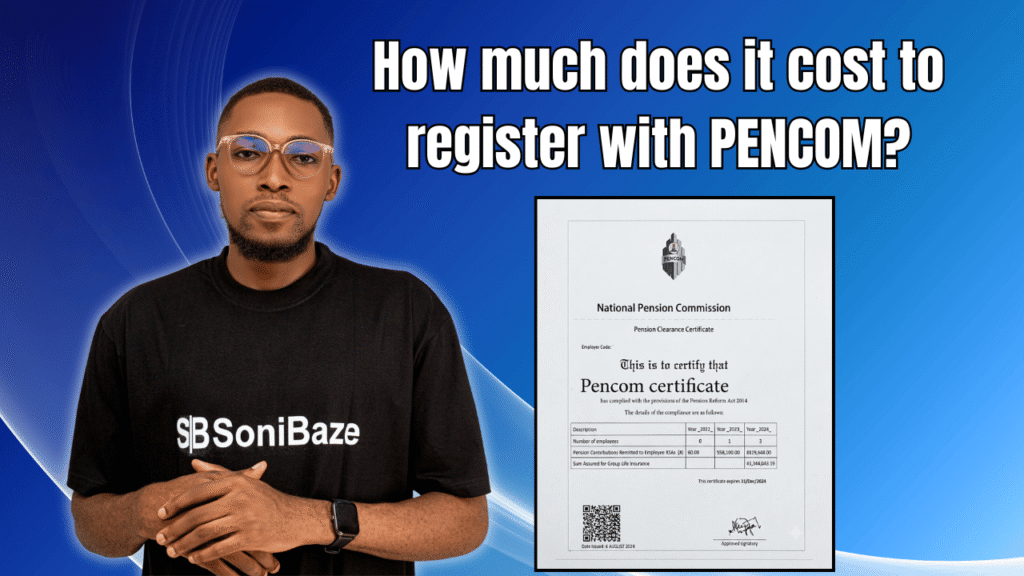
This is one of the most searched questions about PENCOM, and one of the least clearly answered. Most official sources explain the requirements in detail but say little about what you will actually spend. The answer has a few moving parts, and the total depends on factors specific to your company.
This article breaks down every cost component involved in getting a PENCOM Compliance Certificate, what each one covers, and what variables affect the final figure.
Obtain Your PENCOM certificate
Let us help you obtain your PENCOM Compliance Certificate quickly and hassle-free. Our experts provide reliable support throughout the application process, ensuring you meet all requirements and remain compliant.
The PENCOM Certificate Itself Is Free
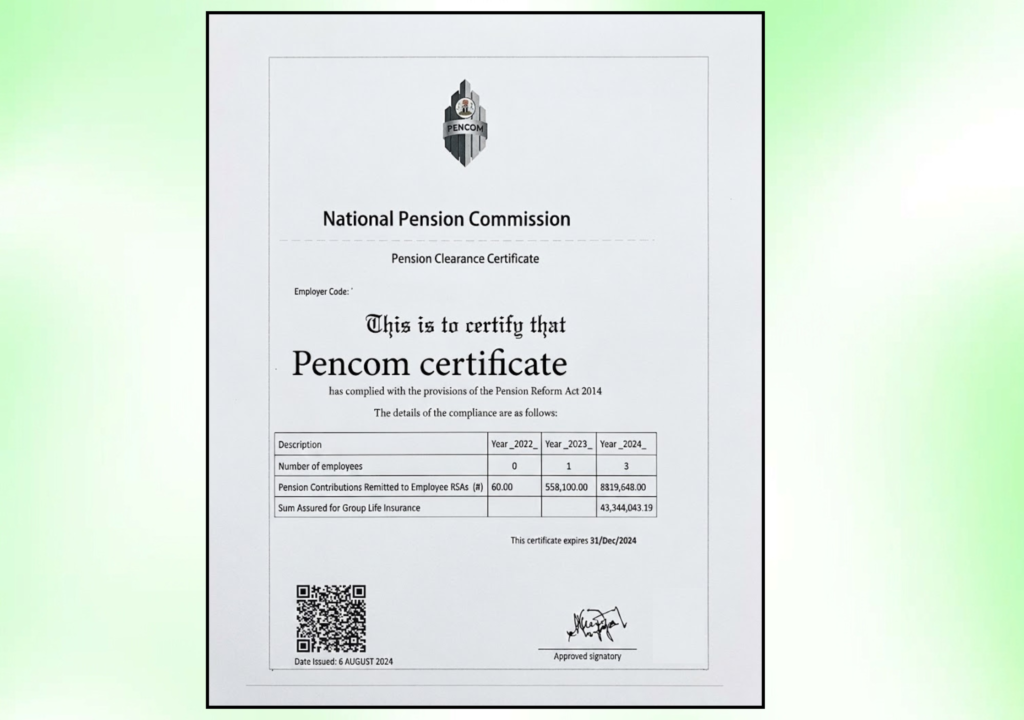
Start here, because it surprises most people. PENCOM does not charge a fee to issue the Pension Compliance Certificate. The certificate is issued at no cost by the National Pension Commission once your application is reviewed and approved.
What costs money is not the certificate but the compliance work that has to be done before you are eligible to receive it. Three cost areas determine what your company will spend.
Cost Area 1: Pension Contribution Remittances
This is the biggest variable in the entire process. PENCOM requires that your company has been remitting pension contributions consistently for all qualifying employees before a certificate can be issued. The contribution rate under the Pension Reform Act 2014 is 18 percent of each employee’s monthly emolument, split between employer and employee.
The employer contributes a minimum of 10 percent and the employee contributes a minimum of 8 percent, making up the combined 18 percent. This is not a one-off payment for the certificate. It is an ongoing statutory obligation that must already be in place and properly documented before your application.
Where the cost really adds up is when companies have been operating without remitting. PENCOM’s review can look back up to 36 months of contribution history for a minimum of three staff members. If your company has three employees earning ₦150,000 each per month, and contributions were not remitted for two years, the arrears calculation alone becomes significant before the certificate process even begins.
Companies that have been remitting correctly throughout should have no arrears to clear. The ongoing contribution is simply part of running a compliant payroll.

Cost Area 2: Group Life Insurance Policy
The Pension Reform Act 2014 requires every employer covered by the Contributory Pension Scheme to maintain a group life insurance policy for its staff, covering a minimum of three times each employee’s annual total emolument.
If your company already has an active group life insurance policy, the cost here is your renewal premium. If you do not have one, you need to obtain it before your PENCOM certificate application will be accepted.
For a minimum of three staff members, the processing cost of group life insurance typically ranges from ₦35,000 to ₦65,000. If your headcount is larger than three, the premium will rise accordingly, since the insured amount is pegged to salary levels across all covered employees.
Cost Area 3: Professional or Consultant Fees
PENCOM applications are not legally required to go through a consultant, but many companies use one because the documentation stage has many moving parts and a single mismatch, such as a name discrepancy on the staff list, can lead to outright rejection rather than a request to correct and resubmit.
Professional fees for handling the PENCOM compliance process typically range from ₦100,000 to ₦250,000 depending on the firm, the complexity of your ownership structure, and whether arrears reconciliation is involved.
Companies with straightforward payrolls, clean remittance records, and fewer than ten employees tend to be at the lower end of this range. Larger organisations or those with years of unremitted contributions will typically spend toward the higher end or beyond it.
Full Cost Summary
| Cost Component | Estimated Cost | Variable Factors |
|---|---|---|
| PENCOM Certificate | Free | N/A |
| Pension Contribution Arrears (if applicable) | 18% of salary × number of staff × months unpaid | Number of employees, salary levels, months overdue |
| Group Life Insurance (minimum 3 staff) | ₦35,000 to ₦65,000 | Staff headcount and salary levels |
| Professional / Consultant Fee | ₦100,000 to ₦250,000 | Firm, company complexity, arrears involved |
Minimum total cost for a company with three staff, a clean remittance record, and no consultant: approximately ₦35,000 to ₦65,000 for the insurance policy.
Realistic total cost for most SMEs using a consultant with no major arrears issues: approximately ₦135,000 to ₦315,000.
Obtain Your PENCOM certificate
Let us help you obtain your PENCOM Compliance Certificate quickly and hassle-free. Our experts provide reliable support throughout the application process, ensuring you meet all requirements and remain compliant.
What Makes the Cost Go Up
Three things push the total higher than the baseline.
Unremitted arrears. If your company has been paying salaries without deducting and remitting the 18 percent pension contribution, those months become a liability that must be resolved before the certificate can be obtained. The more months outstanding and the higher your payroll, the larger this figure becomes.
Larger staff headcount. Group life insurance premiums are calculated based on the total salary exposure across all covered employees. A company with 50 staff will pay significantly more for the policy than one with three.
Complex ownership structures. If your company has multiple directors, a holding company structure, or ownership details that require additional documentation, consultant fees tend to move toward the upper end of the range.
What Makes the Cost More Manageable
Starting early. Companies that register with a Pension Fund Administrator from the beginning and maintain clean remittance records have no arrears to clear. The only real cost they face is the insurance policy and whatever consultant support they choose to use.
Getting documents right the first time. A rejected application does not incur a PENCOM fee, but it does cost time and may require additional consultant hours to identify and fix the problem before resubmitting. Organising your CAC documents, staff list, and RSA records carefully before submission avoids this.
Frequently Asked Questions
Does PENCOM charge a fee to issue the compliance certificate?
No. The Pension Compliance Certificate itself is issued free of charge by the National Pension Commission. The costs associated with PENCOM compliance are the pension contribution remittances, the group life insurance policy for staff, and any professional fees for consultant support.
What is the 18 percent pension contribution exactly?
Under the Pension Reform Act 2014, the total pension contribution is 18 percent of each employee’s monthly emolument. The employer is required to contribute a minimum of 10 percent and the employee contributes a minimum of 8 percent. This remittance must be made to the employee’s chosen Pension Fund Administrator within seven working days of each salary payment.
What if our company has never remitted pension contributions?
Unremitted contributions become arrears. PENCOM’s review can look back up to 36 months of history, and companies with significant arrears will need to clear these before the certificate can be issued. The cost of arrears depends entirely on how many employees were unpaid, at what salary levels, and for how many months.
Can we get the certificate without a group life insurance policy?
No. The group life insurance policy is a statutory requirement under the Pension Reform Act 2014 and forms part of the documentation submitted with the PENCOM application. An application without evidence of a current and valid group life insurance policy covering eligible staff will not be processed.
Is hiring a consultant necessary?
No, it is not compulsory. PENCOM applications can be submitted directly through the online portal. However, because the portal does not allow edits after submission, companies with complex records or limited experience with the process often find that consultant fees are a worthwhile investment compared to the cost of rejection and resubmission delays.
How often do we need to pay for PENCOM compliance?
Pension contribution remittances are ongoing, paid monthly. The group life insurance policy requires annual renewal. The PENCOM Compliance Certificate itself expires on the 31st of December each year and must be renewed annually for companies that need it for contracts or licence renewals.
Conclusion: Budget for Compliance, Not Just the Certificate
The PENCOM certificate has no issuance fee. But the compliance work required to be eligible for it costs real money, particularly if contributions have not been remitted consistently. Understanding the three cost areas upfront, remittances, insurance, and professional support, allows companies to plan for the process rather than being caught off guard by the total.
For companies that maintain clean records from the start, the annual cost of staying PENCOM-compliant is mostly the insurance renewal premium and whatever ongoing payroll support keeps contributions going out on time.
Obtain Your PENCOM certificate
Let us help you obtain your PENCOM Compliance Certificate quickly and hassle-free. Our experts provide reliable support throughout the application process, ensuring you meet all requirements and remain compliant.