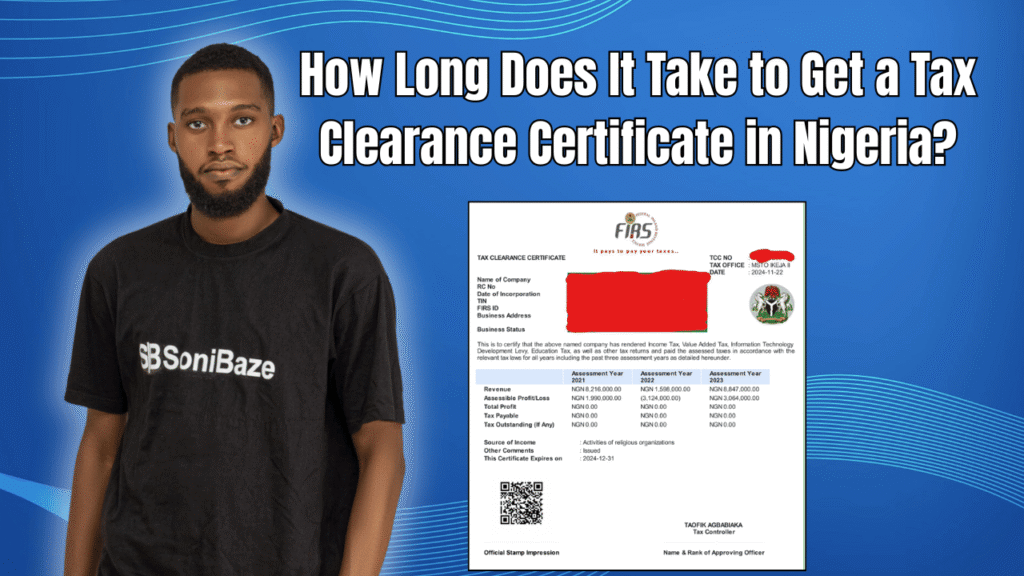
Most Nigerian business owners only start thinking about their Tax Clearance Certificate when they urgently need one. A government contract deadline is approaching, a bank is asking for it before approving a loan, or a regulatory body requires it before issuing a licence. That is when the question lands: how long is this actually going to take?
The answer depends heavily on your compliance history. If your tax returns are filed and your payments are up to date, the process can move quickly. If they are not, the timeline extends considerably before the certificate can even be applied for.
Obtain Your Tax Clearance Certificate (TCC)
Let us help you obtain your Tax Clearance Certificate (TCC) quickly and hassle-free. Our experts provide reliable support throughout the application process, ensuring your business meets all tax compliance requirements.
What Is a Tax Clearance Certificate?
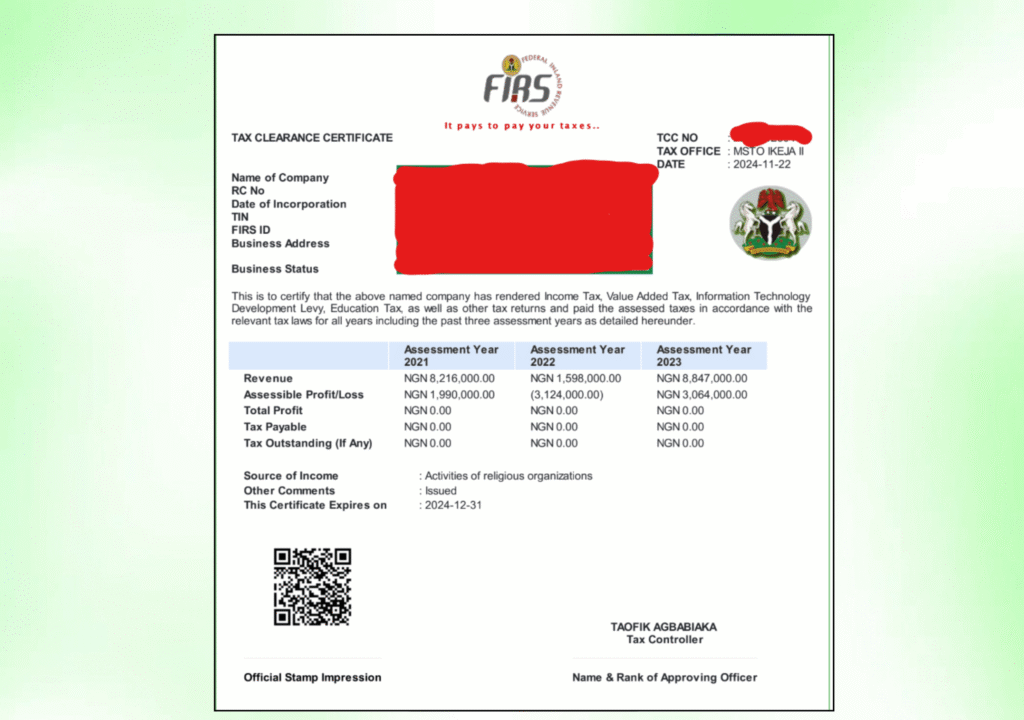
A Tax Clearance Certificate, commonly called a TCC, is an official document issued by the Federal Inland Revenue Service or a State Internal Revenue Service confirming that an individual or company has paid all applicable taxes for a specified period, usually the preceding three years.
FIRS issues TCCs for companies registered under the Companies and Allied Matters Act, NGOs, and entities under federal tax jurisdiction. State Internal Revenue Services handle TCCs for individuals, self-employed persons, sole proprietors, and employees under PAYE in their respective states.
Who Issues It and Where Do You Apply?
| Taxpayer Type | Issuing Authority |
|---|---|
| Limited liability companies (Ltd) | Federal Inland Revenue Service (FIRS) |
| NGOs and federal entities | Federal Inland Revenue Service (FIRS) |
| Individuals and sole proprietors | State Internal Revenue Service (SIRS) |
| Self-employed persons | State Internal Revenue Service (SIRS) |
| Foreign nationals working in Nigeria | State Internal Revenue Service (SIRS) |
Knowing which body handles your category saves time. Applying to the wrong authority means starting over.

So, How Long Does It Take?
There is no single fixed answer, and anyone who gives you one without knowing your compliance status is guessing. There is no fixed statutory timeline, but estimates apply in most cases depending on whether tax filings and payments are up to date.
Here is how the timelines typically break down across different scenarios.
| Scenario | Realistic Timeline |
|---|---|
| Fully compliant — all returns filed, taxes paid, clean records | 5 to 10 working days |
| Minor gaps — one or two outstanding filings, payments current | 2 to 4 weeks |
| Outstanding returns to file before applying | Add 1 to several weeks before application |
| Back taxes owed — assessment and payment required first | 4 to 8 weeks or more |
| E-TCC via FIRS portal (clean compliance) | 7 to 10 working days |
| State-level TCC at some revenue offices | 24 hours to a few days in some states |
| Using a professional tax consultant (compliant applicant) | 7 to 10 working days on average |
The fastest cases involve taxpayers who are fully compliant, submit complete and accurate documents, and apply through the FIRS e-TCC portal. Some consultants average 7 to 10 days for fast-track processing, with document verification done before submission. The slowest cases involve applicants who have not filed returns in years and owe back taxes. Filing outstanding returns alone can take anywhere from a few days to several weeks before the TCC application even begins.
What Determines How Fast You Get It?
Your Tax Compliance Status
This is the biggest factor. If your returns are filed and taxes paid for the past three years, the process is largely administrative. If there are gaps, those must be resolved first. Filing outstanding returns can take anywhere from a few days to several weeks, depending on the volume of filings and complexity of the taxpayer’s records — and this stage often determines how fast a TCC will be issued.
Accuracy of Your Documents
Incomplete or inconsistent documents slow down processing at the review stage. A mismatch between your TIN records and your company registration details, or a missing payment receipt, is enough to trigger a query. Each query adds days to the timeline.
Which Tax Office Is Handling It
Processing speed varies between FIRS offices and state revenue offices. Some state offices report turnaround times as short as 24 hours for straightforward individual applications. FIRS processing for companies can take longer, particularly during peak periods.
Application Method
The introduction of the e-TCC through the FIRS portal has meaningfully reduced processing times for eligible applicants. The digitised process significantly reduces the time required to issue a TCC, and taxpayers can apply for and download their TCCs online without visiting FIRS offices.
Whether You Use a Consultant
Experienced tax consultants know the documentation requirements inside out and avoid the formatting errors that trigger most delays. For businesses under time pressure, this is often the most practical way to reduce the processing window.
Obtain Your Tax Clearance Certificate (TCC)
Let us help you obtain your Tax Clearance Certificate (TCC) quickly and hassle-free. Our experts provide reliable support throughout the application process, ensuring your business meets all tax compliance requirements.
Documents You Need Before Applying
Getting these ready before you start the application removes one of the most common causes of delay.
For Individuals:
| Document | Notes |
|---|---|
| Valid Tax Identification Number (TIN) | Must be active and linked correctly |
| Proof of filed tax returns (3 years) | Returns must already be submitted to FIRS or SIRS |
| Evidence of tax payments | Payment receipts or bank confirmation |
| Valid government-issued ID | NIN, passport, or driver’s licence |
| Proof of address | |
| BVN |
For Companies:
| Document | Notes |
|---|---|
| Valid Tax Identification Number (TIN) | Company TIN, not personal |
| Certificate of Incorporation | CAC registration document |
| Audited financial statements | Where applicable |
| Proof of filed tax returns | Company income tax, VAT, WHT |
| Evidence of tax payments | Receipts for all tax payments |
| Bank statements | |
| MEMART | Memorandum and Articles of Association |
The e-TCC: How It Changes the Timeline
FIRS now issues electronic Tax Clearance Certificates through its online portal at tcc.firs.gov.ng. The e-TCC carries a unique QR code and digital signature for verification, which also makes it harder to forge. For compliant taxpayers with clean records, the e-TCC process is faster than the traditional paper-based route and removes the need to physically visit any FIRS office.
Third parties such as banks, government agencies, and contractors can verify the authenticity of an e-TCC online, which eliminates the verification delays that previously came with physical certificates.
What Delays the Process Most Often
Most TCC delays trace back to one of these situations.
Unfiled or incorrectly filed returns are the most common problem. If your returns were filed late, incorrectly, or not at all for any of the three years covered, those gaps must be resolved before a certificate can be issued.
Outstanding tax liabilities hold up the process at the assessment stage. Prompt payment speeds up the application process, while delayed payments result in stalled applications.
TIN issues also cause delays. If a taxpayer is not properly registered or has problems with their Tax Identification Number, that registration stage may take several days to resolve before anything else can move.
Desk audits or reconciliations triggered by unusual figures in the tax return can extend processing time significantly, sometimes by weeks.
Frequently Asked Questions
Can I get a TCC if my business is new?
Yes, but only for the period your business has been operational. New businesses that have not yet completed a full three-year trading period can obtain a provisional TCC covering the years they have been registered and filing returns.
How long is a TCC valid?
A Tax Clearance Certificate is typically valid for one year. It must be renewed annually, which means ongoing tax compliance is required rather than a one-time application.
Can someone else apply on my behalf?
Yes. Individuals and companies can authorise licensed tax consultants to process their TCC application. The consultant handles document preparation, submission, and follow-up with FIRS or the relevant state authority.
What happens if I use an expired TCC?
Using an expired TCC can result in disqualification from a contract bid and, in some cases, a financial penalty. Always check the validity date before submitting a certificate to any institution.
Is there a fee to get a TCC?
There is no statutory application fee for obtaining a TCC from FIRS or a state revenue service. What businesses sometimes pay is a professional fee to a consultant who assists with filing and processing, not a payment for the certificate itself.
Can I track my TCC application?
Yes. Applications submitted through the FIRS portal can be monitored online. For state-level applications, follow-up with the relevant tax office is often necessary to check status.
What if my TCC application is taking too long?
If your application appears stuck, follow up directly with the FIRS office or state revenue service handling it. Provide your TIN and application reference. In some cases, a desk officer reviewing the application simply needs additional documentation or confirmation that taxes have been paid.
Conclusion: Compliance Before the Deadline Is the Only Real Answer
The businesses and individuals who get their TCC quickly are not those who find shortcuts. They are the ones who keep their filings current and their payment records clean throughout the year, so that when the certificate is needed, the application is largely a formality.
If your compliance is in order, plan for one to two weeks. If it is not, start clearing the backlog immediately and budget for a process that could take a month or longer depending on how far back the gaps go.
Obtain Your Tax Clearance Certificate (TCC)
Let us help you obtain your Tax Clearance Certificate (TCC) quickly and hassle-free. Our experts provide reliable support throughout the application process, ensuring your business meets all tax compliance requirements.