
This is one of the first questions business owners ask when they realise they need a PENCOM Compliance Certificate in a hurry. A government contract deadline is approaching, or a bank is asking for it during a corporate account review, and suddenly the timeline matters a great deal.
The honest answer is: it depends on how ready your documents are. The certificate itself can come through in five working days. Or it can take months. That gap is almost entirely within your control.
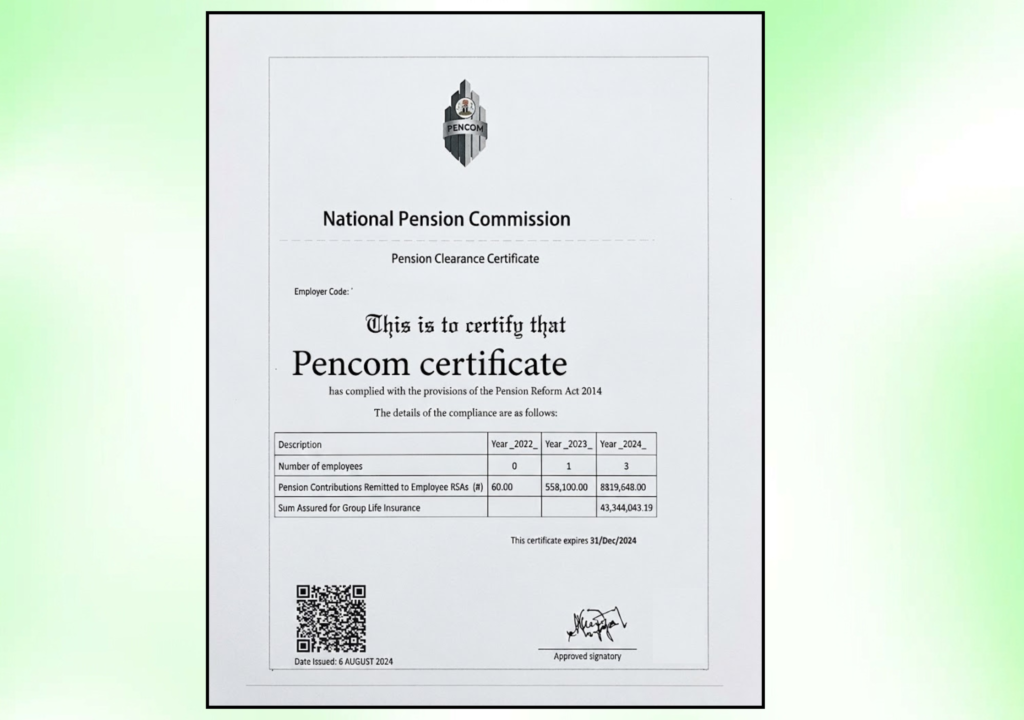
Obtain Your PENCOM certificate
Let us help you obtain your PENCOM Compliance Certificate quickly and hassle-free. Our experts provide reliable support throughout the application process, ensuring you meet all requirements and remain compliant.
The Official Processing Window
PENCOM processes and issues the Pension Clearance Certificate in about 15 working days once a complete and accurate application is successfully submitted. That translates to roughly three calendar weeks, excluding weekends and public holidays.
However, that number has shifted in recent years. Since the full automation of the PCC process, PENCOM now targets a five working day turnaround for employers who apply through the online portal and upload all required documentation correctly.
So the official window sits between five and fifteen working days, with the actual outcome depending on one variable more than any other: whether your documents are complete and accurate from the start.
What Affects How Long It Actually Takes
Complete vs Incomplete Applications
Applications are processed within the advertised time frame of 15 working days only if all requirements are available. In the event of any deficiency, a notification is sent to the applicant for remedial action before the certificate can be issued. The PCC will not be issued if the applicant fails to provide the requested documents.
This means a deficient application does not get processed and returned with corrections. It stops. You get a deficiency notice, fix whatever is missing, and effectively restart the review clock. Some companies go through this cycle more than once.

Post-Submission Errors
After submission, no edits can be made until PENCOM reviews the file. The PENCOM portal does not allow corrections after submission. Any mismatch or omission can lead to automatic rejection.
This is the detail that stretches a five-day process into weeks or months for many applicants. A staff name that does not match what the Pension Fund Administrator has on record, a remittance gap of even one month, or a missing group life insurance policy can all trigger outright rejection rather than a simple correction request.
First-Time vs Renewal Applications
First-time applicants typically take longer because they are also setting up their employer code, reconciling historical remittance records, and sometimes registering employees with PFAs for the first time. Renewal applications, where records are already in the system and contributions have been consistently remitted, tend to move more quickly.
Using a Consultant
With the help of a professional consultant, registration should take between ten and twenty working days, which sounds counterintuitive but reflects the reality that consultants familiar with the portal and PENCOM’s exact requirements tend to submit cleaner applications that avoid the deficiency notice cycle.
Realistic Timeline by Scenario
| Scenario | Likely Processing Time |
|---|---|
| First-time application, documents complete and accurate | 5 to 15 working days |
| First-time application with deficiency or staff list mismatch | 4 to 8 weeks or longer |
| Renewal application, records clean and remittances up to date | 5 to 10 working days |
| Application rejected and resubmitted after correction | Add another full review cycle |
| Application handled by an experienced consultant | 10 to 20 working days, typically without rejection delays |
Obtain Your PENCOM certificate
Let us help you obtain your PENCOM Compliance Certificate quickly and hassle-free. Our experts provide reliable support throughout the application process, ensuring you meet all requirements and remain compliant.
What You Can Do to Get It Faster
The fastest route to a PCC is submitting a complete, accurate application the first time. That sounds obvious. The problem is that most delays are caused by issues that could have been caught before submission, not by anything PENCOM does slowly.
Before you apply, reconcile your staff list against your PFA records. Every employee’s name, RSA PIN, and salary details on your application must match exactly what each PFA holds on file. Even a middle name spelled differently can flag the application.
Pull a fresh CAC status report within weeks of applying, not months. Confirm your group life insurance policy is active and current, not lapsed. Verify your remittance records are complete with no gaps. Check that your employer code is already on PENCOM’s system, because assuming it exists when it does not is a common first-time error.
Once all of that is in order, the portal process itself is straightforward. Upload your documents, complete the form, pay through a PENCOM-approved Payment Solution Service Provider, and submit. Do not expect to go back in and fix anything after that point.
What Happens If Your Application Is Rejected
A rejected application is not the end of the process, but it does reset the clock. PENCOM notifies the applicant of the specific deficiency. The applicant corrects it and submits a fresh application. That fresh application then goes through the same review window again.
For companies that discover a rejection close to a contract deadline, this can be a serious problem. The only practical solution at that stage is to move as fast as possible on the correction and consider engaging a compliance consultant who can push the application through with fewer back-and-forth cycles.
Rejection is also more likely for companies where underlying pension obligations have not been kept up to date. If remittances were paused, employees were registered with wrong details, or contributions were calculated incorrectly, these issues need to be resolved at source before a new application will succeed.
Frequently Asked Questions
Can I get the PENCOM certificate in less than five working days?
Not under normal circumstances. Five working days is the current lower bound under the automated system for applications that are complete and correct. There is no expedited or priority processing lane available.
Does the 15-working-day window include weekends?
No. The 15-working-day timeline refers to business days only, which means it spans roughly three calendar weeks excluding weekends and public holidays. If public holidays fall within that window, processing extends accordingly.
What happens if I submit my application in December?
The PCC is valid from January to December of the year it is issued, regardless of when during the year you apply. If you apply in late November or December and the review takes 15 working days, you may receive a certificate valid only for a few weeks before it expires at year end. Companies that rely on the certificate for contracts should apply early in the year, not as a year-end afterthought.
Can I apply for next year’s certificate before this year’s expires?
PENCOM typically opens the window for new-year applications toward the end of the current year. Applying early ensures continuity, particularly for companies with active government contracts that cannot afford a gap in their compliance status.
Does the application fee affect processing speed?
No. The PCC itself is issued free of charge by PENCOM. Where a payment is required, it must go through PENCOM-approved Payment Solution Service Providers only. Payment through an unapproved channel will not be recognised and will stall your application.
Is there a way to check my application status while it is being processed?
Yes. The PENCOM online portal allows applicants to log in and track the status of a submitted application. Checking the portal is faster than contacting PENCOM directly and gives you an early signal if a deficiency notice has been issued.
Conclusion: Plan Around Fifteen Working Days, Aim for Five
The safest planning assumption for a PENCOM Compliance Certificate is fifteen working days. That gives you buffer for minor queries or review delays without putting a contract deadline at risk.
If your documents are genuinely complete and accurate, you may see it in five working days. If there is any mismatch, any gap in your remittance history, or any error on your staff list, that five-day estimate becomes meaningless because the rejection and resubmission cycle can add weeks.
Start the process at least a month before you actually need the certificate. That window covers the worst-case scenario without making you feel the pressure of a countdown.
Obtain Your PENCOM certificate
Let us help you obtain your PENCOM Compliance Certificate quickly and hassle-free. Our experts provide reliable support throughout the application process, ensuring you meet all requirements and remain compliant.