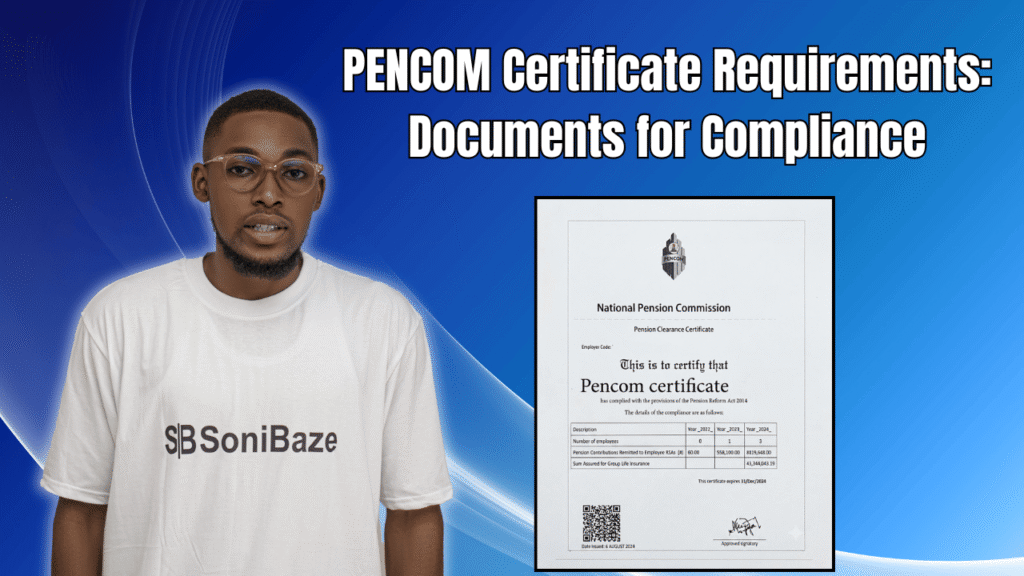
Getting a PENCOM Compliance Certificate sounds straightforward until you actually sit down to gather the documents. Several of them depend on records your HR or payroll team should already have, but rarely keep in one organised place. The application itself moves quickly once everything is ready. The slow part is almost always the document gathering.
This article lists out exactly what you need before applying for a PENCOM Compliance Certificate, why each document matters, and where applicants commonly slip up.
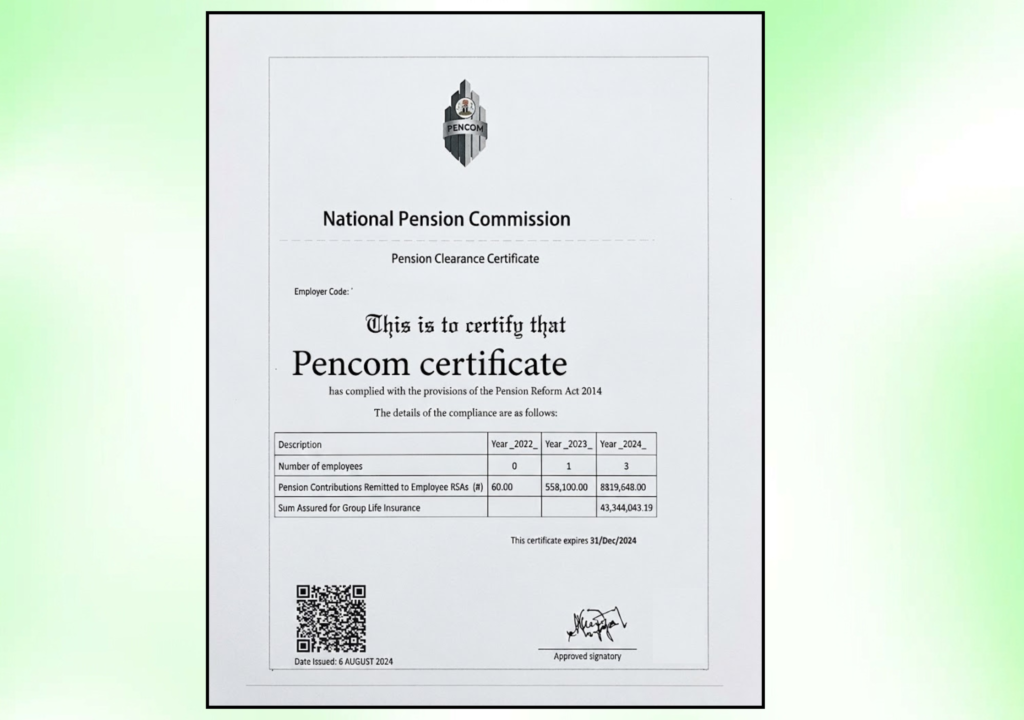
Obtain Your PENCOM certificate
Let us help you obtain your PENCOM Compliance Certificate quickly and hassle-free. Our experts provide reliable support throughout the application process, ensuring you meet all requirements and remain compliant.
Before You Start: Basic Conditions Your Company Must Meet
PENCOM does not issue certificates to companies that have not met the underlying obligations of the Pension Reform Act 2014. Before gathering documents, confirm three things.
Your company must have at least three employees, since this is the threshold at which participation in the Contributory Pension Scheme becomes mandatory. Every one of those employees must have a Retirement Savings Account with a Pension Fund Administrator of their choosing. And your company must have been remitting pension contributions for those employees on a consistent, documented basis.
If any of these three conditions are not yet met, fix them first. No amount of correctly formatted paperwork will get you a certificate if the underlying compliance does not exist.
Core Documents Required for the PCC Application
1. Certificate of Incorporation
This is the foundational proof that your company legally exists. PENCOM needs a photocopy of your Certificate of Incorporation issued by the Corporate Affairs Commission.
If your company has changed its name, address, or directors since incorporation, make sure you also have the updated CAC documents reflecting those changes. Mismatches between your incorporation details and your current company information are a common reason applications get queried.
2. Memorandum and Articles of Association
Alongside the Certificate of Incorporation, PENCOM typically asks for your Memorandum and Articles of Association, or the equivalent constitutional documents for your company structure. These confirm the legal framework under which your business operates.

3. CAC Status Report
A current Status Report from the Corporate Affairs Commission shows your company’s directors, shareholders, registered address, and share capital as they stand today, not as they were at incorporation. Many companies submit an old status report, assuming the one from registration is sufficient. PENCOM wants a fresh one.
Request this report close to your application date. A status report that is several months old by the time you submit can raise questions if anything has changed in the interim.
4. FIRS Tax Identification Number Printout
Your Tax Identification Number from the Federal Inland Revenue Service is a basic requirement for any kind of regulatory compliance in Nigeria, and PENCOM is no exception. You will need a printout of your TIN as evidence.
5. Letter Requesting an Employer Code
Before you can be assessed for compliance, PENCOM needs to have your company on record as a registered employer under the Contributory Pension Scheme. If you do not already have an employer code, your application package needs to include a formal letter requesting one, accompanied by your Certificate of Incorporation and TIN evidence.
Companies that have been operating for years sometimes assume they already have an employer code simply because they have been remitting pension contributions. Confirm this rather than assuming, since applying without a valid employer code on file will stall the process.
6. Employee Staff List with RSA PINs and PFA Details
This is often the document that takes the longest to prepare correctly. PENCOM requires a full staff list showing each employee’s name exactly as registered with their Pension Fund Administrator, their RSA PIN, their job title, and their monthly salary.
The names on this list must match what each employee’s PFA has on file. If an employee registered their RSA under a slightly different name, perhaps a maiden name, a missing middle name, or a different spelling, that mismatch will surface here and can lead to automatic rejection of the application.
7. Evidence of Pension Contribution Remittances
PENCOM needs to see that contributions have actually been paid, not just calculated. This typically means remittance schedules and evidence of payment covering the relevant period, showing the salary, the contribution amount, and the date each payment was made.
This evidence needs to align with the staff list. If your staff list shows ten employees but your remittance records only cover seven, that gap needs an explanation, or correction, before submission.
8. Group Life Insurance Policy
The Pension Reform Act 2014 requires employers to maintain a group life insurance policy for employees, covering a minimum of three times their annual total emoluments. Evidence of an active group life insurance policy is part of the standard PCC documentation package.
Companies sometimes let this policy lapse without realising it, particularly if it was set up years ago and renewal was handled by a since-departed staff member. Confirm the policy is current before you apply, not after a rejection notice points it out.
Document Checklist at a Glance
| Document | What It Proves | Common Issue |
|---|---|---|
| Certificate of Incorporation | Legal existence of the company | Outdated if company details have changed |
| Memorandum and Articles of Association | Legal structure of the company | Often missing for older companies |
| CAC Status Report | Current directors, shareholders, address | Submitted as an old, outdated copy |
| FIRS TIN Printout | Tax registration | Usually straightforward if TIN is active |
| Employer Code Request Letter | Registration as an employer under CPS | Assumed to exist when it doesn’t |
| Staff List with RSA PINs and PFA Details | Employee pension registration | Name mismatches with PFA records |
| Remittance Evidence | Contributions actually paid | Gaps between staff list and remittance records |
| Group Life Insurance Policy | Compliance with insurance requirement | Policy lapsed without renewal |
How the Application Process Works Once Documents Are Ready
As of April 2026, PENCOM requires all PCC applications to be submitted through its online portal rather than in person or by physical submission. Once your documents are assembled, you complete the application online and upload supporting evidence.
One detail that catches applicants out is that the portal does not allow edits after submission. Once you submit, PENCOM reviews the file as it stands, and any mismatch or omission can lead to automatic rejection rather than a request for clarification. This makes the document-gathering stage far more important than it might initially seem, since there is no opportunity to patch a small error after the fact.
Where a fee applies, PENCOM only accepts payment through its approved Payment Solution Service Providers. Attempting to pay through an unapproved channel will not be recognised.
When everything is accurate and complete, processing typically takes two to three weeks. Applications with discrepancies, particularly staff list mismatches, take considerably longer because they often require a fresh submission rather than a simple correction.
Frequently Asked Questions
What is the single most common reason PCC applications get rejected?
Mismatches between the employee staff list submitted to PENCOM and the records held by each employee’s Pension Fund Administrator. Even small differences, such as a name spelled differently or an RSA PIN entered incorrectly, are enough to trigger rejection because PENCOM cross-checks this information directly.
Can I correct my application after submitting it on the portal?
No. The PENCOM portal does not allow edits once an application is submitted. If an error is discovered after submission, the typical outcome is rejection, after which you would need to correct the underlying issue and submit a fresh application.
How many employees does my company need to qualify for a PCC?
PENCOM issues certificates only to employers with at least three active employees, in line with the threshold set by the Pension Reform Act 2014 for mandatory participation in the Contributory Pension Scheme.
Do I need a group life insurance policy even if my company is small?
Yes. The requirement to maintain group life insurance for employees applies regardless of company size, as long as the company is within scope of the Pension Reform Act 2014. This is a standard part of the PCC documentation requirements.
How long is the PENCOM Compliance Certificate valid once issued?
The certificate is valid until the 31st of December of the year it is issued, regardless of when during the year it was obtained. Companies that need it for ongoing contracts or licence renewals must reapply each year.
Can a consultant prepare and submit the application on my company’s behalf?
Yes, many companies engage a consultant to gather documents and manage the submission, particularly when staff lists are large or ownership and remittance records need reconciling before they match. The application itself is still submitted under the company’s details, but a consultant can help identify mismatches before submission rather than after a rejection.
Conclusion: Get Your Records Right Before You Touch the Portal
The PENCOM application portal itself is not complicated. What takes time is making sure your CAC documents, staff list, RSA records, remittance evidence, and insurance policy all tell the same consistent story about your company.
Since the portal does not allow corrections after submission, the only real safeguard against rejection is doing this reconciliation work before you apply, not during the review process. Companies that treat document gathering as the main task, rather than a formality before the “real” application, tend to get through on their first attempt.
Obtain Your PENCOM certificate
Let us help you obtain your PENCOM Compliance Certificate quickly and hassle-free. Our experts provide reliable support throughout the application process, ensuring you meet all requirements and remain compliant.