One of the first questions businesses ask when someone tells them they need a BPP certificate is how much it costs. The answer surprises most people, because the registration itself is free. What is not free is everything else that goes into getting it done properly.
This article breaks down what you actually pay for when getting a BPP certificate in 2026, including consultant fees, compliance document costs, and the annual renewal picture.
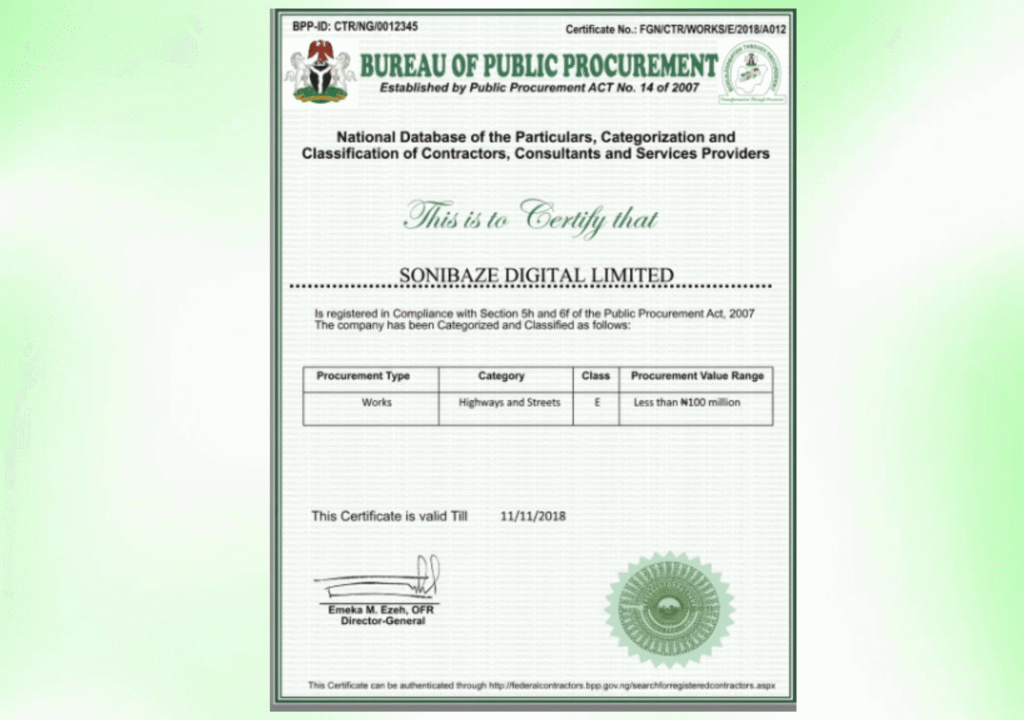
Obtain Your BPP Certificate
Let us help you obtain your Bureau of Public Procurement (BPP) Registration Certificate quickly and hassle-free. Our experts provide reliable support throughout the registration process, ensuring your business is ready to participate in public procurement opportunities.
The BPP Certificate Registration Fee
The Bureau of Public Procurement does not charge a fee to register on the National Database of Federal Contractors, Consultants and Service Providers. Initial registration for Nigerian companies is completely free of charge. This is the official position from the BPP and has not changed going into 2026.
Foreign companies registering on the database may face a verification fee, the amount of which is determined by the BPP. But for the overwhelming majority of Nigerian businesses asking this question, the registration fee is zero.
Where money comes in is the supporting documents required to complete the registration, and the optional consultant fees if you choose not to file the application yourself.
What You Are Actually Paying For
The total cost of getting a BPP certificate in practice includes the compliance certificates that must be in place before the application can be completed. These certificates have their own costs and processing timelines.
| Compliance Document | Issuing Body | Cost | Notes |
|---|---|---|---|
| BPP Registration (IRR) | Bureau of Public Procurement | Free | No fee for Nigerian companies |
| Tax Clearance Certificate (TCC) | FIRS | Free | Requires tax returns to be up to date |
| NSITF Certificate | Nigeria Social Insurance Trust Fund | Based on payroll contributions | Companies must have paid NSITF contributions |
| PENCOM Certificate | National Pension Commission | Based on pension contributions | Exempt for companies with fewer than 3 employees |
| ITF Certificate | Industrial Training Fund | 1% of annual payroll | Exempt for companies with fewer than 5 employees or below ₦50m turnover |
| CAC Documents | Corporate Affairs Commission | Already paid at incorporation | May require certified true copies if originals are unavailable |
The ITF contribution of 1% of total annual payroll is the one that catches most employers by surprise. It is not a flat fee, and for a business with a payroll of ₦5,000,000 annually, that means ₦50,000 in ITF contributions must be settled before the compliance certificate is issued.
Consultant Fees for BPP Registration in 2026
Most businesses, particularly those going through the process for the first time, use a consultant to handle document preparation and submission. The consultant does not pay a government fee on your behalf. Their charge covers the time and expertise spent coordinating your documents, filling the portal correctly, and following up until the certificate is issued.
| Service Level | Fee Range | What Is Included |
|---|---|---|
| Basic assisted registration | ₦20,000 to ₦40,000 | Document checklist, portal submission, follow-up |
| Standard professional service | ₦40,000 to ₦80,000 | Document review, compliance coordination, portal submission, follow-up |
| Full compliance package | ₦80,000 to ₦200,000+ | Includes obtaining NSITF, PENCOM, ITF, TCC, plus BPP submission |
The full compliance package cost varies significantly depending on your company size, payroll, and how many compliance certificates you still need to obtain. A company that already has its TCC, NSITF, and PENCOM certificates in order will pay at the lower end of the range. A company that needs all of these sorted from scratch pays more.
Total Estimated Cost of Getting a BPP Certificate in 2026
The table below gives a realistic view of what different business sizes might spend when getting a BPP certificate for the first time, including all compliance costs.
| Business Profile | Estimated Total Cost | Key Variables |
|---|---|---|
| Sole trader or micro business (below 3 staff) | ₦0 to ₦30,000 | Likely exempt from PENCOM and ITF; consultant fee optional |
| Small business (3 to 10 staff) | ₦40,000 to ₦120,000 | NSITF and PENCOM required; ITF depends on turnover |
| Medium business (10 to 50 staff) | ₦100,000 to ₦300,000 | All compliance certificates required; ITF based on payroll |
| Large business (50+ staff) | ₦300,000 and above | Higher payroll means higher ITF; full compliance package likely needed |
These figures are estimates covering compliance contributions and consultant fees. They do not include legal fees if the company requires a lawyer to certify documents or verify CAC records separately.
Obtain Your BPP Certificate
Let us help you obtain your Bureau of Public Procurement (BPP) Registration Certificate quickly and hassle-free. Our experts provide reliable support throughout the registration process, ensuring your business is ready to participate in public procurement opportunities.
Annual Renewal Costs
BPP registration requires annual renewal at the start of each new year. The renewal itself is also free for local companies. However, if any of your compliance certificates have lapsed, they will need to be renewed before the BPP renewal can be completed.
| Annual Renewal Item | Cost |
|---|---|
| BPP database renewal | Free |
| Tax Clearance Certificate renewal | Free (requires current tax filings) |
| NSITF renewal | Based on annual contributions |
| PENCOM renewal | Based on pension remittances |
| ITF renewal | 1% of annual payroll |
| Consultant renewal fee | ₦15,000 to ₦50,000 |
The practical reality is that businesses that keep their compliance certificates current throughout the year find renewal straightforward and low-cost. Those who let certificates lapse face the cost of catching up on contributions plus penalty fees before renewal is possible.
Freelancer vs Agency vs Self-Filing: Cost Comparison
| Option | Typical Cost | Risk Level | Best For |
|---|---|---|---|
| Self-filing | ₦0 (excluding compliance costs) | High if documents are incorrect | Businesses with all compliance docs already in place |
| Freelance consultant | ₦20,000 to ₦50,000 | Medium | Cost-conscious businesses with basic compliance in order |
| Professional agency | ₦50,000 to ₦200,000+ | Low | First-time registrants or businesses with complex compliance gaps |
Self-filing is possible and some businesses do it successfully. The risk is getting one document wrong and having the application sit in a review queue for weeks. A rejected application does not cost money to resubmit, but the time cost is real, particularly when a contract bid has a deadline.
Red Flags: Signs You May Be Overpaying
Some consultants and agents charge inflated fees by presenting the BPP certificate itself as something that requires a payment to the government. It does not. If anyone tells you there is a mandatory government processing fee for the BPP certificate above and beyond the compliance documents, that is not accurate.
A consultant charging ₦500,000 or more for straightforward BPP registration without including the full suite of compliance certificates is worth questioning. Ask for a breakdown of exactly what the fee covers before committing.
Similarly, if a service provider tells you the process takes three months and the fee must be paid upfront in full with no documentation, look elsewhere.
Frequently Asked Questions
Is there any official government fee for BPP registration?
No. The BPP does not charge a fee for initial registration by Nigerian companies. What companies pay are the compliance contributions to NSITF, PENCOM, and ITF, which are statutory obligations separate from the BPP process itself, and optional consultant fees for assisted filing.
Can I get a BPP certificate without paying a consultant?
Yes. The BPP portal at federalcontractors.bpp.gov.ng is open to any registered Nigerian company. If all your compliance documents are in order and you follow the registration steps carefully, you can complete the process without engaging a consultant. The challenge is usually not the portal itself but having all the required documents ready and correctly formatted.
How much does it cost to renew a BPP certificate?
Renewal is free. You log in to the BPP portal and update your company’s performance information for the preceding year. The only costs involved are if any of your compliance certificates have lapsed and need to be renewed before the BPP update is submitted.
Does BPP registration include NSITF and ITF?
No. NSITF and ITF are separate registrations with separate regulatory bodies. The BPP registration requires you to upload valid NSITF and ITF compliance certificates as part of the application. Getting those certificates is a separate process that costs money based on your payroll and contribution history.
What happens if I register with BPP without valid compliance certificates?
The BPP portal will not allow the registration to be completed without the required documents. If you attempt to submit an application without a valid Tax Clearance Certificate or the applicable compliance certificates, the application will be flagged or rejected.
Is the BPP certificate the same as a no objection certificate?
No. The BPP Interim Registration Report confirms your company is listed on the national contractor database and is eligible to bid for Federal Government contracts. The No Objection Certificate is issued by BPP for specific contracts above ₦100 million and is a separate document tied to a particular procurement process.
Conclusion: The Certificate Is Free, the Preparation Is Not
The BPP certificate itself costs nothing for Nigerian businesses to obtain. What the process costs in practice is the sum of your compliance contributions to NSITF, ITF, and PENCOM, plus whatever you pay a consultant to handle the filing correctly and on time.
For a small business with all compliance certificates already sorted, the total out-of-pocket expense is minimal. For a business starting from scratch with no compliance history, the cost of getting everything in order first is the real investment. Budget for that realistically, get your documents in order before approaching the BPP portal, and the registration itself will be the easiest part of the process.
Obtain Your BPP Certificate
Let us help you obtain your Bureau of Public Procurement (BPP) Registration Certificate quickly and hassle-free. Our experts provide reliable support throughout the registration process, ensuring your business is ready to participate in public procurement opportunities.