Most Nigerian business owners only think about tax compliance when something is blocked. A government contract is on the table. A bank loan application is stuck. A visa requires supporting documents. Then someone mentions the Tax Clearance Certificate and the scramble begins.
The good news is that getting a TCC is not complicated if your tax records are in order. The process is well-defined, and for most existing businesses, it can now be done almost entirely online. This article walks you through every step, from registration to certificate download, and covers the parts that commonly cause delays.
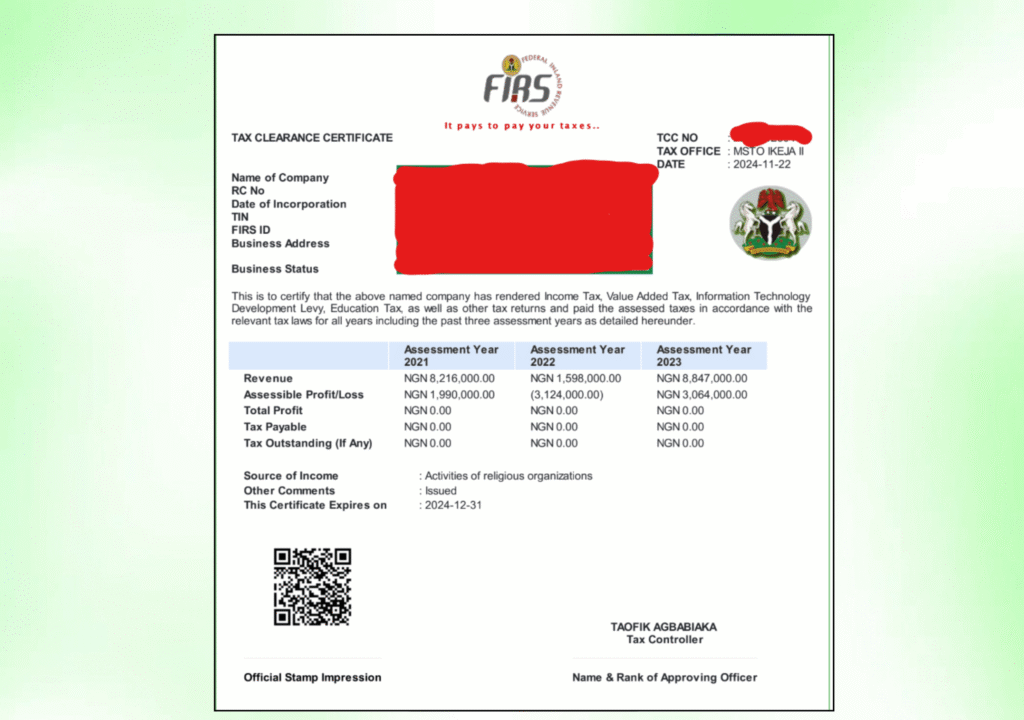
Obtain Your Tax Clearance Certificate (TCC)
Let us help you obtain your Tax Clearance Certificate (TCC) quickly and hassle-free. Our experts provide reliable support throughout the application process, ensuring your business meets all tax compliance requirements.
What Is a Tax Clearance Certificate?
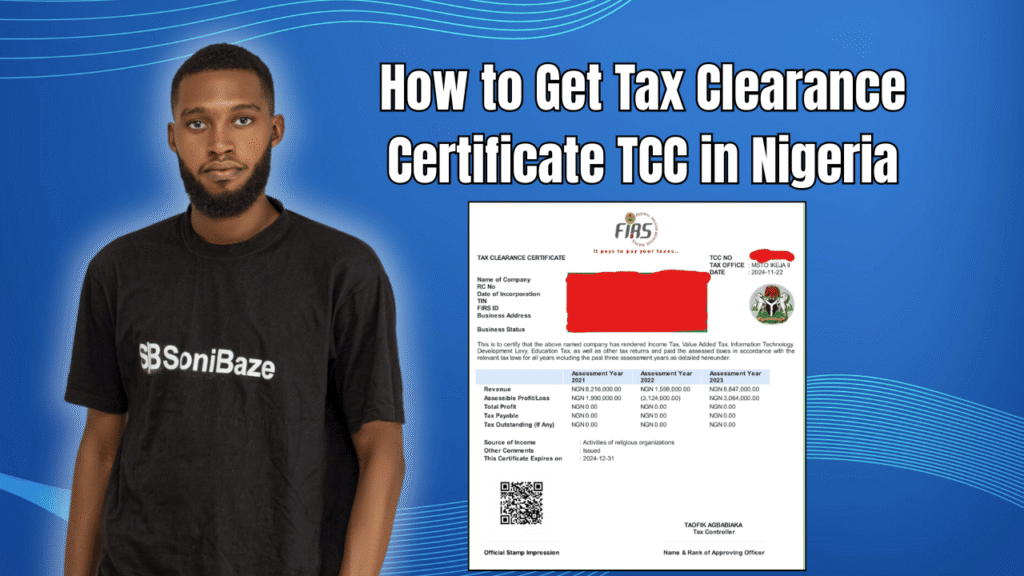
A Tax Clearance Certificate is an official document issued by the Federal Inland Revenue Service or a State Internal Revenue Service confirming that a taxpayer, whether an individual, company, or organisation, has no outstanding tax liabilities for a specified period. In Nigeria, that period is always the three years immediately before the current year of assessment.
If you get a TCC in 2026, it covers your tax compliance status for 2023, 2024, and 2025. The certificate typically remains valid for 12 months from the date of issue, after which it expires and you need a new one.
Two separate authorities issue TCCs in Nigeria. FIRS covers federal taxes including Company Income Tax, Withholding Tax, and Value Added Tax. State IRS offices cover Personal Income Tax for individuals and sole proprietors. Having a FIRS TCC does not mean you are covered at the state level, and vice versa. Many business owners learn this the hard way when a procurement process asks for both.
Who Needs a TCC in Nigeria?
| Situation | TCC Required From |
|---|---|
| Bidding for a government contract | FIRS (and sometimes State IRS) |
| Renewing a business licence or permit | State IRS or FIRS depending on licence type |
| Applying for a bank loan | FIRS or State IRS |
| Applying for an import or export licence | FIRS |
| Obtaining a Certificate of Occupancy or title documents | State IRS |
| Immigration applications, including work permits | FIRS |
| Registering as a contractor with government MDAs | FIRS |
| Repatriating funds abroad | FIRS |
Expatriates and foreign nationals doing business in Nigeria are also required to have a TCC to show compliance with local tax laws, particularly where their home country has a bilateral tax agreement with Nigeria.
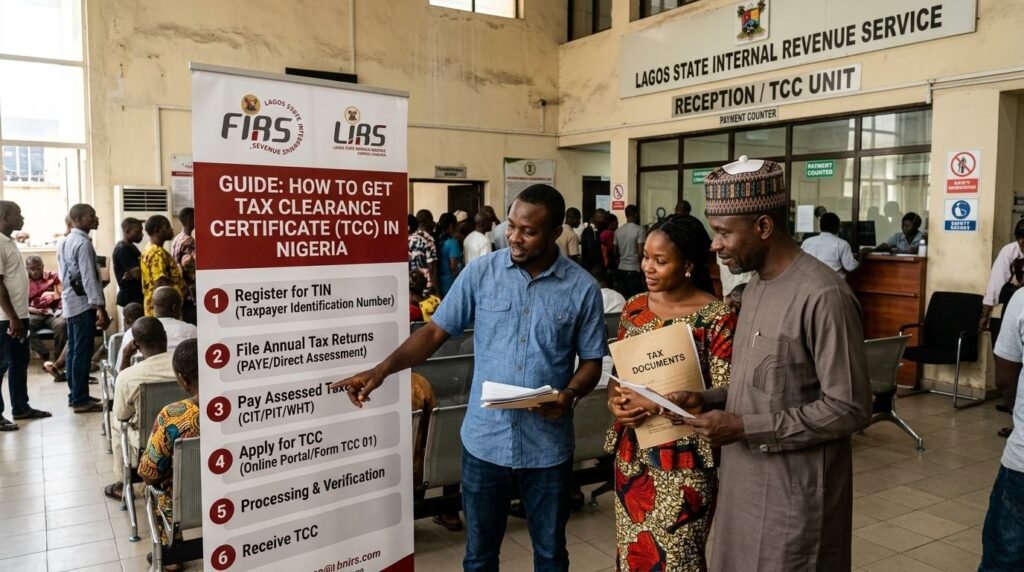
Prerequisites Before You Apply
Getting a TCC is the last step in a tax compliance process, not the first. These things need to be in place before you apply.
| Prerequisite | Details |
|---|---|
| Tax registration | Must be registered with FIRS or the relevant State IRS |
| Tax Identification Number (TIN) | Obtained from the Joint Tax Board or FIRS at registration |
| Filed tax returns | All annual returns must be filed, even years with zero income |
| Paid all outstanding taxes | Any arrears, penalties, or assessments must be cleared before the certificate can be issued |
| Audited financial statements | Required for companies, covering the years in the TCC period |
The most important point here is that unfiled returns and unpaid taxes will block your application entirely. FIRS will not issue a TCC if there are outstanding liabilities or gaps in your return history.
How to Get a TCC in Nigeria: Step by Step
There are two application paths depending on whether you are an existing taxpayer or a new one.
Step 1: Confirm Your Tax Status
Before submitting anything, log into the FIRS TaxPro-Max portal or visit your designated tax office to check your compliance position. Look at whether all returns have been filed for the relevant years, whether any assessments or queries are pending, and whether all payments are reflected in the system.
If there are gaps, address them first. Applying with a pending reconciliation will only result in a query that adds weeks to your timeline.
Step 2: File Any Outstanding Returns
Annual tax returns are typically due between January and March of the following year. If any year in your TCC coverage period is missing a return, file it before you apply. For companies, this means submitting audited financial statements alongside the return. Even if your business made no profit in a particular year, the return must still be filed.
Step 3: Clear All Outstanding Tax Liabilities
Calculate any taxes owed across the TCC period and pay them. This covers Company Income Tax, PAYE where you have employees, VAT, and Withholding Tax. Obtain evidence of payment from FIRS or the relevant State IRS, since you will need this as a supporting document.
Step 4: Apply for the TCC
For existing companies registered with FIRS for two or more years and with filed returns, the process is now largely automated.
Visit the FIRS TCC e-services portal at tcc.firs.gov.ng and log in with your credentials. Click “Generate TCC” and a copy of the certificate will be sent to your registered email address. For most compliant existing companies, this takes less than a minute.
If the online generation fails, it usually means one of the following: there is an unfiled return, there is a pending tax reconciliation, or there is an unresolved query on your account. In any of these cases, visit your designated FIRS tax office directly.
Step 5: New Companies or First-Time Applicants
New companies, meaning those that have filed returns with FIRS for fewer than two years, cannot generate their TCC automatically online. After clicking “Generate TCC” on the portal, the certificate will not be sent automatically. The applicant or an authorised representative must visit the designated FIRS tax office with supporting documents and apply manually.
The tax office will review the application, may request additional information, and upon successful review, will approve the TCC for download from the portal.
Step 6: Download and Store Your Certificate
Once approved, download the TCC from the FIRS portal. FIRS no longer issues physical hard copies of the certificate. Keep the digital copy alongside your other compliance documents, and print a copy for any submission that requires a physical document. The TCC number on the certificate can be used to verify its authenticity online.
Obtain Your Tax Clearance Certificate (TCC)
Let us help you obtain your Tax Clearance Certificate (TCC) quickly and hassle-free. Our experts provide reliable support throughout the application process, ensuring your business meets all tax compliance requirements.
Summary: TCC Application Process at a Glance
| Step | Action | Where |
|---|---|---|
| 1 | Confirm tax compliance status and identify any gaps | FIRS TaxPro-Max portal or tax office |
| 2 | File all outstanding annual returns | FIRS portal or tax office |
| 3 | Pay all outstanding tax liabilities | FIRS portal or bank |
| 4 | Apply online via TCC portal | tcc.firs.gov.ng |
| 5 | If online fails, apply manually | Designated FIRS tax office |
| 6 | Download and save the certificate | FIRS TCC portal |
Required Documents for TCC Application
| Document | Who Needs It |
|---|---|
| Tax Identification Number (TIN) | All applicants |
| Certificate of Incorporation or CAC registration | Companies |
| Audited financial statements | Companies, for the TCC coverage years |
| Filed tax returns (copies) | All applicants |
| Evidence of tax payments | All applicants |
| Valid means of identification | Individuals and sole proprietors |
| Payslips for last three years | Employed individuals on PAYE scheme |
| Bank statement | Individuals without payslips |
| Previous TCC (for renewal) | All applicants renewing |
Common Mistakes That Delay or Block Your TCC
Many applicants run into problems that could have been avoided. Filing returns late or skipping years where no income was earned is the most common one. FIRS requires a return for every year in the TCC period regardless of whether taxes were owed. A missing return for a zero-income year is still a missing return, and it will block the application.
Using a TIN that does not match your current business details is another frequent issue. If your company name, address, or director information changed after registration, those records need to be updated with both CAC and FIRS before applying, since mismatched records across systems will trigger a compliance flag.
Waiting until a contract or licence deadline is days away is the third problem. If your records are not clean, there is no fast route. Address compliance gaps before you need the certificate urgently.
How Long Does It Take to Get a TCC?
For existing companies using the online portal with complete, accurate records, generation can be near-instant. The statutory processing window before FIRS introduced the automated system was two weeks, but the e-TCC system largely eliminates that wait for compliant applicants.
Manual applications, for new companies or those with issues on their account, typically take two to four weeks depending on how quickly queries are resolved and what the processing volume at the tax office is at the time.
Frequently Asked Questions
Can an individual apply for a TCC, not just a company?
Yes. Any registered taxpayer in Nigeria, including employed individuals, self-employed professionals, and sole proprietors, can apply for a TCC. Employed individuals under the PAYE scheme apply through their State IRS rather than FIRS. Self-employed individuals who are registered with FIRS apply through the FIRS system.
Is a FIRS TCC the same as a State IRS TCC?
No. They cover different taxes and are issued by different authorities. FIRS issues TCCs covering federal taxes like Company Income Tax, VAT, and Withholding Tax. State IRS offices issue TCCs covering Personal Income Tax. Some contracts and processes require both. Do not assume that one covers the other.
What happens if my TCC application is rejected?
You will typically receive a query specifying what is missing or incorrect. Common reasons include unfiled returns, unpaid taxes, or mismatched records. Responding promptly to the query and correcting the issue is the only path forward. There is no alternative route or appeals shortcut.
How long is a TCC valid after it is issued?
A TCC is typically valid for 12 months from the date of issue. An expired TCC does not mean you are non-compliant; it just means your proof of compliance is outdated. Some organisations will accept an expired TCC temporarily while you are processing a renewal, but this is not guaranteed and should not be relied upon.
Does having a valid TCC mean I have no tax obligations going forward?
No. A TCC is a snapshot of your compliance status at the time it is issued. It does not exempt you from ongoing tax obligations, including filing returns for the current year, remitting PAYE, and paying VAT. Ongoing compliance is what allows you to renew the certificate without complications the following year.
Can a tax consultant handle the TCC application on my behalf?
Yes. Businesses can engage a tax consultant to manage the application process, particularly when there are outstanding reconciliations or multiple years of returns to file. The consultant cannot access a separate processing channel, but they can structure and submit documents accurately, which reduces the likelihood of queries and delays.
Conclusion: Compliance First, Certificate Second
The TCC is not something you obtain independently. It is a certificate that confirms the compliance work that already happened: the filings, the payments, the record-keeping. If those are clean, the certificate follows quickly. If they are not, no amount of urgency changes that.
The most practical thing any business or individual can do is treat tax compliance as a year-round activity rather than a sprint before a deadline. File returns on time, pay what is owed, and the TCC becomes a formality rather than an obstacle.
Obtain Your Tax Clearance Certificate (TCC)
Let us help you obtain your Tax Clearance Certificate (TCC) quickly and hassle-free. Our experts provide reliable support throughout the application process, ensuring your business meets all tax compliance requirements.