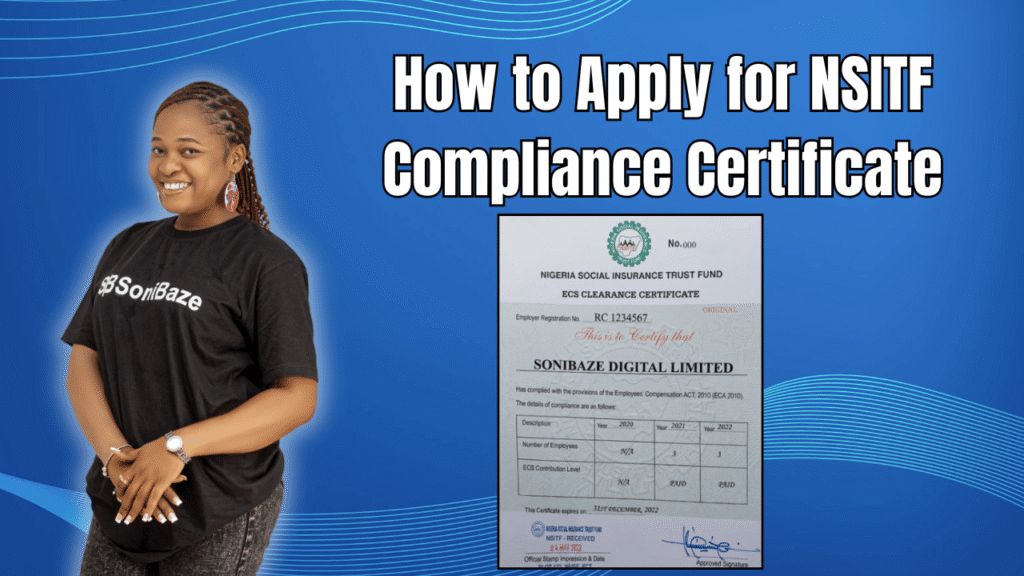
A Lagos construction company won a federal government contract worth ₦48 million in early 2025. They had the capacity, the equipment, and the track record. What they did not have was an NSITF Compliance Certificate. The contract was withdrawn at the procurement stage. By the time they registered and obtained the certificate, the client had moved on to the next bidder.
This is not an unusual story. The NSITF Compliance Certificate is one of the most commonly overlooked compliance documents in Nigeria, and it tends to become urgent only when a contract is already on the table.
This article walks through exactly how to apply for one, what you need to bring, what the process costs, and what to expect at each stage.
Obtain Your NSITF Certificate
Let us help you obtain your Nigeria Social Insurance Trust Fund (NSITF) Compliance Certificate quickly and hassle-free. Our experts provide reliable support throughout the application process, ensuring your business meets all statutory compliance requirements.
What Is NSITF and Why Does the Certificate Exist?
The Nigeria Social Insurance Trust Fund administers the Employees’ Compensation Scheme, a mandatory social insurance programme that financially protects employees who suffer work-related harm. Coverage includes medical treatment, rehabilitation, and financial compensation for injury, disease, or death sustained in connection with work.
NSITF operates under the Employee Compensation Act 2010, which replaced the older Workmen’s Compensation Act. The Act empowers NSITF to collect employer contributions and provide compensation for workplace injuries, occupational diseases, disability, and death.
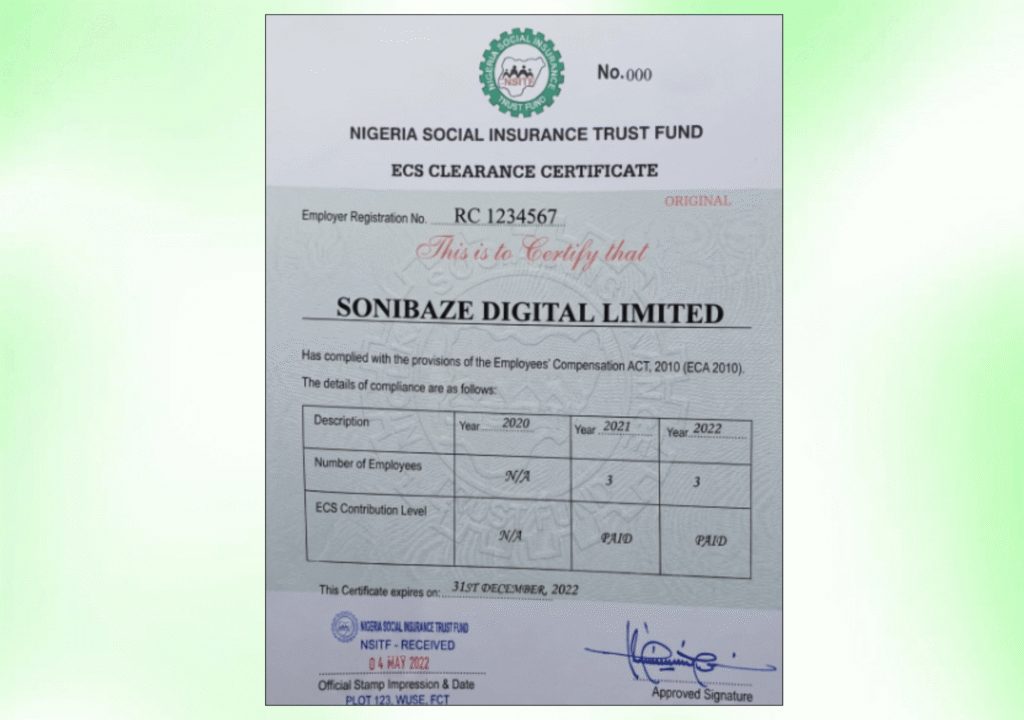
The Compliance Certificate is proof that your organisation has registered under this scheme and has been making contributions as required. Without it, you cannot bid for government contracts. Many private sector clients now ask for it during vendor onboarding as well.
Who Is Required to Register?
All employers in Nigeria, including public and private sector organisations, must register and contribute. Participation is not optional. Coverage applies to all employees on payroll, including full-time workers, contract staff, and casual workers.
The threshold is straightforward. Any business with at least one employee on its payroll must register with NSITF and contribute 1 percent of total monthly payroll. Once a worker appears on your payroll, the obligation begins.
There are limited exemptions. Persons employed in the public service of the Federation or a State or local government who are entitled to pension benefits on substantially similar terms are exempt, as are persons entitled to diplomatic status, non-Nigerian citizens employed in Nigeria for fewer than six years who contribute to a social security scheme in another country, and ministers of religion engaged in the propagation of their faith.

Documents Required Before You Apply
Getting your documentation right before approaching NSITF saves significant time. The following is what you need.
CAC Certificate of Incorporation. This confirms the legal existence of your business and is the starting point for any compliance process in Nigeria.
Memorandum and Articles of Association. Required alongside the Certificate of Incorporation for limited liability companies.
CAC Status Report. A current status report showing your company’s directors, shareholders, and registered address as they stand today.
Tax Identification Number printout. Your TIN from the Federal Inland Revenue Service is required as part of the standard document set.
Staff list with employee particulars. A schedule of all employees on payroll, including their names, job roles, and monthly salaries. This is used to assess your contribution obligation.
Employer Schedule of Payment (Form ECS RE03). This form covers your contribution calculations and is completed during the application process.
Evidence of payment. Once your assessment is done and your contribution amount is determined, you will need proof that payment was made via the approved channel.
Step-by-Step Application Process
Step 1: Obtain and Complete the ECS RE01 Form
The first step is to obtain and complete Form ECS RE01 (Registration of Employer) and Form ECS RE03 (Employer Schedule of Payment).
The first step for registration is to obtain an NSITF ECS RE01 Form from the NSITF office nearest to your company’s location. The form contains particulars of the business for public and private companies, particulars of owners of the organisation for sole proprietorships and partnerships, and the particulars of the business sector categories.
Once this form is completed, it is returned to the NSITF office, after which the ECS RE03 form is issued for completion of your payment schedule.
Step 2: Submit Your Documents and Undergo Wage Assessment
There will be a physical assessment of your employees’ wages by NSITF in order to ascertain the amount that will be paid monthly for the full year.
This is where your staff list becomes critical. NSITF uses your wage schedule to calculate your monthly contribution obligation. Inaccurate or incomplete staff lists will slow this stage down considerably.
Step 3: Pay Your Contribution via Remita
Payments are made via the Remita platform after an assessment of staff remuneration by NSITF. NSITF does not accept payment through unofficial channels. All contributions must go through Remita to be recognised in the system.
The NSITF Employees’ Compensation Scheme contribution is 1 percent of total gross monthly payroll. It is payable by the employer alone — no deduction is made from employee salaries. The remittance due date is the last working day of each month for that month’s payroll.
Step 4: Submit a Request Letter for the Compliance Certificate
To receive the Compliance Certificate, submit an official request letter along with the Certificate of Incorporation, completed ECS forms, and evidence of payment.
The request letter should be on your company letterhead, addressed to NSITF, and should include your Employer Registration Number, which is issued after successful registration.
Step 5: Receive Your Certificate
The Compliance Certificate is typically processed within 5 working days upon successful submission of all requirements and verification of payment.
Upon successful registration, a Letter of Notification with a 10-digit Registration Number will be issued to the employer by NSITF. The Compliance Certificate follows once contributions and documentation are verified.
Obtain Your NSITF Certificate
Let us help you obtain your Nigeria Social Insurance Trust Fund (NSITF) Compliance Certificate quickly and hassle-free. Our experts provide reliable support throughout the application process, ensuring your business meets all statutory compliance requirements.
Cost of the NSITF Compliance Certificate
The initial registration and certification process typically incurs a cost of ₦50,000. This is the registration and certification fee, separate from the ongoing monthly contribution of 1 percent of total payroll.
The contribution itself varies by company since it is based on actual payroll figures. A company with ten employees earning ₦100,000 each per month, for example, would contribute ₦10,000 monthly, which is 1 percent of the ₦1,000,000 monthly payroll.
Late payment carries a penalty. If any contribution is not paid within the due date, five percent of the amount unpaid shall be added for each month or part of a month after the date when payment should have been made. Any unpaid contribution and interest shall be recoverable as a debt owed to NSITF from the employer.
What Happens If You Have Not Been Remitting
Many Nigerian SMEs discover their NSITF gap only when a contract requires the certificate. At that point, the question becomes how to regularise outstanding arrears.
NSITF allows employers to regularise their position by paying arrears of contributions owed, along with the applicable penalty of 5 to 10 percent per month on unpaid amounts. Once arrears are settled and current contributions are in place, the Compliance Certificate can then be issued.
The earlier this is handled, the lower the penalty exposure. Businesses that have been operating for several years without remitting can accumulate significant arrear amounts. Getting an assessment from NSITF before a tender deadline arrives is far better than trying to compress this process into days.
NSITF Application Process at a Glance
| Step | Action | Key Detail |
|---|---|---|
| 1 | Obtain and complete Form ECS RE01 | Available at any NSITF zonal office |
| 2 | Submit documents and undergo wage assessment | NSITF assesses monthly contribution based on staff list |
| 3 | Pay contribution via Remita | 1% of gross monthly payroll, employer’s cost only |
| 4 | Submit request letter for Compliance Certificate | Include CAC documents, ECS forms, and payment evidence |
| 5 | Receive Certificate | Typically within 5 working days of complete submission |
Frequently Asked Questions
Is the NSITF Compliance Certificate the same as the NSITF registration certificate?
No. Registration with NSITF gives you an Employer Registration Number and a Letter of Notification. The Compliance Certificate is a separate document issued after registration is complete, contributions are current, and you formally request it. Many employers have an ERN but have never applied for the Compliance Certificate itself.
How often does the NSITF Compliance Certificate need to be renewed?
The certificate needs to be renewed annually. Employers must maintain ongoing contribution remittances to qualify for renewal. Gaps in remittance will delay or block renewal, which is why consistent monthly payment through Remita matters beyond just the initial application.
Can the NSITF Compliance Certificate be verified online?
Yes. All issued NSITF Compliance Certificates can be verified directly on the NSITF website.This is the channel banks, government agencies, and procurement officers use to confirm authenticity before accepting a certificate.
Does NSITF apply to casual or contract staff, not just permanent employees?
Yes. Once a worker appears on payroll, the employer must contribute. Coverage applies to all employees on payroll, including full-time workers, contract staff, and casual workers.
What is the penalty for not registering with NSITF at all?
Non-compliance exposes a business to penalties, certificate denial, liability claims, and disqualification from government procurement. Beyond the regulatory risk, an employer without NSITF coverage carries the full financial liability if an employee sustains a work-related injury, since there is no fund to draw compensation from.
How long does NSITF registration take if starting from scratch?
Registration with NSITF takes an average of 5 working days when all documents are complete and correct. Complications over missing documents, staff list discrepancies, or arrear assessments can extend this significantly.
Conclusion: Don’t Wait for a Contract to Make This Urgent
The NSITF Compliance Certificate is not complex to obtain. The process is linear, the costs are predictable, and the timeline is short when documents are in order. What makes it difficult for most businesses is that they only think about it when a deadline is already pressing.
Registering early, remitting consistently every month through Remita, and keeping your staff records current means the certificate becomes something you renew annually rather than scramble for on short notice. That is a much better position to be in when a ₦48 million contract appears on your radar.
Obtain Your NSITF Certificate
Let us help you obtain your Nigeria Social Insurance Trust Fund (NSITF) Compliance Certificate quickly and hassle-free. Our experts provide reliable support throughout the application process, ensuring your business meets all statutory compliance requirements.