Outdoor advertising in Nigeria is a booming industry, but it operates within a defined legal and regulatory framework that many advertisers, business owners, and billboard operators either do not know about or choose to ignore until it costs them. From banned product categories to content that violates public decency laws, the rules around what goes on a billboard in Nigeria are more detailed than most people assume.
If you are planning an outdoor advertising campaign or you own billboard structures and want to stay on the right side of the law, this guide covers everything you need to know.
Let’s get your brand on billboards around Abuja and seen by the right audience.
Who Regulates Billboard Content in Nigeria?
Before diving into what is prohibited, it helps to understand who is doing the regulating. Billboard content in Nigeria is governed at both the federal and state level, and in some cases by multiple bodies simultaneously.
The Advertising Regulatory Council of Nigeria (ARCON) is the primary federal body responsible for regulating all advertising in the country, including outdoor. Established under the Advertising Regulatory Council of Nigeria Act, ARCON has authority over advertising standards, content approval, and enforcement across all media.
At the state level, agencies like the Lagos State Signage and Advertisement Agency (LASAA) and the Abuja Metropolitan Management Council (AMMC) in the FCT add another layer of content and placement standards that advertisers must comply with.
Beyond these, sector-specific regulators like the National Agency for Food and Drug Administration and Control (NAFDAC), the National Broadcasting Commission (NBC), and the Securities and Exchange Commission (SEC) each have content rules that extend to outdoor advertising within their respective industries.
In practice, this means a billboard advertising a pharmaceutical product may need to satisfy both ARCON and NAFDAC standards simultaneously.
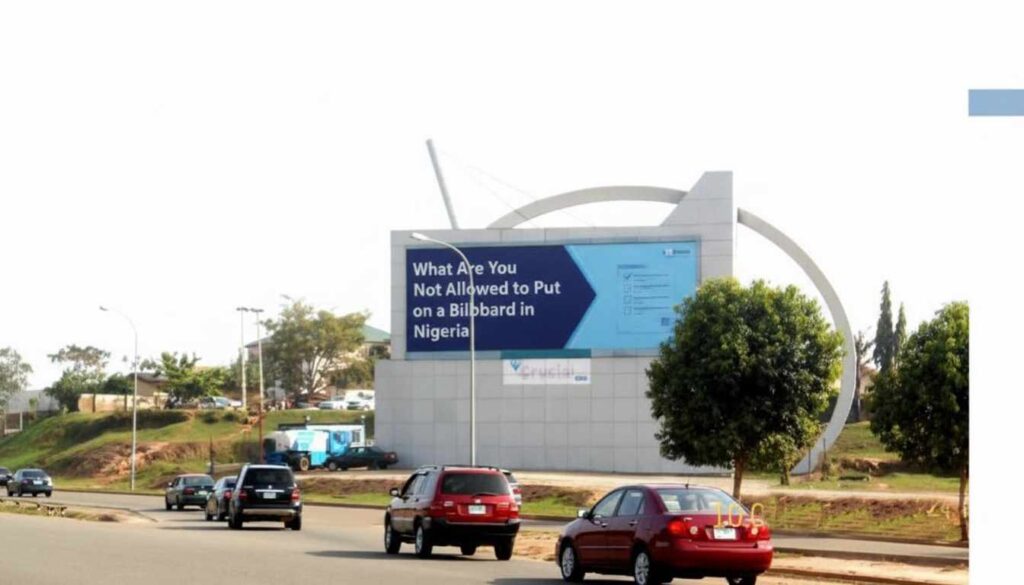
Prohibited and Restricted Content on Nigerian Billboards
1. Tobacco and Cigarette Advertising
This is one of the clearest and most enforced prohibitions in Nigerian advertising law. The advertising of cigarettes, tobacco products, and related smoking accessories on billboards is banned outright. This falls in line with Nigeria’s obligations under the World Health Organisation Framework Convention on Tobacco Control, which the country ratified. Any outdoor campaign promoting tobacco products, directly or indirectly, is illegal and subject to immediate takedown.
2. Alcoholic Beverages (With Conditions)
Alcohol advertising is not banned entirely, but it comes with strict conditions that many campaigns still violate. ARCON guidelines prohibit alcohol advertisements from:
- Targeting or featuring people who appear to be under 18 years of age
- Suggesting that alcohol consumption improves physical performance, mental ability, or social success
- Associating alcohol with driving, operating machinery, or any activity requiring concentration
- Using imagery or language that appeals primarily to minors
- Being placed near schools, places of worship, hospitals, or recreational facilities primarily used by children
Billboards that carry alcohol content must carry a clear responsible drinking disclaimer and must not be located within restricted zones near institutions serving young people.
3. Content That Violates Public Decency
Nigerian law under the Criminal Code and various state-level ordinances prohibits obscene, indecent, or offensive content in public spaces. For billboard advertising, this means:
- Nudity or sexually suggestive imagery is prohibited
- Content that is vulgar, offensive, or likely to cause public distress cannot be displayed
- Images or language that demeans any gender, ethnic group, or religion are banned
ARCON’s code of advertising practice specifically requires that advertisements must not offend against decency and must not contain anything likely to cause serious or widespread offence to the Nigerian public.
4. False and Misleading Claims
Any billboard content that makes claims that are false, exaggerated, or cannot be substantiated is prohibited. This covers:
- Health or medical claims that are not supported by clinical evidence
- Price or discount claims that do not reflect actual offerings
- Product performance claims that exceed what the product can deliver
- Before-and-after imagery that has been manipulated or is unrepresentative
NAFDAC specifically polices false health claims in advertising for food, drugs, cosmetics, and medical devices. Billboard campaigns that make unsupported medical or nutritional claims are routinely shut down.
5. Unregistered Products and Services
A product or service cannot be legally advertised in Nigeria if it has not received the appropriate regulatory approval. For consumer goods, this means a valid NAFDAC registration number must exist before any outdoor campaign goes live. For financial services, SEC or CBN registration is required. Advertising an unregistered product on a billboard exposes both the advertiser and the billboard owner to regulatory action.
6. Political and Electoral Content Without Approval
Political advertising in Nigeria is tightly controlled, particularly during electoral periods. The Independent National Electoral Commission (INEC) has guidelines on political campaign materials including outdoor advertising. Political billboards that contain defamatory content about opposing candidates, use government insignia or symbols in misleading ways, or appear outside approved campaign periods are subject to removal. State governments and the AMMC in Abuja have at various times conducted mass removal exercises of political billboards erected without proper approval or outside designated periods.
7. Content That Promotes Discrimination or Hatred
Billboards that contain messaging promoting ethnic, religious, or racial hatred are prohibited under Nigerian law. Given the country’s diverse religious and ethnic composition, content that can be interpreted as targeting or demeaning any particular group is taken seriously by regulators and can trigger immediate enforcement action beyond just advertising law.
8. Lottery, Gambling, and Betting (Restricted Zones)
Betting and gaming companies have become significant outdoor advertisers in Nigeria, but content regulations apply. Advertising for these platforms cannot target minors or use imagery that appeals to young people, be placed near schools, religious centres, or youth facilities, or make guarantees of winnings or portray gambling as a reliable source of income. Several state governments have imposed additional restrictions on betting advertisement placement, particularly in residential zones and around educational institutions.
9. Counterfeit or Trademark-Infringing Content
Billboards that carry logos, brand identities, slogans, or imagery belonging to another company without authorisation are a violation of intellectual property law. This is more common than it sounds, particularly in markets where counterfeit goods are sold openly. Displaying a billboard for a product that mimics an established brand is both a consumer protection violation and an intellectual property offence.
Let’s get your brand on billboards around Abuja and seen by the right audience.
Placement Restrictions: Where Certain Content Cannot Appear
Content rules are only one side of the equation. Where a billboard is placed also determines what content is acceptable on it. Certain categories of advertising are restricted from specific locations regardless of the content itself.
| Location Type | Content Restrictions |
|---|---|
| Near schools (within 100–200m) | Alcohol, betting, adult-oriented content |
| Near hospitals and clinics | Unverified health claims, tobacco |
| Places of worship | Sexually suggestive content, alcohol |
| Government buildings | Unapproved political content |
| Children’s recreational areas | Betting, alcohol, adult content |
State agencies like LASAA and AMMC maintain their own maps of sensitive zones where content restrictions are stricter than the general standard.
ARCON’s General Standards All Billboard Content Must Meet
Beyond the specific prohibitions above, ARCON requires that all advertising in Nigeria including outdoor must be clearly identifiable as advertising, must not exploit the credulity, lack of knowledge, or inexperience of any audience, must not imitate the advertising of other brands in a way that misleads consumers, must not use testimonials or endorsements that cannot be verified, and must respect the laws of the Federal Republic of Nigeria.
ARCON also requires that advertising materials for certain categories, including pharmaceuticals, financial services, and children’s products, receive pre-approval from the relevant sectoral regulator before going live.
What Happens When You Violate Billboard Advertising Rules in Nigeria?
Enforcement varies by state and by the nature of the violation, but the consequences are real and can be severe.
ARCON has the power to order the immediate removal of non-compliant advertising materials and to sanction both the advertiser and the advertising agency or media owner. Repeat violators can be blacklisted, preventing them from running future campaigns. State agencies like LASAA are known for conducting unannounced enforcement operations where non-compliant billboards are physically taken down, sometimes within hours of a complaint being filed.
For content that violates criminal laws, such as obscenity or incitement to violence, the advertiser may face prosecution beyond just regulatory fines.
Billboard owners who allow prohibited content to run on their structures are not shielded from liability. Regulatory agencies in Nigeria have increasingly pursued both the advertiser and the structure owner in enforcement actions, making due diligence on content a responsibility for both parties.
What Billboard Owners Should Do to Protect Themselves
If you own billboard structures in Nigeria, the content your clients display on your inventory is ultimately tied to your permit and your standing with regulators. Practical steps to protect yourself include reviewing all creative materials before printing or installing any campaign, asking clients to provide evidence of regulatory approval for their product or service before the campaign goes live, including a content compliance clause in your lease or rental agreement that places responsibility on the advertiser for the legality of their content, and staying updated on ARCON advisories and any state-level directives from agencies like AMMC or LASAA that may affect permitted content in your area.
SoniBaze Digital manages billboard placements across Abuja and works with brands to ensure that campaigns meet all regulatory requirements from content to placement. Whether you need outdoor advertising in the FCT or guidance on what your campaign can and cannot say, their team handles the compliance side as part of the placement process. Visit sonibaze.ng to get started.
Frequently Asked Questions
Is alcohol advertising completely banned on billboards in Nigeria?
No, alcohol advertising is not banned outright but it is heavily restricted. Campaigns must follow ARCON guidelines on placement, imagery, and messaging, and cannot target minors or make performance-related claims about alcohol consumption.
Can a religious organisation put anything it wants on a billboard?
Religious content is permitted but must still comply with ARCON’s standards on decency, truthfulness, and non-discrimination. Content that denigrates other religions or makes unverifiable miraculous claims can be challenged by regulators.
Who do I report an offensive or illegal billboard to in Abuja?
You can report to the AMMC, the Abuja Enterprise Agency, or directly to ARCON. LASAA handles complaints in Lagos. Most agencies have online or telephone complaint channels.
Does ARCON approve billboard content before it goes up?
For general categories, billboard content does not always require pre-approval. For regulated sectors like pharmaceuticals, financial products, and children’s goods, pre-approval from the relevant sectoral regulator is required. ARCON can still act on content after it has been displayed if it receives a complaint or identifies a violation.
Can a foreign brand advertise on Nigerian billboards?
Yes, foreign brands can advertise in Nigeria but their campaigns must comply with all Nigerian advertising regulations, including ARCON guidelines and any sector-specific requirements. Products must also be registered for sale in Nigeria through the appropriate regulatory channel.
Are there rules about the language used on billboards?
English and Nigerian languages are both permitted. However, content must not use language that is deceptive, demeaning, or offensive. Slang or cultural references that carry offensive connotations, even if not obviously so to an outside observer, can be subject to regulatory challenge.
Conclusion
Nigeria has a detailed and actively enforced framework governing what can and cannot appear on billboards. Tobacco is out entirely. Alcohol stays within strict boundaries. False claims, indecent content, unregistered products, and unapproved political materials all carry real risk for both advertisers and billboard owners.
The safest approach for anyone involved in outdoor advertising, whether as a brand, an agency, or a structure owner, is to know the rules before the campaign goes live rather than wait for enforcement to find you. ARCON, AMMC, and LASAA are not passive bodies, and the outdoor advertising market in Nigeria is better and more credible for it.
Let’s get your brand on billboards around Abuja and seen by the right audience.