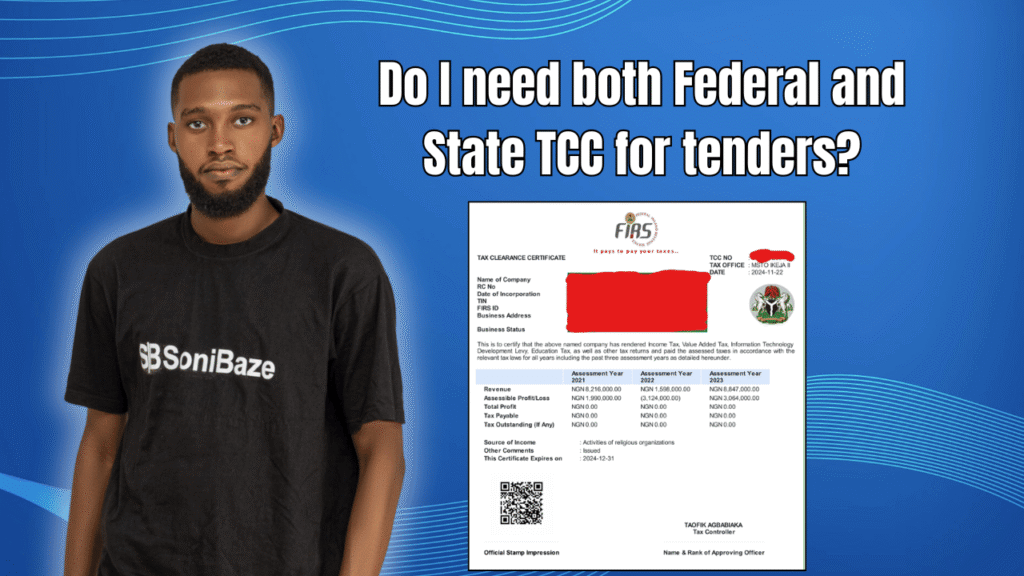
This question comes up constantly among Nigerian business owners preparing their first tender document. You have your FIRS Tax Clearance Certificate and assumed that was enough. Then a procurement officer asks for your state TCC as well, and suddenly a document you thought was sorted becomes a delay.
The short answer is: it depends on the tender. But that is not helpful on its own. This article explains when each type of TCC applies, when both are required, and what the difference actually means in practice.
Obtain Your Tax Clearance Certificate (TCC)
Let us help you obtain your Tax Clearance Certificate (TCC) quickly and hassle-free. Our experts provide reliable support throughout the application process, ensuring your business meets all tax compliance requirements.
What Is a Tax Clearance Certificate?
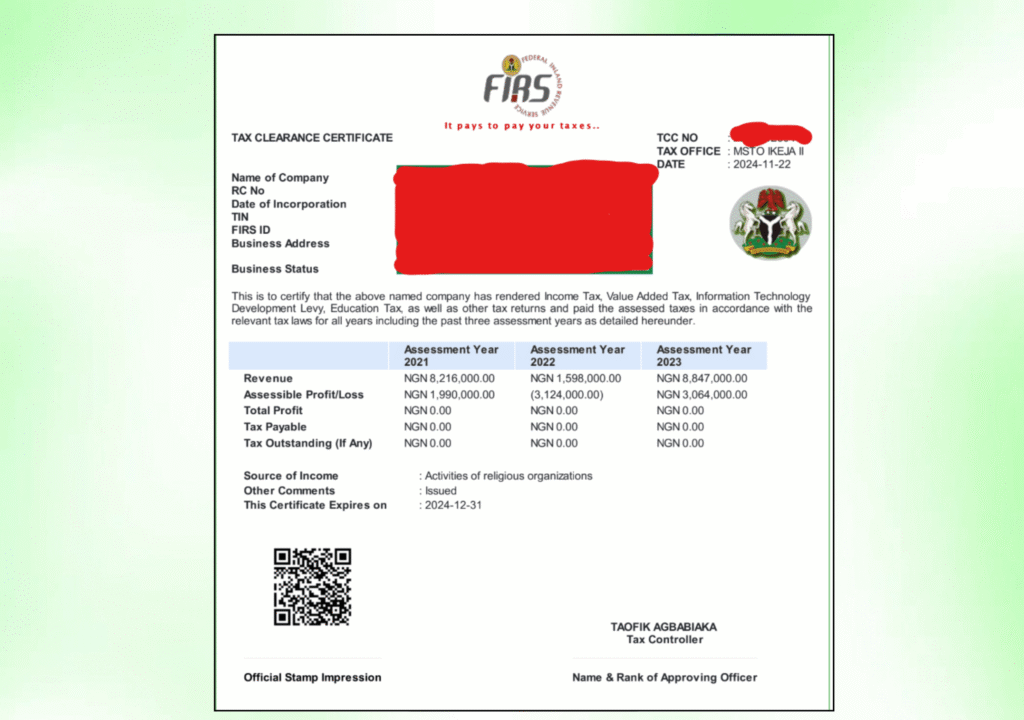
A Tax Clearance Certificate, commonly called a TCC, is an official document issued by a relevant tax authority confirming that a taxpayer has met their tax obligations for the three years immediately preceding the current year of assessment. It proves you have filed your returns and paid taxes due. Without it, most government tenders will not consider your bid at all.
The confusion around “Federal” and “State” TCC comes from the fact that Nigeria operates a three-tier tax system. Different taxes are collected by different authorities, and different TCCs cover different obligations.
Federal TCC vs State TCC: What Each One Covers
| Type | Issuing Authority | Who It Covers | What It Confirms |
|---|---|---|---|
| Federal TCC | Federal Inland Revenue Service (FIRS) / Nigeria Revenue Service (NRS) | Companies registered under CAMA, NGOs, entities under federal tax jurisdiction | Company Income Tax, VAT, Withholding Tax, and other federal levies |
| State TCC | State Internal Revenue Service (SIRS) of the relevant state | Individuals, self-employed persons, sole proprietors, employees under PAYE | Pay As You Earn (PAYE) tax on salaries and state-level personal income tax |
A Federal TCC issued by FIRS covers your company’s corporate tax obligations nationally. A State TCC issued by the SIRS of a particular state covers PAYE and personal income tax obligations within that state’s jurisdiction. Neither certificate covers the other’s obligations.

So Which One Do You Need for Tenders?
Many government contracts now request both the FIRS TCC and the state IRS TCC. The FIRS TCC proves corporate tax compliance while the state TCC proves that the company has been remitting PAYE correctly for its employees.
The practical split works like this:
| Tender Type | TCC Required |
|---|---|
| Federal Government tenders (MDAs) | FIRS / NRS TCC is mandatory. State TCC may also be requested |
| State Government tenders | State TCC is mandatory. FIRS TCC may also be requested |
| Local Government tenders | Requirements vary. Check the specific bid document |
| Private sector contracts | Usually only FIRS TCC, if any |
| Tenders with PAYE compliance checks | Both Federal and State TCC are typically required |
The safest approach is to read the specific tender document carefully rather than assuming. Procurement officers at different MDAs apply the requirements differently. Some ask for only one. Others ask for both.
Why State TCC Is Increasingly Asked For
In the past, many businesses submitted only the FIRS TCC and got away with it. That window has been narrowing. More Federal and State MDAs are tightening their prequalification checklists, and PAYE compliance is one of the areas now under more scrutiny.
The state TCC serves as evidence that your company has been deducting PAYE from employee salaries and remitting it to the relevant State Internal Revenue Service. If your company operates in Abuja, for example, your PAYE obligations are with the FCT Internal Revenue Service. If you operate in Lagos, it is the Lagos State Internal Revenue Service. If your staff are spread across multiple states, technically each state where employees are based could have a claim on PAYE remittances.
For most businesses operating primarily in one location, this means one state TCC. But multi-state operations face a more complex picture.
Obtain Your Tax Clearance Certificate (TCC)
Let us help you obtain your Tax Clearance Certificate (TCC) quickly and hassle-free. Our experts provide reliable support throughout the application process, ensuring your business meets all tax compliance requirements.
When Only the Federal TCC Is Enough
There are situations where the FIRS TCC alone satisfies the requirement. For Federal Government tenders that do not specifically ask for a state TCC, the FIRS certificate is sufficient. The same applies to most banking, loan, and credit facility applications. CAC annual returns and most licence renewals with federal regulatory bodies also rely on the FIRS TCC only.
For companies with fewer than five employees or with minimal payroll, the PAYE compliance issue is smaller, and some procurement officers may not push for the state TCC. But this is not a rule you can rely on. If the bid document asks for it, you need it.
Common Mistakes Businesses Make
The most common mistake is assuming the FIRS TCC covers everything. It covers federal obligations. PAYE is a state obligation, and a company that has been diligent with Company Income Tax but inconsistent with PAYE remittances will struggle to obtain a clean state TCC.
Another mistake is applying for the TCC too late. Allowing at least four to six weeks for the process is advisable, accounting for potential queries or corrections needed. Waiting until a tender deadline is imminent almost guarantees a problem.
A third mistake is applying to the wrong state. If your company address on the CAC certificate lists an Abuja location but your employees are physically working in another state, the state TCC question becomes more complicated. The relevant SIRS is determined by where the employees are based, not necessarily where the company is registered.
What Documents You Need to Get Each TCC
For the Federal TCC (FIRS / NRS)
| Requirement | Details |
|---|---|
| Tax Identification Number (TIN) | Must be registered with FIRS |
| Audited financial statements | Filed with FIRS for the relevant years |
| Tax computation documents | Supporting the amounts assessed and paid |
| Evidence of tax payments | Proof that all assessed taxes have been settled |
| No outstanding liabilities | Unresolved disputes or unpaid balances will delay issuance |
For the State TCC (SIRS)
| Requirement | Details |
|---|---|
| PAYE registration with the relevant SIRS | Company must be registered as an employer |
| Employee payroll records | Evidence of salaries paid and PAYE deductions made |
| PAYE remittance receipts | Proof that deducted PAYE was paid to the SIRS |
| Annual PAYE returns | Filed for the relevant years |
| No outstanding PAYE liabilities | Arrears must be settled before a clean TCC is issued |
How Long Does Each TCC Take?
Both TCCs are typically issued within two weeks of a complete and accurate application. The FIRS now issues electronic Tax Clearance Certificates through its e-TCC portal, which speeds up verification and collection. State Internal Revenue Services vary in their processing speed. Some states have online portals while others still rely on manual processing, which takes longer.
Apply for both at the same time if you know you will need both. Running them in parallel saves weeks compared to waiting for one before starting the other.
Frequently Asked Questions
Is the FIRS TCC valid nationwide for all tenders?
The FIRS TCC is valid nationwide for federal tax compliance purposes. It is accepted by most Federal MDAs as the primary TCC. However, it does not substitute for state PAYE compliance, and some procurement processes specifically ask for both. A TCC issued by a state tax authority applies only to that state’s jurisdiction.
What if my company operates in multiple states?
If your employees are based in different states, your PAYE obligations technically exist in each of those states. In practice, many companies remit all PAYE to the SIRS of the state where the head office is registered. If a tender specifically asks for PAYE compliance documentation and your staff are spread across states, consult a tax consultant on how to handle this before submitting your bid.
Can I verify a TCC before submitting it in a tender?
Yes. FIRS TCCs can be verified through the FIRS e-TCC portal. This is also something procurement officers can do, so submitting an outdated or invalid TCC in a tender is a risk not worth taking. State SIRS verification processes vary by state.
How long is a TCC valid?
A TCC covers the three years immediately preceding the year it is issued. It does not have a strict expiry date printed on it in most cases, but procurement officers typically expect a TCC dated within the current or immediately preceding year. A TCC from two years ago is usually questioned or rejected.
Does a sole proprietor need a Federal or State TCC?
Sole proprietors and self-employed individuals fall under PAYE and personal income tax jurisdiction, which means their TCC is issued by the relevant State Internal Revenue Service, not FIRS. If the tender asks for a TCC, a sole proprietor submits the state TCC. If bidding for a Federal contract that specifically asks for an FIRS TCC, the situation becomes ambiguous and professional advice is worth seeking.
What happens if I submit a tender without the required TCC?
The bid is typically disqualified before it is evaluated. A missing TCC is a prequalification failure, not a minor omission that evaluators overlook. The technical evaluation stage checks compliance documents before anyone looks at pricing or capability.
Conclusion: Read the Bid Document and Prepare Both
The question of whether you need both Federal and State TCC is answered by the tender document in front of you, not by a general rule. But preparing both in advance removes the uncertainty entirely.
Get the FIRS TCC and the relevant state SIRS TCC before tender season starts. Both take time to process, both require your tax records to be clean, and both being available when needed puts you in a stronger position than scrambling when a bid deadline arrives.
Obtain Your Tax Clearance Certificate (TCC)
Let us help you obtain your Tax Clearance Certificate (TCC) quickly and hassle-free. Our experts provide reliable support throughout the application process, ensuring your business meets all tax compliance requirements.