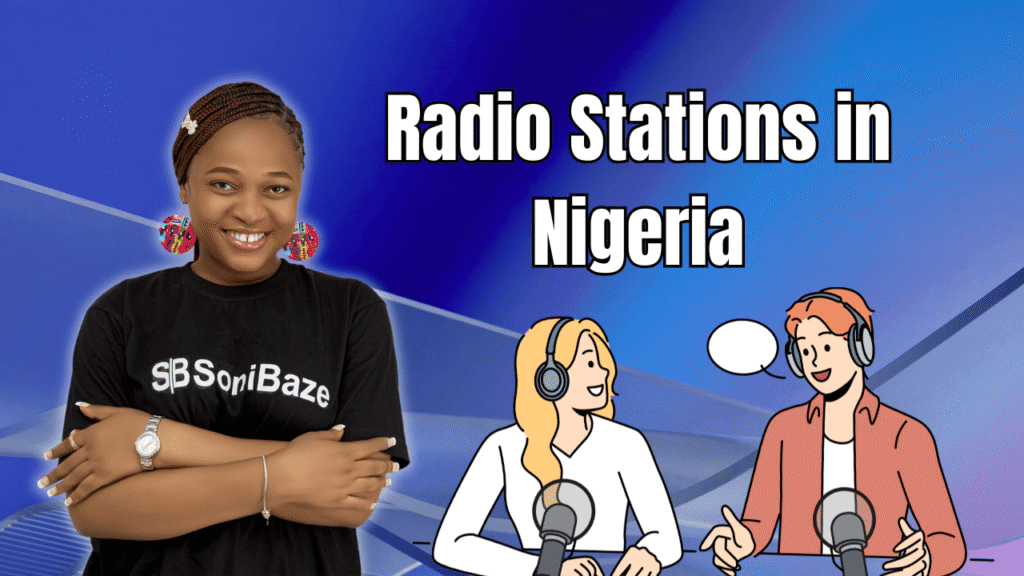
Radio is older than television in Nigeria, and it is still very much alive. Despite the rise of streaming platforms, podcasts, and social media audio, millions of Nigerians tune in to FM radio every single day. In traffic, at markets, on construction sites, in offices. The radio never really left.
This article covers the major radio stations operating in Nigeria, their frequencies across key cities, what each station broadcasts, and who they reach. Whether you are a business looking to advertise on radio, a new listener searching for stations to follow, or just trying to understand the Nigerian broadcast landscape, this is a practical reference.
Get your brand on air across Abuja radio stations and beyond with powerful radio ads.
A Brief Background on Radio in Nigeria
Nigeria’s broadcasting history began in 1932, when the British colonial government established the Radio Distribution Service in Lagos. It was initially a wired relay service, not a true broadcast station. By 1951, the Nigerian Broadcasting Service was created, which later became the Federal Radio Corporation of Nigeria (FRCN) after independence in 1960.
Private radio took off much later. The government monopoly on broadcasting was broken in 1992, when Decree No. 38, later the Nigerian Broadcasting Commission Act, created the National Broadcasting Commission (NBC) and opened the door to private licensing. Raypower FM, licensed in 1994, became one of the first private radio stations in Nigeria.
Today, Nigeria has over 740 functional broadcast stations according to the NBC. That figure covers both radio and television across all 36 states and the FCT. Radio still accounts for the majority.
How Radio Is Regulated in Nigeria
All radio stations in Nigeria must hold a licence from the National Broadcasting Commission. The NBC issues licences, sets content standards through the Nigerian Broadcasting Code, and monitors compliance. Stations that operate without a valid licence or breach the code risk fines, suspension, or revocation.
There are three main categories of radio stations in Nigeria: federal government stations under the FRCN, state government stations under various State Broadcasting Services, and private commercial stations. Community radio stations exist as a separate smaller category. Each category operates under slightly different rules, with federal and state stations having public service obligations and commercial stations being more advertising-driven.
Major Radio Stations in Nigeria
Wazobia FM
Wazobia FM is Nigeria’s first Pidgin English radio station. It launched in Lagos and has since expanded to Abuja, Port Harcourt, Onitsha, and Kano. The station bills itself as “The People’s Station” and broadcasts a mix of local music, talk shows, news, and community discussions entirely in Pidgin.
The appeal is wide. Pidgin cuts across ethnic lines and reaches audiences in markets, motor parks, and working-class neighbourhoods that formal English stations do not always connect with. If you are advertising a mass-market product, Wazobia is one of the most cost-effective radio buys in Nigeria.
| City | Frequency |
|---|---|
| Lagos | 95.1 FM |
| Abuja | 99.5 FM |
| Port Harcourt | 95.1 FM |
| Onitsha | 94.1 FM |
| Kano | 106.3 FM |
Cool FM
Cool FM is one of the most widely distributed private radio stations in Nigeria. It is English-language, music-forward, and aimed primarily at younger urban audiences. The station plays a mix of Afrobeats, pop, hip-hop, and R&B alongside entertainment news and celebrity interviews.
Cool FM operates under the HIER Communications group and has frequencies in Lagos, Abuja, Port Harcourt, and Kano. It is known for well-produced shows and a consistent on-air personality across its branches.
| City | Frequency |
|---|---|
| Lagos | 96.9 FM |
| Abuja | 96.9 FM |
| Port Harcourt | 95.9 FM |
| Kano | 102.7 FM |
Raypower FM
Raypower FM is owned by DAAR Communications, the same group behind AIT television. It is one of Nigeria’s oldest private radio stations, having been on air since the mid-1990s. Raypower broadcasts a mix of news, music, talk shows, and commentary on national issues.
What makes Raypower distinct is its reach. It operates in more Nigerian cities than almost any other private station, including Lagos, Abuja, Kaduna, Benin, Port Harcourt, Jos, Kano, Yenagoa, Enugu, Ilorin, Katsina, Makurdi, Yola, Bauchi, Gombe, Maiduguri, Owerri, Osogbo, and Calabar. For advertisers wanting broad national coverage, Raypower’s network is hard to match.
| City | Frequency |
|---|---|
| Lagos | 100.5 FM |
| Abuja | 100.5 FM |
| Port Harcourt | 98.5 FM |
| Kano | 106.5 FM |
| Enugu | 106.5 FM |
Beat FM
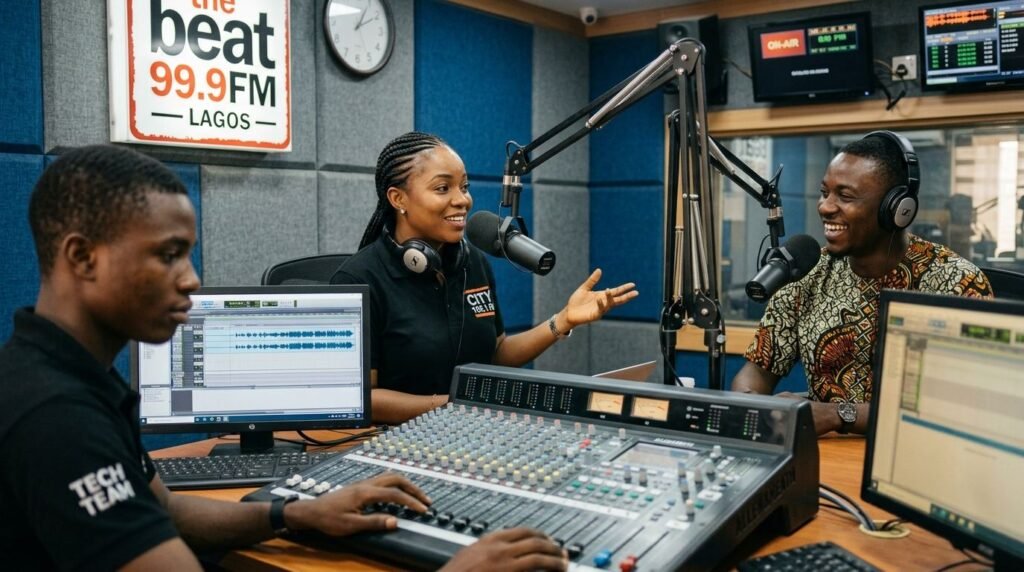
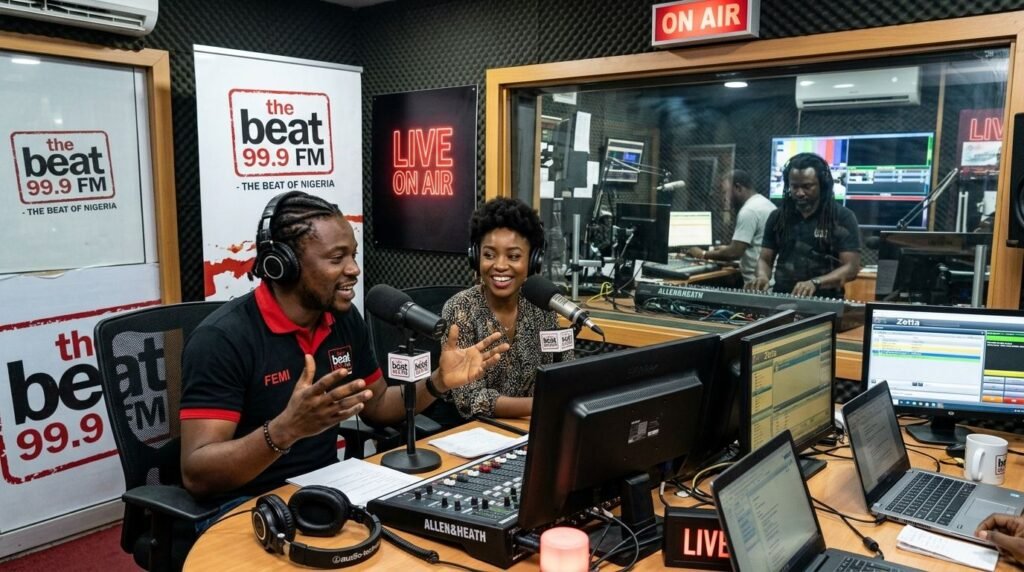
Beat FM, formally The Beat 99.9 FM, is a Lagos-based station focused on the Nigerian entertainment industry. It targets a younger, urban audience with a heavy emphasis on music, pop culture, fashion, and celebrity content. Popular shows include The Morning Rush, The Traffic Beat, and The Nightlife Show.
A separate station, The Beat 97.9 FM, operates in Abuja. Both stations share the same format and brand identity. Beat FM also produces Beat TV, a YouTube channel extension of its on-air content.
| City | Frequency |
|---|---|
| Lagos | 99.9 FM |
| Ibadan | 97.9 FM |
| Port Harcourt | 98.5 FM |
Nigeria Info FM
Nigeria Info FM is a talk radio station. It does not play music. Instead, it runs current affairs programmes, political debates, interviews, and phone-in shows where listeners discuss everything from the economy to local government. Popular programmes include Hard Facts, Morning Crossfire, and The Daily Digest.
Talk radio has a specific audience in Nigeria. These are typically educated, opinionated listeners who follow the news closely, many of them professionals, civil servants, and entrepreneurs. If you are advertising professional services, financial products, or government-facing businesses, Nigeria Info is a well-targeted buy.
| City | Frequency |
|---|---|
| Lagos | 99.3 FM |
| Abuja | 95.1 FM |
| Port Harcourt | 92.3 FM |
| Onitsha | 105.9 FM |
Brila FM
Brila FM is Nigeria’s first and only dedicated sports radio station. It covers football, athletics, basketball, and other sports with live commentary, analysis, and match updates. Its most popular programmes include The Sports Machine, Football Frenzy, and The Weekend Sports Show.
Sports radio in Nigeria has a captive audience. Football is a national obsession, and Brila listeners are among the most loyal and engaged of any station. Brands in the sports, betting, and beverage categories advertise heavily on Brila.
| City | Frequency |
|---|---|
| Lagos | 88.9 FM |
| Abuja | 101.1 FM |
| Onitsha | 88.9 FM |
| Kano | 101.1 FM |
Soundcity Radio
Soundcity Radio is part of the Soundcity Media Group. It focuses on African pop culture, playing Afrobeats, hip-hop, and R&B. Its audience is predominantly young, and it has a strong visual extension through Soundcity TV.
The station is popular across the South-West and South-South regions and is particularly well-regarded for its music programming. If your brand targets young Nigerians aged 15 to 30, Soundcity is worth considering.
| City | Frequency |
|---|---|
| Lagos | 98.5 FM |
| Abuja | 95.3 FM |
| Port Harcourt | 96.3 FM |
| Enugu | 88.3 FM |
Rhythm FM
Rhythm FM is owned and operated by the Silverbird Group, one of Nigeria’s largest media conglomerates. It broadcasts urban contemporary music, a blend of R&B, hip-hop, and Afrobeats, aimed at a younger demographic.
Silverbird operates Rhythm FM across several cities and the station is known for its polished production quality and strong on-air talent. It shares airtime sensibility with Cool FM and Beat FM but has its own loyal following.
| City | Frequency |
|---|---|
| Lagos | 93.7 FM |
| Abuja | 94.7 FM |
| Port Harcourt | 93.7 FM |
| Benin | 93.7 FM |
Classic FM
Classic FM Nigeria is positioned as a premium station for older music and jazz. It plays oldies, classical compositions, and smooth jazz rather than contemporary Afrobeats. The audience is smaller but very specific: typically educated professionals and older Nigerians with a preference for music of a different era.
For niche brands targeting a more mature, affluent audience, Classic FM offers a focused placement that most other stations cannot provide.
Get your brand on air across Abuja radio stations and beyond with powerful radio ads.
Inspiration FM
Inspiration FM blends inspirational content with entertainment and news. It aims at a family-friendly audience and carries uplifting programmes alongside mainstream music. It operates on 92.3 FM in Lagos, 100.5 FM in Ibadan, and 92.3 FM in Uyo.
The station sits between religious broadcasting and mainstream commercial radio. It does well in the South-West and South-South markets.
Federal Radio Corporation of Nigeria (FRCN)
The FRCN is the federal government’s radio broadcaster. It operates Radio Nigeria, which broadcasts from stations in every geopolitical zone of the country. Radio Nigeria operates national, zonal, and state services, broadcasting in English, Hausa, Yoruba, Igbo, and dozens of other Nigerian languages.
The FRCN’s reach into rural and semi-urban areas is unmatched by any private station. Government ministries, health campaigns, agricultural extension services, and public interest programmes rely on FRCN’s network to reach audiences that commercial FM stations do not cover.
State Broadcasting Services
Every state in Nigeria operates at least one government radio station. Lagos State runs Eko FM (89.75 FM) from Ikeja. Abuja has several state and federal frequencies operating in the FCT. Kano State Broadcasting Service, Rivers State Broadcasting Service, and others serve their respective regions with content in local languages and on local issues.
These stations are important for businesses targeting state-level audiences or running campaigns connected to government programmes and public services.
Radio Station Comparison by Use Case
| If You Want To Reach | Best Station(s) | Why |
|---|---|---|
| Mass market across all demographics | Wazobia FM, Raypower FM | Widest geographic and demographic spread |
| Young urban Nigerians 18 to 35 | Cool FM, Beat FM, Soundcity | Music and entertainment format, strong youth listenership |
| Professional and educated Nigerians | Nigeria Info FM | Talk radio attracts engaged, informed audience |
| Sports fans and male audience | Brila FM | Nigeria’s only dedicated sports station |
| Mature and affluent audience | Classic FM | Niche format that filters by taste |
| Rural and semi-urban audiences | FRCN Radio Nigeria | National and zonal reach into underserved areas |
| State-specific audience | State Broadcasting Services | Local language content and state-level reach |
| National multi-city campaign | Raypower FM network | Branches in over 18 cities |
Radio Advertising in Nigeria: What to Know
Radio advertising in Nigeria is sold in spots, typically 30 seconds or 60 seconds. Rates vary significantly by station, time of day, and city. Prime time, which is generally 6am to 9am and 4pm to 7pm, commands the highest rates. Midday and late-night slots are considerably cheaper.
Private FM stations in Lagos and Abuja are the most expensive to advertise on. Stations like Cool FM, Beat FM, and Nigeria Info charge more per spot than state government stations, but they also deliver a more defined audience profile.
If you are running a brand awareness campaign across Nigeria and want radio as part of the media mix, SoniBaze Digital can help with media planning and placement across the right stations for your target audience.
Frequently Asked Questions
How many radio stations are there in Nigeria?
Nigeria has over 740 functional broadcast stations according to the National Broadcasting Commission, though this figure includes both radio and television. The number of licensed FM radio stations alone runs into the hundreds, spread across all 36 states and the FCT.
What is the most popular radio station in Nigeria?
Popularity varies by city and audience. Wazobia FM is often cited as one of the highest-reach stations nationally because of its Pidgin format and multi-city presence. Cool FM and Beat FM lead among younger urban audiences in Lagos and Abuja. Nigeria Info FM is the top choice for current affairs listeners.
Can I listen to Nigerian radio stations online?
Yes. Most major Nigerian radio stations stream live online. Platforms like radio.org.ng and radio.com.ng aggregate Nigerian stations in one place. Individual stations like Cool FM, Beat FM, and Wazobia FM also have their own apps and website streams.
Who regulates radio stations in Nigeria?
The National Broadcasting Commission (NBC) is the regulatory body for all broadcast stations in Nigeria, including radio. It issues and revokes licences, enforces the Nigerian Broadcasting Code, and monitors content standards. The FRCN, which operates federal radio stations, is a separate body but still subject to NBC regulation.
What is the difference between FRCN radio and private FM stations?
The Federal Radio Corporation of Nigeria (FRCN) is a publicly funded broadcaster with a public service mandate. It is required to provide news, education, and cultural content across all regions of Nigeria, including in multiple local languages. Private FM stations are commercially funded through advertising and focus on formats that attract large audiences, primarily music and talk radio in major cities.
What frequency is Cool FM in Abuja?
Cool FM Abuja broadcasts on 96.9 FM. Nigeria Info Abuja is on 95.1 FM. Wazobia FM Abuja is on 99.5 FM. Brila FM Abuja is on 101.1 FM.
Conclusion: Radio Still Reaches Where Other Media Cannot
Television audiences have fragmented. Social media attention is scattered. Radio, for all its age, remains one of the most consistent and cost-effective ways to reach large Nigerian audiences. The morning commute, the market trader, the security guard at the gate, many of them have a radio on.
Understanding which stations reach which audiences is the starting point for any media plan that includes broadcast. The right station placement at the right time of day, with a well-written spot, can deliver results that surprise even experienced advertisers.
Get your brand on air across Abuja radio stations and beyond with powerful radio ads.