The ITF Compliance Certificate is not a one-time document. It expires at the end of every year, and companies that need it for government contracts have to go through the renewal process annually. Miss the window and you can find yourself scrambling to explain a lapsed certificate to a procurement officer while a contract deadline ticks down.
This article covers how the renewal process works, what triggers the obligation to renew, what documents you need, and where things commonly go wrong.
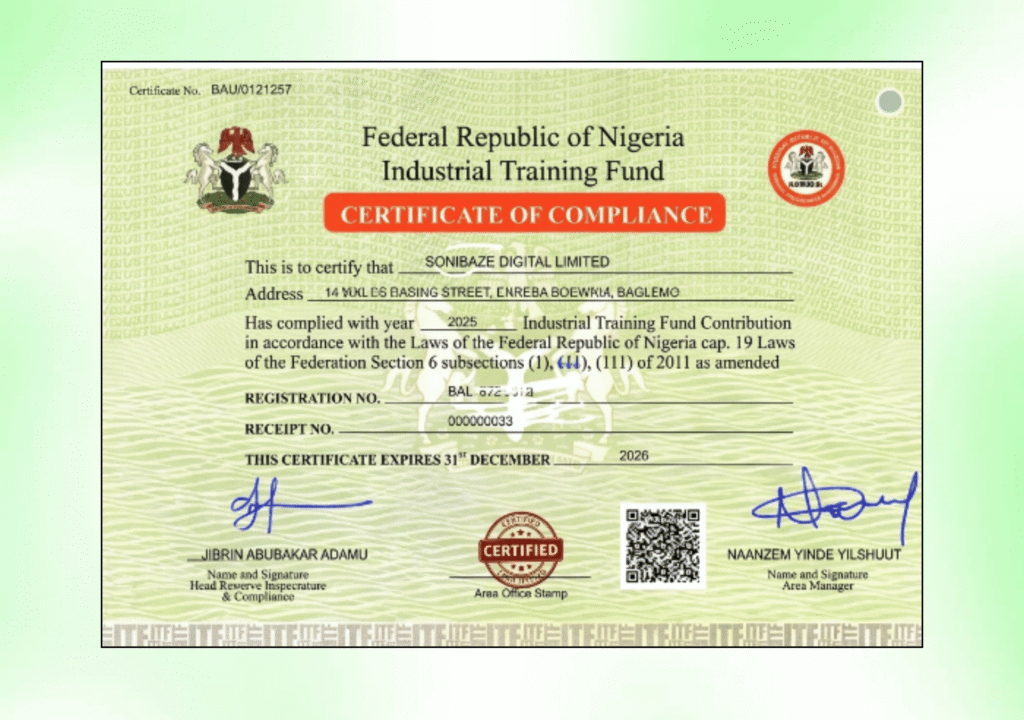
Obtain Your ITF Certificate
Let us help you obtain your Industrial Training Fund (ITF) Compliance Certificate quickly and hassle-free. Our experts provide reliable support throughout the application process, ensuring your business meets all statutory compliance requirements.
What Is the ITF Certificate?
The Industrial Training Fund was established on 8 October 1971 under Decree No. 47, now codified as the Industrial Training Fund Act Cap. I9 Laws of the Federation of Nigeria 2004. Its mandate is to promote and support the acquisition of skills in industry and commerce across Nigeria.
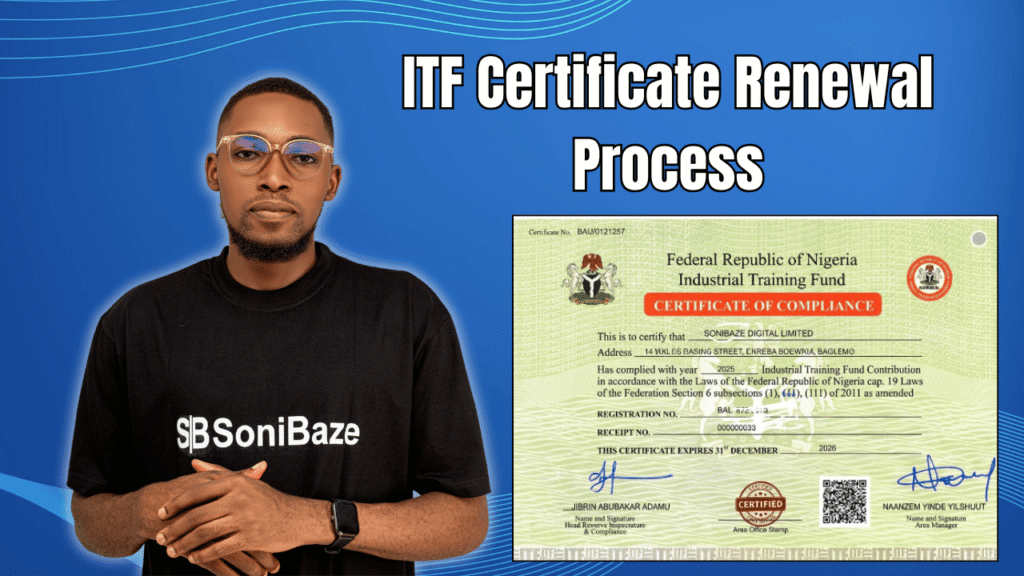
The ITF Compliance Certificate is the document that proves a company has met its obligations under the ITF Act. Specifically, it confirms that the company has registered with the Fund and paid its mandatory annual training contribution. Without it, a company cannot bid for government contracts from federal ministries, departments, or agencies. It is also required for BPP registration and comes up during PENCOM and NSITF compliance checks.
Who Is Required to Renew?
The renewal obligation applies to the same category of businesses required to register in the first place. Any employer with five or more employees, or with an annual turnover of 50 million naira and above, is required to participate in the scheme and therefore must renew each year.
If your company met this threshold when you first registered, assume you still need to renew unless something has materially changed about your headcount or turnover. The ITF does not send automatic reminders when your certificate is approaching expiry.

The Annual Training Contribution: The Core Obligation
Before a renewal certificate can be issued, the company’s outstanding training contribution must be calculated and paid. This is the financial step that the certificate is built on.
Every employer covered by the scheme pays 1 percent of its total annual payroll as a training contribution to the Fund. The contribution covers the full payroll amount and applies to every category of staff on the payroll, not a selected group.
The due date for the annual contribution is April 1 of the year following the contribution year. So contributions based on the 2024 payroll figures are due by April 1, 2025. Late payment attracts a penalty of 5 percent for each month or part of a month on the outstanding amount. That penalty adds up quickly for companies that let contributions slide for several months before addressing them.
Documents Required for Renewal
The renewal process uses largely the same documents as the initial registration. Having them ready before you go to the ITF Area Office or the online portal saves time.
ITF Form 5A, which is the employer’s annual return form. This is the primary form used to declare your payroll figures for the assessment year and calculate the contribution due.
Current audited accounts or management accounts, showing your company’s total payroll for the period being assessed. The ITF uses this to verify the contribution amount due.
Evidence of previous ITF registration, including your ITF National Number, which was issued when your company first registered. Renewal is tied to this number rather than starting a new registration from scratch.
Evidence of payment of the current year’s training contribution, generated through the ITF Pay-Portal or the Remita platform. You cannot walk in with cash. The payment goes through the official channels and the receipt is presented as evidence.
Certificate of Incorporation and current CAC Status Report, to confirm the company’s current legal standing and reflect any changes to directors or company structure since the last renewal.
Tax Identification Number, as part of standard verification.
Obtain Your ITF Certificate
Let us help you obtain your Industrial Training Fund (ITF) Compliance Certificate quickly and hassle-free. Our experts provide reliable support throughout the application process, ensuring your business meets all statutory compliance requirements.
The Renewal Process Step by Step
Step 1: Retrieve and Complete ITF Form 5A
ITF Form 5A is the employer’s return form. It captures your payroll figures for the year being assessed and forms the basis of your contribution calculation. Download it from the ITF portal or collect it from the nearest ITF Area Office.
Fill it in accurately. The figures you enter here are what the ITF Revenue and Compliance Officers will use to assess your liability. Errors or underreporting can trigger queries during assessment and delay the process.
Step 2: Submit Form 5A to Your ITF Area Office
Submit the completed Form 5A to the ITF Area Office where your company is registered. The Area Office vets the form and assesses your contribution liability based on the payroll figures you have declared.
Your company will be assessed by ITF Revenue, Inspectorate, and Compliance Officers at this stage. They review the submission and confirm the amount your company owes for the contribution year.
Step 3: Generate Your Remita Retrieval Reference
Once your liability is confirmed, a Remita Retrieval Reference number is generated through the ITF Pay-Portal or the Remita platform. This reference number is what you take to the bank, or use for online payment, to make the contribution.
Do not attempt to pay without a valid RRR. Payments made without going through this channel are not captured in the ITF system and will not be credited to your account.
Step 4: Make Payment and Obtain Your Teller
Take the RRR to a bank and make the payment. After payment, collect a printout of the payment confirmation and a duplicate teller from the bank. Both documents are needed for the next step.
For companies using Remita’s online payment option, print the payment confirmation immediately after the transaction is completed. Do not rely on email delivery alone.
Step 5: Return to the ITF Area Office with Payment Evidence
Bring the payment printout and duplicate bank teller back to the ITF Area Office. At the office, a hard copy receipt and an acknowledgement letter are issued.
The Area Office then forwards your details, as contained in your Form 5A and payment evidence, to the ITF Headquarters Revenue, Inspectorate and Compliance Department for processing.
Step 6: Receive Your ITF National Number Update and Certificate
Your ITF National Number is updated at headquarters and sent back to the Area Office for scripting and issuance of the renewal Certificate of Compliance. Once issued, this certificate serves as evidence of your compliance with the ITF Act for the current year.
Renewal Timeline
There is no official fixed processing time published for renewal, but the end-to-end process, from Form 5A submission to certificate issuance, typically takes between two and four weeks when documentation is complete and the contribution has been paid without discrepancies.
Companies that arrive at the renewal process with outstanding contributions from prior years, or with payroll figures that do not align with their audited accounts, can expect a longer resolution period.
Start the renewal process at least six to eight weeks before any contract bid deadline where the certificate will be required. This buffer absorbs any back and forth with the Area Office without putting the bid at risk.
Common Issues During Renewal
Outstanding contributions from prior years. If your company missed contributions in a previous year, those arrears must be settled before a renewal certificate for the current year will be issued. The penalty of 5 percent per month on late payments means arrears from even one year ago can represent a meaningful additional cost.
Payroll figure discrepancies. If the figures on Form 5A do not match your audited accounts, ITF officers will query the submission. This is particularly common when companies have expanded their staff significantly between contribution years without adjusting their declared payroll.
Wrong or inactive Area Office. Companies that have moved or changed their registered address sometimes find that their ITF file is still with the Area Office from their previous location. If your company has relocated, confirm which Area Office holds your file before submitting.
Expired RRR. Remita Retrieval Reference numbers have an expiry period. If you generate an RRR and then delay making the payment, the reference can expire and you will need to generate a new one. Do not generate the RRR until you are ready to pay.
Renewal at a Glance
| Step | Action | Common Issue |
|---|---|---|
| 1 | Download and complete ITF Form 5A | Incorrect or understated payroll figures |
| 2 | Submit Form 5A to ITF Area Office | Wrong Area Office used after company relocation |
| 3 | Generate RRR via ITF Pay-Portal or Remita | RRR generated but payment delayed until expiry |
| 4 | Make payment and collect bank teller | Payment made without valid RRR |
| 5 | Return to Area Office with payment evidence | Missing duplicate teller or payment printout |
| 6 | Await certificate issuance from headquarters | Delays from unresolved prior-year arrears |
Frequently Asked Questions
When does the ITF Compliance Certificate expire?
The certificate is valid for one calendar year and expires at the end of December. Regardless of when during the year it was issued, renewal is due the following year.
What is the penalty for late payment of ITF contributions?
Late payment attracts a penalty of 5 percent for each month or part of a month on the outstanding contribution amount. A company that is six months late on a significant payroll figure can accumulate a substantial penalty before the renewal process even begins.
Can a company claim reimbursement from ITF for training it organises itself?
Yes. Employers who organise in-house training for their workers can apply for a partial reimbursement from ITF, provided they have documentary evidence such as course fee receipts, certificates of attendance, and proof of the levy paid. This reimbursement is separate from the renewal process but is worth pursuing for companies that invest in staff development.
Does the renewal process differ for companies outside Lagos and Abuja?
The process is the same across all ITF Area Offices in Nigeria. The office you deal with is the one where your company is registered. Processing times may vary slightly between Area Offices depending on workload, but the steps and requirements are uniform.
Is the ITF certificate required for state government contracts, not just federal?
The ITF certificate is a federal compliance requirement. However, many state government agencies and large private sector clients now include it in their own procurement requirements. Whether it applies to a specific state contract depends on that procurement authority’s own checklist.
Can the renewal be done fully online?
The payment leg of the process runs through the ITF Pay-Portal or Remita. Form 5A submission and document verification still typically require interaction with the ITF Area Office, either in person or by submission. The process is not fully self-service online at this stage.
Conclusion: Treat Renewal as a Calendar Event, Not a Reaction
The ITF renewal process is predictable. The same steps, the same documents, the same contribution calculation, every year. What makes it stressful for most companies is that it gets treated as a reaction to a contract requirement rather than a routine compliance calendar event.
Companies that build the renewal into their annual compliance schedule, starting the process in January or February each year, rarely miss a deadline or accumulate penalties. Those that wait until a tender requires the certificate in a hurry tend to find that the process takes longer than the deadline allows.
Obtain Your ITF Certificate
Let us help you obtain your Industrial Training Fund (ITF) Compliance Certificate quickly and hassle-free. Our experts provide reliable support throughout the application process, ensuring your business meets all statutory compliance requirements.