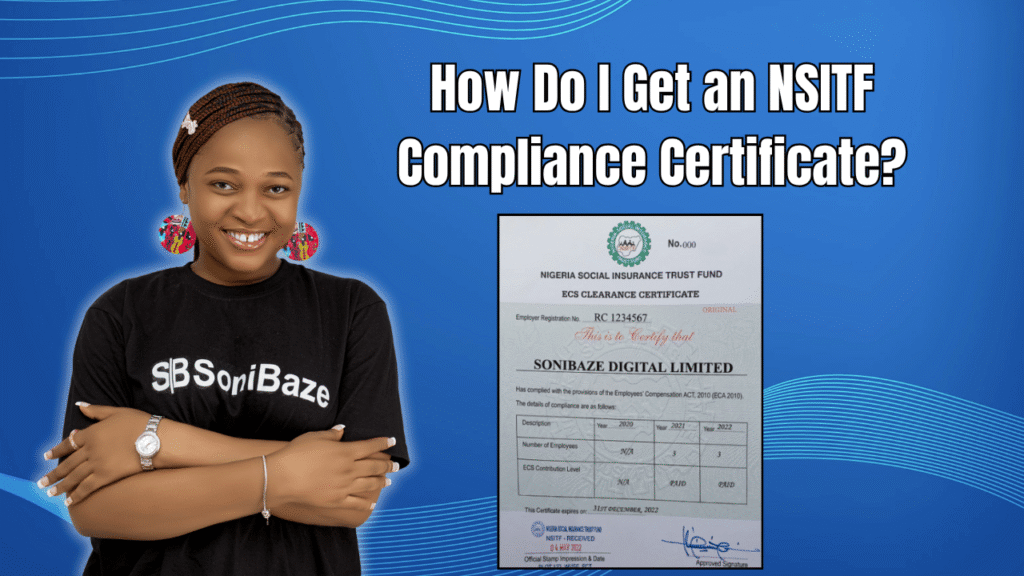
If your business is bidding for a government contract in Nigeria, you will not get far without an NSITF Compliance Certificate. Most procurement desks at federal ministries, departments, and agencies ask for it alongside other statutory documents like ITF, BPP, and PENCOM. Without it, your bid goes nowhere.
But even outside government contracts, registering with NSITF is a legal obligation for employers in Nigeria’s private sector. This guide walks through what the certificate is, who needs it, what it costs, and exactly how to get it.
Obtain Your NSITF Certificate
Let us help you obtain your Nigeria Social Insurance Trust Fund (NSITF) Compliance Certificate quickly and hassle-free. Our experts provide reliable support throughout the application process, ensuring your business meets all statutory compliance requirements.
What Is the NSITF Compliance Certificate?
NSITF stands for the Nigeria Social Insurance Trust Fund. It is a Federal Government body established to compensate employees who suffer work-related injuries, diseases, disability, or death. The Fund operates under the Employees’ Compensation Scheme, which replaced the earlier Workmen’s Compensation Act.
The job of NSITF is to give compensation to insured employees in case of work-related diseases, disability, injuries, or death, whether such an incident happens in the workplace or outside it.
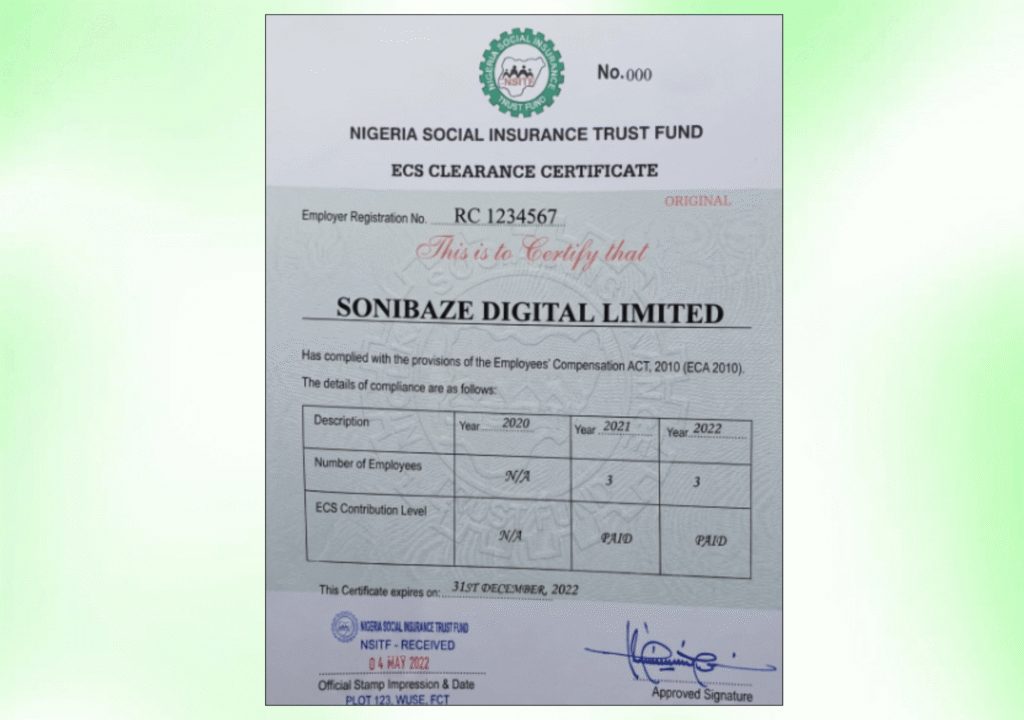
The NSITF Compliance Certificate is the document your business receives after registering with NSITF and demonstrating that you are making the required contributions on behalf of your staff. Beyond regulatory obligation, it signals your commitment to the welfare and protection of employees under social insurance regulations and for government contractors, it is a gateway to public sector opportunities.
Who Is Required to Register?
Under the NSITF Act 1993, all employers of labour in the private sector registered under CAMA, either as companies or partnerships regardless of the number of their employees, or sole businesses with a workforce of not less than five employees, are required to register and remit monthly contributions.
The scheme applies to both public and private sector employers. However, certain categories are exempt.
| Exempt Category | Reason |
|---|---|
| Federal, state, or local government employees | Covered by separate government pension schemes |
| Diplomats and those with diplomatic equivalent status | Covered under international agreements |
| Non-Nigerian employees in Nigeria for fewer than 6 years | Covered by their home country’s social security |
| Ministers of religion engaged in propagating faith | Specific legislative exemption |
If your business falls outside these exemptions and you have at least five employees, NSITF registration is not optional.

What Documents Do You Need?
Before you begin the process, gather the following. Incomplete submissions are the main reason applications get delayed.
| Document | Notes |
|---|---|
| CAC Certificate of Incorporation | Or certificate of business name registration |
| MEMART (Memorandum and Articles of Association) | For limited liability companies |
| Form CAC 1.1 or BN1 (for Business Names) | Or CAC 2A / 7A for older companies showing directors and shareholding |
| Tax Clearance Certificate or TIN printout | Current year preferred |
| Company profile | Should state nature of business and key personnel |
| Employee records in CSV format | Names, roles, monthly salaries of all staff |
| Valid ID of company owners/directors | National ID, international passport, or driver’s licence |
| Company logo and authorised signature | In the correct file format and size |
| Evidence of fee payment via Remita | Required after wage assessment |
How to Get the NSITF Compliance Certificate – Step by Step
The process has three main stages: registration, payment, and certification. Here is how each works.
Step 1: Register Online
Visit nsitf.gov.ng on your computer and click on the employer’s registration section. Fill in the particulars of your business including employer name, incorporation number, address, phone number, and email. Also provide particulars of the owners of the organisation and upload your company logo and signature in the correct file format and size.
During registration, you will complete two forms:
- Form ECS RE01 — Registration of Employer
- Form ECS RE03 — Employer Schedule of Payment (payroll schedule)
Upload your employee records in CSV format when prompted. All employee records should be typed in Microsoft Excel and saved in CSV (Comma Delimited) format for Windows.
Step 2: Attend the Wage Assessment
This is where many applicants are caught off guard. NSITF conducts a physical assessment of your employees’ wages to determine the exact monthly contribution your business will make. You cannot skip this step, the payment amount is determined by it, not set by you.
There will be a physical assessment of your employees’ wages by NSITF in order to ascertain the amount that will be paid monthly for a total year. Bring duplicate copies of all your documents to the nearest NSITF branch office during this stage.
Step 3: Make Payment via Remita
Payments are made via the Remita platform after an assessment of staff remuneration by NSITF.
Employers contribute 1% of employees’ monthly payroll to NSITF. This contribution excludes pension deductions, bonuses, overtime payments, and one-off payments such as 13th-month income. The 1% is calculated on basic remuneration only.
If contributions are not paid by the last day of each month, a 5% penalty is added for each month or part thereof that the payment remains outstanding.
Step 4: Request the Compliance Certificate
Once registration is confirmed and payment evidence is in hand, you can request the certificate. Submit an official request letter along with the Certificate of Incorporation (CAC), completed ECS forms, and evidence of payment to receive the Compliance Certificate.
Upon successful registration, NSITF issues a letter of notification with a 10-digit registration number. The compliance certificate follows after the payment evidence is verified.
Obtain Your NSITF Certificate
Let us help you obtain your Nigeria Social Insurance Trust Fund (NSITF) Compliance Certificate quickly and hassle-free. Our experts provide reliable support throughout the application process, ensuring your business meets all statutory compliance requirements.
Full Process at a Glance
| Stage | Action Required | Where |
|---|---|---|
| 1. Online registration | Complete ECS RE01 and ECS RE03 forms, upload documents | nsitf.gov.ng |
| 2. Wage assessment | Physical review of employee payroll records | Nearest NSITF branch |
| 3. Payment | Remit 1% of monthly payroll via Remita | Online (Remita platform) |
| 4. Certification | Submit request letter, CAC documents, payment evidence | NSITF branch or portal |
| 5. Collection | Receive compliance certificate | NSITF branch office |
What Does It Cost?
The initial step towards compliance involves registration with NSITF, accompanied by certification. This process typically incurs a cost of ₦50,000. This covers the registration and initial certification fee.
Beyond the registration cost, the ongoing liability is 1% of the total salary of at least five employees, paid monthly. The exact amount varies depending on your payroll size and is confirmed during the wage assessment stage.
If you engage a professional consultant to handle the process, expect additional fees for their services. This is separate from what is paid to NSITF directly.
How Long Does It Take?
Registration with NSITF takes an average of 5 working days.This is the baseline when all documents are correctly submitted and the wage assessment is completed promptly. Delays typically occur when documents are incomplete, when the CSV employee records contain errors, or when the Remita payment confirmation takes time to reflect on NSITF’s end.
Plan for up to two weeks if this is your first time registering, to account for the wage assessment appointment and any back-and-forth on documentation.
Why Businesses in Nigeria Need This Certificate
The most immediate reason is government contracting. The NSITF compliance certificate is required by most Ministries, Departments and Agencies of the government for the award of public contracts. This is to ensure that every supplier, contractor, or consultant bidding for contracts, businesses, goods, and services from any Federal Government Ministry, Department, or Agency has fulfilled its statutory obligations.
Beyond contracts, operating without NSITF registration exposes your business to penalties. Unpaid contributions attract 5% interest per month, and the outstanding amount is recoverable as a debt owed to the Fund.
Frequently Asked Questions
Is NSITF registration mandatory for small businesses?
Yes, if you have five or more employees and operate in the private sector under CAMA. The number of employees matters for sole businesses. Companies and partnerships registered under CAMA are required to register regardless of employee count.
Can I register NSITF online without visiting an office?
The initial registration starts online at nsitf.gov.ng, but the wage assessment stage requires a physical visit to an NSITF branch office. You will need to present duplicate copies of your documents at this stage. The process is not fully online end to end.
Does the NSITF Compliance Certificate expire?
The certificate is valid for a period and requires ongoing monthly contributions to maintain compliance. Businesses that fall behind on contributions risk losing their good-standing status with NSITF, which affects certificate renewal.
What happens if I miss monthly NSITF contributions?
A 5% penalty is added on the unpaid amount for each month or part of a month that the contribution remains outstanding. Any unpaid contribution and accumulated interest is recoverable as a debt from the employer.
Is NSITF the same as ITF or BPP?
No. These are three separate regulatory bodies. NSITF covers employee compensation and social insurance. ITF (Industrial Training Fund) covers staff training levies. BPP (Bureau of Public Procurement) is the procurement registration body. Government contracts typically require compliance certificates from all three.
Can a new company apply for NSITF immediately after CAC registration?
Yes. A newly registered company can begin the NSITF registration process as soon as it has a valid CAC certificate and at least a projected payroll structure. In practice, the wage assessment will be based on actual employee records, so the process typically begins once staff have been engaged.
Conclusion: Start the Process Before You Need the Certificate
NSITF registration is the kind of compliance most business owners put off until a contract is on the table. By then, the five-day processing window suddenly feels tight, especially when you still need to attend a physical wage assessment and confirm payment.
The smarter move is to register early, keep monthly contributions current, and treat the compliance certificate as something that is always in order not something you scramble to obtain when a bid deadline is three days away.
Obtain Your NSITF Certificate
Let us help you obtain your Nigeria Social Insurance Trust Fund (NSITF) Compliance Certificate quickly and hassle-free. Our experts provide reliable support throughout the application process, ensuring your business meets all statutory compliance requirements.