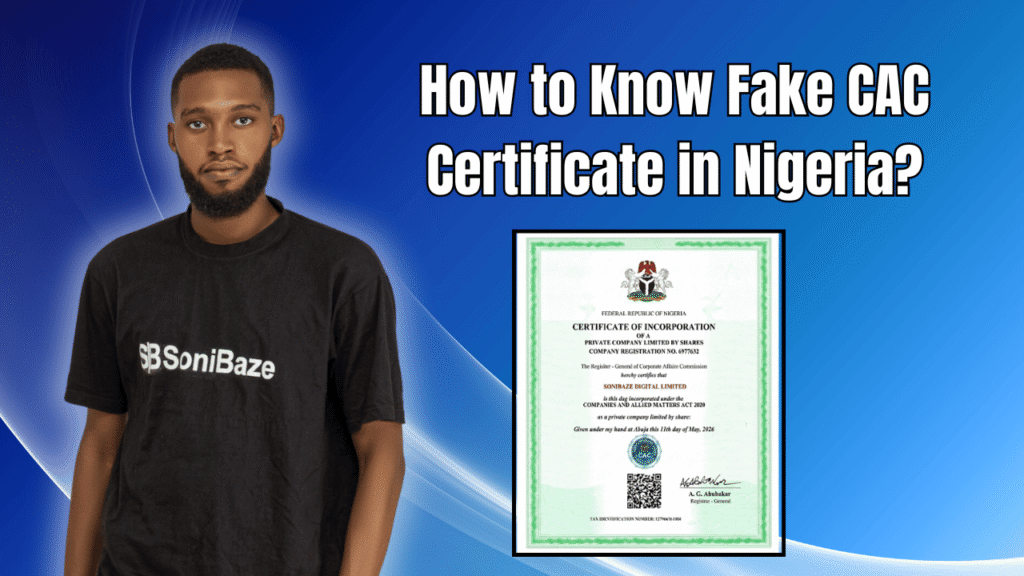
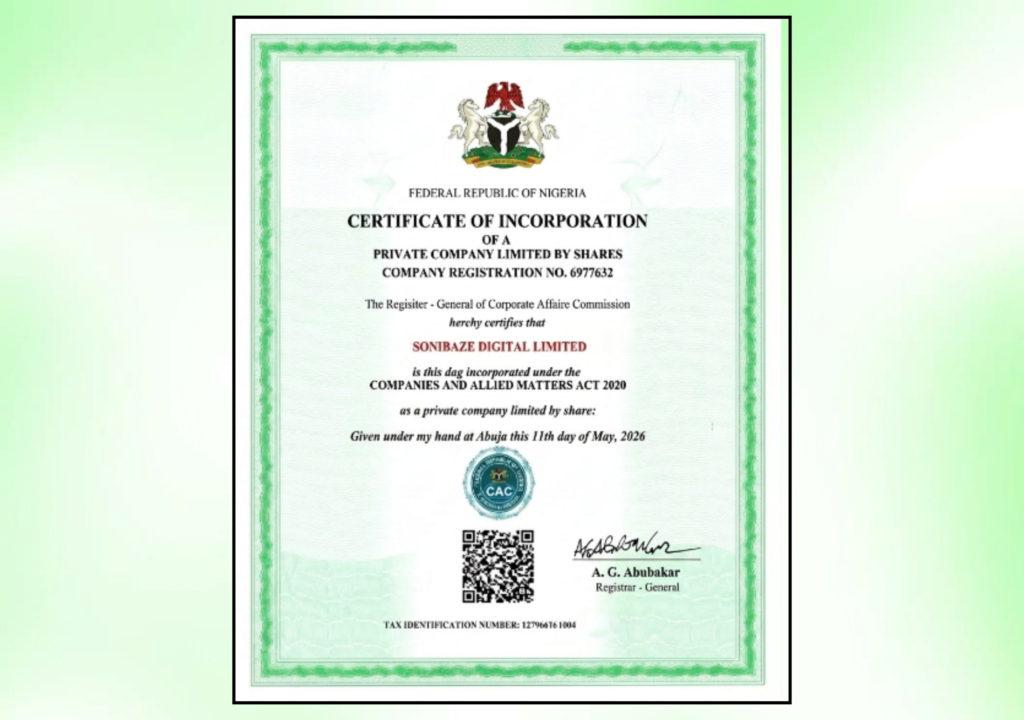
Fake CAC certificates are more common than most people realise. Scammers take real certificates from legitimate businesses, edit the names and details using basic photo editing software, and pass them off as their own. Some go further and print entirely fabricated certificates with registration numbers that do not exist anywhere in the CAC’s database.
As recently as July 2025, the Corporate Affairs Commission publicly flagged three cooperative societies for parading fake certificates of incorporation with registration numbers that were not issued by the Commission at all. If it can happen with registered cooperative societies, it can happen with any vendor, contractor, or partner you deal with.
This article shows you how to spot a fake CAC certificate and how to verify one correctly using official tools.
Obtain Your CAC Certificate
Let our team handle your CAC registration and help you obtain your certificate without stress. From business name registration to company incorporation.
Why People Use Fake CAC Certificates
The short answer is that CAC registration has become a trust signal. Scammers photoshop fake CAC certificates to appear credible, knowing that most people will look at the certificate and assume it is real without checking. A business dealing in large transactions, a vendor on a procurement list, a landlord, or even a social media declutter page can use a fabricated certificate to gain the confidence of a potential victim before disappearing with money.
There have been cases where scammers forged CAC certificates to pass off fake businesses as legitimate ones, leading Nigerians to lose significant amounts of money. The damage is financial, but the process that enables it is surprisingly simple to break.
Red Flags on a CAC Certificate
Before going online to verify, look at the physical or digital certificate itself. There are several things that should catch your attention immediately.
| Red Flag | What It Means |
|---|---|
| RC or BN number is missing or blank | Real CAC certificates always carry a unique registration number |
| Two different RC numbers on the same certificate | A sign of a cloned or edited document |
| The business name on the certificate does not match what the vendor uses | Possible name substitution on an edited certificate |
| The address looks vague or implausible | CAC does not approve registrations with vague or poorly formatted addresses |
| Certificate looks pixelated, distorted, or inconsistently formatted | Signs of image editing |
| The Registrar General’s signature is missing | A real certificate must carry only the signature of the Registrar General of the CAC |
| The vendor cannot produce the certificate quickly when asked | Legitimate businesses keep this document accessible |
| The document has no CAC seal or official header | These are standard on every genuine certificate |
None of these flags alone confirms a fake. But any combination of two or more should stop you from proceeding without a proper verification check.
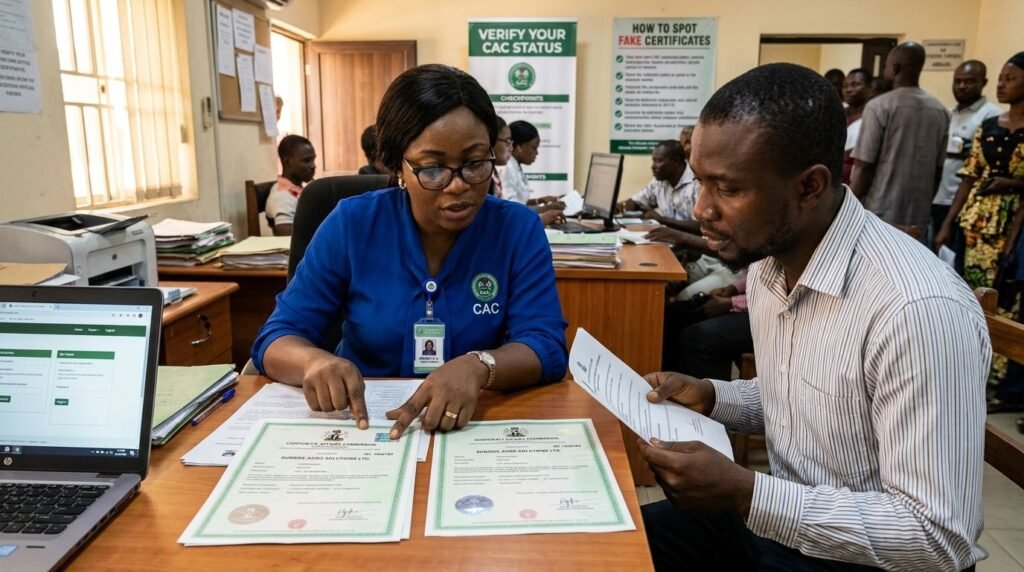
How to Verify a CAC Certificate Online
The most reliable way to confirm whether a CAC certificate is real is to check it against the CAC’s own public records. This is free and takes less than two minutes.
Method 1: CAC Public Search Portal
This is the primary tool for anyone wanting to confirm a business registration.
| Step | What to Do |
|---|---|
| 1 | Go to the official CAC public search portal at search.cac.gov.ng |
| 2 | Enter the exact business name or the RC/BN number shown on the certificate |
| 3 | Complete the CAPTCHA verification |
| 4 | Review the results — a registered business will show its name, RC number, registration status, and entity type |
| 5 | Cross-check every detail against what is on the certificate |
The portal will display details such as the RC number, company status showing whether it is active or inactive, and the type of entity, whether it is a business name, limited company, or another form.
If the name you enter returns no result, or if the result shows a different business name than what is on the certificate, the document in front of you is almost certainly fake or cloned.
Method 2: CAC Main Website
You can also go to the official Corporate Affairs Commission website at cac.gov.ng, navigate to the Public Search section on the homepage, and enter the company name or registration number. This method works the same way as the portal but through the main website interface.
Method 3: In-Person Verification at a CAC Office
For high-value transactions or legal matters, visiting a CAC office in person gives you the most authoritative confirmation. CAC has offices across all 36 states and the FCT. In some cases, especially when requesting certified true copies or official documentation, there may be a small fee of between ₦1,000 and ₦5,000 depending on the type of request.
Method 4: Cross-Check Supporting Documents
A genuine business registration comes with more than just the certificate. Ask for copies of the Certificate of Incorporation and the status report. Any legitimate company will willingly provide these. Be cautious if they refuse, delay, or provide low-quality or mismatched documents.
Cross-check the business name, RC number, registration date, and address across all the documents they provide. A mismatch between any of these is a reason to pause.
Obtain Your CAC Certificate
Let our team handle your CAC registration and help you obtain your certificate without stress. From business name registration to company incorporation.
What the Verification Results Tell You
Running a search on the CAC portal gives you specific information about the company. Here is what each result status means.
| Status Shown | What It Means |
|---|---|
| Registered / Active | The business exists and is currently in good standing with CAC |
| Struck off | CAC has removed the company from its active register, usually for failing to file annual returns |
| Dormant | The business is registered but not currently active |
| No record found | The business name or RC number does not exist in CAC’s database |
A struck-off status means CAC has removed the company from its active register, usually because the company failed to file annual returns for two or more consecutive years. A business presenting a certificate as proof of legitimacy while showing a struck-off status has either not maintained its registration or is presenting an outdated document.
Situations Where You Should Always Verify
Not every transaction requires the same level of scrutiny. These situations warrant a CAC check before you proceed.
| Situation | Why It Matters |
|---|---|
| You are paying a vendor upfront for goods or services | Fake vendors use CAC certificates to build false trust before collecting payment |
| You are entering a business partnership or joint venture | You need to confirm the legal entity you are dealing with actually exists |
| You are hiring a contractor for a significant project | Unregistered contractors have no legal standing if disputes arise |
| You are buying from a social media vendor claiming CAC registration | Certificate cloning is common in online marketplaces and declutter pages |
| A business is applying for a procurement contract with your organisation | Procurement fraud often starts with forged documentation |
| A potential employee or consultant presents a company registration as credentials | This should be verified before any engagement begins |
Frequently Asked Questions
Can I tell a fake CAC certificate just by looking at it?
Sometimes, but not always. Poorly edited certificates have visible signs like pixelation, inconsistent fonts, or formatting errors. A well-edited fake can look convincing to the eye. The only reliable check is to verify the RC or BN number on the CAC public search portal. Looking at the document alone is not enough.
What if the business name exists on CAC but the details do not match the certificate?
This is a cloned certificate. Someone has taken a legitimate certificate belonging to another business and changed the name or details. The RC number belongs to a real business, but the certificate being shown to you has been modified. Do not proceed with the transaction.
Is the CAC public search portal free to use?
Yes. The CAC public search at search.cac.gov.ng is completely free for anyone to use. You do not need to create an account or pay any fee to look up a registered business name or company.
Can a business have a CAC certificate but still be inactive?
Yes. A struck-off status means the company has been removed from CAC’s active register, usually for failing to file annual returns. The certificate exists and may look perfectly legitimate, but the business is no longer in good legal standing. For many transactions, this matters.
What should I do if I discover a certificate is fake?
Report it to the Corporate Affairs Commission directly. You can also report to the EFCC, particularly if money has already been lost as a result of the fraud. Keep all copies of the certificate and any related communication as evidence.
Does verifying on search.cac.gov.ng confirm all the certificate details?
The public portal confirms the business name, RC number, registration status, and entity type. For full document verification, including directors, shareholders, and the actual certificate of incorporation, you would need to request a certified true copy through a CAC office or through the full portal with an account login.
Conclusion: Thirty Seconds Can Save You a Lot of Money
The CAC public search portal exists precisely for this. It is free, it takes under two minutes, and it removes the guesswork entirely. The problem is that most people do not use it until after something has gone wrong.
Make it a habit before any significant business transaction to confirm the RC or BN number on a certificate against the official CAC database. The certificate by itself tells you nothing. The verification tells you everything.
Obtain Your CAC Certificate
Let our team handle your CAC registration and help you obtain your certificate without stress. From business name registration to company incorporation.