A growing number of Nigerian businesses are getting emails they did not expect. The message accuses them of running an advertisement without approval, and attaches a fine that can run into millions of naira. For many of these businesses, the ad in question was just a regular Instagram or Facebook promotion, the kind that has been normal practice for years.
This is ARCON enforcement, and it is not theoretical anymore. This article looks at what actually happens when a business or practitioner operates without ARCON registration or certification, and why the risk has become harder to ignore.
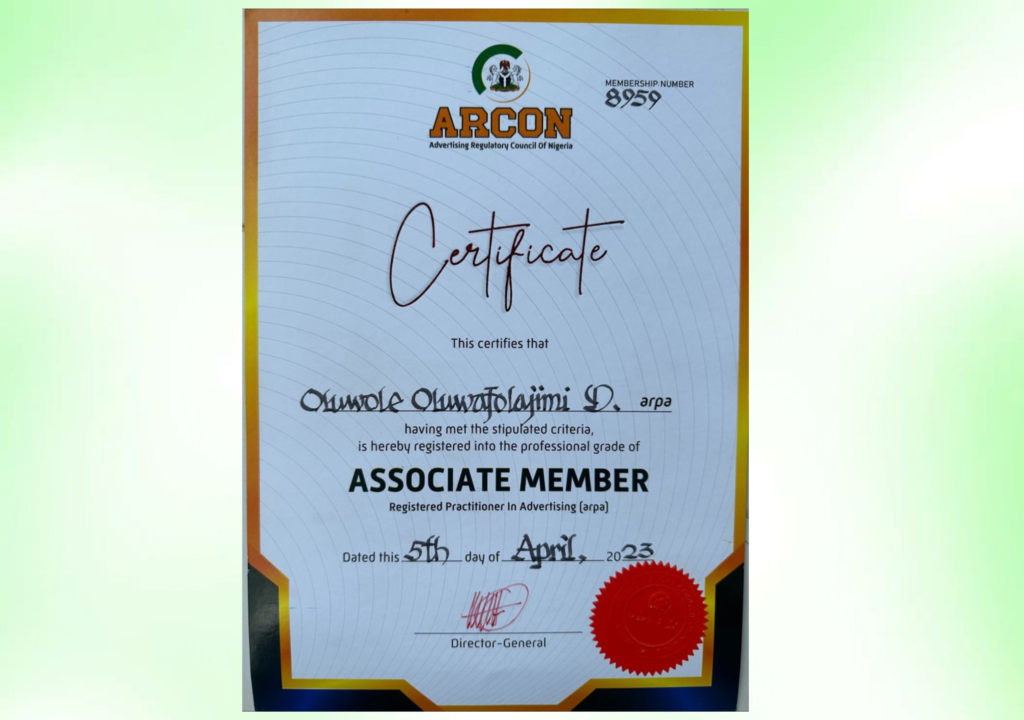
Obtain Your ARCON certificate
Let us help you obtain your Advertising Regulatory Council of Nigeria (ARCON) Certificate quickly and hassle-free. Our experts provide professional guidance throughout the registration and certification process, ensuring compliance with industry regulations.
What ARCON Certification Actually Covers
ARCON, the Advertising Regulatory Council of Nigeria, was created under the Advertising Regulatory Council of Nigeria Act 2022, replacing the older Advertising Practitioners Council of Nigeria. Its job is to make sure advertising in Nigeria is truthful, ethical, and compliant with national standards.
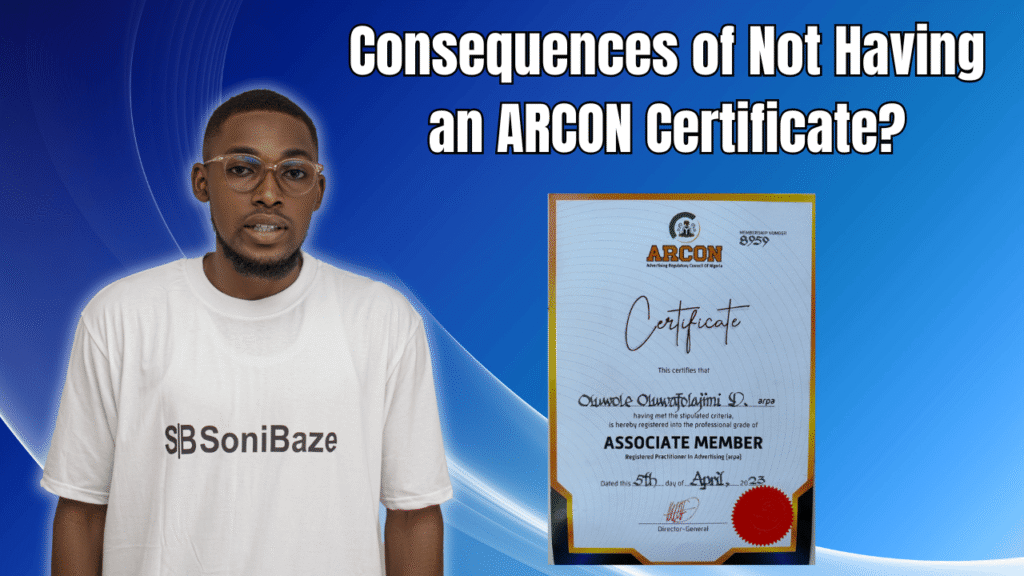
There are two separate things people often lump together under “ARCON certificate.” One is practitioner and agency registration, which is the licence to operate as an advertising professional or agency in Nigeria. The other is the Certificate of Approval, issued by ARCON’s Standards Panel, which clears a specific advertisement for publication.
Both matter, and not having either one carries consequences.
Consequence 1: Direct Financial Penalties
This is the consequence businesses are feeling most right now. ARCON’s vetting guidelines set a minimum penalty of ₦500,000 for each party involved in publishing an advert without a Certificate of Approval. That list of parties includes the advertiser, the agency, the practitioner, and the media platform itself.
In practice, recent enforcement has gone well beyond that statutory minimum. Online businesses have received fines of up to ₦1 million for a single unapproved advert on platforms like Instagram, and some reports describe fines ranging from ₦1 million to ₦3 million per violation depending on the nature of the breach.
The penalty is not a one-off either. If a campaign runs across multiple posts or platforms without approval, each unapproved exposure can be treated as a separate violation.

Consequence 2: Takedown Orders Mid-Campaign
ARCON has the power to order an advertisement pulled down, whether it is on a billboard, on television, or running as a social media campaign. This can happen in the middle of a campaign, after money has already been spent on production, placement, and promotion.
For a business that has timed a campaign around a product launch, a seasonal promotion, or an event, a takedown order does not just cost the fine. It also kills the campaign’s momentum at the exact point it was supposed to be working.
Consequence 3: Legal Action Through the Advertising Offences Tribunal
While ARCON itself can issue warnings and infraction notices, the power to actually impose penalties for breaches sits with the Advertising Offences Tribunal. This separation matters because it means a fine notice is not the end of the process, it can escalate into a formal legal matter heard by a tribunal with the authority to enforce outcomes.
The ARCON Act also gives the Council the power to direct anyone who has violated its provisions to compensate any person who suffered direct loss as a result. So beyond the fine to ARCON itself, a business could be on the hook for compensating a third party harmed by a non-compliant advert, for example through a misleading claim.
Consequence 4: Exposure for Practitioners Working Without Registration
The ARCON Act criminalises providing false information to obtain registration, and also makes false statements about professional qualifications a punishable offence. For individuals working as advertising practitioners without proper registration, this is not just an administrative gap, it is a legal exposure if their status is ever questioned during a dispute or investigation.
Agencies are expected to be registered with ARCON, and businesses can ask an agency directly for its registration number or accreditation status. An agency that cannot produce this, or that has been operating without it, puts both itself and its clients at risk.
Consequence 5: Loss of Recourse and Increased Client Exposure
If your business works with an agency that is not ARCON-accredited, the risk does not stay with the agency. ARCON’s authority applies to the advertiser, not only to whoever produced the advert. If an unregistered agency creates a non-compliant campaign for your brand, your business carries the consequences regardless of who actually built the ad.
Working with an accredited agency reduces this exposure, because accredited agencies are expected to ensure their work meets the standards of the Nigerian Code of Advertising Practice. Without that accreditation as a buffer, the advertiser absorbs the full risk alone.
Consequence 6: Court Action Against Major Platforms, and the Knock-On Effect
ARCON has already taken legal action against Meta over unvetted ads targeting Nigerian audiences, arguing they violated the Council’s rules. Whatever the outcome of cases like this, the direction is clear: ARCON is asserting authority over digital advertising, not just traditional formats like billboards and TV.
For businesses, this means the assumption that “platforms like Instagram or Facebook don’t check for ARCON approval, so it’s fine” is becoming a weaker argument over time. The platforms not enforcing it does not mean the regulator has stopped enforcing it on the advertiser’s side.
Obtain Your ARCON certificate
Let us help you obtain your Advertising Regulatory Council of Nigeria (ARCON) Certificate quickly and hassle-free. Our experts provide professional guidance throughout the registration and certification process, ensuring compliance with industry regulations.
Consequences at a Glance
| Consequence | What It Means in Practice |
|---|---|
| Minimum ₦500,000 fine per violation | Applies to advertiser, agency, practitioner, and media platform separately |
| Fines of ₦1 million to ₦3 million reported | Recent enforcement trends exceed the statutory minimum |
| Mid-campaign takedown orders | Campaign can be pulled after spend has already gone out |
| Tribunal escalation | Penalties enforced through the Advertising Offences Tribunal, not ARCON alone |
| Compensation orders | Business may need to compensate third parties harmed by non-compliant ads |
| Legal exposure for unregistered practitioners | False qualification claims are a punishable offence |
| Shared liability with unaccredited agencies | Advertiser carries risk even if the agency produced the ad |
What Businesses Are Saying About the Practical Side
Part of what makes this difficult for smaller businesses is not disagreement with the principle of vetting, but confusion about how to actually comply. One digital marketer described the situation plainly: the application process requires a council-registered advertising practitioner, but many small online businesses cannot easily access or afford one, and there is no clearly defined pathway for small digital businesses to submit ads for approval on their own.
This gap between the rule and the practical route to compliance is part of why so many businesses are receiving violation notices for ads they had no clear way to get approved in the first place.
What to Do If You’re Not Currently Registered or Vetted
If your business has been running social media ads without ARCON approval, the first step is understanding where you actually stand. Check whether the agency you work with, if you use one, is ARCON-accredited and can show a registration number. If you run ads directly without an agency, look into the vetting application process through ARCON’s Standards Panel, including the accelerated vetting options available for time-sensitive campaigns.
Responding promptly and in writing to any ARCON correspondence matters. Ignoring a violation notice does not make it disappear, and the Council’s escalation path runs through a tribunal that can enforce outcomes.
Frequently Asked Questions
Does ARCON only apply to TV and billboard ads?
No. ARCON’s authority now extends to digital advertising, including social media ads, influencer posts, and sponsored content. This was confirmed through court rulings giving the Council legal authority over online promotions, not just traditional formats.
Who actually pays the fine if an unapproved ad is published?
ARCON’s guidelines name multiple parties as liable, including the advertiser, the agency, the practitioner involved, and the media platform. Each of these can face the minimum penalty separately, which means a single unapproved advert can generate fines for more than one party at once.
Can ARCON pull down an ad that is already running?
Yes. ARCON can issue takedown orders for adverts found to violate its rules, regardless of whether the campaign is mid-run. This can happen after a business has already spent money on production and placement.
What if my agency told me they handled ARCON approval?
It is reasonable to ask your agency directly for their ARCON registration number and to confirm whether the specific advert received a Certificate of Approval. Since liability extends to the advertiser regardless of who produced the ad, written confirmation from the agency is worth keeping on file.
Is there a faster way to get an ad approved if I’m on a deadline?
ARCON offers accelerated vetting options for applicants willing to assume responsibility for an emergency review, with turnaround options including 4, 8, and 16 working hours, compared to the standard monthly review cycle for the Standards Panel.
What should I do if I receive a violation notice from ARCON?
Respond in writing and promptly. Review the specific violation cited, check it against the advert in question, and avoid ignoring the correspondence, since unresolved violations can escalate to the Advertising Offences Tribunal where penalties become formally enforceable.
Obtain Your ARCON certificate
Let us help you obtain your Advertising Regulatory Council of Nigeria (ARCON) Certificate quickly and hassle-free. Our experts provide professional guidance throughout the registration and certification process, ensuring compliance with industry regulations.