
Most Nigerian employers pay the ITF levy every year and stop there. They file the contribution, collect the compliance certificate, and move on. What they miss is that the Industrial Training Fund also gives back. Employers who qualify can reclaim up to 50% of what they paid through the training reimbursement grant. Beyond that, the ITF runs several skills development programmes that individuals and organisations can access for free or at reduced cost.
This article covers both sides of the ITF grant: the employer reimbursement grant and the ITF training programme grants for individuals and organisations.
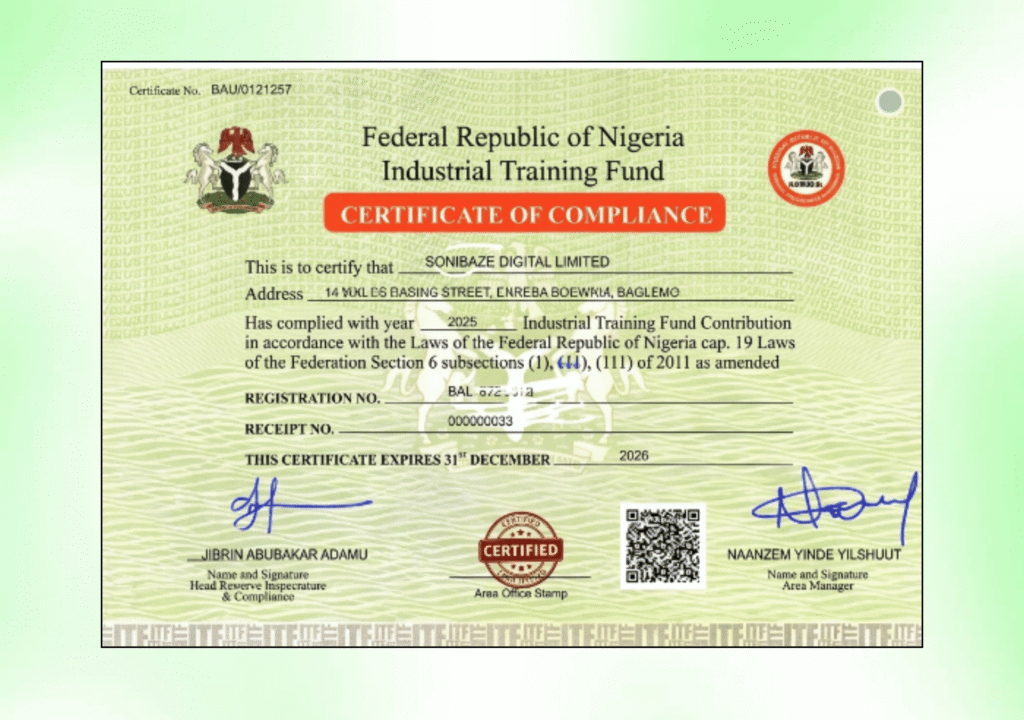
Obtain Your ITF Certificate
Let us help you obtain your Industrial Training Fund (ITF) Compliance Certificate quickly and hassle-free. Our experts provide reliable support throughout the application process, ensuring your business meets all statutory compliance requirements.
What Is the ITF Grant?
The ITF grant refers to two distinct opportunities available through the Industrial Training Fund.
The first is the training reimbursement grant for employers. This allows companies that have paid the ITF annual levy to claim back up to 50% of qualifying training expenses incurred during the contribution year. It is a direct financial return on the levy already paid.
The second is the range of funded training programmes run by ITF for individuals, graduates, artisans, and organisations. These include the National Industrial Skills Development Programme, the ITF/NECA Technical Skills Development Programme, and other skills empowerment initiatives funded entirely or partly by the ITF.
Both are legitimate grants. The process and eligibility for each is different.
Part 1: The Employer Training Reimbursement Grant
Who Is Eligible?
Any employer that has paid the ITF annual training levy and meets the training obligations set by the fund can apply for the reimbursement grant. The key eligibility conditions are:
- The company must have contributed 1% of its total annual payroll to ITF by the April 1 deadline
- The company must have an approved training policy and training plan submitted to the ITF before the start of the training year
- The training activities carried out must have received prior approval from the ITF Area Office
- At least 15% of the total workforce must be trained annually before the company qualifies for full reimbursement
- Course approval must have been sought at least two weeks before any local training, or three weeks before international training
How Much Can Be Claimed?
The maximum reimbursement is 50% of qualifying training expenditure incurred in the preceding contribution year, subject to the fund’s annual reimbursement budget. Despite being entitled to this, approximately 80% of Nigerian employers who pay the ITF levy never claim their reimbursement. The money is simply left unclaimed.
The 50% reimbursement is split across different training categories. These include management training, supervisory training, learning and development personnel costs, occupational health, safety, and environment training. To benefit fully, a company needs to train employees across these categories rather than concentrating all training in one area.
What Qualifies as Reimbursable Training Expenditure?
| Qualifying Expenditure | Details |
|---|---|
| Fees paid to external trainers or institutions | For staff development programmes attended by employees |
| Cost of training materials | Directly related to skill development activities |
| Internally delivered training costs | Including facilitator costs for in-house programmes |
| Apprenticeship scheme costs | For registered apprenticeship arrangements |
Expenses that are not directly tied to employee skill development, or that were not pre-approved by the ITF, do not qualify for reimbursement.
Obtain Your ITF Certificate
Let us help you obtain your Industrial Training Fund (ITF) Compliance Certificate quickly and hassle-free. Our experts provide reliable support throughout the application process, ensuring your business meets all statutory compliance requirements.
Step-by-Step: How to Apply for the ITF Reimbursement Grant
Step 1: Submit your training policy and calendar before January
At the start of each year, before January 31, submit the following to your ITF Area Office:
| Document | Details |
|---|---|
| Company training policy | Document outlining how the company approaches staff development |
| Training plan or calendar for the year | Schedule of all planned training activities for that year |
| ITF Form 3A | Application for Approval of Learning and Development Personnel |
| Appointment letter and CV of L&D personnel | For the staff member responsible for training |
Step 2: Get course approval before each training
For every training programme your staff will attend during the year, submit course details to the ITF using Form 4A. Do this at least two weeks before local training and at least three weeks before any international training. Without this pre-approval, the training expense will not be reimbursable, regardless of how much was spent.
Step 3: Pay your ITF levy by April 1
The ITF contribution of 1% of total annual payroll must be paid on or before April 1 of the following year. For example, the contribution on 2025 payroll is due by April 1, 2026. Late payment attracts a penalty of 5% per month on the outstanding amount.
Step 4: Submit your reimbursement claim by June 30
Once the levy has been paid, the company has until June 30 of the year of payment to submit the reimbursement claim. The following documents are required:
| Document | Purpose |
|---|---|
| ITF TR Form 1 | Summary of Contributing Employer’s Training Reimbursement Claims for the Year |
| ITF TR Form 2 | Areas of Reimbursement Award |
| Approved Form 3A | Training Personnel or HR Manager details |
| Course approval letters | Obtained from ITF before each training |
| Cost and expense details | Receipts, invoices, and supporting documents for all training expenditure |
Step 5: Await assessment and payment
After submission, the ITF reviews the claim and assesses the reimbursable amount. Payment is made directly to the employer once the claim is approved.
Key Dates to Remember
| Activity | Deadline |
|---|---|
| Submit training policy and Form 3A | By January 31 |
| Course approval (local training) | At least 2 weeks before training |
| Course approval (international training) | At least 3 weeks before training |
| Pay annual ITF levy | By April 1 |
| Submit reimbursement claim | By June 30 |
Part 2: ITF Training Programme Grants for Individuals and Organisations
Beyond the employer reimbursement, ITF runs direct training programmes that Nigerians can apply to participate in. These are funded from the levy pool and provide skills training at no cost or minimal cost to participants.
ITF/NECA Technical Skills Development Programme (TSDP)
This is one of the most active ITF-funded programmes currently running. It is implemented in partnership with the Nigeria Employers’ Consultative Association and corporate sponsors including Nigerian Breweries Plc. Applications for the 2026 programme are currently open.
The programme runs for 12 months and covers technical fields including Mechanical and Automation Maintenance and Engineering, Quality Assurance, and Logistics and Distribution. Participants receive professional training, industry exposure, industry certification, and a monthly stipend during the programme. Training takes place at the Supply Chain Academy of Nigerian Breweries in Ibadan, with industrial attachments across brewery locations in Lagos, Aba, Enugu, Kaduna, and other cities.
| Programme Detail | Information |
|---|---|
| Duration | 12 months |
| Training location | Nigerian Breweries Supply Chain Academy, Ibadan |
| Fields covered | Mechanical/Automation Engineering, Quality Assurance, Logistics |
| Benefits | Free training, monthly stipend, industry certification |
| Residential | Non-residential |
| Employment guarantee | None; participation does not guarantee employment |
Eligibility for TSDP:
- Nigerian citizen
- Higher National Diploma with at least Lower Credit from a recognised institution
- Five credits in WASCE including English Language, Mathematics, Physics, and Chemistry
- For Mechatronics tracks: relevant engineering or technical discipline required
How to apply: Visit the ITF official website at itf.gov.ng or the NECA website. Applications are submitted online during the announced application window. Candidates are required to present original credentials at assessment stages.
National Industrial Skills Development Programme (NISDP)
The NISDP is ITF’s flagship programme for providing workplace training to Nigerian graduates and artisans. It operates through ITF Area Offices and Skills Training Centres across all 36 states and the FCT. The programme covers a wide range of trades and vocational areas including:
- Web design and programming
- Advanced computer networking and mobile app development
- Air conditioning and refrigeration
- Plumbing and GSM repairs
- Iron bending and masonry
- Crop production and aquaculture
- Ladies wig cap making and other craft trades
Training runs for three to six months depending on the programme track. To apply, visit the nearest ITF Area Office in your state or check for announcements on the ITF website at itf.gov.ng.
Skill-Up Artisans Programme (SUPA)
SUPA is ITF’s current initiative targeting artisans and people looking to enter skilled trades. The programme provides tech-driven training, official licensing, access to essential toolkits, and promotes industry standards across the artisan sector. It is designed both for practising artisans who need formal recognition and for individuals entering artisan trades for the first time. Applications and announcements are published through ITF Area Offices and the official ITF website.
Other ITF Skills Programmes
ITF has run several other programme streams over recent years, some of which operate on a periodic basis:
| Programme | Focus Area |
|---|---|
| Skills Training and Empowerment Programme for the Physically Challenged (STEPP-C) | Skills development for people with disabilities |
| Construction Skills Empowerment Programme (CONSEP) | Construction sector trades |
| Passion to Profession Programme (P2PP) | Converting informal skills into professional competencies |
| Agri-preneurship Training Programme (ATP) | Agricultural skills and enterprise development |
| Info-Tech Skills Empowerment Programme (ISEP) | ICT and digital skills |
Availability of these programmes varies by year and ITF budget. Follow ITF’s official website and area office announcements for current open applications.
Frequently Asked Questions
Can a small business with fewer than five employees apply for the ITF reimbursement grant?
No. Employers with fewer than five employees, or with an annual turnover below N50 million, are exempt from the ITF levy. Since the reimbursement grant is tied to having paid the levy, a company that is exempt from contributing is also not eligible to claim reimbursement.
What happens if I missed the June 30 reimbursement deadline?
Once the June 30 deadline passes, the claim for that contribution year is forfeited. The ITF does not process reimbursement claims outside the stated window. This is the main reason most Nigerian employers miss the grant. They pay the levy in April and assume they have the full year to claim. The reimbursement window closes two months later.
Do I need a consultant to apply for the reimbursement grant?
Not necessarily. The process is manageable internally if you have an HR or finance team with the capacity to track training documentation and meet the submission deadlines. However, given that most employers forfeit the grant due to administrative errors or missed deadlines, many businesses use compliance consultants to manage the process and ensure nothing is missed.
How long does it take for the ITF to process and pay the reimbursement?
Processing timelines are not fixed and depend on the volume of claims received and the fund’s assessment process. In practice, most employers report waiting several months between submission and actual payment. Filing early within the window and submitting complete documentation reduces delays.
Can a company claim reimbursement for training that happened before ITF approval was obtained?
No. Course approval from ITF must be obtained before the training takes place, not after. Training expenses incurred without prior ITF approval do not qualify for reimbursement, regardless of the amount spent or the quality of the training.
Is there an age limit for ITF training programmes like TSDP?
Specific eligibility criteria vary by programme. The TSDP for 2026 specifies an HND with at least Lower Credit and relevant academic qualifications. Some ITF empowerment programmes do not specify age limits and are open to artisans of any age. Check the specific announcement for each programme before applying.
Conclusion: Two Separate Benefits, Both Worth Pursuing
The ITF grant is not a single thing. Employers have access to a direct financial return on their levy through the training reimbursement programme, provided they plan ahead, seek course approvals before training, and file by June 30. Individuals and organisations have access to funded training programmes through NISDP, TSDP, SUPA, and other ITF schemes that provide free or subsidised skills development.
The employer reimbursement in particular is one of the most overlooked financial benefits available to compliant Nigerian businesses. Paying 1% of payroll and reclaiming 50% of that contribution through documented training is a straightforward arrangement. The paperwork is manageable. What most companies lack is the discipline to start the process at the beginning of the year rather than discovering it after the June deadline has passed.
Obtain Your ITF Certificate
Let us help you obtain your Industrial Training Fund (ITF) Compliance Certificate quickly and hassle-free. Our experts provide reliable support throughout the application process, ensuring your business meets all statutory compliance requirements.