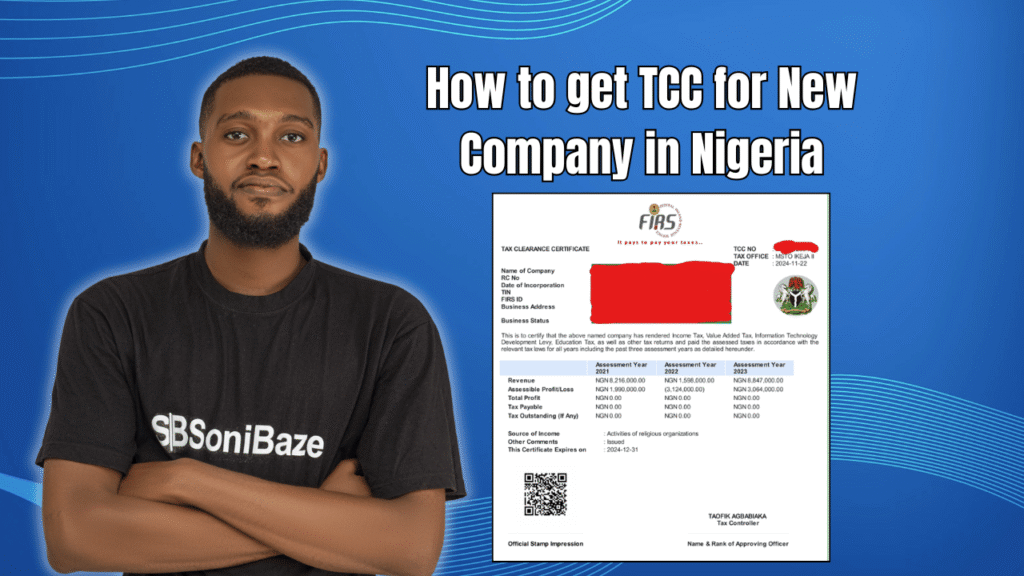
A Tax Clearance Certificate is one of those documents that shows up on almost every serious compliance checklist in Nigeria. Government contracts require it. Banks ask for it. Regulatory bodies want to see it. And yet many new company owners do not know how the process works, especially because the rules for new companies are different from those that apply to businesses that have been filing tax returns for years.
This article focuses specifically on how a new company in Nigeria can obtain a Tax Clearance Certificate, what the process looks like, and what to prepare before you start.
Obtain Your Tax Clearance Certificate (TCC)
Let us help you obtain your Tax Clearance Certificate (TCC) quickly and hassle-free. Our experts provide reliable support throughout the application process, ensuring your business meets all tax compliance requirements.
What Is a Tax Clearance Certificate?
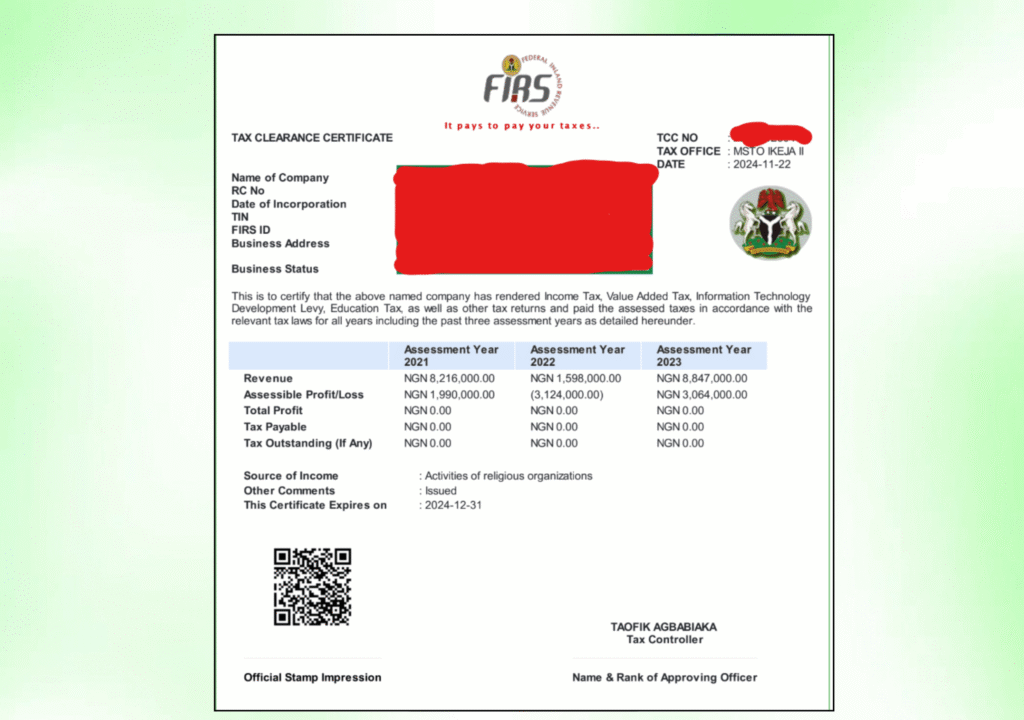
A Tax Clearance Certificate, or TCC, is an official document issued by the Federal Inland Revenue Service confirming that a taxpayer has settled all tax obligations for a specified period. For companies, the TCC covers the three years immediately before the current year of assessment.
It is worth noting that company TCC and personal TCC are two different things issued by two different bodies. Company TCC for registered limited liability companies is issued by FIRS, a federal authority. Personal TCC for individuals and business name owners is issued by the relevant State Internal Revenue Service. This article is about the company TCC.
The certificate carries details including the company’s name, Tax Identification Number, nature of business, and the tax assessment for each of the preceding three years.
Why New Companies Are Treated Differently
Most online guides to getting a TCC in Nigeria assume the applicant is an existing company with two or more years of filed corporate tax returns. The process for those companies is largely automated. They log in to the FIRS e-services portal at tcc.firs.gov.ng, click to generate their TCC, and a copy is sent to their registered email.
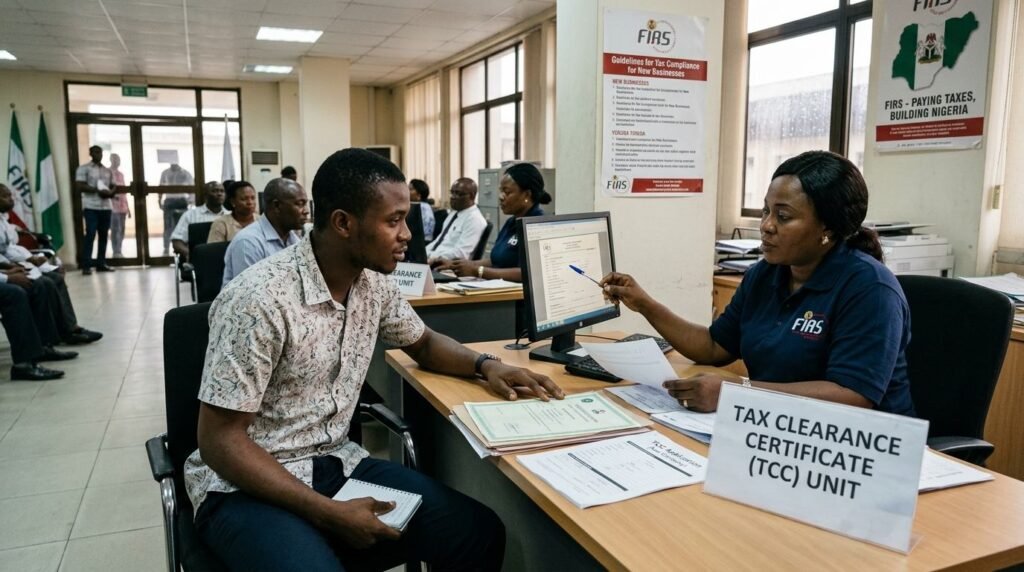
New companies cannot use that route. A new company has not yet filed tax returns, which means the automated system has nothing to work with. The application has to go through a different channel, and it requires physical engagement with a FIRS office rather than a purely online process.
Who Counts as a New Company for TCC Purposes?
For TCC purposes, a new company is one that registered for taxes with FIRS less than two years ago and has not yet filed corporate tax returns for two complete assessment years. This is the category that requires a manual application rather than the self-service online option.
Documents Required for a New Company TCC Application
Gathering documents before going to the FIRS office saves time and avoids repeat visits. Here is what a new company typically needs.
Certificate of Incorporation from the Corporate Affairs Commission. This must be for a registered limited liability company, not a business name. Bring at least three copies.
CAC Status Report showing your current directors, shareholders, and registered address. Bring at least three copies. Pull a fresh one close to your application date.
Tax Identification Number certificate from FIRS, confirming your company is already registered in the FIRS system.
Memorandum and Articles of Association, confirming the legal structure and objects of the company.
Completed TCC application form, available at the FIRS office. The form asks for your company name, registration address, incorporation reference number, and TIN, among other details.
Evidence of commencement of business or letter of non-commencement, depending on your situation. If your company has not yet commenced trading operations, a letter stating this is typically accepted and is important for demonstrating that no taxable income has been earned yet.
Audited financial statements, where applicable. For companies that have commenced operations, FIRS uses audited accounts to determine taxable income. A newly registered company that has not yet completed its first financial year may not have these, in which case management accounts or a nil return may be accepted.
Company’s bank account details, along with the name of the company’s bank.
Valid means of identification for the director or authorised representative making the application.
Obtain Your Tax Clearance Certificate (TCC)
Let us help you obtain your Tax Clearance Certificate (TCC) quickly and hassle-free. Our experts provide reliable support throughout the application process, ensuring your business meets all tax compliance requirements.
Step-by-Step: How to Get TCC as a New Company
Step 1: Register Your Company With FIRS and Obtain a TIN
Before you can apply for a TCC, your company must be registered with FIRS and have a Tax Identification Number. If your company was registered through the CAC’s new company incorporation process, a TIN may have been auto-generated. Confirm this by checking with FIRS or verifying on the JTB TIN verification portal.
If your TIN has not been generated, visit any FIRS office with your Certificate of Incorporation and CAC Status Report to complete registration.
Step 2: File a Tax Return or Letter of Non-Commencement
This step is what distinguishes the new company process from the existing company process. Even if your company has earned no income, FIRS expects a tax return or a declaration that operations have not yet commenced.
For companies that have started trading, file a Company Income Tax return covering your income and allowable deductions. For companies that have not yet commenced business, submit a letter of non-commencement signed by a director, stating clearly that the company has not begun trading operations as of the date of application.
Filing a nil return or a non-commencement letter is what makes you eligible to receive a TCC showing zero tax liability, which is still a valid TCC and accepted for compliance purposes.
Step 3: Settle Any Outstanding Tax Liabilities
If your company has commenced operations and income has been assessed, any outstanding tax liabilities must be settled before FIRS will issue a TCC. Proof of payment is required as part of the application package.
For a genuinely new company with no assessed income and no outstanding liabilities, this step is straightforward. The TCC will reflect nil assessments for the relevant years.
Step 4: Visit Your FIRS Tax Office
New company TCC applications require a visit to the FIRS office that covers your company’s registered address. Take all your documents, at minimum three copies of the key ones, and ask to speak with the desk responsible for TCC applications for new companies.
Submit the completed application form along with your supporting documents. The FIRS officer will review the submission, stamp received copies, and initiate the process.
Step 5: Follow Up and Collect Your Certificate
FIRS announced a processing time of under one minute for automated TCC generation for existing companies. For new companies going through the manual process, processing typically takes between five and fifteen working days, though this can vary depending on the FIRS office and how busy the period is.
Follow up with the office if you have not received confirmation after two weeks. Bring your stamped submission receipt when following up, as this allows the officer to locate your file quickly.
Once approved, the TCC is issued in paper form from the FIRS office and may also be sent to your registered email address. The certificate is valid for twelve months from the date of issue.
Common Reasons New Company TCC Applications Are Delayed
Unregistered TIN. If your company’s TIN has not been properly registered with FIRS or does not appear in their system, the application cannot be processed until this is corrected.
Email address conflict. If the email address used for your company’s FIRS registration was previously used for another tax registration, it can cause a system conflict that blocks processing. Use a unique email address that has not been used for any prior FIRS application.
Missing or incomplete documents. Arriving at the FIRS office without the full document set means a return visit. The checklist above covers the standard requirements, but officers may request additional items depending on the specifics of your company.
No filed return or non-commencement letter. This is the most common gap. Many new company owners assume they do not need to file anything because they have earned no income. FIRS still expects a return or a declaration before issuing a TCC.
TCC Quick Reference for New Companies
| Step | Action | Notes |
|---|---|---|
| 1 | Register with FIRS and obtain TIN | Confirm TIN is active in the FIRS system |
| 2 | File nil return or non-commencement letter | Required even if no income has been earned |
| 3 | Settle any outstanding liabilities | N/A for companies with no assessed income |
| 4 | Visit FIRS office with full document set | Bring three copies of key documents |
| 5 | Follow up and collect certificate | Processing typically takes 5 to 15 working days |
Frequently Asked Questions
Can a new company get a TCC if it has not started operating yet?
Yes. A company that has not yet commenced operations can submit a letter of non-commencement signed by a director. FIRS will issue a TCC reflecting nil assessments, which is valid for compliance purposes and accepted by government procurement bodies and banks.
Is the TCC application process for new companies done online or in person?
For new companies that have not yet filed two years of corporate tax returns, the application must be done in person at a FIRS office. The fully automated online route at tcc.firs.gov.ng is only available to existing companies with two or more years of filed returns in the system.
How long does a TCC last for a new company?
The TCC is valid for twelve months from the date of issue, regardless of whether the company is new or established. Renewal is required annually to keep the certificate current.
What is the difference between company TCC and personal TCC?
Company TCC covers registered limited liability companies and is issued by the Federal Inland Revenue Service. Personal TCC covers individuals and business name owners and is issued by the relevant State Internal Revenue Service, for example the Lagos Internal Revenue Service for taxpayers in Lagos. The two certificates are separate documents issued by different authorities.
Is a TCC with nil assessment accepted for government contracts?
Yes. A TCC showing nil tax liability for the assessment years covered is a valid TCC. The document confirms that no taxes are owed, which is what procurement bodies and compliance officers are checking for. A nil TCC is treated the same as one showing assessed and paid liabilities.
Can a business name owner apply for a company TCC?
No. Company TCC from FIRS is only issued to registered limited liability companies. Business name owners and sole proprietors obtain their TCC from the State Internal Revenue Service in the state where they are registered and operating.
Conclusion: File First, Then Apply
The most important thing to understand about getting a TCC as a new company in Nigeria is that the certificate is the end of a compliance process, not a standalone application. You register with FIRS, you file a return or submit a non-commencement declaration, and then you apply for the certificate.
Skipping the filing step and going straight to the TCC application is the most common mistake new company owners make. FIRS has no basis to issue the certificate without a return on file. Getting that sequence right is what makes the difference between a smooth process and repeated visits to a tax office.
Obtain Your Tax Clearance Certificate (TCC)
Let us help you obtain your Tax Clearance Certificate (TCC) quickly and hassle-free. Our experts provide reliable support throughout the application process, ensuring your business meets all tax compliance requirements.