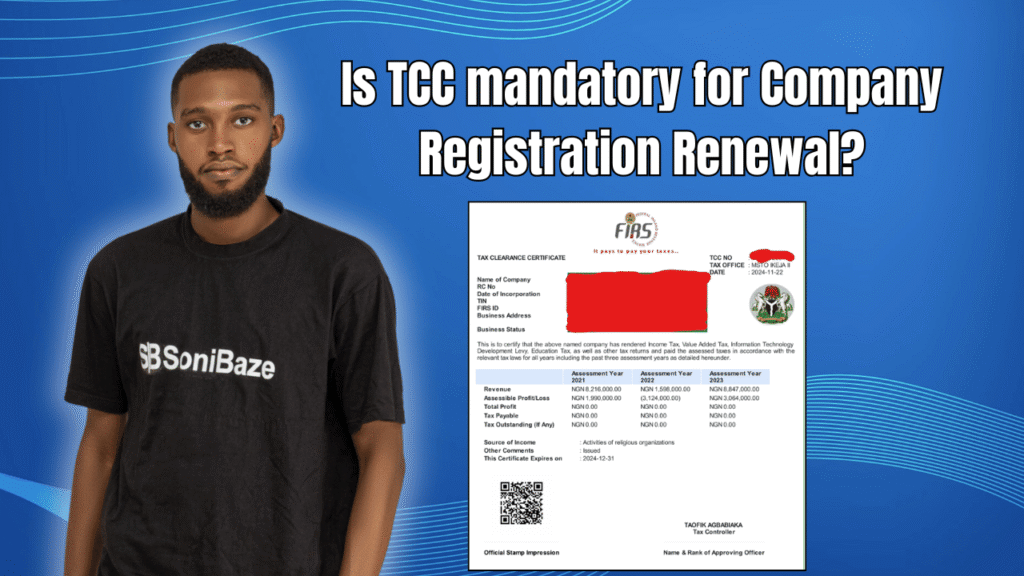
The question comes up every time a business owner tries to file annual returns with the Corporate Affairs Commission and is not sure what documents they actually need. Is a Tax Clearance Certificate required to renew your company’s registration? The answer depends on what you mean by “company registration renewal” and what you intend to use the renewed status for.
This article breaks down the relationship between TCC and CAC annual returns, what each document is, when one affects the other, and where the confusion usually comes from.
Obtain Your Tax Clearance Certificate (TCC)
Let us help you obtain your Tax Clearance Certificate (TCC) quickly and hassle-free. Our experts provide reliable support throughout the application process, ensuring your business meets all tax compliance requirements.
What Is a TCC?
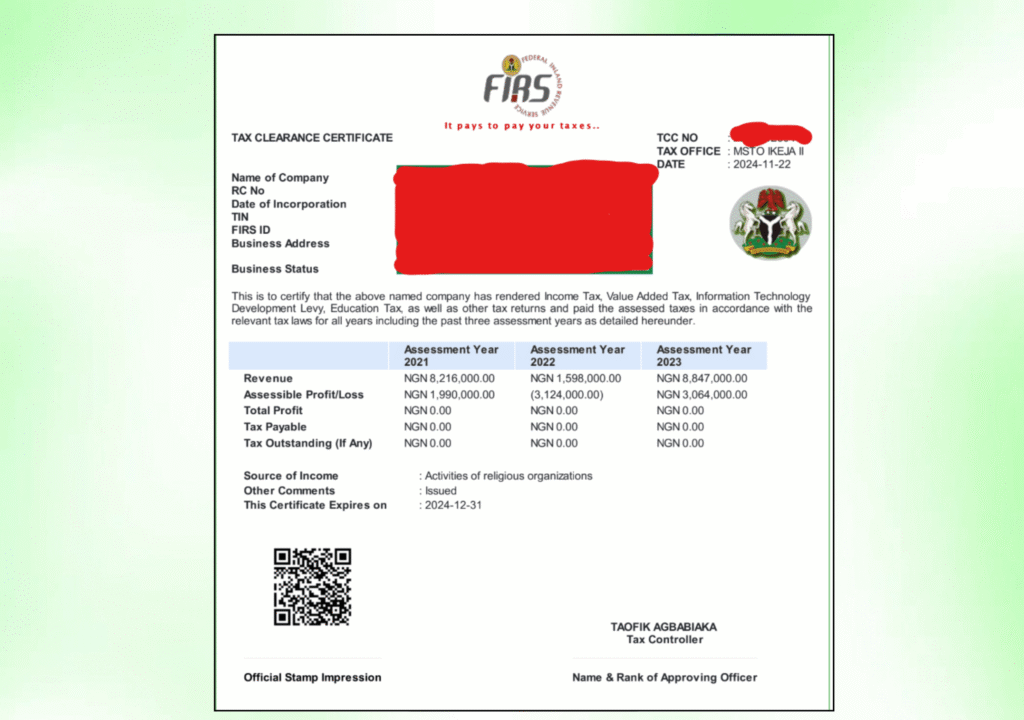
A Tax Clearance Certificate, commonly called a TCC, is a document issued by the Nigeria Revenue Service confirming that a taxpayer has been assessed and has paid all taxes due for the three preceding years of assessment. It is a tax compliance document, not a CAC document. It tells whoever is asking that your company has no outstanding tax liabilities with the federal tax authority.
A TCC is typically valid until December 31 of the year it is issued, regardless of when it was obtained. A certificate collected in March expires at year-end. This makes annual renewal effectively mandatory for any company that regularly needs the document for tenders or compliance purposes.
What Is CAC Annual Returns Filing?
CAC annual returns are a separate obligation entirely. Every registered entity in Nigeria, whether a business name, limited liability company, or incorporated trustee, must file annual returns with the Corporate Affairs Commission under the Companies and Allied Matters Act 2020. This filing confirms to the CAC that your company is still active, that your registered information remains current, and that the business is being run in accordance with the law.
Filing with the CAC does not satisfy your obligations with the Nigeria Revenue Service. The two are separate, have separate deadlines, and are submitted to separate agencies. Confusing them is one of the most common compliance errors Nigerian business owners make.

Is TCC Required to File CAC Annual Returns?
This is where the direct answer sits. TCC is not a statutory requirement for filing annual returns with the CAC. The CAC annual returns process does not list a valid TCC as a compulsory document for submission. You can file your annual returns on the CAC portal without uploading or presenting a Tax Clearance Certificate.
However, there is a practical connection between the two that creates confusion.
Some guides and consultants list a TCC as part of the annual returns filing process, and some versions of the CAC form include a field for tax compliance information. Whether this is a mandatory field or an optional one can vary depending on the entity type and the current state of the CAC portal at the time of filing. If you encounter the TCC field during your filing and it is marked required, you will need it to complete that particular submission.
The safest working assumption is that while TCC may not be a universal requirement across all CAC annual returns filings, having one in place before you start is cleaner and avoids potential complications mid-process.
Where the TCC Requirement Actually Applies
The TCC requirement becomes firmly mandatory in the following situations, which often overlap with why a company bothers to renew its CAC status in the first place.
| Situation | TCC Required? |
|---|---|
| Filing CAC annual returns (business name) | Not always mandatory, but may be requested |
| Filing CAC annual returns (limited company) | Field may appear; safer to have one ready |
| Bidding for Federal Government contracts | Yes, always required |
| BPP contractor database registration | Yes, TCC is a core requirement |
| SCUML registration (for DNFBPs) | Required as part of compliance |
| Opening a corporate bank account | Required by most commercial banks |
| Applying for government grants or loans | Yes, mandatory in most cases |
| Renewing NAFDAC, SON, or sector licences | Required by most regulatory bodies |
The pattern is clear. TCC is not specifically a condition for renewing your company’s existence with the CAC. It is a condition for almost everything you want to do once your company’s status is renewed.
Obtain Your Tax Clearance Certificate (TCC)
Let us help you obtain your Tax Clearance Certificate (TCC) quickly and hassle-free. Our experts provide reliable support throughout the application process, ensuring your business meets all tax compliance requirements.
The Relationship Between CAC Status and TCC
Here is where things get circular in a way that catches many business owners off guard. The Nigeria Revenue Service requires your CAC annual returns to be up to date before it will issue a TCC. A company that has not filed annual returns may find itself unable to get a TCC because the tax authority sees its CAC status as inactive or flagged.
On the other side, a company that has not cleared its tax obligations with the Nigeria Revenue Service cannot get a TCC, which then blocks it from the government contracts and compliance processes that require one.
The two obligations reinforce each other. Staying current with CAC annual returns keeps you eligible for a TCC. Staying current with NRS tax filings keeps you eligible for a TCC. Falling behind on either creates a bottleneck that affects both.
Filing Deadlines to Know
| Entity Type | Annual Returns Deadline |
|---|---|
| Business name | On or before 30 June each year, except the year of registration |
| Limited liability company | Within 42 days after the Annual General Meeting |
| First filing (new company) | Within 18 months of incorporation |
| Incorporated trustees | Within 42 days after each year-end |
Missing these deadlines triggers daily penalties under CAMA 2020. From January 2024, the CAC began full enforcement of penalties against defaulting companies and their directors. A company that has gone three years without filing can face penalties exceeding NGN 300,000 before the backlog is cleared.
What Happens If You Skip Annual Returns
The CAC can strike a company off the register for persistent non-compliance. A struck-off company no longer exists legally, which means it cannot enter contracts, cannot hold bank accounts, and cannot be revived without a formal restoration process that involves additional fees and delays.
Practical consequences hit sooner than the strike-off itself. An inactive or flagged CAC status delays TCC issuance. It creates problems when opening new bank accounts. It disqualifies the company from government tenders. Partners and investors checking the CAC public portal will see the inactive flag, which raises questions about the company’s credibility.
Frequently Asked Questions
Can I file CAC annual returns without a TCC?
Generally yes, for business names in particular. The CAC annual returns process does not universally require a TCC as a submission document. However, some entity types or specific portal requirements at the time of filing may prompt for it. If your TCC is current, include it. If it is not, file what you can and resolve the TCC separately.
What documents do I need for CAC annual returns?
For a limited liability company, the typical requirements include a completed CAC 10 form, details of the company’s shareholding and directors, and confirmation of the registered address and business activities. For a business name, the requirements are simpler: proprietor details, business address, and confirmation of business activities. Payment of the applicable filing fee is also required.
Do dormant companies need to file annual returns?
Yes. There is no exemption for dormant entities unless the CAC has formally classified the company as dormant through the proper process. A company that was registered but conducted no business in the preceding year still has the annual returns obligation.
What happens if I file CAC annual returns but skip TCC renewal?
Your CAC status remains active, which protects you from strike-off. However, without a current TCC, you cannot participate in government tenders, pass BPP registration requirements, or satisfy most corporate compliance requests. The two run in parallel, and allowing either to lapse creates problems for the other.
How much does it cost to file annual returns with CAC?
Fees vary by entity type. Business names pay lower fees than limited companies. The exact figures are set by the CAC and are paid through the online portal via Remita. Late filing attracts additional penalty fees on top of the standard rate.
Does TCC renewal happen automatically?
No. A TCC must be applied for each year through the Nigeria Revenue Service. The process requires up-to-date tax filings, payment of any outstanding tax liabilities, and a formal application. Companies with audited accounts will need those prepared before applying. The renewal window for a new year’s TCC opens in January.
Conclusion: Two Separate Obligations That Are Practically Linked
TCC is not a statutory requirement for CAC annual returns. The CAC and the Nigeria Revenue Service are separate agencies with separate obligations, separate deadlines, and separate processes. You file annual returns to keep the company alive in the CAC register. You obtain a TCC to prove your tax standing to third parties.
What makes them feel connected is that each one affects access to the other. Fall behind on annual returns and TCC issuance gets complicated. Let TCC lapse and most of the reasons you bothered to file annual returns in the first place become inaccessible anyway.
The practical answer for any Nigerian business: treat both as non-negotiable, run them in parallel, and do not let the annual returns deadline arrive before the TCC process is already underway.
Obtain Your Tax Clearance Certificate (TCC)
Let us help you obtain your Tax Clearance Certificate (TCC) quickly and hassle-free. Our experts provide reliable support throughout the application process, ensuring your business meets all tax compliance requirements.