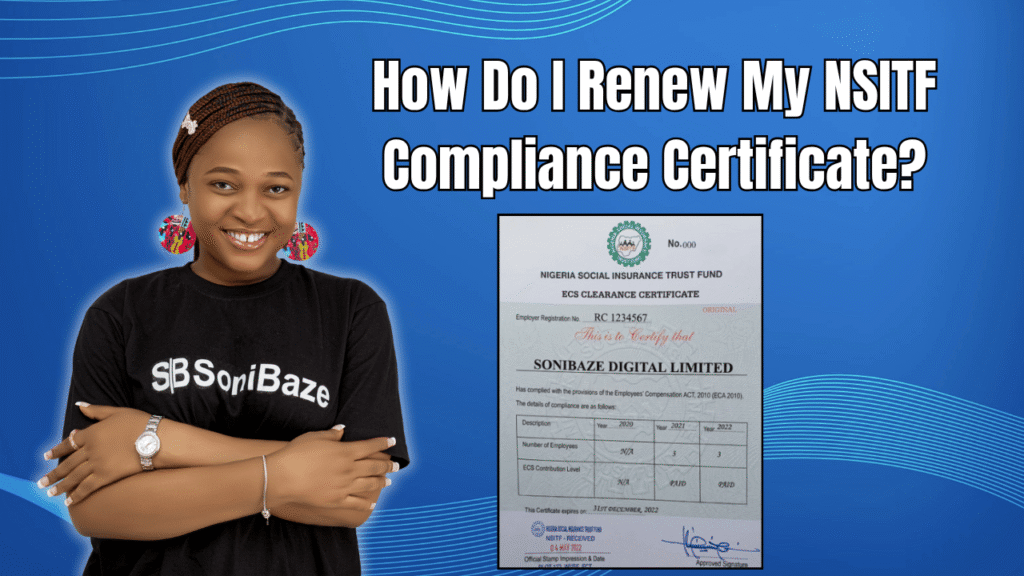
The NSITF compliance certificate is valid for one year. That sounds simple enough until you realise the renewal window is every January, your certificate expired last month, and a procurement deadline is two weeks away. This scenario plays out for businesses across Nigeria more often than anyone would like to admit.
This article explains exactly what renewal involves, what documents you need, how the process works, and what happens if you let it lapse.
Obtain Your NSITF Certificate
Let us help you obtain your Nigeria Social Insurance Trust Fund (NSITF) Compliance Certificate quickly and hassle-free. Our experts provide reliable support throughout the application process, ensuring your business meets all statutory compliance requirements.
What Is the NSITF Compliance Certificate?
The Nigeria Social Insurance Trust Fund administers the Employee Compensation Scheme, a mandatory social insurance programme that protects employees who suffer work-related injuries, diseases, disability, or death. Every employer in Nigeria, whether in the public or private sector, is required to register with NSITF and contribute 1 percent of total monthly payroll on behalf of their workers.
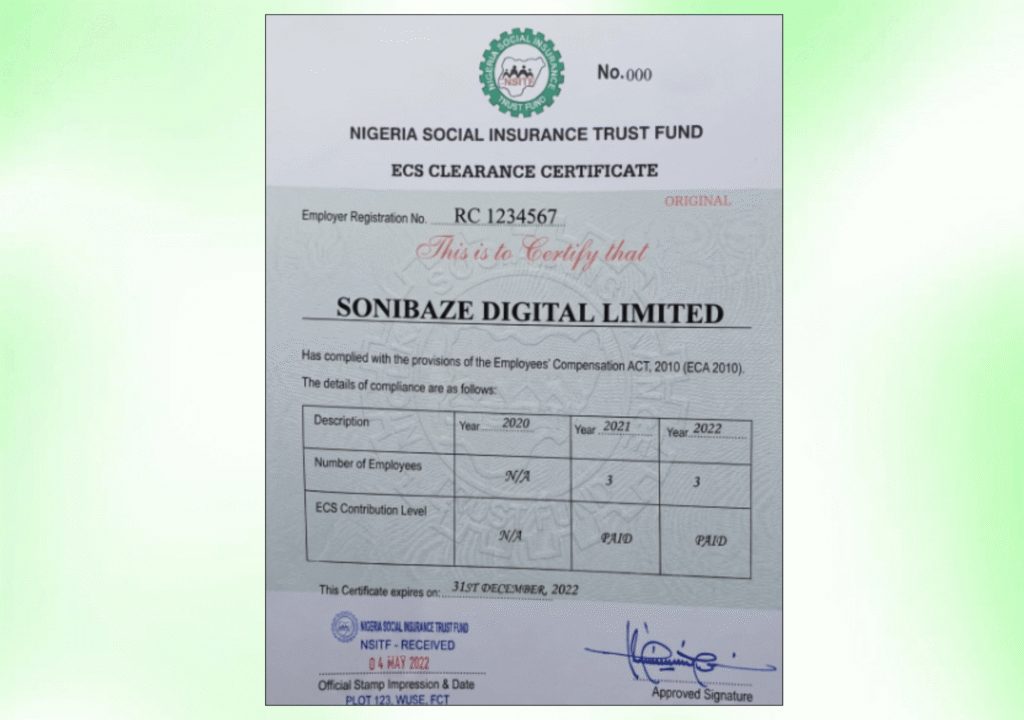
The compliance certificate is issued annually to employers who are current with their contributions. It confirms that the company has fulfilled its obligations under the Employee Compensation Act and is used as a mandatory requirement for government contract applications, BPP registration, and certain banking and regulatory processes.
Who Needs to Renew?
Any employer who has already registered with NSITF and holds a compliance certificate needs to renew it annually. The certificate does not auto-renew. If you registered last year, obtained your certificate, and have been remitting monthly contributions since then, renewal is what you do at the start of each new year to get an updated certificate covering the current period.
Companies that have never registered cannot renew. They need to go through the initial registration process first, which involves a physical assessment of employee wages by NSITF staff to establish the monthly contribution amount.

What You Need Before You Can Renew
The renewal process requires that your contribution records are current. No employer can obtain a renewed certificate if monthly remittances are in arrears. Before approaching NSITF for renewal, confirm that every monthly payment for the preceding year has been made and that you have the receipts to show for it.
Beyond that, the documents required for renewal are as follows.
| Document | Details |
|---|---|
| Official request letter | Written on company letterhead, addressed to the relevant NSITF office, requesting issuance of the compliance certificate |
| Previous NSITF certificate | The certificate issued in the prior year, submitted as part of the renewal package |
| Evidence of monthly remittances | Receipts or bank confirmation of all contributions made during the year |
| CAC Certificate of Incorporation | Copy of the company’s registration document from the Corporate Affairs Commission |
| Tax Identification Number (TIN) | From the Federal Inland Revenue Service. A full Tax Clearance Certificate can also be submitted in place of the TIN |
| NSITF payment receipt | Official receipt from NSITF confirming the latest payment made |
| Employee schedule | Updated list of employees and their remuneration, used to confirm the contribution basis |
How the Renewal Process Works
Unlike BPP registration, which is done entirely online, NSITF certificate renewal involves a physical visit to an NSITF branch office. The agency operates 13 regional offices and 62 branch offices across the country, so there is likely one within reach regardless of where your business is located.
The process from start to certificate works like this. Prepare duplicate copies of all the documents listed above. Visit the NSITF branch office closest to your company’s registered location. Submit the documents and the request letter. NSITF staff will review the submission and verify that contributions are current. If everything checks out, the new compliance certificate is issued.
The timeline for processing sits at an average of five working days from the date of submission, provided all documents are in order on the first visit.
What NSITF Contributions Cover
Understanding what you are paying for makes it easier to treat the renewal as a business priority rather than a checkbox exercise. NSITF contributions fund compensation for employees who experience work-related harm. This covers medical treatment including surgeries, hospital stays, and medication. It also covers income replacement during temporary disability, long-term compensation for permanent injury, and lump-sum payments to dependants in cases of work-related death. Where possible, NSITF also supports retraining for workers who cannot return to their previous roles after an injury.
Critically, once an employer is consistently contributing, the Employee Compensation Act shields the business from personal injury lawsuits arising from workplace accidents. NSITF handles the claims rather than the courts.
Obtain Your NSITF Certificate
Let us help you obtain your Nigeria Social Insurance Trust Fund (NSITF) Compliance Certificate quickly and hassle-free. Our experts provide reliable support throughout the application process, ensuring your business meets all statutory compliance requirements.
What Happens If You Miss the Renewal
Late or missed contributions attract a penalty of 5 percent of the unpaid amount for each month or part of a month after the due date. Monthly contributions are due on the last working day of each month. Any unpaid amount and accumulated interest is recoverable as a debt owed to NSITF.
Beyond financial penalties, an expired certificate has immediate operational consequences.
| Consequence | Impact |
|---|---|
| Disqualification from government contracts | Federal procurement rules require a valid NSITF certificate at bid submission. An expired certificate disqualifies the bid regardless of other qualifications |
| BPP registration problems | NSITF is one of the compliance certificates required for BPP database registration and annual renewal |
| Regulatory audit exposure | Inspections and audits by relevant agencies can result in sanctions for non-compliant employers |
| Legal liability | Without NSITF coverage, the employer carries personal liability for any workplace injury or death claims |
A certificate that expired even one day before a bid submission date will disqualify the application. Building renewal into a fixed annual calendar, ideally completing it in the first two weeks of January, removes that risk entirely.
How Much Does Renewal Cost?
The contribution itself is 1 percent of total monthly payroll, calculated on total emoluments excluding pension contributions, bonuses, overtime payments, and one-off payments such as a 13th-month salary. There is no separate government fee specifically for the renewal of the certificate. The cost is essentially the sum of your monthly contributions for the year.
If you use a compliance consultant to manage the renewal process on your behalf, professional fees typically range from modest amounts depending on the firm and the complexity of your employee records.
Practical Tips for Staying Ahead of Renewal
The businesses that run into NSITF certificate problems are almost always the ones managing it reactively. The fix is simple: treat it like a tax payment, not a one-time registration.
Set a reminder in December each year to begin gathering your renewal documents. Keep a dedicated folder, physical or digital, containing every monthly remittance receipt for the year. When January arrives, the submission is already assembled. NSITF processes renewal within five working days, which means an early January submission has the new certificate ready well before most procurement deadlines land in Q1.
If your previous certificate is lost, contact your nearest NSITF branch office directly. The agency can verify your contribution history and advise on the process for obtaining a replacement or proceeding with renewal.
Frequently Asked Questions
Can I renew my NSITF certificate online?
The renewal process currently requires a physical visit to an NSITF branch office for document submission. The initial registration begins at nsitf.gov.ng, but the certificate issuance and renewal involves an in-person process at a branch. Check with your local NSITF office for any updates to this process, as the agency has been expanding its digital capabilities.
What if my monthly contributions are in arrears?
You cannot obtain a renewal certificate while contributions are outstanding. The arrears, plus the applicable 5 percent monthly penalty on the unpaid amounts, must be cleared first. Once the full outstanding balance is settled, the renewal application can proceed normally.
Is the NSITF certificate the same as the NSITF registration letter?
No. When a company first registers with NSITF, it receives a Letter of Notification with a 10-digit registration number. The compliance certificate is a separate document issued annually to employers who are current with their contributions. Renewal applies to the compliance certificate, not the registration letter.
How do I verify if my NSITF certificate is still valid?
You can verify a certificate’s authenticity and current status by searching the certificate number on the verification section of the official NSITF website at nsitf.gov.ng, or by contacting the nearest NSITF branch office directly.
Does the certificate cover contract staff and casual workers?
Yes. Coverage under the Employee Compensation Scheme extends to all employees on payroll, including full-time workers, contract staff, and casual workers. The contribution is calculated on the total payroll for all of these categories.
Where is NSITF’s head office?
NSITF headquarters is located at Plot 794, Mohammadu Buhari Way, Central Business Area, PMB 446, Garki, Abuja. The agency also operates 13 regional offices and 62 branch offices across the country to make compliance accessible in all states.
Conclusion: Renewal Is Simpler Than Starting Over
Renewing an NSITF compliance certificate is not a complex process. It is a document-gathering exercise, a branch visit, and five working days of processing. The difficulty most businesses experience comes from letting monthly contributions slip and then scrambling to regularise before a procurement deadline.
Keep contributions current every month. Prepare renewal documents in December. Submit in early January. That sequence keeps the certificate active year-round without the pressure of a last-minute fix.
Obtain Your NSITF Certificate
Let us help you obtain your Nigeria Social Insurance Trust Fund (NSITF) Compliance Certificate quickly and hassle-free. Our experts provide reliable support throughout the application process, ensuring your business meets all statutory compliance requirements.