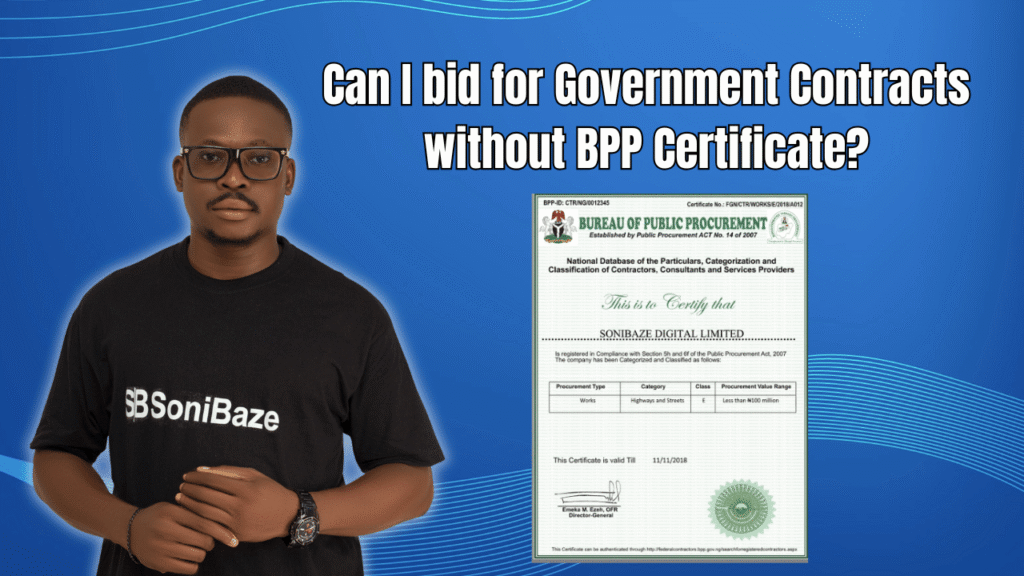
The short answer is no. But the longer answer is worth understanding, because the consequences of trying go further than just having your bid rejected.
Many Nigerian businesses ask this question after spotting a government contract opportunity with a tight deadline. The BPP certificate was not on their radar, registration takes time, and the temptation is to submit anyway and hope the evaluation team does not look too closely. That approach creates more problems than it solves.
This article explains what happens when you bid without a BPP certificate, what the law says, and what your options are if you need to get compliant quickly.
Obtain Your BPP Certificate
Let us help you obtain your Bureau of Public Procurement (BPP) Registration Certificate quickly and hassle-free. Our experts provide reliable support throughout the registration process, ensuring your business is ready to participate in public procurement opportunities.
What the Law Actually Says
The Bureau of Public Procurement was established under the Public Procurement Act of 2007. That law gives BPP the authority to set conditions for participation in federal procurement processes. Registration on the National Database of Federal Contractors, Consultants and Service Providers is not a suggestion. It is a statutory requirement for any company, consultant, or service provider intending to do business with the Federal Government.
In practice, this means that most Federal Ministries, Departments, and Agencies specify BPP registration as a mandatory requirement in their tender documents, regardless of contract size. Even for smaller contracts below the major threshold levels, procurement officers are expected to verify that bidders are listed on the national database before processing their submissions.
What Happens If You Submit Without One
Your Bid Gets Disqualified
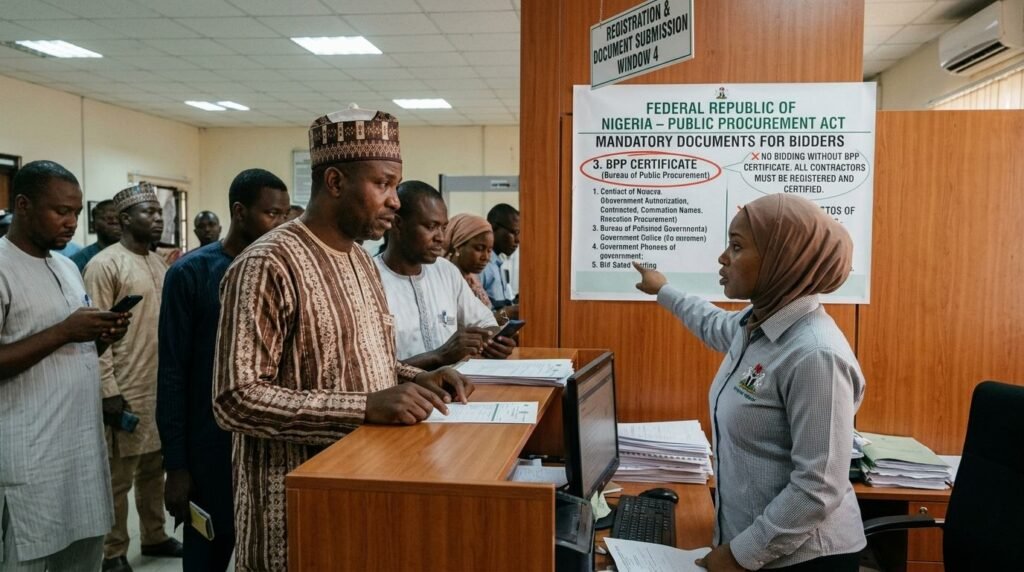
This is the most immediate consequence. Procurement evaluation teams check compliance documents early in the review process, often before technical or financial evaluation begins. A bid missing a BPP certificate gets flagged at this stage and set aside. It does not matter how competitive your pricing is or how strong your company’s track record. A disqualified bid does not proceed to evaluation.
The time, resources, and preparation that went into the bid are lost. And because most procurement processes do not give feedback on why a bid was disqualified at the preliminary stage, some companies do not even realise what caused the rejection.
You Risk Debarment From Future Procurement
Submitting false declarations or misrepresenting your company’s compliance status during bidding is treated seriously. The BPP portal itself warns that any false declaration and submission could lead to prosecution, debarment, and disqualification for 10 years from public procurement under Section 58 of the Public Procurement Act 2007.
Ten years is not a minor administrative inconvenience. For a business that depends on government contracts, or intends to build that revenue stream, a decade-long ban effectively closes off the federal market entirely.
Officers and Contractors Can Face Sanctions
The risk does not only fall on the company. Recent BPP guidelines, issued under Sections 5(a) and (o) of the Public Procurement Act 2007, make clear that contract variations and procurement processes handled without proper BPP certification will attract sanctions including suspension of responsible officers and debarment of contractors. This applies not just at the bid stage but throughout contract execution.
The Federal Government tightened these rules in December 2025, requiring that every variation order, fluctuation claim, or scope modification must now be submitted to BPP for review and certification before proceeding, regardless of size.
What About Contracts Below the Major Threshold?
All federal government contracts above NGN 100 million require a BPP Certificate of No Objection as a condition for award. For contracts below that threshold, registration on the national database is still expected for most procurement processes.
The distinction matters less than many businesses assume. In practice, most MDAs apply BPP registration as a mandatory check across all their tender documents, not just the large contracts. Relying on a contract being too small to attract scrutiny is not a reliable strategy.
Can State Government Contracts Be Bid Without a BPP Certificate?
This is a genuine exception worth knowing. BPP’s authority covers federal procurement specifically. State governments operate under their own procurement laws and frameworks, which vary across Nigeria. Some states have adopted BPP-aligned requirements. Others have their own compliance certificates and procurement agencies.
If your business is targeting state government contracts rather than federal ones, check the specific requirements of the relevant state’s procurement authority. The federal BPP certificate may not be required, though equivalent local registration likely is.
Obtain Your BPP Certificate
Let us help you obtain your Bureau of Public Procurement (BPP) Registration Certificate quickly and hassle-free. Our experts provide reliable support throughout the registration process, ensuring your business is ready to participate in public procurement opportunities.
What If You Cannot Register in Time for a Deadline?
This is the situation most businesses find themselves in when they first encounter the BPP requirement. There is no shortcut that allows an unregistered company to bid legitimately for a federal contract. The options at that point are limited to three.
The first is to miss that particular bid and focus on getting registered before the next opportunity. This is the most straightforward path, and the BPP registration process moves quickly when documents are complete and consistent.
The second is to partner with a registered company as a joint venture or subcontractor arrangement, where the registered entity leads the bid and your company provides capacity or services within the structure. This must be set up properly and transparently, with the registered company genuinely meeting the qualification criteria.
The third is to engage a consultant who can prioritise your BPP application and manage the process end to end. Registration itself is free, but a consultant who knows the portal and can identify document issues before submission can reduce the time to completion significantly.
What Counts as the BPP Certificate
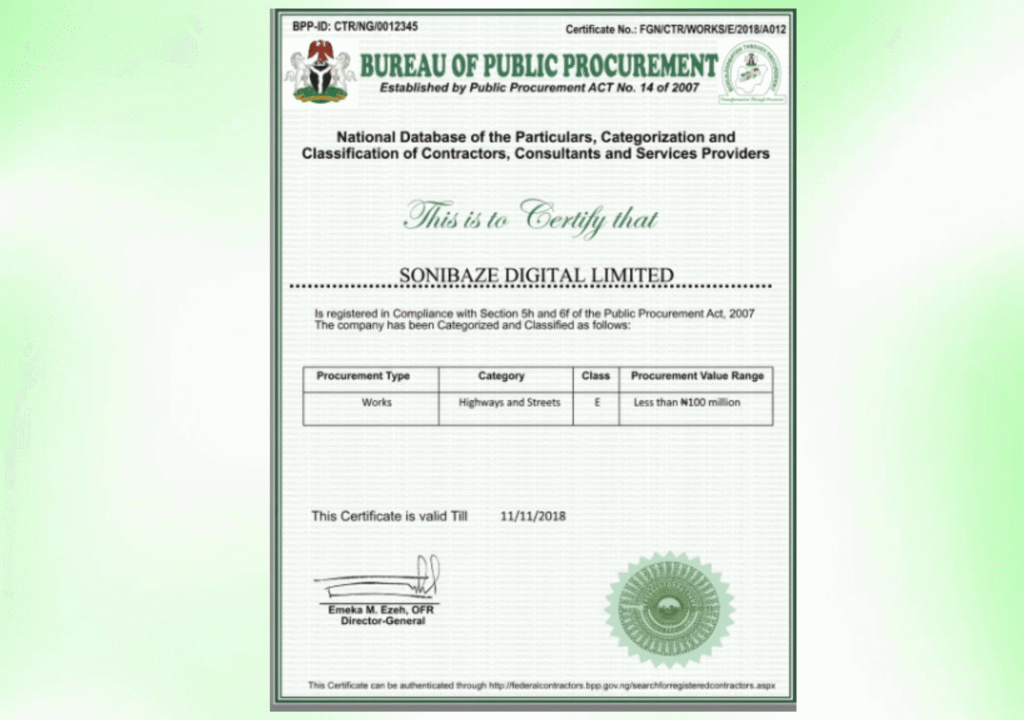
It is worth clarifying what document you are actually looking for. After successfully registering on the national database, BPP issues what is formally called the Interim Registration Report, commonly referred to as the IRR. This is the document that serves as your BPP registration certificate and confirms your company’s listing as an eligible government vendor.
The IRR has an expiration date. Companies that registered and then left their certificate to lapse will not be in good standing for a new bid, even though they were registered at some point in the past. Keeping the certificate current through annual renewal is as important as getting it in the first place.
Quick Reference: BPP Certificate and Bidding
| Situation | Can You Bid? | What to Do |
|---|---|---|
| Registered with a valid, current IRR | Yes | Include the IRR in your bid documents |
| Registered but IRR has expired | No | Renew your registration before bidding |
| Never registered | No | Register before the next bid opportunity |
| Targeting a state government contract | Depends on state | Check the relevant state procurement authority |
| Partnering with a registered company | Possible | Structure as a joint venture or subcontract properly |
| False declaration submitted | Serious consequences | Risk of 10-year debarment under Section 58 PPA 2007 |
Frequently Asked Questions
Can I bid for a federal contract while my BPP registration is still being processed?
No. Your registration must be complete and your certificate issued before you can legitimately include it in a bid submission. An application in progress is not the same as a valid registration, and procurement officers have no way to verify a pending application.
How long does BPP registration take if I start immediately?
When all required documents are complete and consistent, the registration process can be completed relatively quickly through the online portal. Applications with missing documents, inconsistencies between submitted information and CAC or FIRS records, or other issues take longer. Starting the process at least four to six weeks before any anticipated bid deadline is the safer approach.
What documents do I need to get BPP registered quickly?
The core documents are your CAC Certificate of Incorporation, a current CAC Status Report, your FIRS Tax Identification Number and tax clearance certificate, NSITF and ITF compliance certificates where applicable, PENCOM remittance evidence for companies with qualifying staff numbers, a staff list with key personnel details, and financial documentation such as audited accounts or bank statements.
Is my company automatically debarred if I submit a bid without a BPP certificate?
Not automatically, but deliberately misrepresenting your compliance status carries the risk of formal debarment proceedings. A bid being disqualified for a missing certificate is a different outcome from a false declaration being investigated. Both are avoidable by registering before bidding.
Can a foreign company bid for Nigerian government contracts without a BPP certificate?
Foreign companies can register on the BPP National Database. Unlike Nigerian companies, which register free of charge, foreign companies may face a verification fee. Regardless of nationality, registration on the database is required before participating in Federal Government procurement processes.
What is the difference between BPP registration and a BPP Certificate of No Objection?
BPP registration gets your company listed on the national database as an eligible vendor. A Certificate of No Objection is a separate document that BPP issues specifically for contracts above NGN 100 million, certifying that the proposed contract has been reviewed and cleared. Both are relevant to government contracting but serve different purposes at different stages.
Conclusion: Register Before the Opportunity, Not After
The BPP certificate is not a document you should be chasing while a bid deadline approaches. By that point, your options are limited and the risk of taking shortcuts is real.
Registration is free, the portal is online, and the process is manageable when documents are in order. For any business that plans to pursue federal government contracts at any point, getting registered now, before a specific opportunity comes up, removes one of the most avoidable barriers to winning public sector work.
Obtain Your BPP Certificate
Let us help you obtain your Bureau of Public Procurement (BPP) Registration Certificate quickly and hassle-free. Our experts provide reliable support throughout the registration process, ensuring your business is ready to participate in public procurement opportunities.