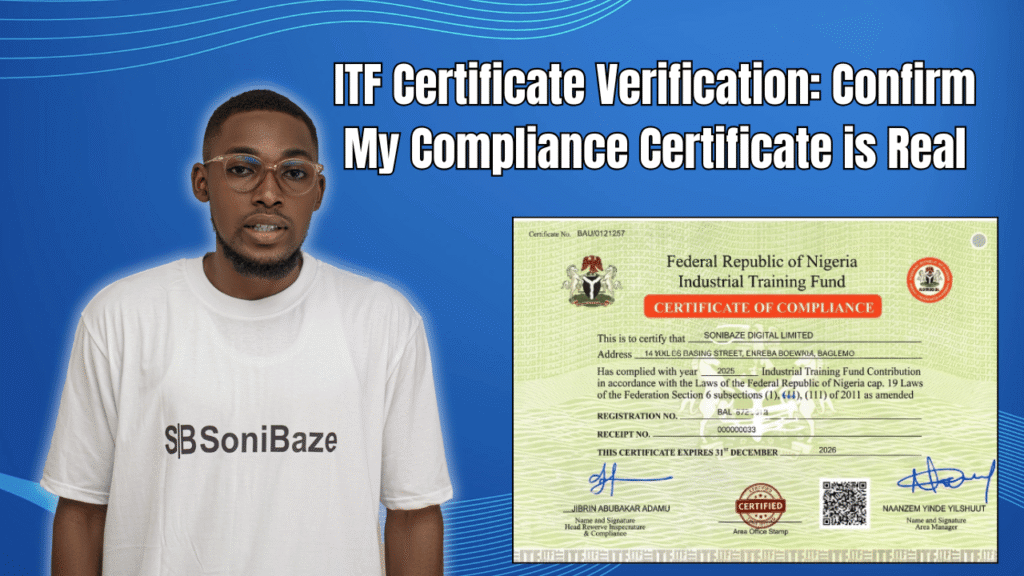
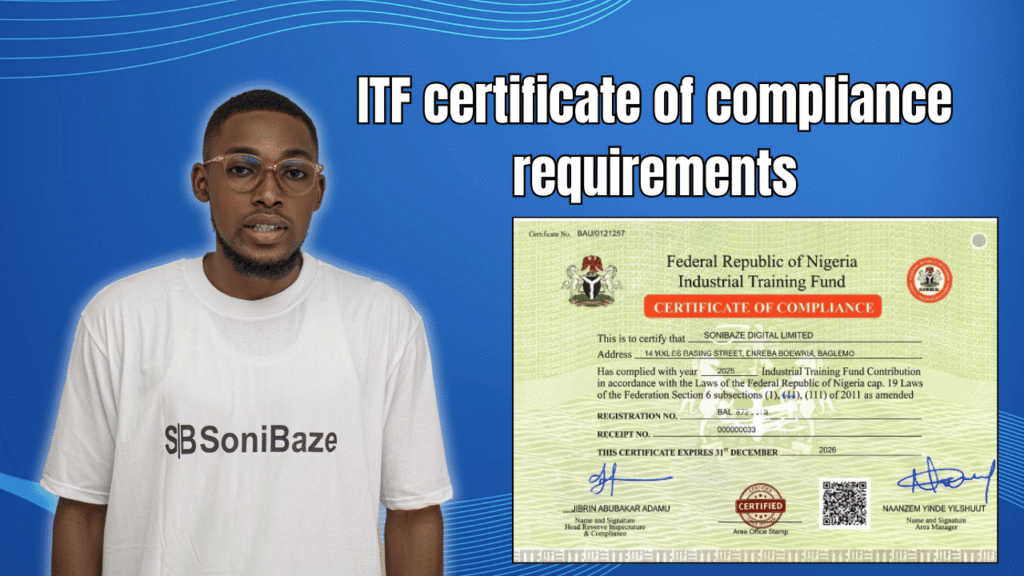
Ask ten Nigerian business owners whether their company is ITF-compliant and at least six will pause. Most know the acronym. Fewer can explain the rate. Even fewer have actually filed and obtained the ITF Compliance Certificate. Yet for any business bidding on federal government contracts, this certificate is as mandatory as a tax clearance, and a missing one is just as disqualifying.
This article covers what the ITF Compliance Certificate is, the documents required to obtain it, who is liable, and how the registration process works from start to finish.
Obtain Your ITF Certificate
Let us help you obtain your Industrial Training Fund (ITF) Compliance Certificate quickly and hassle-free. Our experts provide reliable support throughout the application process, ensuring your business meets all statutory compliance requirements.
What Is the ITF Compliance Certificate?
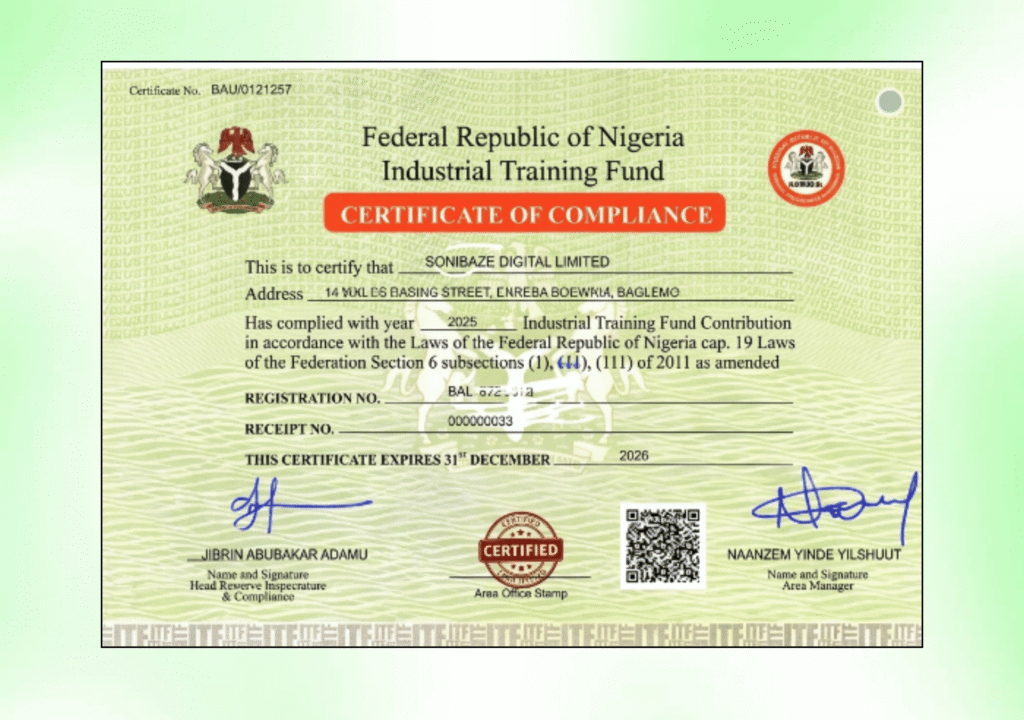
The Industrial Training Fund was established under the Industrial Training Fund Act of 1971, later amended in 2011, to promote and encourage the acquisition of skills in industry and commerce across Nigeria. The ITF Compliance Certificate confirms that an employer has filed their annual Training Contribution Return and paid the assessed levy to the Fund.
The certificate is required for all federal government procurement bids under the Public Procurement Act 2007. It is also increasingly requested by state agencies and private sector clients during vendor qualification. Like most compliance certificates in Nigeria, it is valid for one year and must be renewed annually.
Who Is Required to Register?
Two categories of employers are obligated to contribute to the ITF:
Every employer with five or more employees in their establishment is required to contribute. Also covered are employers with fewer than five employees but with an annual turnover of N50 million or above. If your business falls into either of these categories, ITF registration and contribution are not optional.
The contribution rate is 1% of the company’s total annual payroll. Payroll here is defined broadly to mean the sum total of all basic pay, allowances, and other entitlements payable within and outside Nigeria to any employee. The contribution for each calendar year is due by the 1st of April of the following year. For example, contributions covering January to December 2025 were due by 1 April 2026.
Companies that have been ignoring this obligation and need to regularise should note that late filing carries a penalty of 5% of the unpaid amount for each month of default.

Documents Required for ITF Registration
The document requirements differ slightly depending on whether you are registering for the first time or renewing as an already-registered employer.
New Employers: First-Time Registration
New employers with five or more employees are required to complete ITF Form 7A, which is the Employer Registration and Payment of Training Contribution Form. This form is available on the ITF website and from any ITF Area Office.
Along with the completed Form 7A, the following documents must be submitted to the nearest ITF Area Office:
Certificate of Incorporation from the Corporate Affairs Commission, confirming the company’s legal registration status.
Certified true copies of the company’s Audited Account, which the ITF uses to assess the company’s total annual payroll and calculate the contribution due.
Tax Clearance Certificate covering the most recent years of assessment. Where a Tax Clearance Certificate is not immediately available, a Tax Identification Number slip from FIRS may be accepted as an interim substitute.
New Start-Up Companies With Fewer Than Five Employees
Companies in this category are not automatically liable under the standard threshold, but many need the certificate for business purposes such as government contracts or vendor onboarding. ITF grants a concession for these employers.
To apply, the company writes a formal application letter on its letterhead addressed to the Area Manager of the nearest ITF Area Office. This letter is submitted alongside a copy of the Certificate of Incorporation and any other documents the Area Office requests based on the company’s profile. A fixed fee of N110,000 applies for new start-up companies in this category.
Already-Registered Employers: Annual Renewal
Companies that are already registered with ITF and need to renew their certificate complete ITF Form 5A rather than Form 7A. The completed Form 5A is submitted to the ITF Area Office where the company is registered. The office vets the company’s liability to the Fund based on updated payroll figures, after which payment is generated and processed.
Obtain Your ITF Certificate
Let us help you obtain your Industrial Training Fund (ITF) Compliance Certificate quickly and hassle-free. Our experts provide reliable support throughout the application process, ensuring your business meets all statutory compliance requirements.
Document Checklist at a Glance
| Document | New Employer | Start-Up Under 5 Staff | Existing Employer (Renewal) |
|---|---|---|---|
| Completed ITF Form 7A | Required | Not applicable | Not applicable |
| Completed ITF Form 5A | Not applicable | Not applicable | Required |
| Application letter on letterhead | Not applicable | Required | Not applicable |
| Certificate of Incorporation (CAC) | Required | Required | Not typically required again |
| Certified True Copies of Audited Account | Required | May be requested | Required for payroll assessment |
| Tax Clearance Certificate or TIN Slip | Required | May be requested | Required |
Step-by-Step: How the ITF Registration Process Works
Step 1: Complete the Relevant Form
New employers complete ITF Form 7A. Already-registered companies complete ITF Form 5A. Start-up companies with fewer than five staff write an application letter instead. All forms are available from ITF offices and the ITF website at itf.gov.ng.
Step 2: Submit to the Nearest ITF Area Office
The completed form and supporting documents go to the ITF Area Office covering the jurisdiction where the company is registered. Do not submit to a different area office, as this can cause delays in processing and in the issuance of the ITF National Number.
Step 3: Assessment by ITF Officers
ITF Revenue, Inspectorate, and Compliance Officers review the submission and assess the company’s liability based on the total annual payroll contained in the Audited Account. The contribution due is 1% of this payroll figure.
Step 4: Generate an RRR and Make Payment
Once assessed, the company generates a Remita Retrieval Reference through the ITF Pay-Portal or the Remita platform. The generated RRR is taken to any bank for payment of the training contribution. Companies should not make payment before generating the RRR, as unlinked payments can be difficult to reconcile.
Step 5: Submit Payment Evidence to the ITF Office
After paying at the bank, the company returns to the ITF office with the Remita payment receipt and the duplicate bank teller. The office issues a hard copy receipt and an acknowledgement letter as confirmation of payment.
Step 6: ITF National Number Is Issued
The ITF Area Office forwards the company’s details from the Form 7A to ITF Headquarters’ Revenue, Inspectorate and Compliance Department. Headquarters then issues the ITF National Number, which is sent back to the Area Office.
Step 7: Certificate of Compliance Is Issued
With the National Number confirmed, the Area Office scripts and issues the Certificate of Compliance. This document serves as evidence of the company’s compliance with the ITF Act and is valid until the 31st of December of the year it is issued.
Costs Involved
There is no single flat government fee for ITF registration beyond the 1% payroll contribution itself. However, the following costs are typically involved:
The 1% training contribution, calculated on the company’s total annual payroll, is the core financial obligation. For new start-up companies with fewer than five employees seeking the certificate for business purposes, a fixed fee of N110,000 applies.
Preparing audited accounts through an external auditor typically costs between N30,000 and N150,000 depending on the complexity of the company’s financials. Companies that engage a professional consultant to manage the registration process pay professional fees that typically range from N50,000 to N150,000.
Frequently Asked Questions
What happens if my company does not register with ITF?
Any company that fails to register, fails to file its annual contribution return, or remits false information is in breach of the ITF Act. Late filing carries a penalty of 5% of the unpaid contribution for each month of default. Deliberate falsification carries a fine of N500,000 for a first offence and N1,000,000 for each subsequent offence. Beyond the statutory penalties, a missing ITF certificate disqualifies your company from federal government procurement bids.
Can my company get the ITF certificate without audited accounts?
Audited accounts are the primary document ITF uses to calculate your payroll contribution. Without them, the compliance officers have no basis for assessment. Companies that have not prepared audited accounts will need to do so before they can proceed with ITF registration. This is often where the process is delayed for smaller businesses.
Does the ITF certificate expire?
Yes. The certificate is valid until the 31st of December of the year it is issued, regardless of when during the year it was obtained. Companies must renew annually by filing Form 5A, making fresh payment, and obtaining a new certificate before the old one expires.
Is the ITF certificate the same as the ITF National Number?
No. The ITF National Number is an identifier assigned to your company within the ITF system. It is a prerequisite for the certificate but not the certificate itself. The Certificate of Compliance is the formal document issued after the National Number has been confirmed and scripted at the Area Office.
Can a company with fewer than five employees get the ITF certificate?
Yes. ITF grants a concession for new start-up companies below the five-employee threshold that need the certificate for contract or business purposes. The process involves writing an application letter rather than completing Form 7A, and a fixed fee of N110,000 applies. The Area Office handles this on a case-by-case basis.
How long does the ITF certificate process take?
There is no fixed published timeline. The process moves faster when documents are complete, the audited account is accurate, and payment is made promptly after assessment. Delays typically occur at the assessment stage if audited accounts are unclear, or at the National Number stage if there is a backlog at ITF Headquarters. Working with the Area Office directly and following up regularly helps keep the process moving.
Conclusion: Sort the Documents Before the Deadline Arrives
The ITF Compliance Certificate is straightforward in theory. One percent of payroll, filed annually, submitted with three core documents. In practice, the process slows down at whichever point the documents are not ready, usually the audited accounts or a mismatch between submitted payroll figures and what the compliance officers expect.
For companies that renew every year, the process becomes routine. For businesses applying for the first time, or those regularising after years of non-compliance, starting the document preparation early and submitting a clean, complete package to the Area Office is what separates a two-week turnaround from a two-month one.
Obtain Your ITF Certificate
Let us help you obtain your Industrial Training Fund (ITF) Compliance Certificate quickly and hassle-free. Our experts provide reliable support throughout the application process, ensuring your business meets all statutory compliance requirements.