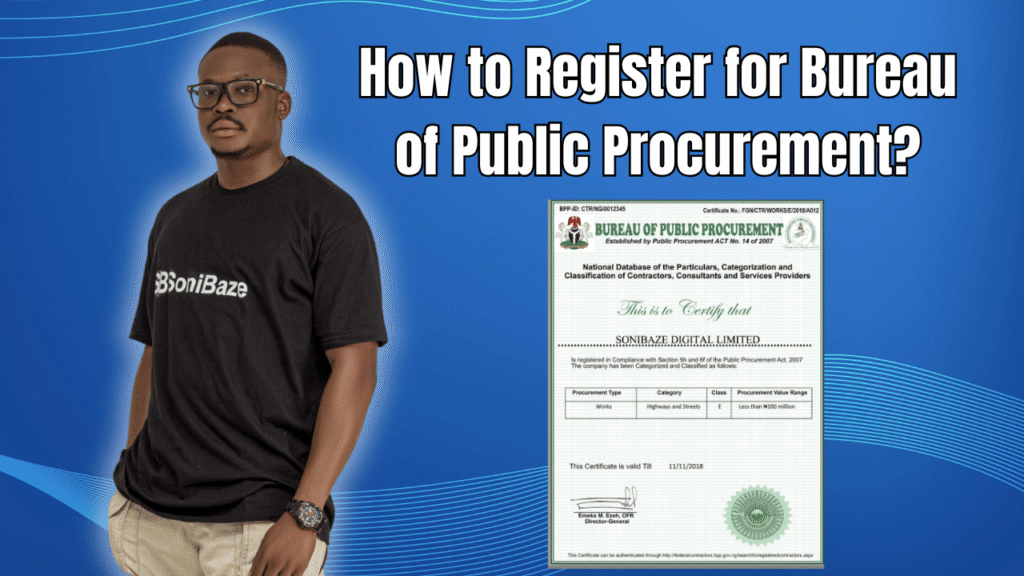
There are companies in Nigeria that have been operating for years, winning private sector contracts, building a solid track record, and then the moment a government contract comes up, they realise they cannot bid. One missing registration is all it takes.
Bureau of Public Procurement registration is that registration. It is the gateway to Federal Government contracts in Nigeria, and this article explains exactly how to get it done.
Obtain Your BPP Certificate
Let us help you obtain your Bureau of Public Procurement (BPP) Registration Certificate quickly and hassle-free. Our experts provide reliable support throughout the registration process, ensuring your business is ready to participate in public procurement opportunities.
What Is the Bureau of Public Procurement?
The Bureau of Public Procurement, commonly called BPP, is the federal agency responsible for regulating public procurement across Nigeria. It was established by the Public Procurement Act of 2007, and its core mandate is to ensure that government spending on goods, works, and services is done transparently, competitively, and with value for money.
The BPP maintains the National Database of Federal Contractors, Consultants and Service Providers. This database is the official record of every company cleared to do business with Federal Government ministries, departments, and agencies. If your company is not on it, you cannot participate in federal procurement, regardless of your experience, capacity, or relationships.
Who Should Register?
Any company that wants to supply goods, deliver works, or render services to a Federal Government entity needs to be on the BPP database. This applies to contractors in construction, civil engineering, and road works. It applies to IT companies, management consultants, financial consultants, and legal service providers. It applies to suppliers of everything from office furniture to medical equipment to vehicles.
State-owned enterprises and parastatals that work closely with federal procurement processes also benefit from registration. And companies that currently supply to the private sector but plan to expand into government work should register ahead of that move, not when an opportunity is already on the table.
One important point: only incorporated companies can register. Sole proprietors and business names are not eligible. If your business is not yet incorporated as a limited liability company with the Corporate Affairs Commission, that step needs to happen first.
What You Need Before You Start
The BPP registration process is online and free of government fees. But the preparation before you log into the portal is what determines how smoothly the process goes.
Here is what to have ready before you begin.
Your Certificate of Incorporation from the CAC, confirming your company’s legal existence and registration number.
A current CAC Status Report showing up-to-date information on your directors, shareholders, and registered address. This should be pulled fresh, not from years ago. If your company has undergone any changes since incorporation, including changes in directors or share structure, the status report needs to reflect the current position.
Your Tax Identification Number from the Federal Inland Revenue Service, along with a valid Tax Clearance Certificate covering the most recent three assessment years. Tax compliance is checked during BPP verification.
A company email address that is actively monitored. Your login credentials will be sent to this address after initial account creation, and missing that email means your registration stalls before it properly starts.
Your ITF compliance certificate from the Industrial Training Fund and your NSITF certificate from the Nigeria Social Insurance Trust Fund. Both are required during BPP registration. PENCOM remittance evidence is also expected for companies with three or more employees.
A list of your key personnel including their names, qualifications, and roles within the company. BPP uses this to evaluate whether your organisation has the human capacity to deliver contracts in the categories you are registering under.
Audited financial statements or bank statements that demonstrate your company’s financial capacity. The size and type of contracts you can bid for will be informed partly by what you can show here.
Evidence of professional or trade association membership, where your sector requires it. A construction company affiliated with COREN-registered engineers, or an IT company with CPN-registered staff, should have this documentation ready.
The Registration Process
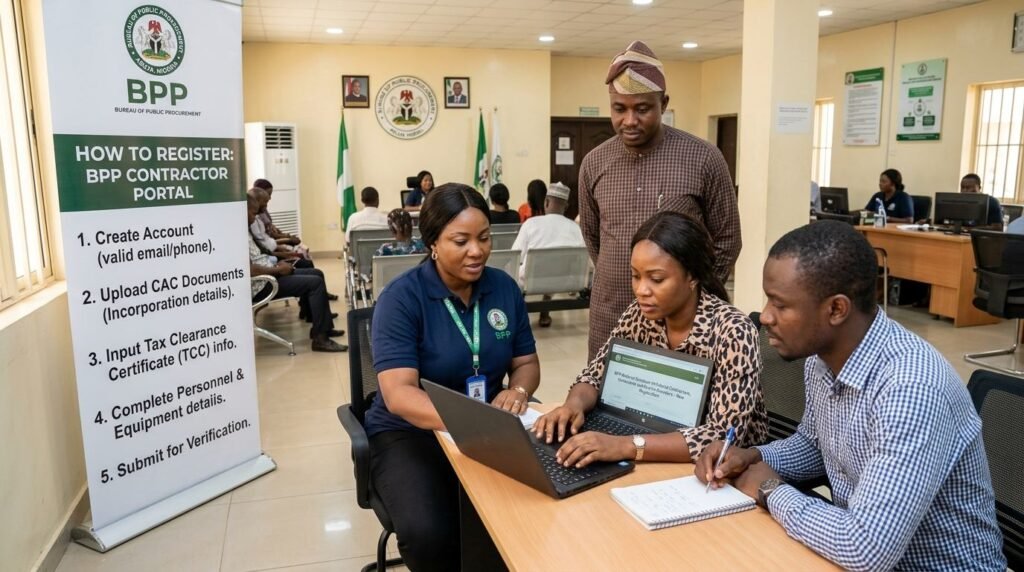
Create Your Account on the BPP Portal
The registration portal is at federalcontractors.bpp.gov.ng. This is the official address. Do not register through any other website or third-party platform.
On the portal, start by creating a company account. You will enter your CAC registration number, your company type, your FIRS TIN, your company address, and your contact details. The system will send login credentials to the email address you provide. Check that inbox promptly once you submit, since the next steps require those credentials.
Complete Your Company Profile
After logging in with your credentials, you proceed to complete your full company profile. This is the section that takes the most time and requires the most care.
You will enter information about your directors and shareholders, your key personnel and their qualifications, the business categories you operate in, your financial standing, your professional memberships, and whether you represent or distribute products manufactured by other companies.
Every detail here is subject to verification against official records. What you enter must match what your CAC documents, FIRS records, and compliance certificates actually say. Inconsistencies between your profile entries and your official documents are the most common reason BPP applications get queried or rejected.
Obtain Your BPP Certificate
Let us help you obtain your Bureau of Public Procurement (BPP) Registration Certificate quickly and hassle-free. Our experts provide reliable support throughout the registration process, ensuring your business is ready to participate in public procurement opportunities.
Upload Your Supporting Documents
Once the profile is complete, you upload the supporting documents. Name your files clearly so reviewers can identify them quickly. Check that file formats are accepted and that file sizes are within the portal’s limits before uploading. Upload failures caused by format or size issues are not always flagged clearly by the system, so confirming a successful upload matters.
Submit and Allow Verification to Run
After submission, BPP cross-checks everything. Your CAC details are verified against the Corporate Affairs Commission’s records. Your tax compliance is checked with FIRS. Your compliance certificates are reviewed for validity.
If the verification team finds any mismatch or gap, they will query the application. You will need to correct the issue and resubmit. There is no penalty for resubmission, but each cycle adds time. Applications with clean, consistent documentation tend to move through verification without delays.
Receive Your Certificate
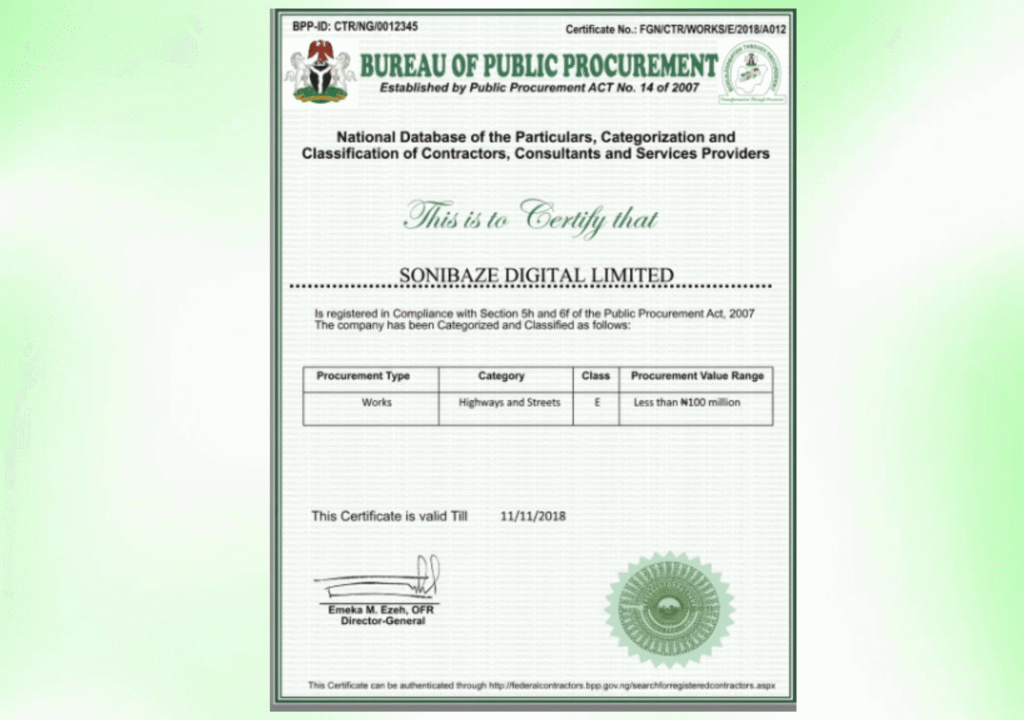
Once verification is complete, BPP issues your registration certificate with a unique registration number. This number is what procurement officers look for when reviewing your bid. It can also be used by anyone wanting to confirm your registration status on the BPP database.
As of March 2025, all correspondence with BPP is handled through its Digital Submission Portal. Physical submissions and email correspondence are no longer accepted. Follow-ups on your registration, responses to queries, and any post-registration requests all go through the portal.
After Registration: What to Know
BPP registration is not permanent. It expires and needs to be renewed annually. BPP requires registered entities to generate an Interim Registration Report each year as part of the renewal process. Companies that miss this renewal can find their registration lapsing, which affects their eligibility to bid for contracts until the renewal is completed.
The BPP also periodically audits registered contractors to confirm ongoing compliance. Keeping your compliance certificates current, including ITF, NSITF, PENCOM, and tax clearance, is not just a registration requirement. It is an ongoing obligation that keeps your registration in good standing.
Common Mistakes to Avoid
Submitting an outdated CAC status report is one of the most frequent problems. Companies that incorporated years ago and never updated their CAC records end up submitting documents that no longer match their current structure. The mismatch triggers a query that could have been avoided with a fresh status report.
Using an email address that is no longer active is another avoidable problem. Several applicants miss their login credentials because the email address entered belongs to a former staff member or a rarely checked account.
Failing to include sector-specific documents is also common. Different business categories have additional requirements beyond the standard list. A company that assumes the standard document set is sufficient for every category will likely receive a request for additional submissions.
Registering through unofficial websites or agents who promise to do it on your behalf without using the official portal creates a different set of problems. The BPP National Database requires direct registration on federalcontractors.bpp.gov.ng. Any other approach does not result in a valid registration.
Registration Summary
| What to Do | Where to Do It | What to Watch |
|---|---|---|
| Create company account | federalcontractors.bpp.gov.ng | Use an active email address |
| Complete company profile | BPP portal after login | Match all entries to official documents |
| Upload supporting documents | BPP portal | Check file formats and sizes before uploading |
| Submit for verification | BPP portal | Expect queries if documents are inconsistent |
| Receive certificate | Via portal | Note the expiry date and plan for annual renewal |
Frequently Asked Questions
How long does BPP registration take in Nigeria?
There is no fixed published timeline. Applications with complete and accurate documentation can be processed within a few weeks. Those with document mismatches or missing compliance certificates take longer because each query cycle adds time to the process.
Is BPP registration free?
Yes. The government does not charge a fee for registration on the National Database. Businesses that engage consultants to assist with the process will pay professional fees, but the registration itself carries no official cost.
Can my company register under more than one business category?
Yes. During profile completion, you can select multiple business categories that reflect your company’s areas of work. This allows you to bid across different sectors without separate registrations.
What happens if my BPP registration expires?
An expired registration means your company is no longer listed as an active, eligible vendor on the National Database. This affects your ability to bid for government contracts until the renewal is completed. BPP requires companies to generate an Interim Registration Report annually as part of the renewal process.
Do state government contracts also require BPP registration?
Not always. BPP’s mandate covers federal procurement specifically. State governments have their own procurement frameworks, and requirements vary by state. However, some state agencies reference BPP registration as part of their own vendor qualification requirements, so having it does not hurt.
What is the 2026 Interim Registration Report that BPP mentioned?
BPP periodically issues notices for registered contractors to generate an Interim Registration Report, which is a required step in the annual renewal cycle. The 2026 notice went out to all companies registered on the National Database reminding them to generate this report to maintain active status. Registered companies should check the BPP portal and their registered email for these notices regularly.
Conclusion: Registration Opens the Door, Compliance Keeps It Open
Getting on the BPP National Database is the starting point for any company that wants to work with the Federal Government. The process itself is not complicated. The challenge is almost always in the preparation: making sure your documents are current, consistent, and complete before you go near the portal.
Companies that treat BPP registration as an ongoing compliance requirement, rather than a one-time task, tend to stay in good standing year after year. Annual renewals, up-to-date compliance certificates, and active portal management are what separate companies that can b
Obtain Your BPP Certificate
Let us help you obtain your Bureau of Public Procurement (BPP) Registration Certificate quickly and hassle-free. Our experts provide reliable support throughout the registration process, ensuring your business is ready to participate in public procurement opportunities.