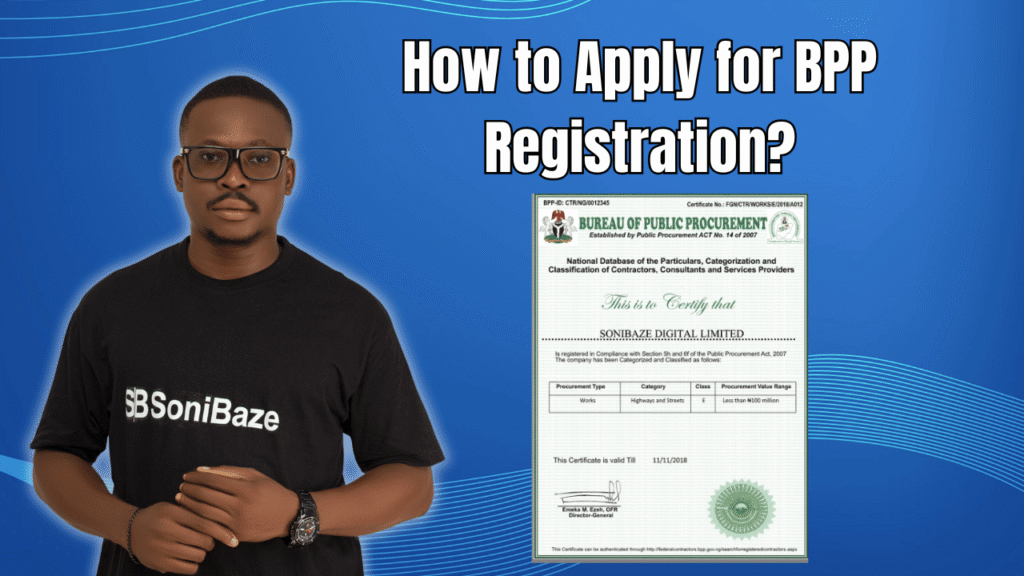
Most Nigerian businesses discover BPP registration the same way they discover PENCOM and SCUML. A government contract opportunity comes up, the requirements list includes it, and the scramble begins. The difference with BPP is that the registration itself is free, entirely online, and faster than most people expect, once the documents are in order.
This article walks through the BPP registration process step by step, what you need before you start, and what to watch out for along the way.
Obtain Your BPP Certificate
Let us help you obtain your Bureau of Public Procurement (BPP) Registration Certificate quickly and hassle-free. Our experts provide reliable support throughout the registration process, ensuring your business is ready to participate in public procurement opportunities.
What Is BPP Registration?
The Bureau of Public Procurement is the regulatory agency responsible for monitoring and overseeing public procurement in Nigeria. It was established under the Public Procurement Act of 2007 as part of government reforms to eliminate corruption and inefficiency in public procurement.
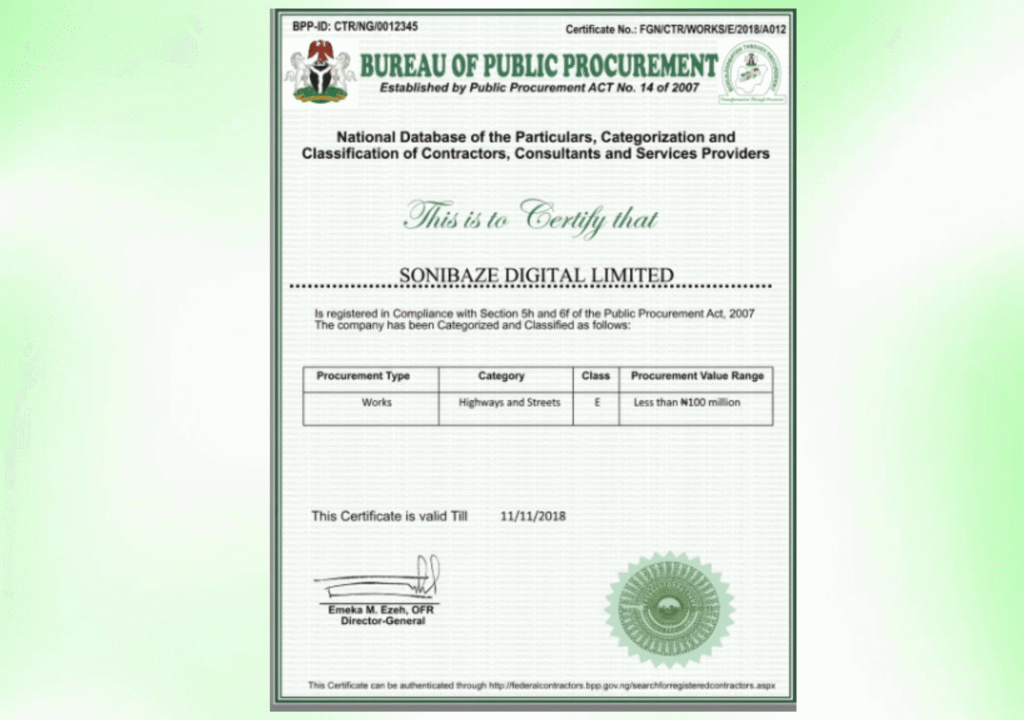
The BPP maintains the National Database of Federal Contractors, Consultants and Service Providers. Registering on this database is the official step that makes your company an eligible vendor for the Federal Government of Nigeria. Think of it as your company’s entry ticket to government contracting. Without it, procurement officers cannot consider your bid, regardless of how competitive your pricing or how strong your track record.
The BPP certificate gives companies an edge and boosts their chances of winning bids with both local and international organisations.
Who Needs to Register?
Any company, consultant, or service provider that intends to bid for or execute contracts with the Federal Government of Nigeria for the supply of goods, works, or services is required to register on the BPP’s National Database.
This covers a wide range. Contractors in construction, road works, and civil engineering. Consultants in IT, finance, legal, and engineering. Suppliers of goods from office equipment to medical supplies. Service providers in facility management, training, logistics, and beyond. If the client is a federal ministry, department, or agency, BPP registration applies.
Documents Required Before You Apply
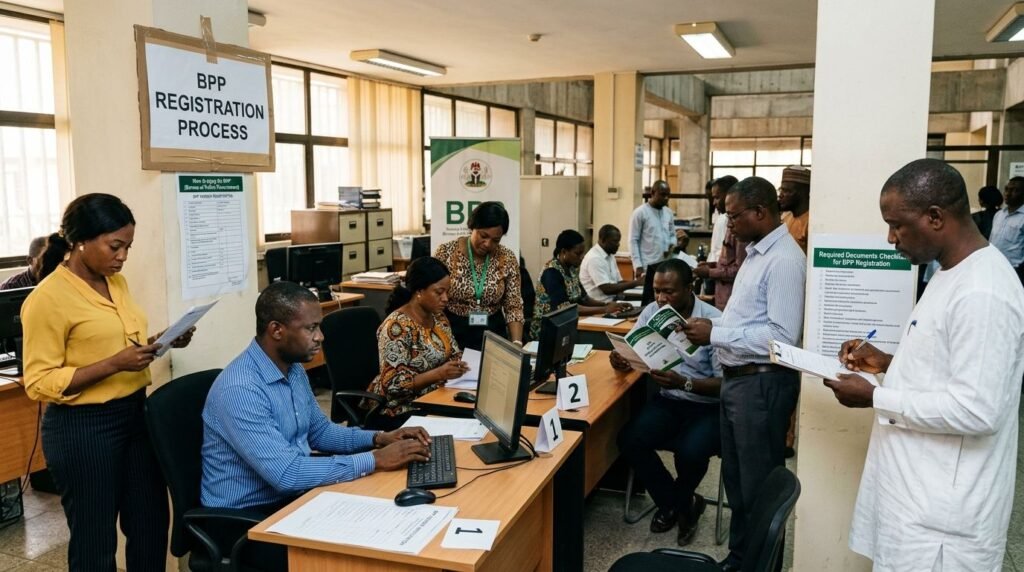
Getting your documents together before touching the portal saves a lot of back and forth. Here is what you need.
Certificate of Incorporation from the Corporate Affairs Commission, confirming your company legally exists and is registered in Nigeria.
Current CAC Status Report showing your directors, shareholders, and registered address as they stand today. An outdated one from years ago will not reflect changes in company structure and can cause verification issues.
Tax Identification Number from the Federal Inland Revenue Service, along with a current tax clearance certificate covering the most recent three years of assessment.
Company address details and contact information, including a unique email address that will receive your login credentials after initial registration.
Business category information, specifying whether your company operates as a contractor, consultant, supplier, or service provider, and the specific sectors or areas of work you cover.
List of key personnel, including their names, roles, qualifications, and experience. BPP uses this to assess whether your company has the human capacity to deliver the kind of contracts you are registering to bid for.
Financial capacity documentation, which typically includes audited financial statements or bank statements showing the company’s financial standing.
Evidence of professional association membership, where applicable. If your sector requires membership of a relevant professional or trade body, evidence of that membership strengthens your application.
NSITF and ITF compliance certificates. Both are required during the BPP registration process. Alongside these, PENCOM remittance evidence is also expected for companies with qualifying staff numbers.
Obtain Your BPP Certificate
Let us help you obtain your Bureau of Public Procurement (BPP) Registration Certificate quickly and hassle-free. Our experts provide reliable support throughout the registration process, ensuring your business is ready to participate in public procurement opportunities.
Step-by-Step: The BPP Registration Process
Step 1: Access the BPP Contractor Registration Portal
The National Database for the Registration, Categorisation and Classification of Federal Contractors, Consultants and Service Providers is an online system that registers, categorises, and classifies contractors, consultants and service providers doing business or intending to do business with the Federal Government of Nigeria.
The portal is at federalcontractors.bpp.gov.ng. This is the official BPP registration system. Do not register through any third-party website or agent portal. Your application must go directly through this address.
Step 2: Create Your Company Account
To register your company on the system, you provide your CAC Registration Number, Company Type, FIRS TIN, Company Address Details, and Company Contact Information. On successful completion, your login credentials are sent to the email address provided during registration.
Use an email address that is actively monitored. The login credentials arrive by email, and if the address is wrong or rarely checked, the process stalls at this point.
Step 3: Log In and Complete Your Company Profile
Once you receive your credentials, log in to the portal and complete the full company profile. This is where the detailed information about your business goes: directors and shareholders, key personnel and their qualifications, business category and sector, financial capacity, professional memberships, and any manufacturer representation details if you distribute products made by other companies.
Fill in every field accurately. Incomplete or inconsistent information at this stage is one of the most common reasons applications are held up during verification.
Step 4: Upload Supporting Documents
After completing the company profile, upload the supporting documents. Each document should be clear, legible, and named in a way that makes it easy for the reviewer to identify what they are looking at.
Check document sizes and file format requirements before uploading. Oversized files or unsupported formats can cause upload errors that are not always clearly flagged by the portal.
Step 5: Submit and Await Verification
Once submitted, BPP cross-checks your information against CAC records, FIRS data, and the compliance certificates you have uploaded.
This verification stage is where applications with mismatches or missing documents get queried. If your CAC status report shows different directors from what you have entered, or if your tax clearance certificate does not cover the required years, the application will be held pending correction.
Step 6: Receive Your BPP Registration Certificate
Once verification is passed, BPP issues your registration certificate with a unique registration number. This number is what procurement officers check when evaluating your bid documents.
BPP launched a Digital Submission Portal and moved to a fully paperless process from March 1, 2025. All correspondence with BPP, including follow-ups on your registration, now goes through the digital portal rather than by physical submission or email.
Cost of BPP Registration
BPP registration is free. There is no government fee attached to getting on the National Database. The expenses businesses incur are typically for gathering the required compliance certificates, such as ITF, NSITF, and PENCOM, and for any consultant fees if they choose to engage a professional to manage the application.
Registration at a Glance
| Stage | What Happens | Common Issue |
|---|---|---|
| Portal access | Visit federalcontractors.bpp.gov.ng and begin account creation | Wrong portal used, or third-party site used instead |
| Account creation | Enter CAC number, TIN, company type, contact details | Inactive or incorrect email address used |
| Profile completion | Enter directors, personnel, financials, business category | Inconsistencies with CAC or FIRS records |
| Document upload | Upload all required certificates and statements | Oversized files, wrong formats, or missing documents |
| Verification | BPP cross-checks submitted data | Mismatches between form entries and official records |
| Certificate issuance | BPP issues registration certificate with unique number | Delays caused by unresolved verification queries |
How Long Does BPP Registration Take?
There is no single published timeline for BPP registration completion. The process typically moves faster for companies with complete and consistent documentation. Applications that trigger verification queries can take several weeks to resolve depending on what needs to be corrected and how quickly the company responds.
Starting the process well ahead of any specific contract deadline is the safest approach. Waiting until a tender closes in two weeks is too late to comfortably accommodate any back and forth with the verification team.
Renewal: What to Know
BPP registration has an expiration period and needs to be renewed periodically. Companies that let their registration lapse mid-contract period can find themselves in a difficult position if an MDA checks their status during contract execution. Keep track of your certificate’s validity date and initiate renewal well before it expires.
Frequently Asked Questions
Is BPP registration compulsory for all Nigerian businesses?
No. Registration is required specifically for companies that intend to bid for or execute contracts with the Federal Government. Private sector work, or contracts with state governments under their own procurement frameworks, does not necessarily require BPP registration, though some state agencies have adopted similar requirements.
Can a sole proprietorship or business name register with BPP?
No. Only companies are allowed to register on the BPP National Database. Businesses operating as a sole proprietorship or under a business name need to first incorporate as a limited liability company with the CAC before they can apply.
Does BPP registration guarantee winning government contracts?
No. Registration makes you eligible to bid. It does not guarantee contract awards. Contracts are awarded based on the full evaluation of bids, including technical capacity, financial standing, compliance certificates, and pricing.
Is there a separate registration for each sector or category?
Your registration covers the specific business categories you select during profile completion. If your company operates across multiple sectors, you can specify multiple categories rather than registering separately for each one.
Do I need a consultant to register?
Not necessarily. The portal is designed to be used directly by businesses. However, many companies choose to work with a consultant for the first application to avoid common pitfalls, particularly around document consistency and profile completion. If your company has a complex ownership structure or has had changes since incorporation, professional guidance can shorten the process.
What happens if my application is rejected?
A rejection typically comes with a specific reason, usually a verification mismatch or missing document. The correction and resubmission process goes back through the portal. There is no penalty for resubmission, but each cycle adds time, which is why getting documents right before the first submission matters.
Conclusion: Start Early, Get Documents Right
BPP registration is one of the more straightforward federal compliance processes in Nigeria, especially now that it is fully online and free to apply. The main variable is document readiness. Companies that go into the portal with clean, consistent, and current paperwork tend to get through verification without delays. Those that patch documents together as the portal asks for them tend to go back and forth several times before receiving a certificate.
If government contracts are part of your business development plan, BPP registration is not something to defer. Get the compliance documents in order first, then the registration itself becomes a formality.
Obtain Your BPP Certificate
Let us help you obtain your Bureau of Public Procurement (BPP) Registration Certificate quickly and hassle-free. Our experts provide reliable support throughout the registration process, ensuring your business is ready to participate in public procurement opportunities.