
A lot of business owners in Nigeria hear “PENCOM Compliance Certificate” for the first time when a government agency asks for it during a contract bid. By then, it is often too late to get one quickly, since the process can take two to three weeks once your records are in order.
This article breaks down exactly who needs a PENCOM Compliance Certificate, why it exists, and what triggers the requirement so you are not caught off guard.
Obtain Your PENCOM certificate
Let us help you obtain your PENCOM Compliance Certificate quickly and hassle-free. Our experts provide reliable support throughout the application process, ensuring you meet all requirements and remain compliant.
What Is a PENCOM Compliance Certificate?
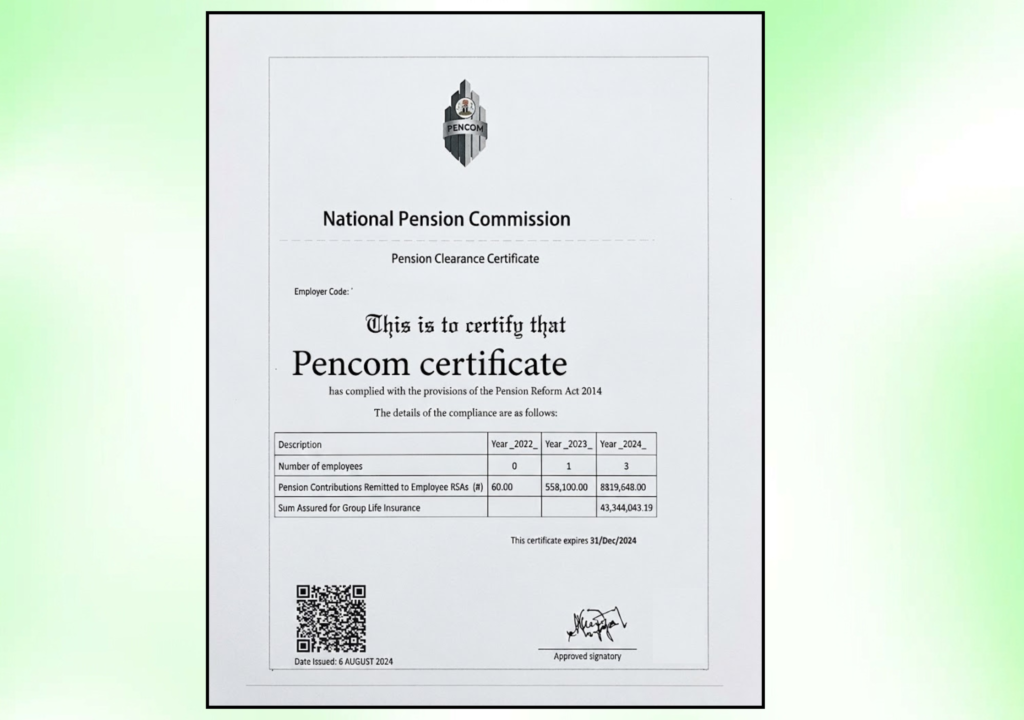
The PENCOM Compliance Certificate, officially called the Pension Clearance Certificate (PCC), is issued by the National Pension Commission. It is a statutory compliance document that PenCom issues to employers who comply with the Contributory Pension Scheme under the Pension Reform Act 2014.
In simple terms, it proves that your company is remitting pension contributions correctly for your staff. The certificate is valid until the 31st of December each year, so it needs renewal annually if your business depends on it.
The certificate itself costs nothing. PenCom does not charge a fee for issuing it, but getting to the point where you qualify for one usually involves real costs, including pension remittances and group life insurance for your staff.
Who Is Legally Required to Get One
The law sets a clear threshold for who must comply with the Contributory Pension Scheme in the first place. The Pension Reform Act 2014 makes it mandatory for all organizations with at least three employees to participate in the Contributory Pension Scheme.
That said, the certificate itself is most strictly enforced for a slightly larger group. Public and private sector employers with five or more employees are required to obtain a PenCom Certificate under the Act.
So there is a difference between two things. Pension scheme participation kicks in at three employees. The compliance certificate becomes a hard requirement once you cross five. If you are anywhere near either number, it is worth getting your pension remittances in order now rather than later.

Who Needs a PENCOM Compliance Certificate in Nigeria?
Businesses Bidding for Government Contracts
This is the situation that brings most companies to PENCOM in the first place. The PCC is evidence of compliance with the Pension Reform Act 2014 and a prerequisite for all suppliers, contractors, or consultants soliciting any contract or business from Federal Government Ministries, Departments, and Agencies.
If you are a contractor, supplier, or consultant trying to work with any federal MDA, this certificate is not optional paperwork. It is a gatekeeping document. Without it, your bid does not move forward, regardless of how strong your technical proposal is.
This applies whether you are bidding for a small local government supply contract or a major federal infrastructure project. The certificate is a critical requirement for any organisation seeking to bid for government contracts in Nigeria.
Companies Renewing Licenses or Pursuing Regulatory Approvals
Government contracts are not the only trigger. The requirement for a PCC applies to a broad range of businesses, particularly those that are either seeking public contracts or wishing to demonstrate regulatory compliance.
Several regulatory bodies in Nigeria now request a valid PCC as part of license renewals. If your business operates under a sector regulator, whether that is in finance, telecoms, oil and gas, or another regulated industry, check whether your renewal checklist includes a pension clearance certificate. Many businesses discover this requirement only when their renewal application stalls.
Companies Entering Public-Private Partnerships
Beyond contracts and licenses, businesses entering joint ventures or partnerships with government bodies are typically asked to prove pension compliance before the partnership is finalised. Whether a company is bidding for a government tender, renewing a license, or entering a public-private partnership, having a valid PENCOM Compliance Certificate is non-negotiable.
If your company is in early discussions with any government-linked entity, ask about this requirement before the conversation gets too far along. It is far easier to apply early than to scramble for it once a deal is close to signing.
Companies That Recently Crossed the Employee Threshold
Growing businesses often miss this one. A company that started with two or three staff and has since grown past five employees is now in PENCOM’s regulatory scope, even if it has never bid for a government contract.
The risk here is twofold. First, if you eventually need the certificate for a contract or license, you will not qualify until your pension records are in order, and that takes time to fix retroactively. Second, non-compliance itself can create liability under the Pension Reform Act, separate from any certificate requirement.
Companies That Don’t Strictly Need It But Get One Anyway
Not every business that obtains a PCC is legally forced to. Even when exemptions apply, many organizations still obtain the certificate to strengthen their compliance profile and credibility.
This is common among companies preparing to scale, attract investors, or position themselves for future government work. A valid PCC signals that the company treats statutory obligations seriously, which can matter during due diligence, partnership talks, or even when applying for business loans that require proof of regulatory standing.
Obtain Your PENCOM certificate
Let us help you obtain your PENCOM Compliance Certificate quickly and hassle-free. Our experts provide reliable support throughout the application process, ensuring you meet all requirements and remain compliant.
Quick Reference: Who Needs a PENCOM Compliance Certificate
| Your Situation | Do You Need It? |
|---|---|
| Fewer than 3 employees | Not legally required, but worth registering early as you grow |
| 3 to 4 employees | Must participate in the Contributory Pension Scheme, certificate not yet mandatory |
| 5 or more employees | Certificate is a legal requirement under the Pension Reform Act |
| Bidding for any federal MDA contract | Mandatory, no exceptions |
| Renewing a regulatory license | Check your regulator’s checklist, increasingly common requirement |
| Entering a public-private partnership | Mandatory before deal completion |
| Preparing for investment or due diligence | Not mandatory, but strengthens credibility |
What You Need Before You Apply
Getting the certificate depends on having your underlying compliance in order first. At a minimum, you need an Employer Code from PenCom, evidence of pension remittances for your staff, and a current group life insurance policy.
A current group life insurance policy for a minimum of three staff, specifying the sum assured, is required as part of the application. You will also need your Certificate of Incorporation and FIRS Tax Identification Number as foundational documents.
As of April 2026, businesses with a minimum of fifteen employees applying for the certificate face additional requirements, so larger companies should confirm the current portal requirements before submitting, since these details change periodically.
Frequently Asked Questions
How long does it take to get a PENCOM Compliance Certificate?
Processing typically takes around two weeks if all requirements are met, though some sources note it can extend to two to three weeks depending on document accuracy. Errors or mismatches in employee records are the most common cause of delay.
Does the certificate cost money?
No, the National Pension Commission does not charge an issuance fee for the PENCOM Compliance Certificate. The real costs come from the underlying compliance, including pension contributions, group life insurance premiums, and any consultant fees you choose to pay for help with the process.
What happens if I submit the wrong documents?
The PENCOM portal does not allow corrections after submission, and any mismatch or omission can lead to automatic rejection. This makes it worth double-checking everything, particularly employee details against your Pension Fund Administrator’s records, before you submit.
Can a company with fewer than three employees get a PENCOM certificate?
PenCom only issues certificates to employers with at least three active employees. If your business is below that threshold, you are not eligible regardless of whether you want one for credibility purposes.
Is the certificate a one-time document?
No. The certificate is valid until the 31st of December of the year it was issued, which means businesses that rely on it for ongoing contract work need to renew it annually. Build this into your compliance calendar so it does not lapse during an active bidding cycle.
My business doesn’t deal with government contracts. Should I still bother?
If you have five or more staff, the law requires it regardless of whether you currently pursue government work. Beyond legal obligation, having the certificate ready means you are not blocked if an opportunity comes up unexpectedly. Many businesses only realise they need one when a tender deadline is days away, and by then the two to three week processing window becomes a real problem.
The Bottom Line
The PENCOM Compliance Certificate matters most to two groups: businesses with five or more employees, who are legally required to have one, and any business pursuing government contracts, licenses, or partnerships, where it functions as a hard gate rather than a formality. Everyone else falls somewhere on a spectrum between “not yet required” and “useful to have anyway.”
If your headcount is approaching five, or if government work is even a possibility down the line, the smart move is registering with PenCom and getting your pension remittances current now. The certificate itself is free. The only cost is time, and that cost grows the longer compliance is left unaddressed.
Obtain Your PENCOM certificate
Let us help you obtain your PENCOM Compliance Certificate quickly and hassle-free. Our experts provide reliable support throughout the application process, ensuring you meet all requirements and remain compliant.