Nobody gives you a straight answer on this. Ask five people how much it costs to learn web development in Nigeria and you will get five different figures, usually ranging from “it’s free if you use YouTube” to “I paid ₦800,000 for a bootcamp.” Both answers are technically true. Neither is particularly useful.
The real answer depends on how you want to learn, how fast you need to get job-ready, and what kind of web developer you are trying to become. This article breaks down every major learning route, what each one costs in 2026, and what you actually get for your money.
Ready to start a career in web development? Learn and start your tech career today.
Why Web Development Costs Vary So Much in Nigeria
There is no fixed price for learning web development in Nigeria. A university diploma, a private bootcamp, a government-funded scheme, and a free YouTube playlist can all teach you the same fundamentals. What differs is the structure, the support, the speed, and the credential at the end.
Internet access is also a cost many people overlook. If you are learning online, you are paying for data every day. A learner spending three to four hours daily on video tutorials can consume 5GB to 10GB of data per week. At current Nigerian data rates, that adds up.
Hardware matters too. You can learn web development on a modest laptop, but you need one. A functional secondhand laptop capable of running a code editor and browser costs between ₦150,000 and ₦300,000 in 2026. If you already have one, skip this. If you do not, factor it in.
The Main Routes to Learning Web Development in Nigeria
There are four main paths: self-study using free resources, paid online courses, physical training schools and bootcamps, and university or polytechnic programmes. Each has a different cost structure and a different outcome.
Free and Self-Study Routes
Free is real. Platforms like freeCodeCamp, The Odin Project, MDN Web Docs, and YouTube carry enough content to take a motivated person from zero to employable without spending a naira on tuition. In 2026, these resources are better than they have ever been.
The cost is not zero, though. You still pay for data, electricity, and time. Self-study typically takes 12 to 24 months to reach a job-ready standard, compared to six to nine months in a structured bootcamp. For people who can stay disciplined without accountability, it works. Many cannot.
| Resource | Cost | Time to Job-Ready |
|---|---|---|
| freeCodeCamp | Free | 12 to 18 months |
| The Odin Project | Free | 12 to 24 months |
| YouTube (structured playlist) | Free | 14 to 20 months |
| MDN Web Docs | Free | Used alongside other resources |
| Sololearn / Mimo (app) | Free to ₦10,000/year | Supplementary only |
Paid Online Courses (Udemy, Coursera, Scrimba)
This is the most popular starting point for Nigerian web development learners in 2026. Platforms like Udemy sell individual courses for between ₦5,000 and ₦25,000 during frequent sales. A full curriculum covering HTML, CSS, JavaScript, and a framework like React can be assembled for ₦30,000 to ₦80,000 in course fees alone.
Coursera and edX charge higher rates for certificate programmes, typically $49 to $79 per month (roughly ₦75,000 to ₦120,000 per month at current exchange rates). Their professional certificates from Google, Meta, and IBM carry some employer recognition, particularly for roles with international companies or remote work.
Scrimba, a coding-specific platform, offers a frontend developer career path for around $200 (approximately ₦310,000) for annual access. It is one of the few platforms with an interactive coding environment built into the lessons.
| Platform | Cost (2026 estimate) | Credential | Best For |
|---|---|---|---|
| Udemy (full curriculum) | ₦30,000 to ₦80,000 | Course completion certificate | Budget-conscious self-learners |
| Coursera Professional Certificate | ₦75,000 to ₦120,000/month | Recognised certificate | Remote/international job seekers |
| Scrimba Career Path | ₦280,000 to ₦320,000/year | Career path certificate | Frontend development focus |
| edX MicroBachelors | ₦150,000 to ₦400,000 total | University-backed credit | Academic credentialling |
Physical Bootcamps and Training Schools in Nigeria
This is where Nigerian pricing gets its widest spread. A weekend workshop at a small training centre in Lagos or Abuja might cost ₦30,000 for three days of instruction. A full six-month bootcamp at an established institution can run from ₦200,000 to ₦900,000 depending on the school, the city, and what is included.
The better bootcamps in Nigeria cover HTML and CSS, JavaScript, a backend language (usually Python or Node.js), version control with Git, database basics, and project work. Some include job placement support or access to a hiring network. The weaker ones cover surface-level content and issue a certificate regardless of competence.
SoniBaze Tech Academy in Karu, Abuja runs a certified web development programme with physical, online, and corporate training options. The programme is built for people who want practical, job-ready skills rather than theory-heavy instruction.
| Training Type | Typical Cost Range | Duration | Includes |
|---|---|---|---|
| Weekend workshop | ₦20,000 to ₦60,000 | 2 to 3 days | Introduction only |
| Short course (4 to 8 weeks) | ₦50,000 to ₦150,000 | 4 to 8 weeks | One area of focus |
| Full bootcamp (3 to 6 months) | ₦200,000 to ₦900,000 | 3 to 6 months | Full stack or frontend curriculum |
| Corporate / cohort training | ₦500,000 to ₦2,000,000 | Varies | Team-based, customised |
University and Polytechnic Programmes
A Computer Science or Software Engineering degree from a Nigerian university costs between ₦100,000 and ₦600,000 per year in tuition at private institutions. Federal and state universities charge far less in fees but come with ASUU strike disruptions, inconsistent teaching quality, and a four to five year time commitment.
University education gives you a formal qualification and a broad technical foundation. It does not always give you current industry skills. Most web development employers in Nigeria care more about your portfolio and what you can build than the name on your certificate.
If you already have a degree in any field and want to pivot into web development, a bootcamp or intensive self-study route will get you hired faster than going back to school.
| Programme Type | Annual Cost | Duration | Outcome |
|---|---|---|---|
| Federal/State University (CS) | ₦30,000 to ₦100,000 | 4 to 5 years | B.Sc. Computer Science |
| Private University (CS) | ₦300,000 to ₦600,000/year | 4 years | B.Sc. Computer Science |
| Polytechnic (HND) | ₦50,000 to ₦200,000/year | 2 years (post-ND) | HND Computing |
| Government-Funded Scheme (3MTT, NITDA) | Free to low cost | 3 to 6 months | Government certificate |
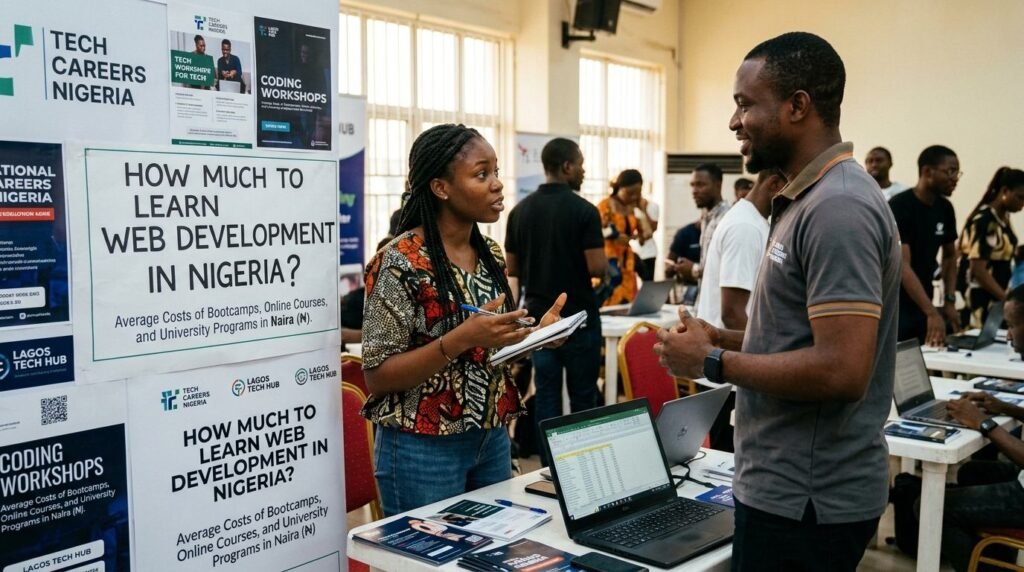
Government-Funded Web Development Training in Nigeria
In 2026, the Federal Government’s 3 Million Technical Talent (3MTT) programme continues to offer subsidised and free tech training across Nigeria, including web development. NITDA and some state governments also run periodic digital skills initiatives at low or no cost to participants.
These schemes vary in quality. Some cohorts receive strong instruction and real mentorship. Others are under-resourced. If you can get a place in a well-run cohort, it is a significant financial advantage. The credential carries government backing, which matters for some public sector or NGO roles.
Total Cost Comparison: Full Learning Journey
The table below shows an honest estimate of total spend from beginner to job-ready, including hidden costs like data and tools.
| Route | Tuition Cost | Data + Electricity | Tools/Hardware | Total Estimate |
|---|---|---|---|---|
| Self-study (free resources) | ₦0 | ₦60,000 to ₦120,000 | ₦0 to ₦300,000 | ₦60,000 to ₦420,000 |
| Paid online courses only | ₦30,000 to ₦150,000 | ₦60,000 to ₦120,000 | ₦0 to ₦300,000 | ₦90,000 to ₦570,000 |
| Local bootcamp (3 to 6 months) | ₦200,000 to ₦900,000 | ₦30,000 to ₦60,000 | ₦0 to ₦300,000 | ₦230,000 to ₦1,260,000 |
| University degree | ₦400,000 to ₦2,400,000 total | ₦100,000+ over 4 years | ₦0 to ₦300,000 | ₦500,000 to ₦2,700,000+ |
Red Flags When Choosing a Web Development Programme in Nigeria
Some training providers charge premium rates without delivering premium outcomes. Watch for these warning signs before paying.
No portfolio requirement at graduation is a serious problem. Any programme worth its fees should produce students who can build and present real projects. If the only output is a certificate with no working code behind it, the training has failed its purpose.
Be careful of programmes that promise job placement without showing you any data on where past graduates actually work. “We help you get a job” and “90% of our graduates are employed within three months” are very different claims. Ask for evidence.
Short programmes that claim to teach full stack development in four weeks are almost always cutting corners. Frontend basics in four weeks is achievable. Full stack in four weeks is not, unless the learner already has a programming background.
Finally, watch the curriculum dates. A programme still teaching jQuery as a primary skill in 2026 has not updated its content in years. Current programmes should cover modern JavaScript (ES6+), React or Vue for frontend, Node.js or Python for backend, and Git for version control at minimum.
How Long Does It Take to Get a Web Development Job in Nigeria After Training?
Timeline depends on the route and the effort you put in outside training hours. Bootcamp graduates who actively build projects and apply for roles typically see their first offer within three to six months of completing training. Self-taught developers taking the free route often spend nine to eighteen months before landing their first paid role.
Portfolio quality is the biggest factor. Nigerian employers and international remote-hiring companies both want to see live, working projects. Three to five strong portfolio projects carrying your real code will open more doors than any certificate.
Ready to start a career in web development? Learn and start your tech career today.
Freelance vs Employment: Which Pays Off Faster?
Many Nigerian web developers start freelancing before finding full-time employment, and some never stop. Freelancing lets you start earning while still learning. A developer who can build basic WordPress or Webflow sites can charge between ₦80,000 and ₦250,000 per project within six months of starting to learn.
Entry-level employed web developers in Nigeria earn between ₦120,000 and ₦300,000 per month in 2026 at local companies. Mid-level developers with two to three years of experience and a strong portfolio earn between ₦300,000 and ₦700,000 per month locally, or significantly more on remote contracts with international clients paying in dollars or pounds.
| Experience Level | Local Salary Range | Remote/International Range |
|---|---|---|
| Junior (0 to 1 year) | ₦80,000 to ₦200,000/month | $500 to $1,500/month |
| Mid-level (2 to 3 years) | ₦250,000 to ₦600,000/month | $1,500 to $4,000/month |
| Senior (4+ years) | ₦600,000 to ₦1,500,000/month | $4,000 to $10,000+/month |
Frequently Asked Questions
Can I really learn web development for free in Nigeria?
Yes. freeCodeCamp alone has a curriculum covering responsive web design, JavaScript algorithms, front-end libraries, back-end development, and APIs, all free with certification. The honest limitation is time and self-discipline. Without a structured schedule and someone holding you accountable, many learners stall or abandon the process. Free works best for people who are already self-motivated.
Is a local bootcamp in Nigeria worth the cost?
It depends on the bootcamp. The best ones in Nigeria produce developers who can build real products and enter the job market within six months. The worst ones collect fees and hand out certificates with no practical value. Before paying, ask to speak with two or three past graduates, ask to see their portfolios, and ask whether they are employed or freelancing in web development. That conversation will tell you more than any sales pitch.
What is the minimum budget to start learning web development in Nigeria in 2026?
If you have a working laptop and a stable internet connection, you can start for as little as ₦5,000 covering your first month of data. If you need a laptop, budget ₦150,000 to ₦250,000 for a functional secondhand machine. If you want structured training without a laptop cost, many bootcamps allow you to use their facilities during class hours.
Does the type of web development I learn affect how long it takes to get a job?
Yes. Frontend development, which covers what users see in the browser, is generally faster to learn and has more entry-level job openings. Backend development, which handles databases and servers, takes longer but commands higher salaries. Full stack development covers both and takes the longest, but makes you more competitive for solo projects and freelance work. Most beginners start with frontend and add backend skills later.
Are government training programmes like 3MTT actually good?
Some cohorts are, some are not. The 3MTT programme is ongoing in 2026 and has produced genuinely skilled graduates in well-run batches. The key variable is the facilitator assigned to your cohort. If you get placed with an experienced instructor and a structured curriculum, the free training is excellent value. If not, you may need to supplement with self-study. Apply and assess the quality in the first two weeks before committing fully.
How do I know if a web development certificate from a Nigerian school is recognised?
Most Nigerian employers hiring junior web developers care more about your portfolio and a coding test than your certificate’s issuing institution. The certificate matters more for government-affiliated roles, NGOs, or positions requiring documented qualifications. For private sector tech companies and freelance work, what you can build is the credential.
Conclusion: What You Should Actually Budget in 2026
If you are starting from scratch and want to be employable within six to nine months, budget between ₦250,000 and ₦600,000 for a quality bootcamp, data, and a working laptop if you need one. That is a realistic all-in figure for a structured, supported learning experience at a reputable Nigerian training school.
If your budget is tighter, ₦50,000 to ₦100,000 in online course fees plus consistent self-discipline can get you there too. It will take longer. But people do it every month in Nigeria.
The most expensive mistake is not choosing the wrong route. It is paying for training and then not building anything with it. Whatever you spend on learning, spend twice as much time building projects. That is what gets you hired.
Ready to start a career in web development? Learn and start your tech career today.